
Free tool
Is it a meteorite?
Nine quick checks, one at a time, built on the advice of the meteorite experts at Washington University in St. Louis. You get an honest verdict, the look-alikes your answers point to, and who can confirm a real one.
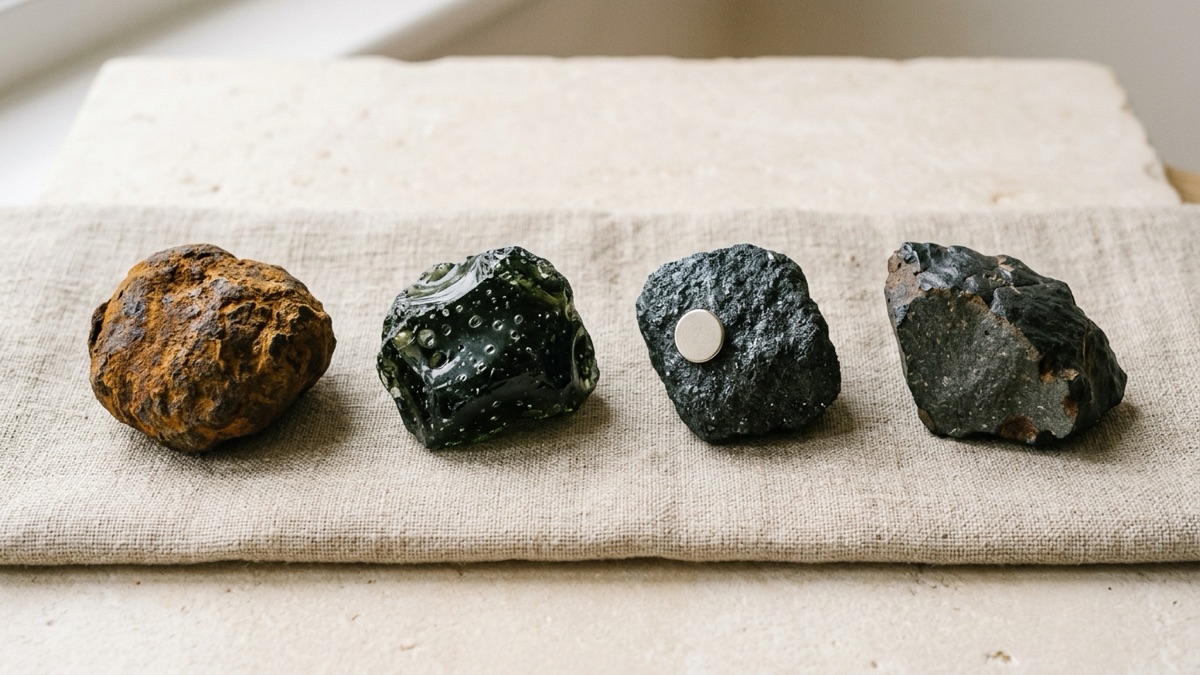
How the meteorite checker works
Each check asks one question you can answer with things at home: a cheap fridge magnet, the back of a white bathroom tile, a hand lens and, ideally, a cut or broken face. Skip any check you cannot do. At the end you get one of four verdicts: very unlikely, unlikely, worth a closer look, or worth asking an expert. It never says a rock is a meteorite, because only a laboratory can.
The checks, in order of importance
- Fusion crust. A thin, dark rind, rarely more than 1 to 2 mm thick, that is darker than the inside. Washington University in St. Louis puts it first: without a fusion crust there is little reason to suspect a meteorite.
- A cheap magnet. About 95 percent of meteorites attract a weak fridge magnet, because they contain iron-nickel metal. A strong rare-earth magnet attracts many Earth rocks too, so do not use one.
- Metal flecks inside. Most stony meteorites show shiny metal grains on a cut face. A rock that pulls on a magnet but shows no metal inside is usually magnetite or slag.
- No bubbles. Meteorites almost never have many holes. Glassy and bubbly means slag; dark and bubbly means lava rock.
- Streak. Meteorites leave no streak, or a faint gray one. Red-brown means hematite and dark gray to black means magnetite, the two most common meteor-wrongs.
- Weight, surface and place. Heft, thumbprint-like dents and where you found it help, but each is weak on its own.
Common meteor-wrongs
| Look-alike | Why it fools people | What gives it away |
|---|---|---|
| Slag | Heavy, dark, often magnetic | Glassy with gas bubbles |
| Magnetite | Heavy, black and strongly magnetic | Dark gray to black streak, no metal flecks, no fusion crust |
| Hematite and iron concretions | Heavy, rusty or shiny | Red to red-brown streak |
| Basalt and scoria | Dark volcanic rock | Bubbles, same color inside and out |
| Man-made iron | Metallic and magnetic | Bends, or has a cast or tool shape |
Heads up
Do not clean or test a possible meteorite with a wire brush, acid, other chemicals or a torch. And check the rules before you keep one: collecting of any kind is not allowed in national parks.
Who can confirm a meteorite
Arizona State University's Buseck Center for Meteorite Studies stopped identifying samples for the public in 2010 and suggests your state geological survey, the geology department of a local university or a natural history museum. Send sharp, well-lit photos of the whole rock with a coin for scale. A meteorite is only confirmed when a specialist laboratory classifies it and its name is approved in the Meteoritical Society's Meteoritical Bulletin, which Washington University in St. Louis says will likely cost several hundred dollars, so get an expert opinion before paying for tests.
Questions
How can I tell if a rock is a meteorite at home?
Look for a thin, dark fusion crust that is darker than the inside, check whether a cheap fridge magnet sticks, and look for shiny metal specks on a cut face. Rocks with bubbles, or with a red-brown or black streak, are almost never meteorites.
Do all meteorites stick to a magnet?
Most do. Washington University in St. Louis says about 95 percent of meteorites attract a cheap magnet because they contain iron-nickel metal. Many Earth rocks with magnetite also stick, so a magnet alone proves nothing.
What rocks are mistaken for meteorites?
Slag, magnetite, hematite and other iron-oxide concretions, dark volcanic rocks such as basalt and scoria, and pieces of man-made iron.
Where can I get a meteorite identified?
Start with the Washington University in St. Louis self-test checklist, then contact your state geological survey, a university geology department or a natural history museum with clear photos. Formal classification is done by specialist laboratories and costs money.
Can a metal detector find meteorites?
It can detect the metal in iron meteorites and many stony ones, but it cannot tell whether metal contains nickel, so it cannot confirm a meteorite. Metal detectors are not allowed in national parks.