Blog meteorites
Meteor vs Meteorite vs Meteoroid: The Simple Difference
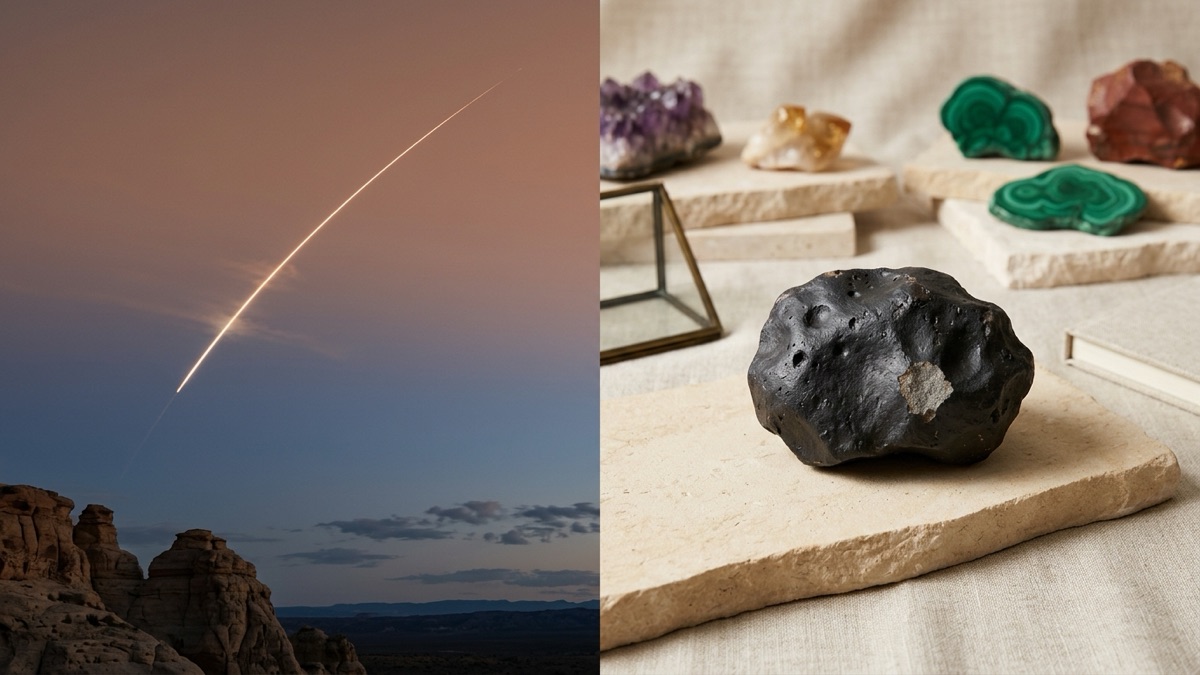
You saw a bright streak cross the sky, or you found a strange dark rock, and now you are not sure which word to use. Meteor? Meteorite? Something ending in "oid"? Good news: it is one object with three names, and the name just depends on where it is.
Quick answer
A meteoroid is a space rock, from a dust grain up to about a meter across, still traveling through space. A meteor is the streak of light you see when one plunges into the atmosphere and glows. A meteorite is any piece that survives and lands on the ground. You can hold a meteorite, never a meteor.
Key takeaways
- Meteoroid in space, meteor in the sky, meteorite on the ground. Same object, three stages.
- A meteor is light, not a rock. Like lightning, you cannot pick one up.
- A fireball is a meteor brighter than about Venus; a bolide is a fireball that ends in a bright flash.
- Meteor showers come mostly from comet dust that burns up, so they do not drop meteorites you can find.
- Nearly all meteorites come from asteroids. A tiny share come from the Moon and Mars.
What is the difference between a meteoroid, a meteor and a meteorite?
Here is a memory trick: the "oid" floats in the void, the meteor lights up the air, and the "ite" is the one that made it to the ground. The table puts the whole family side by side, including two words that often get mixed in.
| Word | Where it is | What it is | Can you hold it? |
|---|---|---|---|
| Asteroid | Orbiting the Sun | A rocky or metallic body, generally over 1 m | No |
| Meteoroid | Traveling through space | A natural solid object up to about 1 m | No |
| Meteor | In the upper atmosphere | The streak of light as a meteoroid plunges in | No, it is light |
| Fireball | In the atmosphere | A meteor brighter than about Venus | No |
| Bolide | In the atmosphere | A fireball that ends in a bright flash | No |
| Meteorite | On the ground | The piece that survived the fall | Yes |
Scientists use these words carefully. Washington University in St. Louis geochemist Randy Korotev puts it simply: if you found a rock, it might be a meteorite, but it is definitely not a meteor.
What is a meteoroid?
A meteoroid is a space rock that has not hit anything yet. Arizona State University's Buseck Center for Meteorite Studies defines it as a natural, solid object up to 1 meter in size moving through interplanetary space. NASA describes the range as dust grains up to small asteroids, and the word only applies while the rock is still in space.
Most meteoroids are chips of something bigger. NASA says many were broken or blasted off asteroids, some come from comets, and a few come from the Moon and other planets. Korotev adds two size labels: above about 1 meter the object is usually called an asteroid, and below about 2 millimeters it is a micrometeoroid.
What is a meteor?
A meteor is the flash, not the rock. When a meteoroid hits the atmosphere, it arrives at somewhere between 11 and 72 kilometers per second (about 25,000 to 160,000 miles per hour), according to the American Meteor Society. It compresses the air in front of it so violently that its surface heats and glows, starting about 100 kilometers up, and it sheds glowing material behind it. That streak is the meteor.
"Shooting star" is the everyday name, and it has nothing to do with stars. NASA notes that you can usually see several meteors per hour on any clear night, and Arizona State says most of them come from dust-sized particles rather than big rocks. The American Meteor Society notes that particles from dust size up to a few kilograms are usually consumed completely in the atmosphere.
What are fireballs and bolides?
A fireball is simply a very bright meteor. The American Meteor Society draws the line at about magnitude minus 4, roughly the brightness of Venus in the evening sky. Its FAQ says several thousand meteors of fireball brightness happen every day, but most occur over oceans, over empty land or in daylight, so nobody notices.
A bolide is a fireball that explodes in a bright final flash, often breaking into visible pieces. The very brightest ones, if they penetrate below about 50 kilometers, can produce sonic booms heard on the ground a minute and a half to four minutes after the flash.
Tip
If you see a fireball, note the time, the direction you were facing, where the streak started and ended against stars or landmarks, and how long it lasted. The American Meteor Society collects fireball reports, and many reports together can reveal a fireball's path.
What is a meteor shower, and does it drop meteorites?
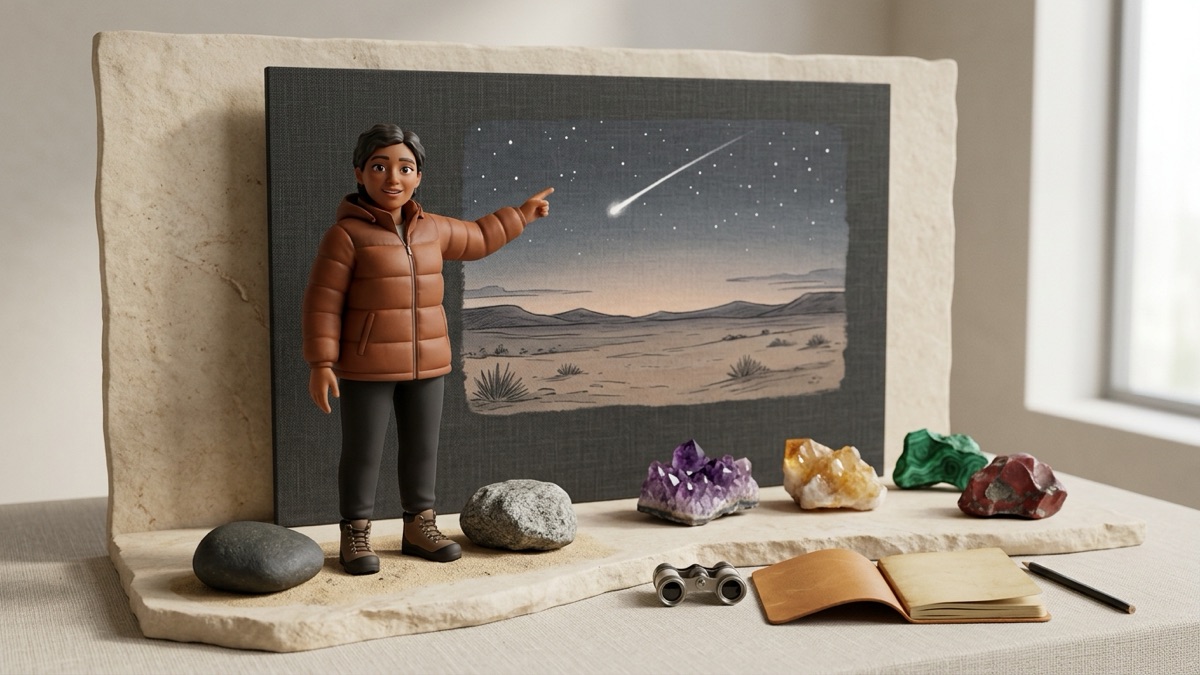
A meteor shower happens when Earth passes through a trail of debris left by a comet (and, in a few cases, an asteroid). NASA calls the Perseids, which peak around August 12 each year, perhaps the most famous; every Perseid is a tiny piece of comet Swift-Tuttle. The Geminids in December are an exception to the comet rule, since their parent is the asteroid (3200) Phaethon.
Shower debris is small and fragile. NASA says most of it is between the size of a grain of sand and a pea and burns up before reaching the ground, and it plainly advises not to expect meteorites after a meteor shower. Korotev is even more direct: if you found a rock after watching a meteor shower, the rock is not a meteorite.
What is a meteorite?
A meteorite is the survivor. The Meteoritical Society defines it as an object that has fallen to Earth from space, and NASA says most range between the size of a pebble and a fist. Very little of the original space rock makes the trip: NASA notes that less than 5 percent of an object usually reaches the ground.
The last part of the fall is surprisingly calm. The American Meteor Society explains that a meteorite-dropping fireball usually goes dark somewhere around 15 to 20 kilometers up (9 to 12 miles). The stones then fall in "dark flight" at terminal velocity, about 200 to 400 miles per hour, and reach the ground at or only slightly above air temperature. Korotev puts it plainly: meteorites are not glowing when they hit the ground, and they are not hot.
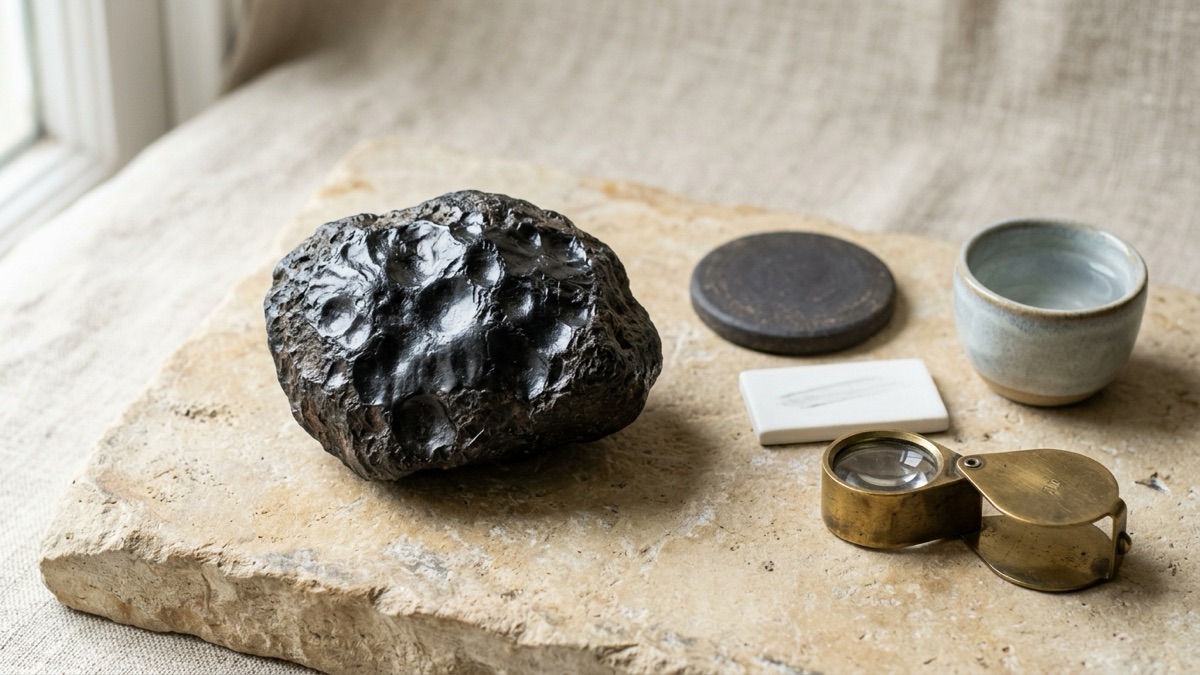
What you can hold is usually a rounded stone with a thin, dark skin called a fusion crust, the melted outer layer from its trip through the air. According to NASA, 99.8 percent of the meteorites found so far come from asteroids, with the rest split roughly equally between Mars and the Moon. For the different kinds (stony, iron and stony-iron) and famous falls, read our guide to what a meteorite is.
Where do asteroids and comets fit in?
They are the parents. Arizona State describes an asteroid as a rocky or metallic body orbiting the Sun that formed early in the solar system's history and has changed little since. Most sit in the asteroid belt between Mars and Jupiter, and collisions there knock off the meteoroids that become most meteorites.
A comet is an icy, dusty body on a long, stretched-out orbit. As it nears the Sun, gas and dust boil off and form its tail, and that dust becomes meteor showers. According to the American Meteor Society, comet material makes up about 95 percent of the meteors we see, yet it is so fragile that it has virtually no chance of reaching the ground unless an extremely large piece comes in.
One more name that gets mixed in: tektites. Arizona State explains that these are glassy objects formed when a large impact melts Earth rock and throws it into the air. They are made of Earth material, not space rock, and our guide to meteorite impact glass covers them.
If you saw a meteor, can you find the meteorite?
Almost certainly not on your own. Most meteors leave nothing behind at all, and Korotev explains that when pieces do survive, they land tens to hundreds of miles from where people saw the light. Finding them usually takes the meteor's path worked out from several viewpoints, typically cameras.
So if a bright meteor was followed by a rock in your yard the next morning, the two are almost never connected. Korotev says he has received many stories from people sure they saw their rock fall, and his answer stays the same: if you saw a meteor and later found a rock, the rock is not the meteorite.
Fun fact
Meteorology is the study of weather, not meteors. The science of meteorites is called meteoritics, a mix-up common enough that Washington University's meteorite pages give it its own entry. Your local TV meteorologist is not the person to ask about your rock.
How can you tell if a rock you found is a meteorite?
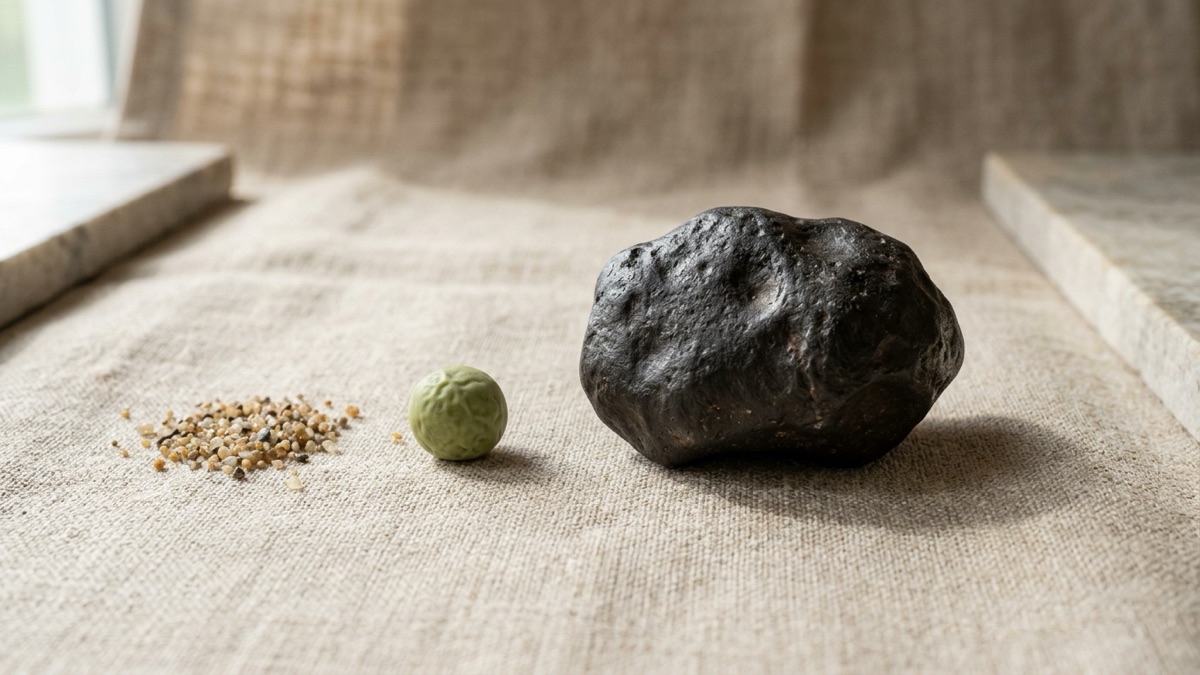
Start with the outside. A real meteorite almost always has a thin, dark fusion crust that is darker than the inside, and about 95 percent of meteorites attract a cheap fridge magnet. A cut face should show shiny metal flecks. Bubbles, layers or a red streak point to an Earth rock instead.
Our hub guide on how to identify a meteorite walks through all eight checks, and the field guide to meteorite or meteor-wrong shows the look-alikes that fool people most.
Try it
Answer nine quick questions in the free meteorite checker. It gives an honest verdict, from "very unlikely" to "worth asking an expert," and tells you which look-alikes your answers point to.
The takeaway
Meteoroid, meteor, meteorite: in space, in the sky, on the ground. The streak of light is never something you can hold, and the rock in your hand is only a meteorite if it truly fell from space and survived. The RockhoundID app, coming soon, will suggest likely matches from a photo of a rock and point out the meteorite checks worth doing next. Until then, keep watching the sky and keep your fridge magnet handy.
RockhoundID guides help you narrow down what you found. They suggest likely candidates, not certain identifications or appraisals. For anything valuable, rare or possibly from space, ask a museum, a university geology department or your state geological survey, and check the collecting rules for the land before you take anything home.
Questions rockhounds ask
Is a shooting star a meteor?
Yes. A shooting star is simply a meteor: the streak of light made when a meteoroid plunges into the atmosphere at high speed. It has nothing to do with real stars, and most of the ones you see come from particles no bigger than a grain of sand.
What is the difference between a fireball and a bolide?
The American Meteor Society calls any meteor brighter than about magnitude minus 4, roughly as bright as Venus, a fireball. A bolide is a fireball that ends in a bright terminal flash, often breaking apart as it goes.
Do meteor showers drop meteorites?
No hand-sized ones. Most meteor showers come from fragile comet dust between the size of a sand grain and a pea, which burns up high in the atmosphere. NASA says not to expect meteorites after a meteor shower.
Is a meteorite hot when it lands?
No. A meteorite stops glowing high in the atmosphere, then falls the last miles in darkness at a few hundred miles per hour. It reaches the ground at or only slightly above air temperature.
What is the difference between an asteroid and a meteoroid?
Mostly size. Arizona State University defines a meteoroid as a natural solid object up to about 1 meter across moving through space. Larger rocky or metallic bodies orbiting the Sun are asteroids, and many meteoroids are chips knocked off asteroids in collisions.
Where these facts come from
- NASA Science: Meteors and Meteorites, Facts: science.nasa.gov/solar-system/meteors-meteorites/facts/
- Arizona State University, Buseck Center for Meteorite Studies: Meteorite facts: meteorites.asu.edu/meteorites/meteorite-facts
- Arizona State University, Buseck Center for Meteorite Studies: FAQ, meteorite facts: meteorites.asu.edu/faq/faq-meteorite-facts
- American Meteor Society: Fireball FAQs (archived copy, December 2025): web.archive.org/web/20251230021807/https://www.amsmeteors.org/fireballs/faqf/
- Washington University in St. Louis (Randy Korotev): Meteors: sites.wustl.edu/meteoritesite/items/meteors/
- Washington University in St. Louis: Some meteorite realities: sites.wustl.edu/meteoritesite/items/some-meteorite-realities/
- The Meteoritical Society: Meteorites: meteoritical.org/meteorites
- Natural History Museum, London: Meteorites and meteor-wrongs: www.nhm.ac.uk/discover/meteorites-and-meteor-wrongs.html