Blog color id
Rock Identification by Color: A Guide to Every Shade
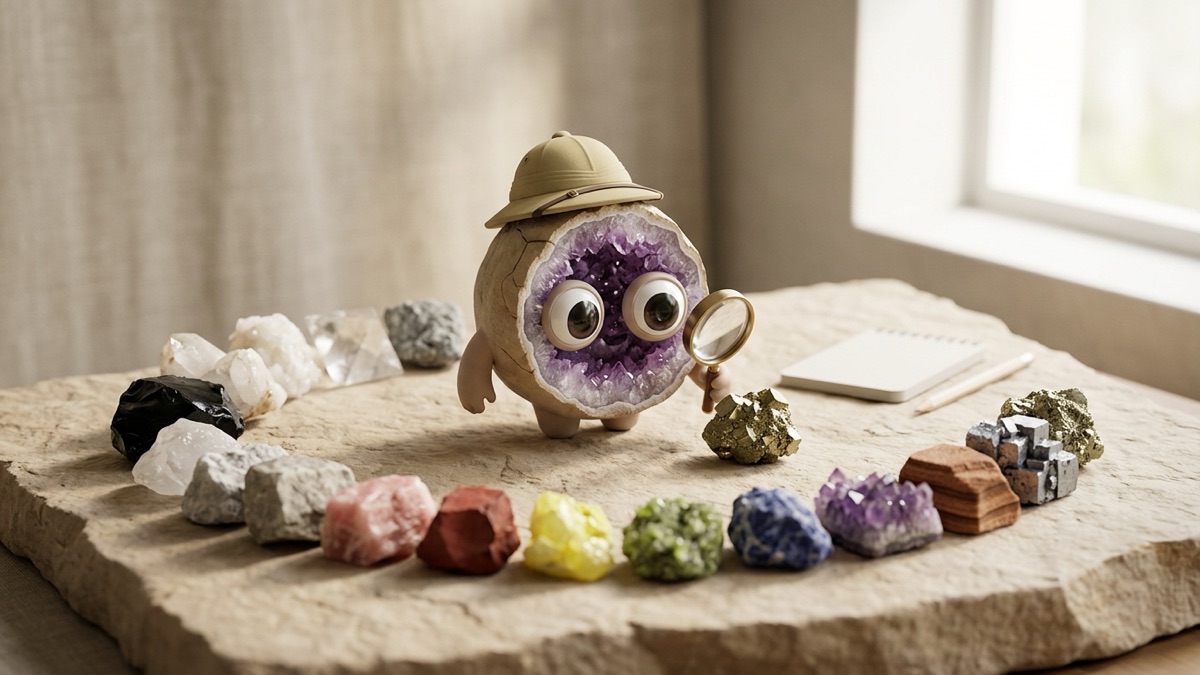
You found a pink pebble on the beach, or a black chunk that glitters in the sun, and the first thing you notice is its color. That is where almost everybody starts. It is a fine place to start, as long as you do not stop there.
Quick answer
Color is a useful first clue but the least reliable one, because tiny impurities can paint the same mineral almost any shade. Use color to build a short list of usual suspects, then settle it with one quick test: streak, a scratch test, a magnet, a drop of vinegar, or a close look at luster and weight.
Key takeaways
- Color narrows the field; it rarely names the rock. Quartz alone comes clear, white, purple, pink, yellow and smoky brown to black.
- Streak, the color of a mineral's powder on an unglazed tile, is steadier than surface color, especially for metallic minerals.
- Each color has a short list of usual suspects, and one test usually separates them.
- Judge color on a fresh, clean surface in daylight. Weathering, rust and dirt hide the real color.
- Metallic gold and silver are where color fools people most: pyrite, chalcopyrite, mica, hematite and galena all imitate precious metals.
Why is color the least reliable clue?
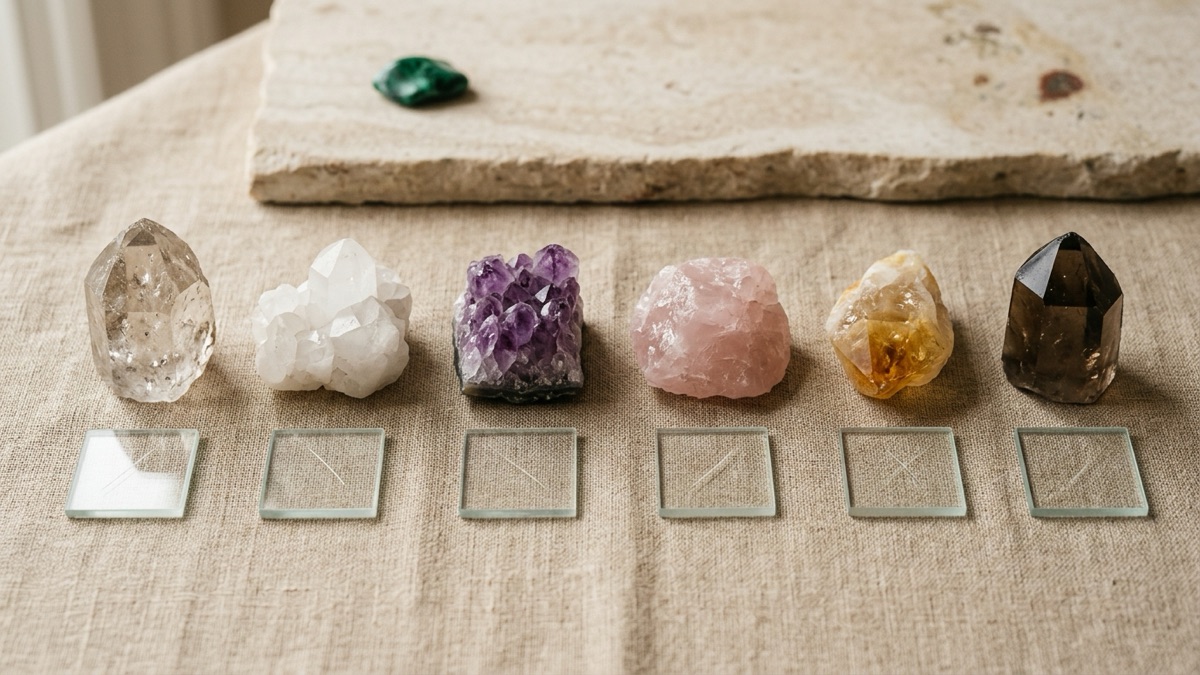
The University of Auckland's mineral guide puts it plainly: color is often not a reliable property, because minute amounts of impurities can change it dramatically, especially in minerals that would otherwise be colorless or white. Quartz is the classic example. Pure quartz is clear, yet it also turns up milky white, purple (amethyst), pink (rose quartz), yellow to orange (citrine) and gray, brown or black (smoky quartz).
Plenty of other minerals do the same. Calcite is usually white or clear but comes in light shades of yellow, orange, blue, pink, red, brown, green, gray and even black. A single fluorite crystal can hold several colors at once. In Lake Superior agates, iron supplies the reds, oranges and yellows, and in petrified wood the colors come from impurities such as iron, carbon and manganese.
Then there is the outside of the rock. Iron minerals rust to red, orange and brown, olivine often wears a brownish weathering rind, and dirt and lichen cover the rest. So use color to make your short list, and let a test make the call.
Tip
Check color on a clean, freshly broken or scraped surface in daylight, not on the weathered outside. Wetting a dull rock also brings out its color and banding, the way a beach pebble glows in the surf. Wear safety glasses if you knock a corner off.
Which quick tests beat color?
You only need a few household things, and each test answers a different question.
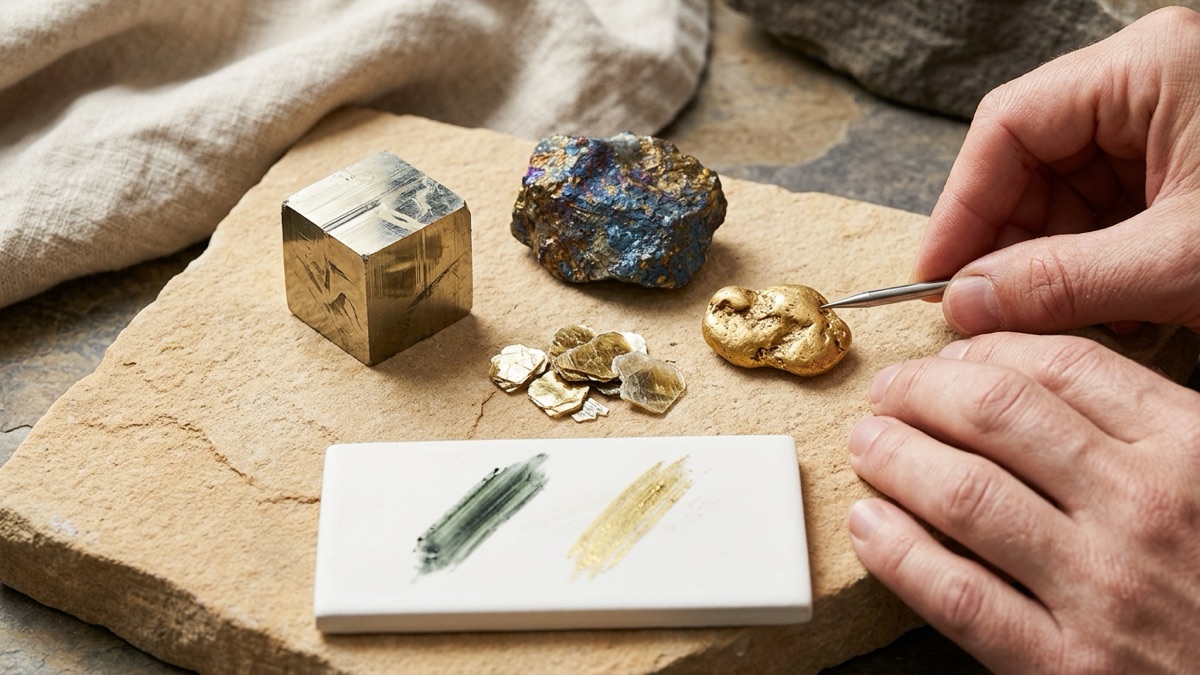
- Streak: rub the rock on the unglazed back of a white tile and look at the powder. Pyrite is gold colored but streaks greenish black. Most pale minerals streak white, and minerals harder than about 6.5 leave no streak at all. Our streak test guide shows the common colors.
- Scratch: a fingernail is about 2 to 2.5 on the Mohs scale, a pre-1983 copper penny about 3, a steel knife or nail about 5 to 5.5 and window glass about 5.5. Anything that scratches glass is harder than about 5.5.
- Magnet: a cheap fridge magnet grabs magnetite. Pure hematite does not attract a magnet, even though it can look almost identical.
- Vinegar: a drop on calcite, limestone or marble fizzes.
- Luster and weight: luster (how a surface reflects light: metallic, glassy, waxy, pearly) has to be seen in person, not in a photo. For weight, about 2.7 times the weight of water is average for a rock, so anything that feels much heavier for its size is a clue.
Rock colors at a glance
Find your color, then run the test in the last column.
| Color | Usual suspects | The test that splits them |
|---|---|---|
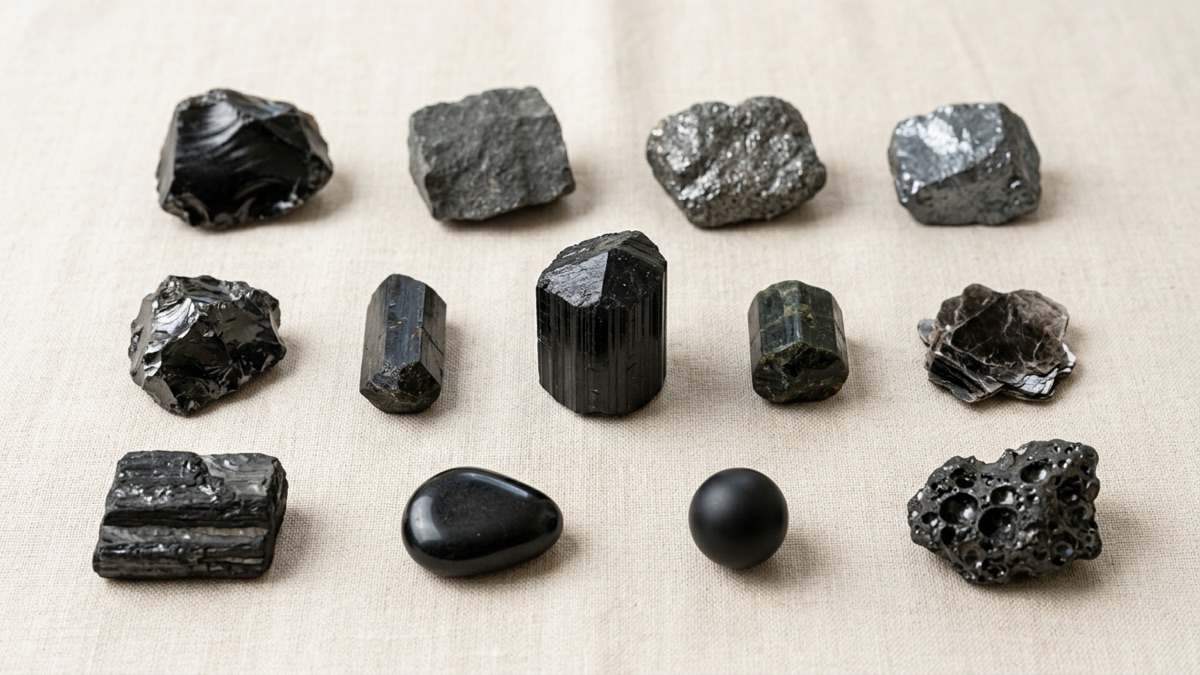
| Black | Obsidian, basalt, magnetite, black tourmaline, coal | Streak and a magnet |
| White | Milky quartz, calcite, gypsum, barite, feldspar | Scratch tests plus vinegar |
| Clear | Quartz, calcite, selenite, halite, glass | Try to scratch glass |
| Gray | Limestone, chert, slate, shale, granite | Vinegar, glass scratch, tap |
| Pink | Rose quartz, pink feldspar, rhodochrosite, rhyolite | Knife and glass scratch |
| Red | Jasper, carnelian, garnet, hematite, sandstone | Streak and a flashlight |
| Orange and yellow | Citrine, sulfur, goethite, calcite, amber | Scratch test and streak |
| Green | Olivine, malachite, serpentine, jade, fluorite | Streak, then glass scratch |
| Blue | Sodalite, lapis lazuli, azurite, turquoise, chrysocolla | Streak |
| Purple | Amethyst, fluorite, apatite, dyed agate | Try to scratch glass |
| Brown | Smoky quartz, jasper, sandstone, goethite, petrified wood | Hand lens and streak |
| Silver metallic | Galena, hematite, magnetite, graphite, mica | Streak, magnet, heft |
| Brassy gold | Pyrite, chalcopyrite, weathered mica, gold | Poke test and streak |
Try it
In the free rock identifier, pick your color, add any other clue you have (luster, hardness, streak, texture, a magnet or a fizz) and watch the likely matches line up from 66 common rocks, minerals and look-alikes, each with the one test that would settle it.
What are the usual suspects for each color?
Black rocks and minerals
Usual suspects: obsidian (natural volcanic glass with smooth, curved breaks), basalt (dark and fine grained), magnetite (metallic, heavy and magnetic), black tourmaline (long crystals with lengthwise grooves) and coal (black, layered and light for its size).
The test: streak and a magnet. Magnetite streaks black and grabs a magnet. A black or silvery rock with a red to reddish-brown streak is hematite. Our guide to black rocks and minerals walks through 12 look-alikes, including slag and meteorites.
White rocks and minerals
Usual suspects: milky quartz, calcite, gypsum, barite and feldspar.
The test: go up the hardness ladder. A fingernail scratches gypsum, a copper penny scratches calcite, and only quartz (7) and feldspar (6 to 6.5, and only just) scratch glass. Calcite fizzes in vinegar; barite looks like calcite but feels surprisingly heavy and does not fizz. More in white rocks and minerals.
Clear rocks and crystals
Usual suspects: quartz crystals, calcite, selenite (clear gypsum), halite (rock salt) and man-made glass.
The test: try to scratch glass. Quartz does; calcite, selenite and halite do not. Set clear calcite on a printed line and you see a double image. A chip of halite dissolves in a glass of water. Glass, quartz and their look-alikes each get a section in rocks that look like glass.
Heads up
Never taste or lick an unknown mineral to check for salt. Use the water test instead, and wash your hands after handling unknown specimens.
Gray rocks
Usual suspects: limestone, chert and flint, slate, shale and gray granite.
The test: vinegar first, then glass. Limestone fizzes and a knife scratches it; chert ignores vinegar and scratches glass. For flat, layered gray rocks, tap them: slate rings, while shale and mudstone give a dull thud. Granite shows grains you can see: glassy gray quartz, white or pink feldspar and dark specks.
Pink rocks and minerals
Usual suspects: rose quartz (hazy pink), potassium feldspar (salmon-pink blocks with flat, shiny faces, the pink in pink granite), rhodochrosite (rose to cherry red, often banded), rhyolite (pale, fine-grained volcanic rock) and pink calcite or dolomite.
The test: a steel knife. It scratches rhodochrosite (3.5 to 4), calcite and dolomite; rose quartz and feldspar resist it, and rose quartz scratches glass easily. Full lineup in pink rocks and minerals.
Red rocks and minerals
Usual suspects: jasper (opaque brick red), carnelian (translucent orange-red chalcedony), garnet (round, many-faced crystals, often in schist), hematite (earthy red or steel gray) and red sandstone (sand grains glued by a cement that can be iron oxide).
The test: streak and a flashlight. Hematite leaves a red to reddish-brown streak; jasper, carnelian and garnet leave a white streak or none at all. Shine a light through a thin edge: carnelian glows, jasper stays dark. See red rocks and minerals.
Fun fact
The University of Auckland notes that the red color of soils all over the planet comes from hematite, the same mineral that can look like polished steel as a crystal.
Orange and yellow rocks
Usual suspects: citrine (yellow to orange quartz), sulfur (bright lemon yellow), goethite or limonite (rusty yellow-brown), yellow calcite and amber (fossil resin).
The test: scratch, then streak. Citrine scratches glass. A fingernail can mark sulfur and amber, and amber feels very light in the hand. Goethite leaves a yellow-brown streak, and yellow calcite fizzes in vinegar. Keep sulfur away from flames. More in yellow and orange rocks.
Green rocks and minerals
Usual suspects: olivine (glassy olive-green grains, often in dark volcanic rock), malachite (banded bright green), serpentine (mottled and waxy), jade (nephrite and jadeite) and green fluorite.
The test: streak first. Malachite leaves a green streak; the others leave a white streak or none. Then glass: olivine scratches it and jade (about 6 to 7) just does, while serpentine, fluorite (4) and malachite (3.5 to 4) do not. See green rocks and minerals.
Blue rocks and minerals
Usual suspects: sodalite (royal blue with white veins), lapis lazuli (deep blue, often with brassy pyrite flecks), azurite (deep azure, often with green malachite), turquoise (sky blue to green and waxy) and chrysocolla (blue-green and light).
The test: streak. Lapis (its blue mineral, lazurite) and azurite leave blue powder. Sodalite and chrysocolla streak white, and turquoise white to pale blue-green. Keep in mind that agate and other chalcedony can be dyed almost any color, blue included. More in blue rocks and minerals.
Purple rocks and crystals
Usual suspects: amethyst (purple quartz), purple fluorite (glassy cubes, often color-zoned), purple apatite and dyed agate.
The test: try to scratch glass. Amethyst (7) scratches it easily; fluorite (4) and apatite (5) do not. Dyed agate shows curved bands in unusually vivid colors. The full lineup is in purple crystals and rocks.
Brown rocks
Usual suspects: smoky quartz, brown jasper, sandstone, goethite or limonite, and petrified wood.
The test: a hand lens and a streak. Sand grains you can see mean sandstone. Growth rings and bark texture mean petrified wood. A yellow-brown streak means goethite. Smoky quartz is glassy, often crystal shaped, and scratches glass.
Silver metallic rocks
Usual suspects: galena (lead-gray cubes), hematite (steel-gray, sometimes sparkly and flaky), magnetite (black to gray), graphite (soft and greasy) and muscovite mica (silvery flakes that are not metal at all).
The test: streak, magnet and heft. Galena streaks lead gray and feels like a lump of lead, about 7.6 times as heavy as water. Hematite streaks red. Magnetite grabs a magnet. Graphite marks paper like a pencil and feels light, and mica peels into thin, flexible sheets. Wash your hands after handling galena, a lead mineral. The heavy ones get their own guide: heavy shiny silver rocks.
Brassy gold rocks
Usual suspects: pyrite (fool's gold, often in cubes), chalcopyrite (brassy, with a blue and purple tarnish), weathered mica (golden flakes) and, occasionally, real gold.
The test: the USGS suggests two. Poke it with a metal point: pyrite, chalcopyrite and mica flake, powder or crumble, while gold gouges or dents like soft lead. Then streak it: gold leaves a golden yellow streak, pyrite and chalcopyrite a dark green to black one, and mica a white one. Why gold is so soft is explained in gold, silver and platinum hardness.
What if your rock is more than one color?
Speckles, stripes and patches usually mean you are holding a rock, which is a mixture of minerals, rather than a single mineral. Granite is salt-and-pepper or pink-speckled, gneiss is striped, conglomerate is a jumble of rounded pebbles, and agate shows curved bands. In that case, pick the largest grain or band and test it on its own, then do the same with the next one. Our step-by-step identification method shows how to put those clues together.
The takeaway
Color is how you notice a rock, not how you name it. Let it point you to the right short list above, then let a streak, a scratch, a magnet or a drop of vinegar decide. The RockhoundID app, coming soon, will suggest likely matches from a photo and tell you which of these quick tests confirms them. Until then, a white tile, a steel nail and a fridge magnet will take you a very long way.
RockhoundID guides help you narrow down what you found. They suggest likely candidates, not certain identifications or appraisals. For anything valuable, rare or possibly from space, ask a museum, a university geology department or your state geological survey, and check the collecting rules for the land before you take anything home.
Questions rockhounds ask
Can you identify a rock by its color alone?
Rarely. Tiny amounts of impurities can turn the same mineral many different colors, so color is best used to make a short list of candidates. A streak, scratch, magnet or vinegar test usually decides between them.
Why is streak more reliable than color?
Streak is the color of a mineral's powder on an unglazed white tile, and it stays much the same even when the surface color changes. Hematite can look silver, black or red, but its streak is always red to reddish brown.
What is a shiny black rock?
The usual suspects are obsidian (glassy, no grains), magnetite (metallic and magnetic), hematite (metallic with a red streak), black tourmaline (grooved crystals) and coal (layered and light). A streak test and a fridge magnet sort most of them.
How can I tell if a gold-colored rock is real gold?
The USGS suggests two tests. Poke it with a metal point: real gold dents like soft lead, while pyrite, chalcopyrite and mica flake or crumble. Then check the streak: gold leaves a golden yellow streak, pyrite and chalcopyrite a dark green to black one, and mica a white one.
What colors does quartz come in?
Almost all of them. Pure quartz is clear, but it is also found milky white, purple (amethyst), pink (rose quartz), yellow to orange (citrine) and gray, brown or black (smoky quartz). Every color of quartz is 7 on the Mohs scale, so every one of them scratches glass.
Where these facts come from
- University of Auckland, minerals: Colour: rocksminerals.flexiblelearning.auckland.ac.nz/minerals/colour.html
- University of Auckland, minerals: Streak: rocksminerals.flexiblelearning.auckland.ac.nz/minerals/streak.html
- University of Auckland, minerals: Lustre: rocksminerals.flexiblelearning.auckland.ac.nz/minerals/lustre.html
- University of Auckland, minerals: Specific gravity: rocksminerals.flexiblelearning.auckland.ac.nz/minerals/gravity.html
- University of Auckland, minerals: Quartz: rocksminerals.flexiblelearning.auckland.ac.nz/minerals/quartz.html
- University of Auckland, minerals: Calcite: rocksminerals.flexiblelearning.auckland.ac.nz/minerals/calcite.html
- University of Auckland, minerals: Fluorite: rocksminerals.flexiblelearning.auckland.ac.nz/minerals/fluorite.html
- University of Auckland, minerals: Hematite: rocksminerals.flexiblelearning.auckland.ac.nz/minerals/hematite.html
- University of Auckland, minerals: Olivine: rocksminerals.flexiblelearning.auckland.ac.nz/minerals/olivine.html
- University of Auckland, rocks: Sandstone: rocksminerals.flexiblelearning.auckland.ac.nz/rocks/sandstone.html
- University of Auckland, rocks: Slate: rocksminerals.flexiblelearning.auckland.ac.nz/rocks/slate.html
- Mineralogical Society of America: Mineral Identification Key, hardness: www.minsocam.org/MSA/collectors_corner/id/mineral_id_keyi4.htm
- USGS: What is Fool's Gold?: www.usgs.gov/faqs/what-fools-gold
- USGS, Gemstones (mineral gemstones): pubs.usgs.gov/gip/gemstones/mineral.html
- USGS, Gemstones (organic gemstones): pubs.usgs.gov/gip/gemstones/organic.html
- GIA: An Introduction to Gem Treatments: www.gia.edu/gem-treatment
- Handbook of Mineralogy: Galena: www.handbookofmineralogy.org/pdfs/galena.pdf
- Handbook of Mineralogy: Lazurite: www.handbookofmineralogy.org/pdfs/lazurite.pdf
- Washington University in St. Louis meteorite site: Magnetic attraction: sites.wustl.edu/meteoritesite/items/magnetic_attraction/
- Minnesota DNR: Lake Superior agate: www.dnr.state.mn.us/snapshots/rocks_minerals/lakesuperioragate.html
- National Park Service, Petrified Forest: petrified wood: www.nps.gov/pefo/learn/nature/petrified-wood.htm