
Pink Rocks and Minerals: 10 You Can Actually Find
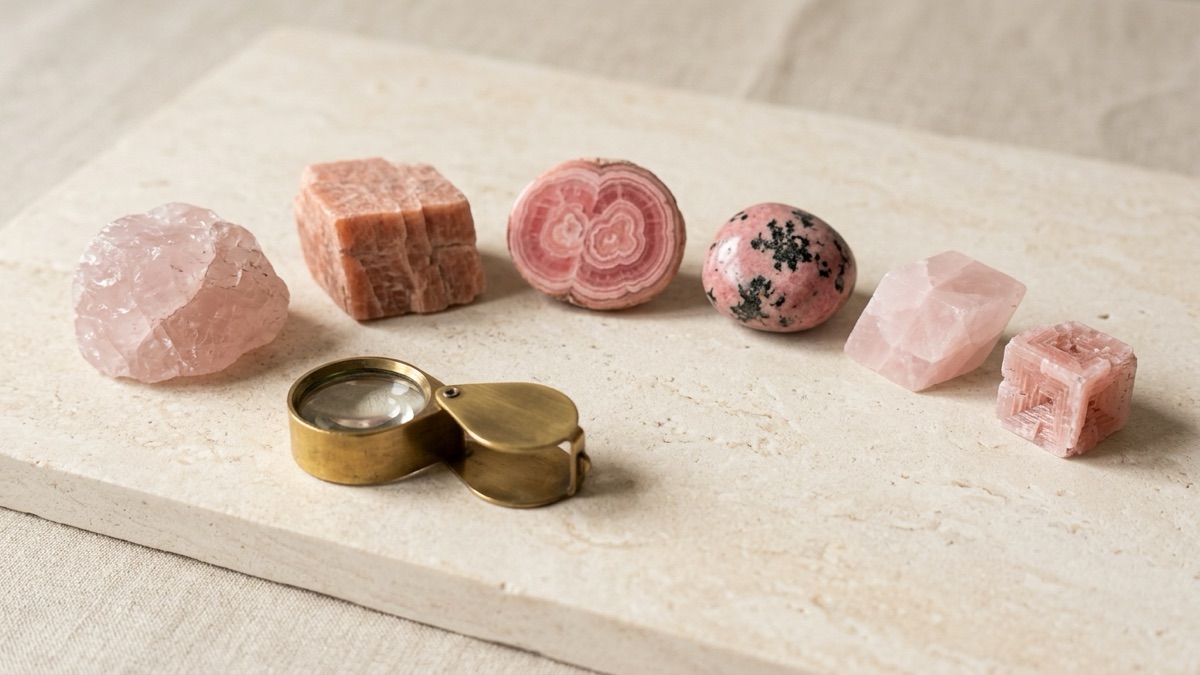
Most pink rocks you will find are rose quartz, pink feldspar or pink calcite. Pink narrows the field more than most colors do, and two or three kitchen-table tests (a piece of glass, a copper coin and a drop of vinegar) usually settle which pink it is.
Quick answer
The usual pink finds are rose quartz, pink feldspar (the pink grains in granite) and pink calcite. Test hardness first: rose quartz scratches glass easily, feldspar just scratches it and shows flat, shiny faces, and calcite is scratched by copper and fizzes in vinegar. Rhodochrosite, rhodonite, fluorite, halite and thulite are rarer.
Key takeaways
- Color gets you to a shortlist. Hardness, cleavage and one special test get you to a likely answer.
- A glass test splits the pinks in two: rose quartz, feldspar, rhodonite and thulite scratch glass or come close; calcite, dolomite, rhodochrosite, fluorite and halite do not.
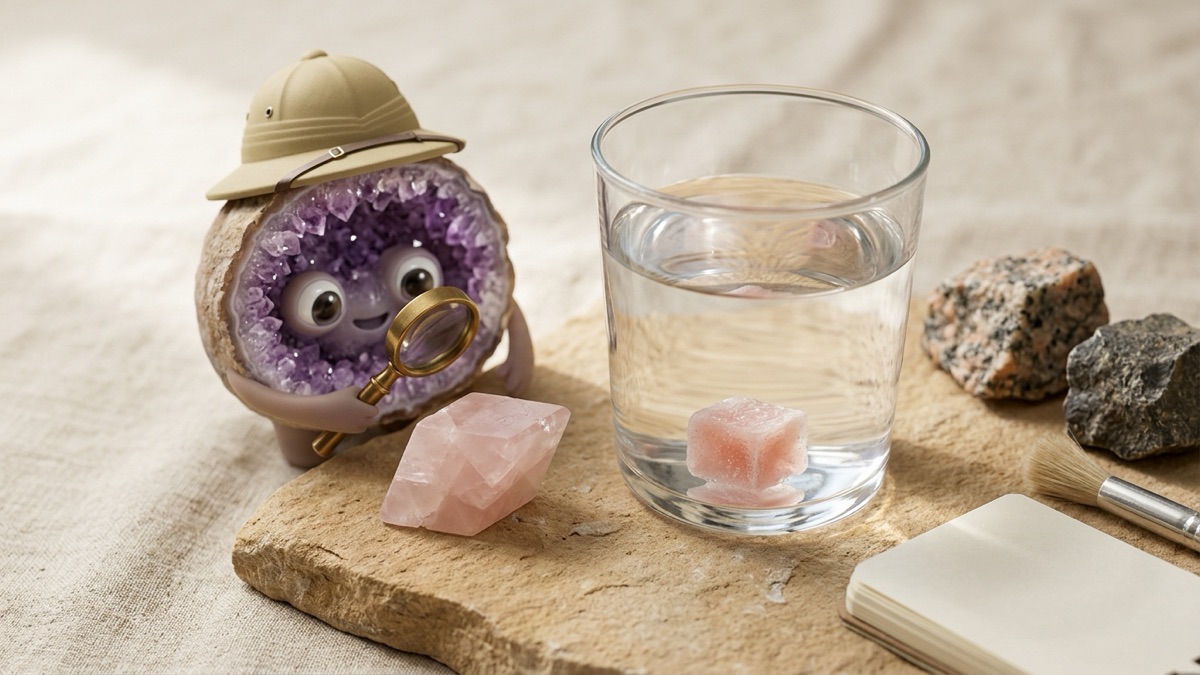
- Vinegar picks out pink calcite. A glass of water picks out halite, because it dissolves.
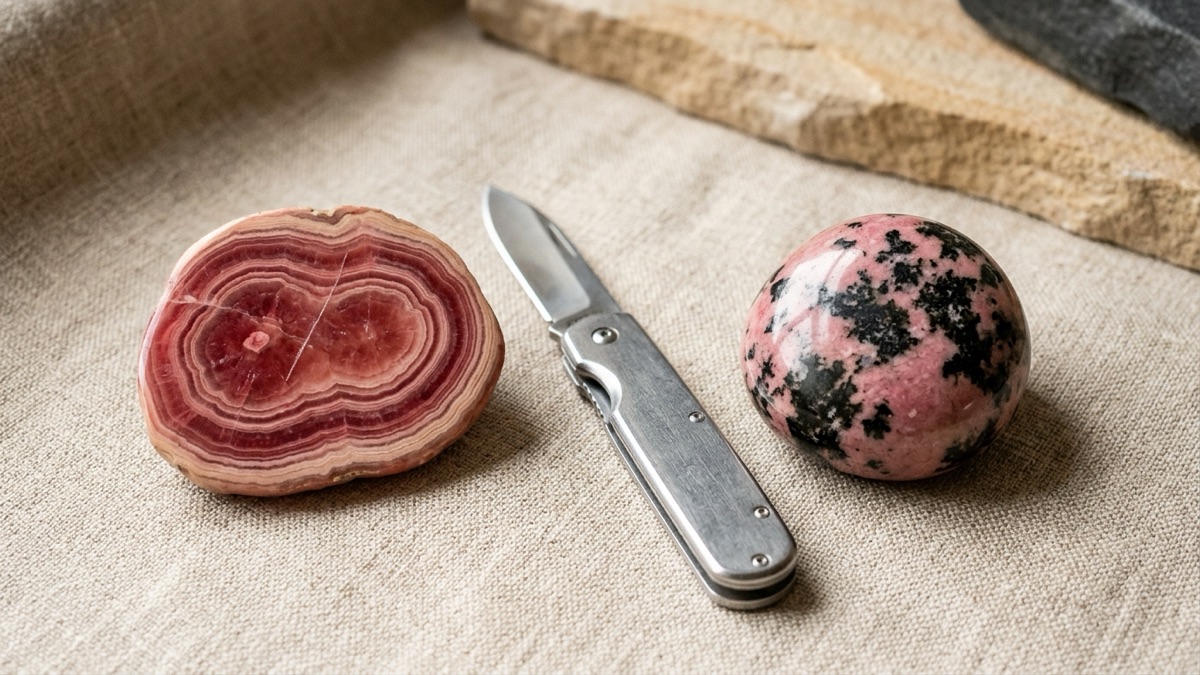
- Rhodochrosite and rhodonite are both manganese minerals. A steel knife scratches rhodochrosite easily and struggles with rhodonite.
- An even, candy-bright pink with color pooled in cracks is a warning sign for dye.
Why is pink such a tricky color?
Pink is usually a small amount of something else. Rhodochrosite and rhodonite are pink because manganese is part of their recipe (rhodonite takes its name from the Greek for rose). Thulite is a pink, manganese-rich form of the mineral zoisite. Pink sandstone gets its blush from iron oxide: the Utah Geological Survey explains that tiny differences in iron oxide, a fraction of a percent, separate red, pink and white sandstone.
Meanwhile, common minerals such as quartz, calcite, fluorite and halite come in pink as well as many other colors. So treat pink as a clue, not an answer. For how every color family works, start with our rock identification by color hub.
What are the 10 pink rocks and minerals you can actually find?
Here is the shortlist, with the one test that separates each from its look-alikes. Hardness is on the Mohs scale; glass is about 5.5, a steel knife about 5 to 5.5 and copper about 3.
| Pink find | Mohs hardness | The tell | Best quick test |
|---|---|---|---|
| Rose quartz | 7 | Hazy pink, curved breaks, rarely crystals | Scratches glass easily |
| Pink feldspar | 6 to 6.5 | Blocky grains with flat, shiny faces | Just scratches glass; look for flat faces |
| Rhodochrosite | 3.5 to 4 | Rose to cherry red, often banded, heavy | Knife scratches it easily |
| Rhodonite | 5.5 to 6.5 | Pink with black patches | Knife barely marks it |
| Pink calcite | 3 | Breaks into slanted boxes | Fizzes in vinegar |
| Pink dolomite | 3.5 to 4 | Pale pink, curved saddle crystals | Copper does not scratch it; powder may fizz |
| Halite | 2 to 2.5 | Cubes, often stepped | Dissolves in water |
| Pink fluorite | 4 | Cubes, color zones | Knife scratches, copper does not |
| Thulite | 6 to 7 | Compact pink mass, no crystals to speak of | Scratches glass, unlike the soft pinks |
| Pink sandstone or rhyolite | varies | A rock, not a crystal | Look for grains with a lens |
1. Rose quartz
Rose quartz is quartz in a translucent pink, usually in hazy chunks rather than crystals. It has no cleavage, so a broken edge shows smooth, curved (conchoidal) surfaces, like chipped glass. At Mohs 7 it scratches glass without effort. Our rose quartz guide covers it in depth.
2. Pink feldspar (and pink granite)
If your pink is a blocky grain inside a speckled rock, think potassium feldspar. The University of Auckland lists orthoclase as pinkish white to shades of red, and it is the pink in most pink granite. Feldspar has two cleavages that meet at right angles, so tilt the grain under a lamp and watch for flat faces that flash. At Mohs 6 to 6.5 it just scratches glass.
3. Rhodochrosite
Rhodochrosite is manganese carbonate, colored pink, rose-red or cherry-red and often banded in lighter and darker stripes. It is soft for its looks (Mohs 3.5 to 4) and heavy for its size, with a specific gravity of about 3.7 against quartz's 2.65. A steel knife scratches it easily.
4. Rhodonite
Rhodonite is a manganese silicate in rose-pink to brownish red, and the Handbook of Mineralogy notes its exterior is commonly black from manganese oxides. That pink-and-black look is the giveaway. It is much harder than rhodochrosite, at 5.5 to 6.5.
5. Pink calcite
Calcite comes in white and clear but also light shades of pink and many other colors. It breaks along three cleavages that are not at right angles, so broken pieces look like slanted boxes (rhombs). At Mohs 3, a copper coin or wire scratches it, and a drop of vinegar makes it fizz.
6. Pink dolomite
Dolomite is calcite's close cousin, and the Handbook lists pale pink among its colors. Crystals often curve into saddle shapes. It is a little harder (3.5 to 4), so copper usually fails to scratch it. It may fizz weakly or not at all on a solid surface, so scrape a little powder with a nail and test that instead, a trick the Nevada Bureau of Mines and Geology suggests for any sample that stays quiet at first.
7. Halite (pink rock salt)
Halite is natural rock salt. It is colorless or white when pure, but pink, orange, red, blue and purple specimens exist. It grows in cubes, sometimes with stepped, hollow "hopper" faces, and breaks into smaller cubes. It is soft (2 to 2.5) and, most usefully, it dissolves in water.
8. Pink fluorite
Fluorite forms cubes and eight-sided octahedra, often with zones of different color, and pink is one of its many shades. It splits along four directions that give octahedral pieces. At Mohs 4, a steel knife scratches it but copper does not. Many fluorites also glow under an ultraviolet lamp.
9. Thulite
Thulite is the pink, manganese-rich variety of zoisite, and Encyclopaedia Britannica notes it is the national stone of Norway. Zoisite is Mohs 6 to 7, so thulite scratches glass, which quickly rules out the soft pinks.
10. Pink sandstone and pink rhyolite
Some pinks are rocks, not minerals. Pink sandstone feels like sandpaper and shows sand grains under a lens; the pink is a thin iron oxide coating or filling between the grains. Rhyolite is a pale, fine-grained volcanic rock that can be pink, often with flow bands or a few small crystals.
How do you tell the pink look-alikes apart?
Run the tests in this order and most pink stones sort themselves out in a few minutes:
- Glass test. Press a sharp edge firmly across a glass jar or a taped glass square, then rub the mark. A scratch that stays means rose quartz, feldspar, rhodonite or thulite. Our Mohs hardness test guide shows how to do it cleanly.
- Knife and copper test. For stones that fail the glass test, a steel knife scratches rhodochrosite, fluorite and dolomite; copper also scratches calcite, and even a fingernail marks halite.
- Vinegar test. A steady fizz on a clean surface points to calcite. See our vinegar fizz test for doing it properly.
- Water test. A chip that dissolves is halite.
- Look for cleavage and bands. Right-angle flat faces suggest feldspar, slanted boxes suggest calcite, bands suggest rhodochrosite and black patches suggest rhodonite.
Most of these pink minerals leave a white streak, so a streak plate will not help much here.
Tip
Wet your stone before you judge its shade. Water deepens the pink and shows bands, patches and grains, then dries off without a trace.
Is my pink stone dyed?
Dyed stones do turn up for sale. GIA describes dyeing as putting color into porous or fractured gem materials, and lists howlite, chalcedony and quartz among the materials that have long been dyed; sometimes cracks are made on purpose by heating so the stone takes the dye.
Clues to look for:
- Color in the cracks. With a hand lens, dye often gathers in fractures and pits, darker than the body of the stone.
- Too perfect. An even, candy-bright pink across a whole strand of beads deserves a closer look.
- The swab test. GIA notes many dyes come off with acetone or alcohol. Rub a cotton swab with nail polish remover on a hidden spot and check it for color.
Heads up
Only swab-test stones you own, and never on a finished piece of jewelry you care about, since the test can remove dye. Wear safety glasses whenever you scratch or chip a stone, and never taste or lick an unknown mineral, even one you suspect is salt.
What about pink gem crystals?
A few gem minerals also come in pink, and each has its own tell:
- Morganite: pink beryl, Mohs 7.5 to 8, in six-sided crystals with flat ends.
- Pink tourmaline (rubellite): pink to red, Mohs 7 to 7.5, with long grooves running down the crystal.
- Kunzite: GIA describes it as the light pink to violetish purple variety of spodumene, and notes its color can fade with heat and bright light.
- Lepidolite: a pink to purple lithium mica that peels into thin, flexible sheets that spring back.
Kunzite and lepidolite sit right on the border with purple, so our guide to purple crystals and rocks covers them in more detail.
Where can you find pink rocks?
Pink feldspar turns up wherever pink granite is exposed, in boulders and river gravels. Rose quartz, pink calcite and rhodochrosite come from particular deposits.
Before you collect, check who manages the land. On most BLM (Bureau of Land Management) public land you may take reasonable amounts of rocks and minerals for personal, noncommercial use, except where an area is posted closed, and you may not use explosives or motorized digging equipment. Collecting is prohibited in national parks. On private land, ask the owner first. Our guide to rock collecting rules explains the details.
Try it
Open the free rock identifier, choose pink, then add hardness, luster or a vinegar result. It lines up the likely candidates, explains why each one fits and names the test that would settle it. It runs in your browser with no photo upload.
The RockhoundID app, coming soon, will suggest likely matches from a photo and tell you which test confirms them.
The takeaway
Pink is a friendly color to identify because the candidates split so cleanly. Try glass first, then a knife and copper, then vinegar or water, and look for cleavage, bands or black patches. Most pink stones will point to one or two likely names in a few minutes. If yours still will not settle, a local rock club or your state geological survey can take a look.
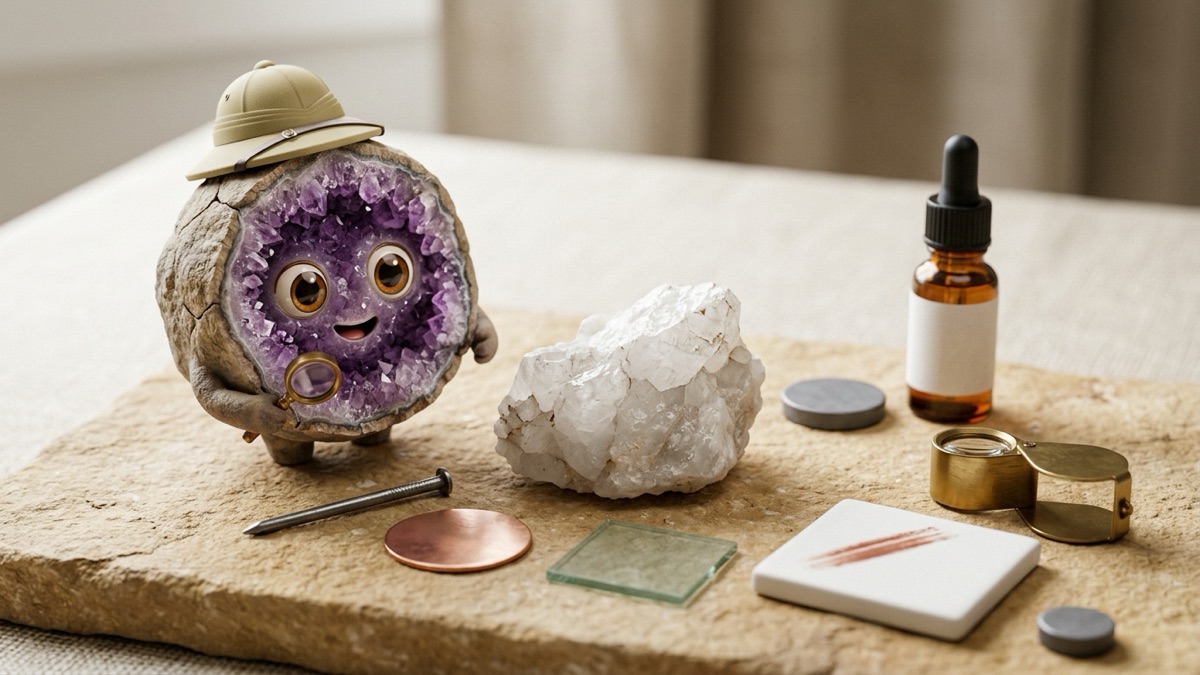
The pictures in this guide are AI-generated illustrations of what to look for; real specimens vary, so trust the tests over any picture. RockhoundID guides help you narrow down what you found. They suggest likely candidates, not certain identifications or appraisals. For anything valuable, rare or possibly from space, ask a museum, a university geology department or your state geological survey, and check the collecting rules for the land before you take anything home.
Questions rockhounds ask
How do I tell rose quartz from pink calcite?
Try to scratch a piece of glass with it. Rose quartz, at Mohs 7, scratches glass easily. Pink calcite, at Mohs 3, cannot scratch glass, a copper coin or wire scratches it, and it fizzes under a drop of vinegar.
Is rhodochrosite the same as rhodonite?
No. Both are pink manganese minerals, but rhodochrosite is a carbonate at Mohs 3.5 to 4 that a steel knife scratches easily and that is often banded in lighter and darker pink. Rhodonite is a silicate at Mohs 5.5 to 6.5 that resists the knife and often carries black patches of manganese oxide.
How can I tell if a pink stone is dyed?
Look with a hand lens for color that gathers in cracks and pits, and be suspicious of an even, candy-bright pink. GIA notes that many dyes come off with acetone or alcohol, so a cotton swab with nail polish remover on a hidden spot of your own stone may pick up color.
How do I test pink halite without tasting it?
Drop a small chip into a glass of water and stir. Halite dissolves, while look-alikes such as pink calcite and pink fluorite do not. Never taste or lick an unknown mineral, even one you think is salt.
What pink rock has black veins or patches?
Rhodonite is the classic pink stone with black, because its surfaces are commonly coated with black manganese oxide. It is hard enough to resist a steel knife, which separates it from softer rhodochrosite.
Where these facts come from
- USGS, Gemstones (mineral gemstones: rose quartz, morganite, rubellite, orthoclase): pubs.usgs.gov/gip/gemstones/mineral.html
- University of Auckland, minerals: Quartz: rocksminerals.flexiblelearning.auckland.ac.nz/minerals/quartz.html
- University of Auckland, minerals: Orthoclase: rocksminerals.flexiblelearning.auckland.ac.nz/minerals/orthoclase.html
- University of Auckland, minerals: Calcite: rocksminerals.flexiblelearning.auckland.ac.nz/minerals/calcite.html
- University of Auckland: Cleavage and fracture: rocksminerals.flexiblelearning.auckland.ac.nz/minerals/fracture.html
- Handbook of Mineralogy: Rhodochrosite: www.handbookofmineralogy.org/pdfs/rhodochrosite.pdf
- Handbook of Mineralogy: Rhodonite: www.handbookofmineralogy.org/pdfs/rhodonite.pdf
- Handbook of Mineralogy: Dolomite: www.handbookofmineralogy.org/pdfs/dolomite.pdf
- Handbook of Mineralogy: Halite: www.handbookofmineralogy.org/pdfs/halite.pdf
- Handbook of Mineralogy: Fluorite: www.handbookofmineralogy.org/pdfs/fluorite.pdf
- Handbook of Mineralogy: Zoisite: www.handbookofmineralogy.org/pdfs/zoisite.pdf
- Handbook of Mineralogy: Lepidolite: www.handbookofmineralogy.org/pdfs/lepidolite.pdf
- Handbook of Mineralogy: Spodumene: www.handbookofmineralogy.org/pdfs/spodumene.pdf
- Encyclopaedia Britannica: Thulite: www.britannica.com/science/thulite
- GIA: Kunzite description: www.gia.edu/kunzite-description
- GIA: An introduction to gem treatments (dyeing): www.gia.edu/gem-treatment
- Utah Geological Survey: What gives Utah's Red Rock Country its color?: geology.utah.gov/map-pub/survey-notes/glad-you-asked/glad-you-asked-what-gives-u
- Nevada Bureau of Mines and Geology (University of Nevada, Reno): Mineral identification activity: nbmg.unr.edu/_docs/ScienceEducation/Activities/MineralID.pdf
- Mineralogical Society of America, Mineral Identification Key: identification kit: www.minsocam.org/MSA/collectors_corner/id/mineral_id_keyi2.htm
- eCFR: 43 CFR 8365.1-5 (BLM rockhounding rule): www.ecfr.gov/current/title-43/subtitle-B/chapter-II/subchapter-H/part-8360/subpa
- eCFR: 36 CFR 2.1 (national parks): www.ecfr.gov/current/title-36/chapter-I/part-2/section-2.1
Read next
identification
How to Identify Rocks: A Simple 7-Test Method