Guides rockhounding
Rockhounding for Beginners: Where, How and What to Bring
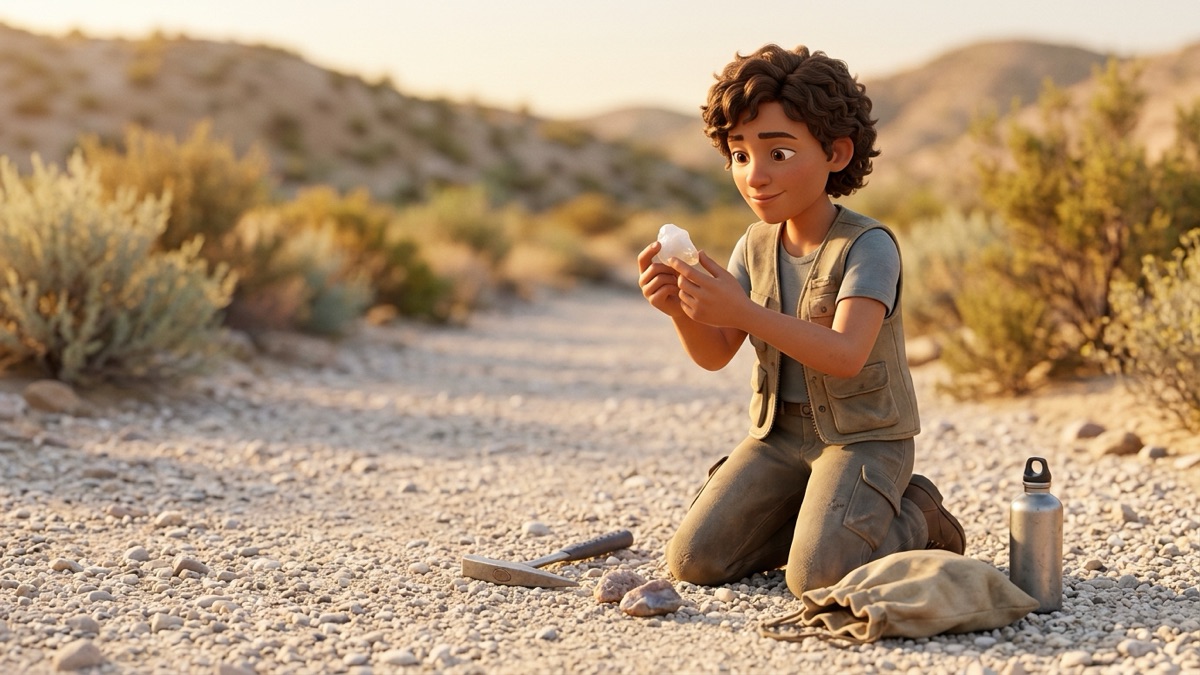
Rockhounding is the hobby of finding and collecting rocks, minerals and common fossils yourself, for fun rather than for sale. You can start with a hammer, a bag, safety glasses and one piece of homework: finding out who manages the land you plan to search. Once you start, you notice rocks everywhere, from road cuts to the gravel at the edge of the parking lot.
Quick answer
Rockhounding is collecting rocks, minerals and semiprecious stones for fun. In the US, start on Bureau of Land Management land, where small personal amounts are generally allowed, or join a club field trip. Skip national parks entirely, ask before entering private land, bring water and safety glasses, and label every find on the spot.
Key takeaways
- Rockhounding means collecting rocks, minerals, semiprecious gems, petrified wood and common invertebrate fossils for your own use, never for sale.
- The land decides the rules: BLM land is generally open for small personal amounts, national forests vary by forest, national parks are closed, and private land needs the owner's permission.
- Leave vertebrate fossils and artifacts, including arrowheads, exactly where you find them.
- Bring water, sun protection and safety glasses, and never enter an old mine.
- Write down where every rock came from the moment you pick it up.
What is rockhounding?
Rockhounding is the hands-on side of geology: you go outside, read the ground and bring home a few pieces that caught your eye. The Bureau of Land Management (BLM), the federal agency that manages public lands and runs several designated rockhound areas, describes it in its Arizona brochure as collecting reasonable amounts of mineral specimens, rocks, semiprecious gems, petrified wood and invertebrate fossils. Invertebrate fossils are the remains of animals without bones, such as shellfish, corals, trilobites and crinoids.
The same brochure draws two hard lines. What you collect must not be sold or bartered, and some things are not part of the hobby at all. Vertebrate fossils (dinosaurs, mammals, sharks, fish, anything with a skeleton) need a BLM permit that goes only to qualified applicants. Artifacts, from arrowheads and flakes to pottery, old bottles and pieces of old equipment, may not be collected on public land without a permit.
From there the hobby grows in whatever direction you like: trips to known collecting areas, club field trips, gold panning where it is allowed, tumbling and polishing, or a shelf of neatly labeled specimens.
Where are you allowed to go rockhounding?
The most important question in rockhounding is not "what is this rock?" but "whose land am I standing on?" Every agency sets its own rules, so the same agate can be fine to pick up on one side of a fence and illegal to take on the other.
| Land | Can you collect? | The short version |
|---|---|---|
| BLM public land | Generally yes | Reasonable amounts for personal, noncommercial use. No motorized or mechanical tools, except metal detectors. |
| National forests and grasslands | Often, rules vary | Forest Service policy allows hobby collecting; some forests require a free use permit first. |
| National parks | No | Removing rocks, minerals and fossils is prohibited. |
| State parks and state land | Varies, often no | Check the state agency's own page before you go. |
| Private land | Only with permission | Ask the owner first, every time. |
BLM land is a natural first stop in the West. The rule, 43 CFR 8365.1-5, lets the public collect reasonable amounts of rocks, mineral specimens and semiprecious gemstones for noncommercial purposes. BLM's own FAQ adds that a permit is generally not needed, but collecting is generally not allowed on developed recreation sites, on active mining claims, or where the mineral rights are privately owned. BLM Arizona sets "reasonable" at up to 25 pounds a day and 250 pounds a year.
National forests are run by the USDA Forest Service. Its national Rockhounding Guide says most forest land is open to rock and mineral collecting for personal, hobby and noncommercial use, generally through a free use permit, with no mechanical equipment. Individual forests set the details, so check the forest's own page or call the ranger district.
National parks are closed to collecting under 36 CFR 2.1, which also bans possessing a metal detector unless it is broken down and stowed. State land varies a lot: the Utah Geological Survey notes that Utah's state parks are closed to collecting, and BLM's Arizona brochure warns that rockhounding is not allowed on Arizona State Trust Land. Our full guide to rock collecting rules walks through each land type with its limits.
Heads up
"Public" does not always mean "open." BLM lists active mining claims among the places where collecting is generally not allowed, and its Oregon Sunstone Collection Area has private claims around it and even inside it. Know exactly where you are before you pick anything up.
How do you find a good place to start?
You do not need a secret spot. Start here:
- BLM designated rockhound areas. BLM's rockhounding page lists Black Hills and Round Mountain in Arizona, Wiley Well Geode Beds, Chambless and Savahia Peak in California, Garnet Hill in Nevada, the Sunstone Collection Area in Oregon, and Dugway Geode Beds and Topaz Mountain in Utah. Read each area's own BLM page before you go.
- Your state geological survey. Many surveys publish collecting guides and rules. The Utah Geological Survey, for example, posts collecting sites, maps and club lists, and reminds readers that a site description is not permission to collect there.
- A local rock club. Field trips are the fastest way to learn what to look for, and they often go places you could not reach alone (more on clubs below).
Our guide to rockhounding near me shows how to check land ownership before you go, and state guides such as rockhounding in Arizona go site by site. If geodes are the goal, our guide to where to find geodes covers Dugway, Wiley Well and the geode country around Keokuk, Iowa.
How do you read a collecting site?
The USGS booklet Collecting Rocks says the best places to see rock are quarries, road cuts, natural cliffs and outcrops (bare rock sticking out of the ground), and that hills and steep slopes beat open, level fields. Fresh, unweathered rock shows its minerals best. Quarries and many road cuts are private or busy with traffic, so treat them as places to look, not to hammer, unless you have permission.
Then follow the clues the land gives you:
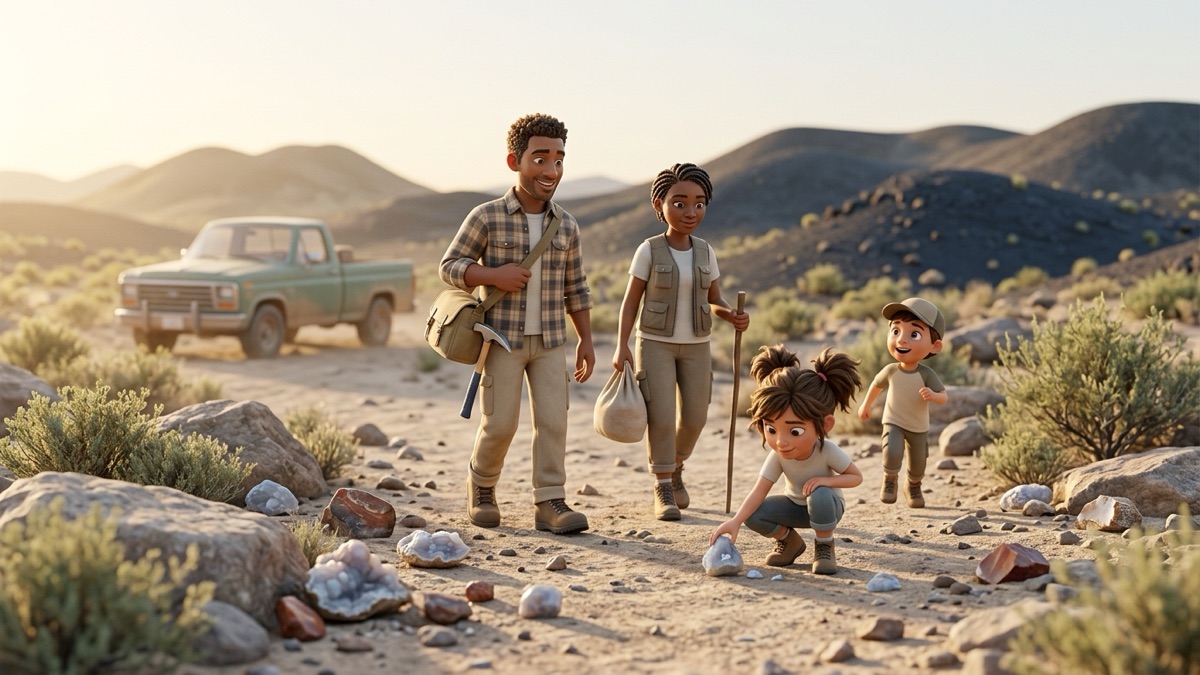
- Follow the water. Hard stones weather out of softer rock and move downhill. BLM's Garnet Hill page explains that garnets there sit in small cavities in volcanic rock but also weather out and wash downhill, so you can search the surface and the drainages. The Minnesota DNR says people look for Lake Superior agates on riverbanks, at river mouths, in gravel pits and anywhere pebbles pile up.
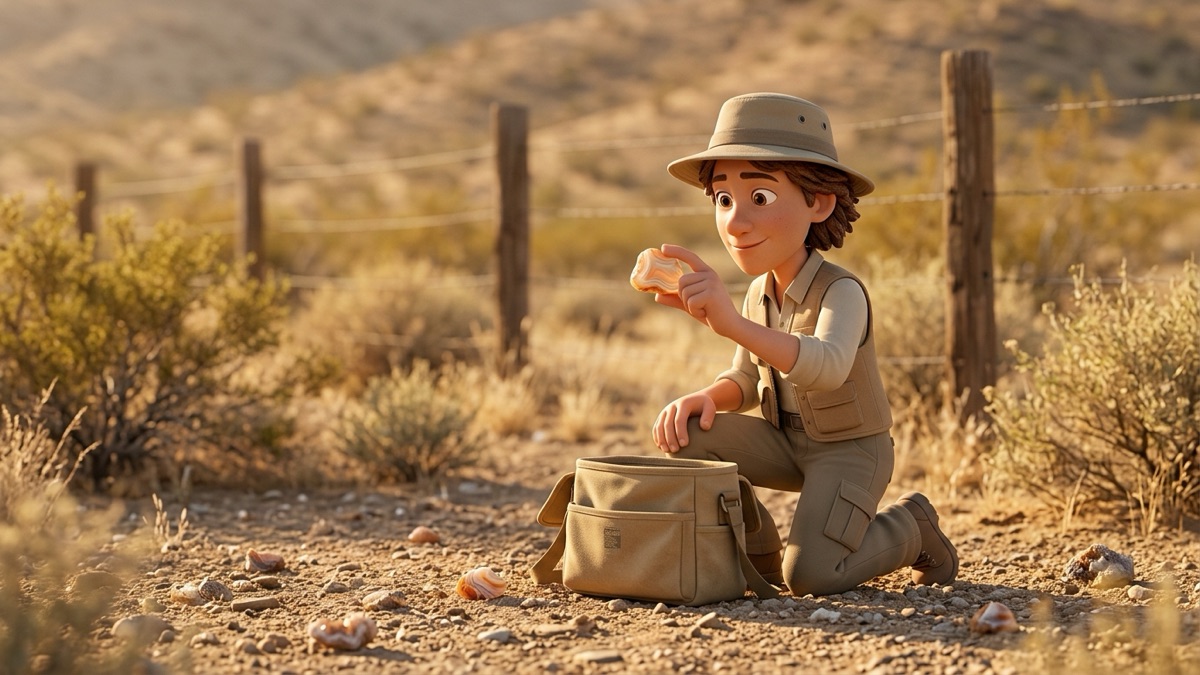
- Look for contrast. At Savahia Peak in California, BLM notes that bright white chalcedony is easy to spot against the darker soil, and suggests walking east through the wash.
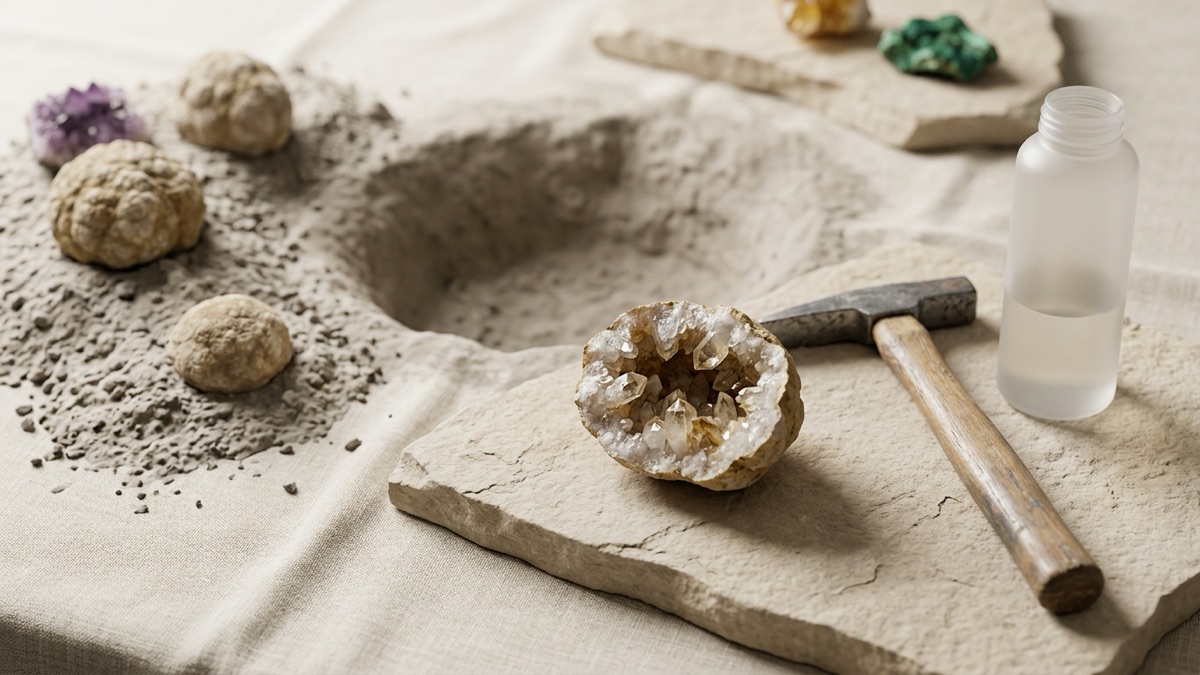
- Look for old diggings. At the Dugway Geode Beds, the Utah Geological Survey suggests starting at past excavations to find the right layer instead of digging blind.
- Slow down. Stop often, and turn over anything that looks different in color, shine or shape.
What should you bring on your first trip?
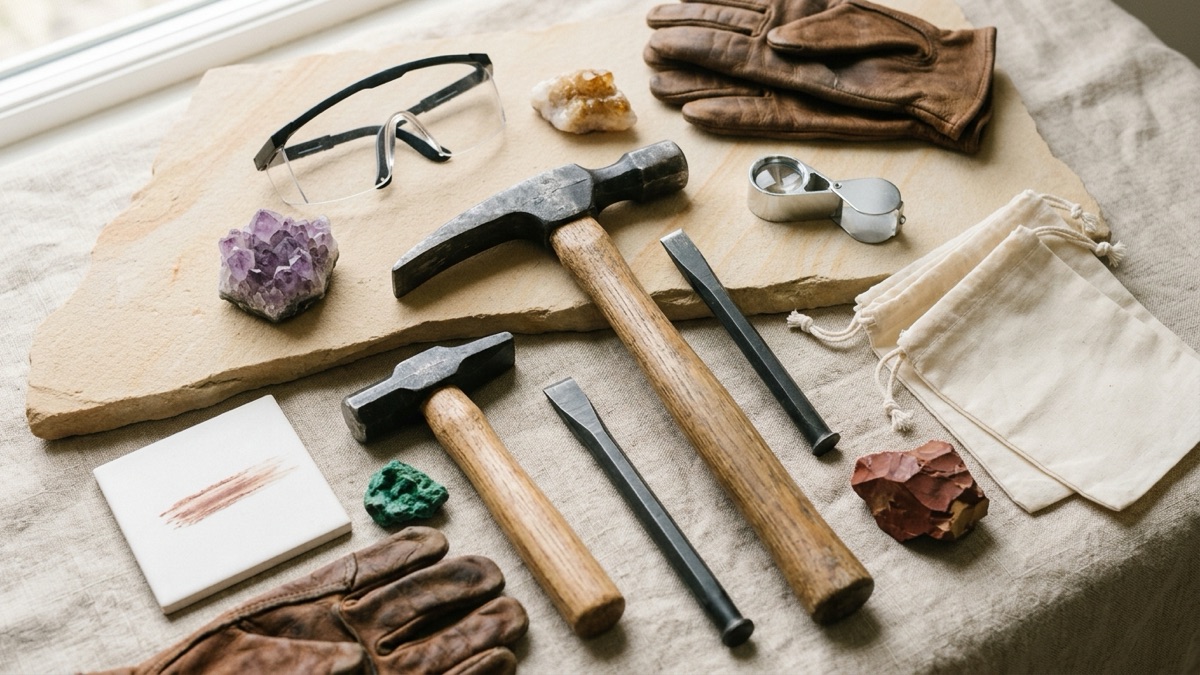
The USGS booklet names only two pieces of specialized gear for a beginner: a geologist's hammer and a hand lens. Everything else is ordinary stuff you probably own.
- A rock hammer, with one flat striking end and a pick or chisel on the other.
- Safety glasses, every time you hammer.
- A 10x hand lens for looking at grains and crystal faces.
- Bags, a marker and a notebook for wrapping and labeling finds.
- Water, sun protection, a first aid kit and a map or GPS, the core of the National Park Service's Ten Essentials list.
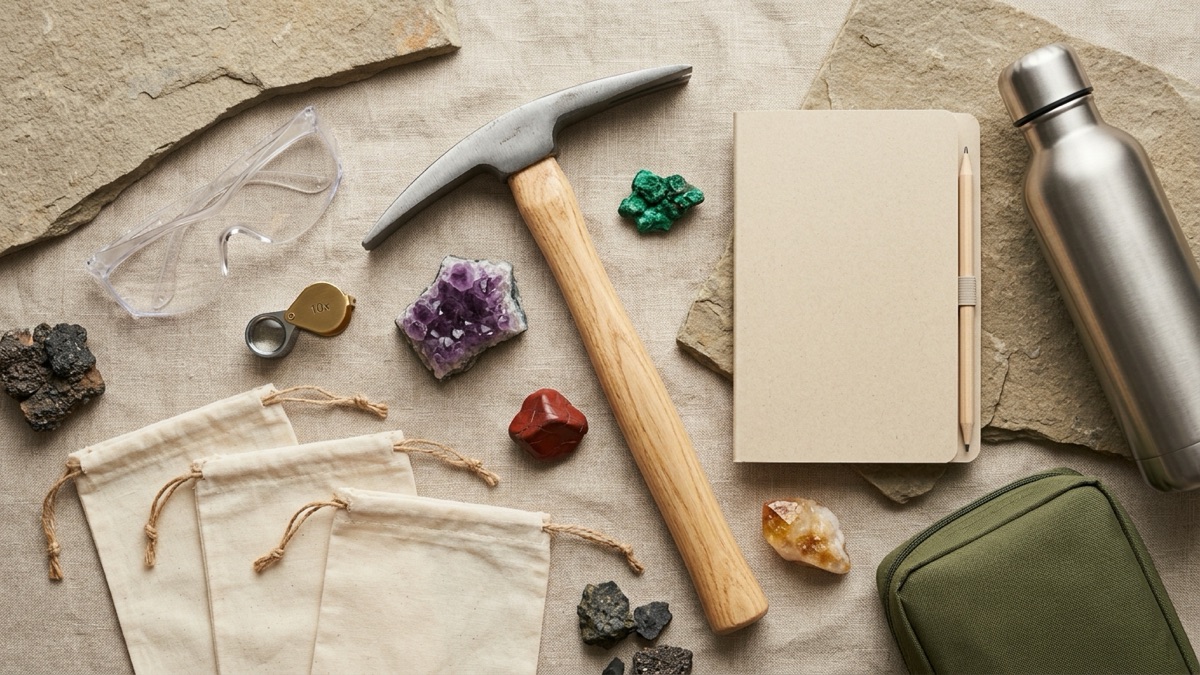
Our rockhounding tools guide covers each item, plus what to skip, in more detail.
How do you stay safe while rockhounding?
The real risks in rockhounding are heat, steep ground, old mines and weather. Each has a simple rule.
Heat and water
Many collecting areas are deserts. At Death Valley, the National Park Service tells visitors to drink at least one gallon of water a day and not to hike at low elevations when it is hot. BLM's Black Hills Rockhound Area page warns that summers there can top 100 degrees Fahrenheit, and its Garnet Hill page says no water is available on site. Go in the cool season, start early and carry extra water.
Know the warning signs. The National Weather Service lists heavy sweating, weakness, cool and clammy skin, dizziness and nausea among the signs of heat exhaustion: get to shade, loosen clothing and sip water. Heat stroke is a medical emergency, so call 911.
Cliffs, slopes and pits
The USGS advises staying away from overhanging rock and from the edges of steep natural or quarried walls. The Utah Geological Survey adds: never work directly above or below someone on a slope, do not work alone, and tell someone your plans. Soft digging sites can collapse too; BLM's Dugway Geode Beds page warns that the material there can cave in at any time.
Old mines
Heads up
Never enter an old mine or climb down a shaft. BLM estimates there may be as many as half a million abandoned mines in the US, and most have no warning sign. Shafts can be hundreds of feet deep and hidden by debris or rotting timbers, and deadly gases can collect even near the entrance, usually with no smell. BLM's message is short: stay out, stay alive.
BLM also notes that drowning in water-filled pits and quarries is the leading cause of death at abandoned mines. Stay on marked trails around old workings, as BLM advises, and keep children and dogs close.
Storms and flash floods
Dry washes are great places to hunt, and dangerous in a storm. The National Weather Service says just 6 inches of fast-moving water can knock over an adult and 12 inches can carry away most cars. For lightning, its advice is to move to shelter when you hear thunder and to get off hills, ridges and peaks right away. A car or a solid, enclosed building is safe; a small shed or a lone tree is not.
Handling what you find
Wear safety glasses whenever you hammer or chip. Never taste or lick an unknown mineral to test it. Wash your hands after handling lead or copper ores such as galena, which is a lead mineral.
How should you label your finds?
Label as you go. The USGS booklet puts it bluntly: identification can wait, but the place where a rock was found should be recorded at once, because many collections got hopelessly mixed up when collectors skipped this step. The Mineralogical Society of America includes blank specimen labels and pens in its basic identification kit for the same reason.
A simple system that works:
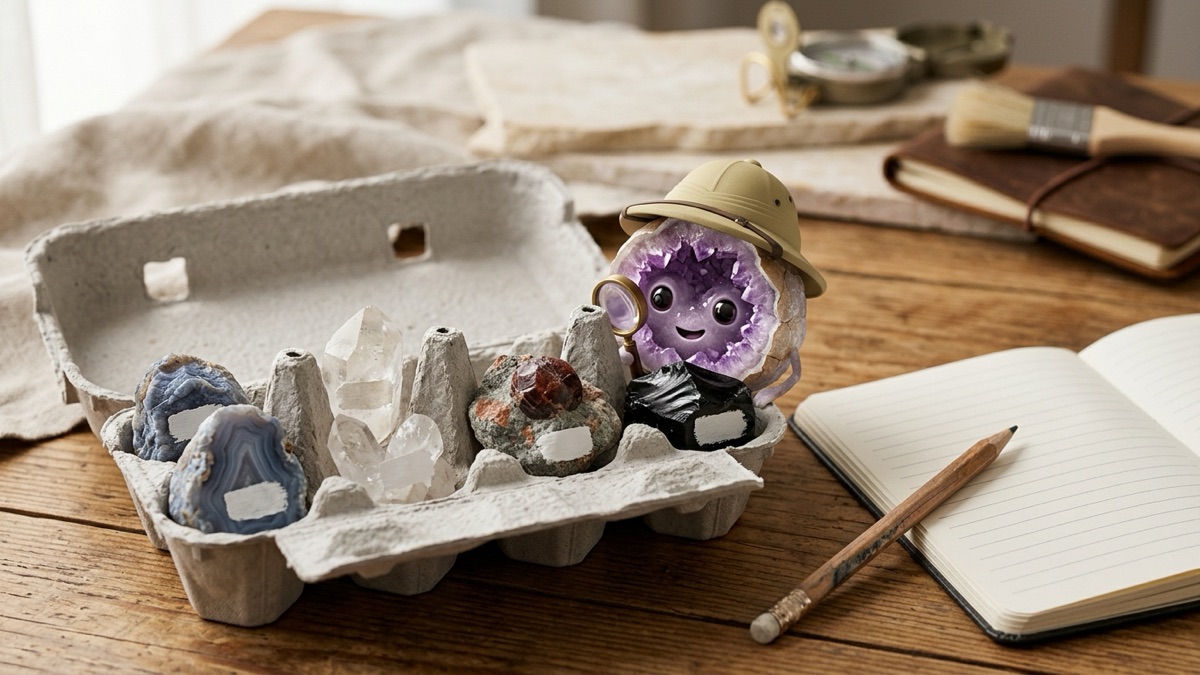
- Write the date, the place (GPS coordinates or a clear description) and the land manager on the bag or on masking tape before the rock goes in.
- At home, give each specimen a number. The USGS describes painting a small white patch on a corner of the rock and writing the number on it.
- Keep a notebook or spreadsheet with the number, the rock's name (or your best guess), the date, the location and any notes.
- Store small finds in egg cartons or shallow boxes, as the USGS suggests, with a label card in each section.
Where do rock clubs and shows fit in?
Clubs are the best shortcut in the hobby. The American Federation of Mineralogical Societies (AFMS) says rock clubs offer field trips, cutting and polishing workshops and activities for kids and adults. Clubs affiliated with the AFMS follow its Code of Ethics and can get liability insurance through their regional federation, which gives members access to field trip sites that would otherwise be closed to them. The AFMS website has a club map organized by regional federation.
Shows are the other half. The Minnesota DNR points to rock and mineral shows as a good place to see many different agates, and comparing your finds with labeled specimens is a quick way to train your eye.
What if you cannot name what you found?
You will be stumped often, and that is part of the fun. Start with the tests that do not need a lab: how hard it is, what color its powder is, how it shines and how heavy it feels. Our guide on how to identify rocks walks through them in order, and single-topic guides such as how to identify petrified wood help with the common finds.
Try it
Answer a few questions about color, hardness and streak in the free rock identifier. It suggests likely candidates and the one test that tells them apart.
The RockhoundID app, coming soon, will suggest likely matches from a photo and tell you which test confirms them.
The takeaway
Rockhounding asks for very little: curiosity, a hammer, a bag and the habit of checking whose land you are on. Start with BLM rockhound areas, a club trip or your state survey's guide. Take only small amounts for yourself, leave fossils with bones and all artifacts in place, stay out of old mines, and write down where every rock came from. Do that, and every trip adds a little more to your collection and your eye.
The pictures in this guide are AI-generated illustrations of what to look for; real specimens vary, so trust the tests over any picture. RockhoundID guides help you narrow down what you found. They suggest likely candidates, not certain identifications or appraisals. For anything valuable, rare or possibly from space, ask a museum, a university geology department or your state geological survey, and check the collecting rules for the land before you take anything home.
Questions rockhounds ask
What is rockhounding?
Rockhounding is the hobby of finding and collecting rocks, minerals, semiprecious gemstones, petrified wood and common invertebrate fossils for your own use. On public land the finds must stay personal: selling or bartering them is not allowed without a permit.
Is rockhounding legal?
Yes, in the right places. On most Bureau of Land Management land you may collect reasonable amounts for personal use, many national forests allow hobby collecting (some with a free permit), private land needs the owner's permission, and national parks do not allow collecting at all.
Can you keep rocks you find in a national park?
No. National Park Service rules prohibit removing rocks, minerals and fossils from parks, and even possessing a metal detector there unless it is broken down and stowed. Similar rocks often turn up on public land outside the park where collecting is allowed.
What do I need to start rockhounding?
A rock hammer, safety glasses, a 10x hand lens, sturdy bags, a marker and a notebook cover the basics. Add water, sun protection, a first aid kit and a map, and check the land rules before you go.
What should I never collect while rockhounding?
Leave vertebrate fossils such as bones and teeth, and all artifacts such as arrowheads, pottery and old bottles, exactly where you find them. On public land they need a research permit or cannot be collected at all.
Where these facts come from
- BLM: Rockhounding on public lands (checked September 30, 2026): www.blm.gov/programs/recreation/rockhounding
- BLM: Public collection of rocks, mineral specimens and semiprecious gemstones FAQ (February 28, 2024): www.blm.gov/sites/default/files/docs/2024-02/BLM-Rock-Collection-FAQs_2-28-24.pd
- BLM Arizona: Rock Hounding in Arizona brochure: www.blm.gov/sites/default/files/documents/files/2014%20Rockhounding_14_web_2018.
- eCFR: 43 CFR 8365.1-5, property and resources (BLM): www.ecfr.gov/current/title-43/subtitle-B/chapter-II/subchapter-H/part-8360/subpa
- eCFR: 36 CFR 2.1, preservation of natural resources (National Park Service): www.ecfr.gov/current/title-36/chapter-I/part-2/section-2.1
- USDA Forest Service: Rockhounding Guide, FS-1091 (June 2017): www.fs.usda.gov/media/229394
- Utah Geological Survey: Rock, mineral and fossil collecting rules: geology.utah.gov/popular/rocks-minerals/collecting-rules/
- USGS: Collecting Rocks (general interest publication): pubs.usgs.gov/gip/collect1/collectgip.html
- BLM: Dangers at Abandoned Mines: www.blm.gov/sites/default/files/uploads/AML_PUB_DangersAtAbandonedMines.pdf
- NPS Death Valley: Safety (updated November 14, 2024): www.nps.gov/deva/planyourvisit/safety.htm
- National Weather Service: Heat illness: www.weather.gov/safety/heat-illness
- NPS: The Ten Essentials (updated May 28, 2026): www.nps.gov/articles/10essentials.htm
- BLM: Black Hills Rockhound Area, Arizona: www.blm.gov/visit/black-hills-rockhound-area
- BLM: Sunstone Collection Area, Oregon: www.blm.gov/visit/sunstone-collection-area
- BLM: Dugway Geode Beds, Utah: www.blm.gov/visit/dugway-geode-beds
- Utah Geological Survey: The Rockhounder, Dugway Geode Beds: geology.utah.gov/popular/rocks-minerals/rock-mineral-collecting-sites/dugway-geo
- National Weather Service: Turn Around Don't Drown: www.weather.gov/safety/flood-turn-around-dont-drown
- National Weather Service Blacksburg: Outdoor activities and lightning safety: www.weather.gov/rnk/outdoorslightning
- BLM: Garnet Hill, Nevada: www.blm.gov/visit/garnet-hill
- BLM: Savahia Peak Rock Collecting Area, California: www.blm.gov/visit/savahia-peak-rock-collecting-area
- Minnesota DNR: Lake Superior agate: www.dnr.state.mn.us/snapshots/rocks_minerals/lakesuperioragate.html
- American Federation of Mineralogical Societies: www.amfed.org/
- Mineralogical Society of America: Mineral Identification Key, identification kit: www.minsocam.org/MSA/collectors_corner/id/mineral_id_keyi2.htm
Read next

rockhounding
Where to Find Geodes: The Best Places in the US