Gold Panning for Beginners: Where You Can Pan Legally
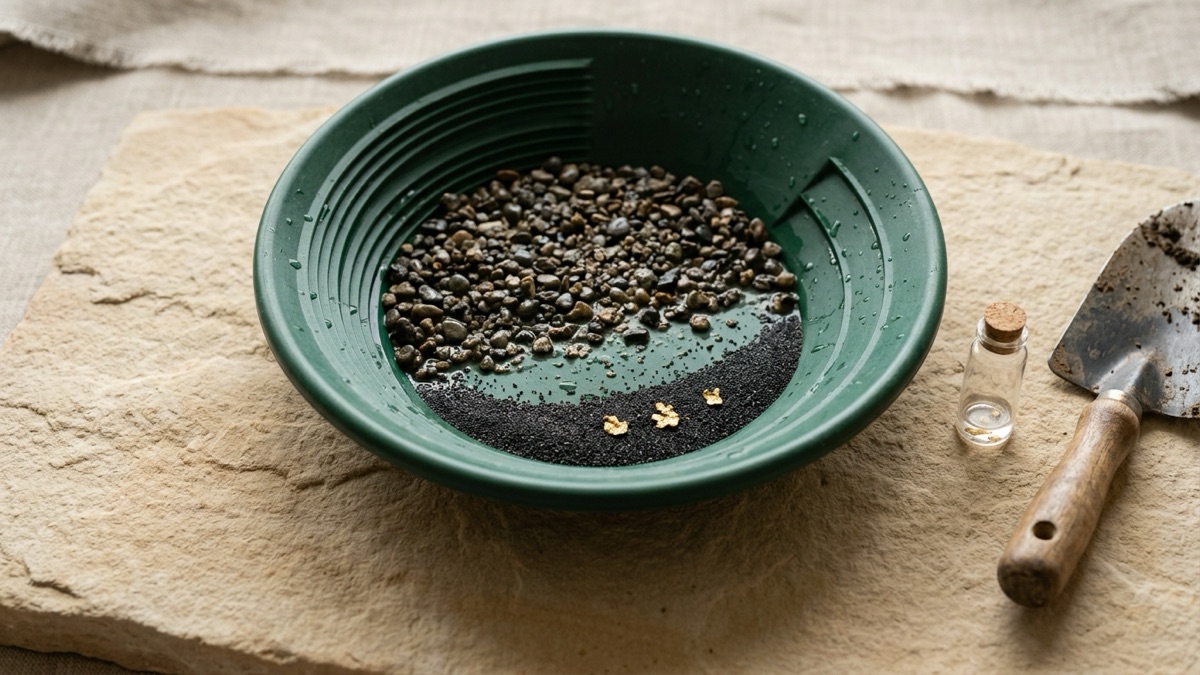
A green plastic pan, a sunny creek and a flash of yellow in the black sand. Gold panning is the one kind of rockhounding where the target is heavy, bright and easy to recognize, which is exactly why it is so much fun for beginners. The tricky part is not the technique. It is knowing where you are allowed to dip your pan.
Quick answer
You can pan for gold with hand tools on most BLM and Forest Service land without a permit, as long as you stay off mining claims and out of wilderness, withdrawn areas and national parks. Verified beginner sites include Auburn State Recreation Area in California, Whiskeytown with a permit, Oregon's Quartzville corridor, Alaska's Nome Creek and Reed Gold Mine in North Carolina.
Key takeaways
- Hand panning counts as "casual use" on BLM land (43 CFR 3809.5) and needs no notice of intent on national forests (36 CFR 228.4). Motors, dredges and chemicals change that.
- Mining claims are the beginner's trap. A claim holder owns the right to the minerals, and panning on one without permission is trespassing. Check the BLM's MLRS records.
- National parks are closed to collecting. Whiskeytown is the one unit with a paid gold panning permit.
- State sites set their own rules: Auburn allows a pan only and 15 pounds a day; Reed Gold Mine charges per pan.
- Gold is heavy (density about 19.3) and settles with black sand near bedrock and on the inside of bends. Expect flakes, not nuggets.
Why does a pan work at all?
Gold is absurdly heavy. The Handbook of Mineralogy gives native gold a density of about 19.3, against roughly 2.65 for quartz and the sand around it. Drop a mix of gravel, sand and gold flakes into moving water and the gold sinks first and stays put. The USGS describes the gold pan, rocker and sluice box as agitating and collecting devices that separate gold from clay, silt, sand and gravel by that difference in density.
The same physics tells you where to look. The USGS says gold in stream deposits is often concentrated on or near bedrock, that fine gold collects in depressions and in pockets in sand and gravel bars where the current slackens, and that prospectors look where coarse gravel has piled up along with the "black sands" that settle with gold. Magnetite is the most common mineral in black sand, so a magnet in your kit helps you read what you have. For the classic shiny impostors, see pyrite vs gold: pyrite is brassy, brittle and hard, gold bends and dents.
What are the rules for gold panning on public land?
The rules change with the land manager, and the first job on any trip is figuring out who that is. Here is the picture as of September 2026.
| Land | Who manages it | Hand panning | What changes the rules |
|---|---|---|---|
| BLM public land | Bureau of Land Management | Allowed as casual use, no permit for pans and hand tools | Mining claims, developed recreation sites, closures, motorized equipment |
| National forests | USDA Forest Service | Allowed, no notice of intent for panning and hand sluicing | Wilderness, withdrawn areas, private inholdings, claims, dredges and motors |
| National parks | National Park Service | Prohibited (36 CFR 2.1) | Whiskeytown NRA allows panning with a paid permit (36 CFR 7.91) |
| State parks and historic sites | State agencies | Varies by site | Each park sets tools, limits and fees |
| Private land and mining claims | Owner or claim holder | Only with permission | Everything |
BLM land: casual use
BLM regulations at 43 CFR 3809.5 define "casual use" as activities that ordinarily result in no or negligible disturbance of the public lands, and the definition specifically includes hand panning, non-motorized sluicing, collecting specimens with hand tools, metal detectors and even small portable suction dredges. It excludes mechanized earth-moving equipment, chemicals, explosives and motorized vehicles in closed areas. Casual use needs no notice or permit, but the BLM's rock collection FAQ adds that collecting is generally not allowed on developed recreation sites, where there are active mining claims, or where the mineral estate is privately owned. Ask the local field office about closures.
National forests: no notice of intent for a pan
Forest Service rules at 36 CFR 228.4 say a notice of intent is not required for prospecting and sampling that will not cause significant surface disturbance, and the examples include gold panning, metal detecting, non-motorized hand sluicing and collecting mineral specimens with hand tools. Individual forests add local detail. The Eldorado National Forest, in the original California gold country, says no permit is required for panning, that the Desolation and Mokelumne wilderness areas are withdrawn from mining, and that it is your responsibility to know whether you are on private land or a mining claim. It also asks that all activity stay within the wetted perimeter of the stream, with no digging into banks or removal of streamside plants.
The Black Hills National Forest's page, updated in June 2026, gives the same picture: hand tools need no authorization, motorized equipment and suction dredges require a notice of intent, and wilderness and mineral withdrawal areas are off limits.
Mining claims: the beginner's trap
The BLM defines a mining claim as a parcel of public land for which the claimant has asserted a right to develop and extract a discovered, valuable mineral deposit. That right covers the gold in the gravel. The claim holder does not get exclusive surface rights, so you can hike or camp across a claim, but the Black Hills National Forest puts the mining side bluntly: entering a claim to prospect without permission is claim jumping, which is trespassing, and most easy-to-find deposits are already claimed. Before you pick a creek, search the BLM's Mineral and Land Records System (MLRS) for active claims and look for claim posts and signs on the ground. Alaska's Petersville fact sheet says the same about state claims: any minerals inside a claim belong to the claim owner.
Heads up
Never pan in a national park unless the park itself has a permit program. Park Service rules (36 CFR 2.1) prohibit possessing or disturbing mineral resources, and metal detectors must be broken down and stowed. Whiskeytown is the exception, and even there the rules are strict.
Where can you pan for gold legally? Verified public sites
Every site here was checked on its managing agency's own page in September 2026. Rules, fees and seasons change, so read the current page before you go.
| Site | Who manages it | The rule (as of September 2026) |
|---|---|---|
| Auburn State Recreation Area, American River, California | California State Parks, with the Bureau of Reclamation | Pan only, no other tools; up to 15 pounds of material a day; only in wave-action zones and flood-washed gravel bars; muddy water must not show more than 20 feet away |
| Marshall Gold Discovery State Historic Park, Coloma, California | California State Parks | Pan in the American River; panning lessons most days; no lessons above 100 degrees |
| Whiskeytown National Recreation Area, California | National Park Service | Permit required for ages 17 and up, $1 for one year, plus an entrance pass; pan and small trowel only; no sluices, suction, mercury or bank digging; a section of Clear Creek is closed |
| Quartzville Back Country Byway, near Sweet Home, Oregon | BLM Northwest Oregon District | Recreational mining allowed along the BLM portion; no day-use fee; designated campsites only |
| Nome Creek, White Mountains National Recreation Area, Alaska | BLM Eastern Interior Field Office | Designated gold-panning area reached from Steese Highway mile 57; campgrounds nearby |
| Petersville Recreational Mining Area, Peters Creek, Alaska | Alaska Department of Natural Resources | Pans, picks and shovels allowed without a permit; no mining claims inside the area; suction dredges need permits and a May 15 to July 15 season; no facilities |
| Reed Gold Mine, near Concord, North Carolina | North Carolina Division of State Historic Sites | $5 per pan plus tax; Tuesday to Saturday; outdoor panning area March to November, troughs December to February; children under 8 help an adult |
A few notes on the standouts. Marshall Gold Discovery park is where James Marshall found gold in the tailrace of Sutter's sawmill in 1848, and Reed Gold Mine is the site of the first documented gold find in the United States. Whiskeytown's regulation (36 CFR 7.91) limits panning to a pan and a digging tool with a blade no larger than 4 by 8 inches. Alaska's legislature set aside the Petersville corridor in 1997 and closed it to new claims; the state fact sheet advises staying on the Peters Creek valley floor, since claims sit on higher ground nearby, and warns that the last stretch of road wants four-wheel drive. Our hub on rockhounding for beginners explains how to read any site's page for these details.
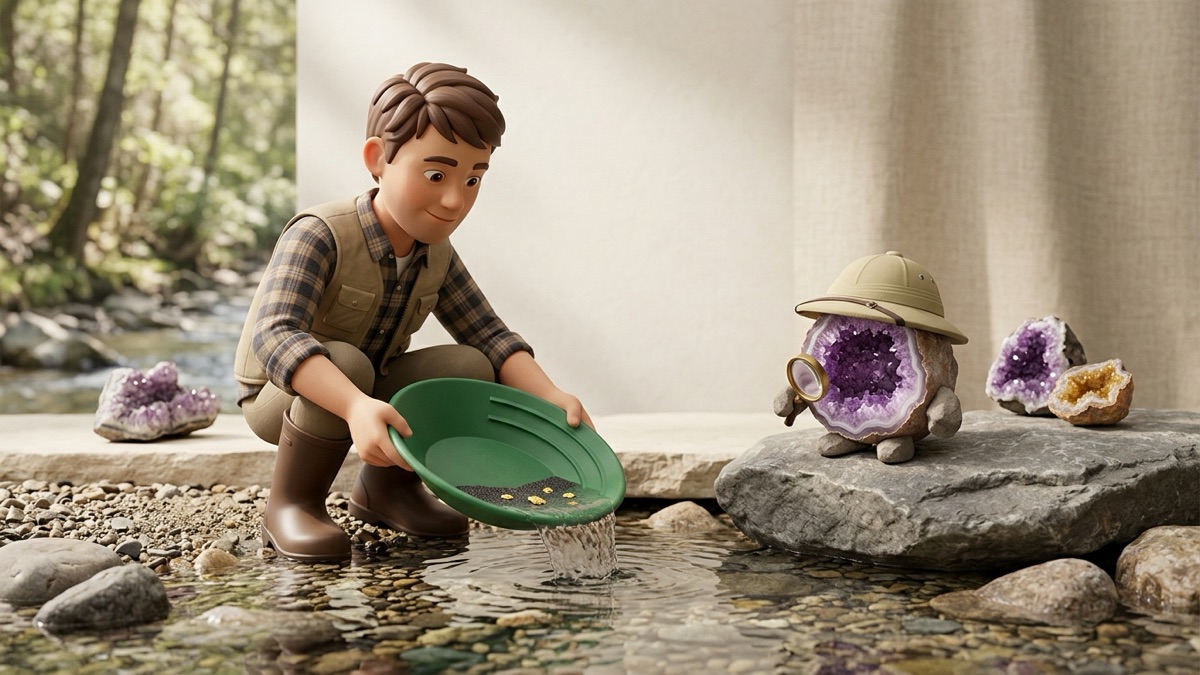
How do you pan for gold?
The pan is a sorting machine. Your job is to keep the heavy stuff in and wash the light stuff out.
- Pick the spot. Following the USGS, dig where gravel and black sand collect: the inside of a bend, behind a boulder, in a bedrock crevice, or the downstream end of a gravel bar. Stay inside the wetted channel and do not dig into the bank.
- Fill the pan about two thirds full of gravel and sand. Pull out the big rocks by hand after rinsing them off in the pan.
- Submerge and shake. With the pan just under the water, shake it side to side and in small circles. This lets the heavy grains sink to the bottom.
- Tilt and wash. Tip the pan away from you so the far lip is just under the surface, and let the water carry the top layer of light sand over the edge. Shake again to resettle, then wash again.
- Repeat until only black sand remains. Magnetite and other heavy minerals collect in a dark crescent along the riffles or the bottom edge.
- Swirl the black sand with a little water. Gold, being far heavier, lags behind as a bright tail. Lift flakes out with a wet fingertip or a snuffer bottle into a vial.
Most beginners lose gold by rushing step four. If sand is jumping out of the pan, slow down. The material you wash away should be fine and light, never the coarse, dark stuff.
Try it
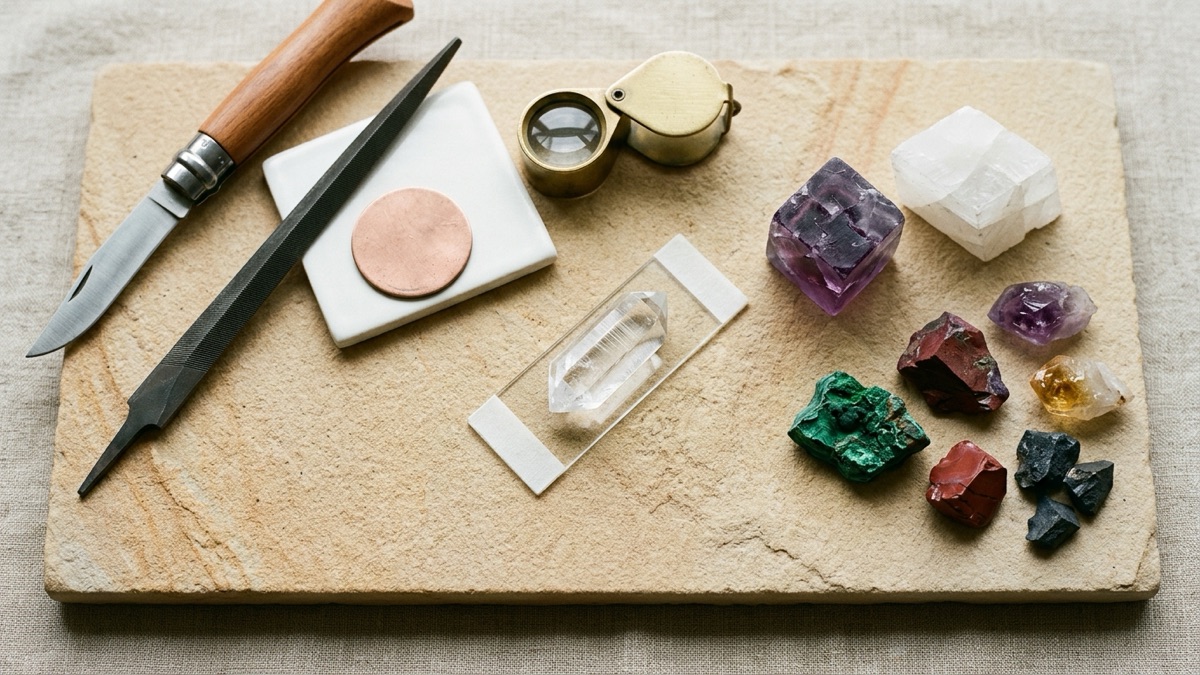
Found a heavy, bright flake and not sure it is gold? Gold is soft enough to dent with a pin, while pyrite crumbles and mica floats off. Check the hardness on the free Mohs hardness scale and run the flake through the rock identifier. Both run in your browser and never upload a photo.
What gear do you need?
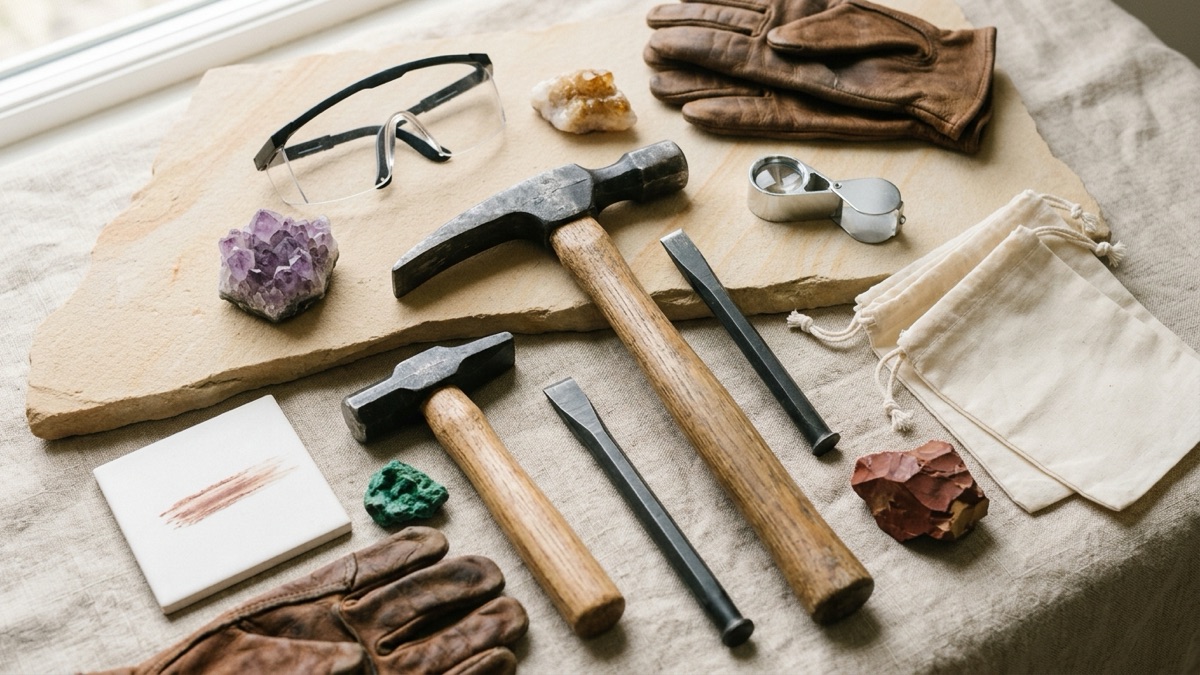
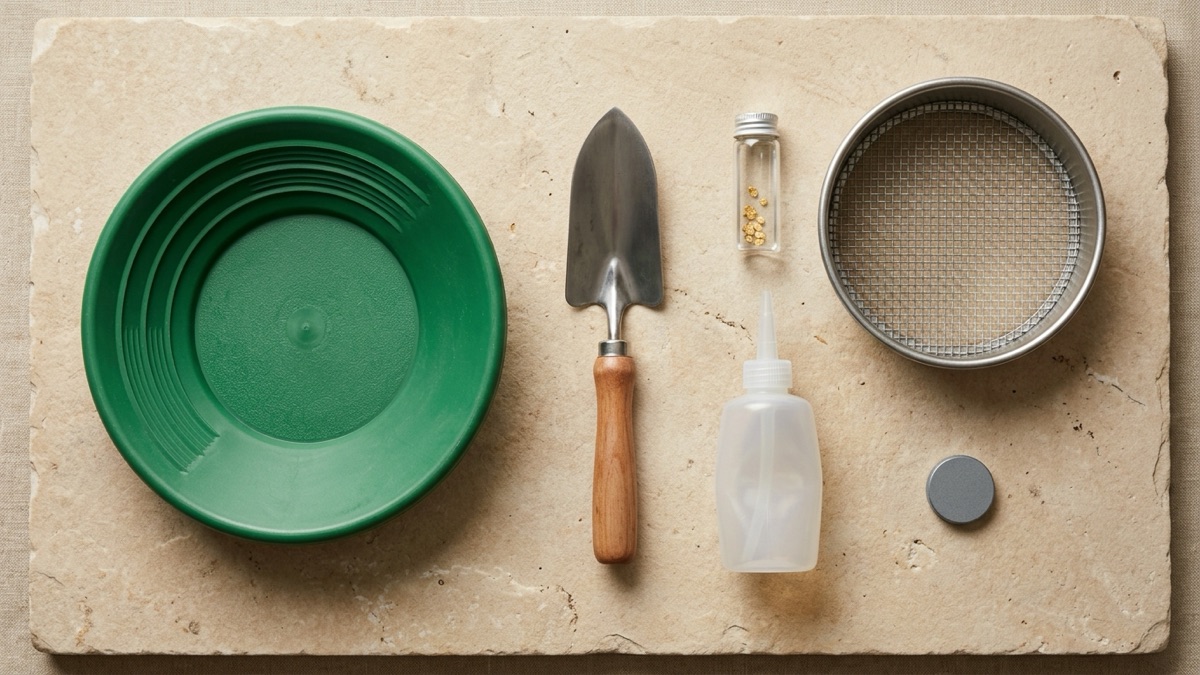
You need less than the catalogs suggest. A plastic pan with riffles, a small trowel, a classifier screen to sift out pebbles, a snuffer bottle and a glass vial cover the panning. Add rubber boots, gloves, a hat, water and a cheap magnet to test black sand. Skip sluices, high-bankers and dredges until you know a site's rules: they need permits in most places and are banned outright at Auburn and Whiskeytown. Our rockhounding tools guide covers the rest of the kit.
What should a beginner expect to find?
Flakes and specks, on a good day. The Black Hills National Forest notes that most easy-to-find deposits are already claimed, and the public panning areas above are open precisely because nobody expects to get rich there. Gold's market price changes daily and a vial of flakes weighs almost nothing, so think of any find as a souvenir. If a spot looks too good to be unclaimed, it probably is claimed, so check MLRS again.
How do you stay safe on the water?
- Watch the current. The National Weather Service says six inches of fast-moving water can knock over an adult. Stay out of fast, deep or rising water, and get out at the first sign of a storm upstream.
- Cold and heat both bite. Mountain creeks are snowmelt, so bring dry clothes. Reed Gold Mine closes panning when the heat index passes 103 degrees, so carry water.
- No mercury, ever. Whiskeytown bans it by regulation, and no beginner needs it.
- Stay out of old mines. Shafts near historic gold districts can collapse or hold bad air.
- Fill your holes and leave the bank alone. Every agency above asks for it, and it keeps sites open.
For rules on the rest of your finds, from geodes to agates, see our guide to rock collecting rules and, for a different kind of treasure hunt, where to find geodes.
The takeaway
Gold panning is legal and free on most BLM and Forest Service land with a pan and hand tools, as long as you stay off mining claims, out of wilderness and withdrawn areas, and out of national parks. The verified sites above are the safe way to start. Dig where black sand collects, wash slowly, and count any flake as a win. The RockhoundID app, coming soon, will suggest likely matches from a photo and tell you which quick test confirms them.
The pictures in this guide are AI-generated illustrations of what to look for; real specimens vary, so trust the tests over any picture. RockhoundID guides help you narrow down what you found. They suggest likely candidates, not certain identifications or appraisals. For anything valuable, rare or possibly from space, ask a museum, a university geology department or your state geological survey, and check the collecting rules for the land before you take anything home.
Questions rockhounds ask
Is gold panning legal on public land?
Usually yes. BLM rules treat hand panning as casual use, and the Forest Service needs no notice of intent for gold panning with hand tools. Wilderness, withdrawn areas, developed sites, national parks and active mining claims are the exceptions, so check the local office first.
Can I pan for gold on someone's mining claim?
Not without the claim holder's permission. A claim gives its holder the right to the minerals, and the BLM's FAQ says collecting is generally not allowed where there are active mining claims. Look up claims in the BLM's MLRS records before you pick a spot.
Where can a beginner pan for gold?
Verified public sites include Auburn State Recreation Area and Marshall Gold Discovery park in California, Whiskeytown National Recreation Area with a permit, the Quartzville corridor in Oregon, Nome Creek and the Petersville area in Alaska, and Reed Gold Mine in North Carolina.
Do I need a permit to pan for gold?
For hand panning on most BLM and Forest Service land, no. Whiskeytown requires a paid permit, state parks and historic sites have their own tickets or rules, and motorized equipment or suction dredges need permits almost everywhere.
How much gold will I find panning?
Expect flakes and specks, or nothing. The Black Hills National Forest notes that most easy-to-find deposits are already claimed. Treat panning as a day outdoors with a possible sparkle at the bottom of the pan, not as income.
Where these facts come from
- USGS: Gold (General Interest Publication; placers, black sands, the gold pan): pubs.usgs.gov/gip/prospect1/goldgip.html
- Handbook of Mineralogy: Gold (hardness, density): www.handbookofmineralogy.org/pdfs/gold.pdf
- 43 CFR 3809.5: Definition of casual use on BLM land: www.law.cornell.edu/cfr/text/43/3809.5
- 36 CFR 228.4: Forest Service operations that need no notice of intent (gold panning, hand sluicing): www.law.cornell.edu/cfr/text/36/228.4
- BLM: Mining claims (what a claim is; MLRS records): www.blm.gov/programs/energy-and-minerals/mining-and-minerals/locatable-minerals/
- BLM: Public collection of rocks, minerals and semiprecious gemstones FAQ (February 28, 2024): www.blm.gov/sites/default/files/docs/2024-02/BLM-Rock-Collection-FAQs_2-28-24.pd
- BLM: Mineral and Land Records System (MLRS): www.blm.gov/services/land-records/mlrs
- Black Hills National Forest: Gold panning, rockhounding and metal detecting (updated June 15, 2026): www.fs.usda.gov/r02/blackhills/recreation/gold-panning-rockhounding-metal-detect
- Eldorado National Forest: Recreational panning and dredging (2024): www.fs.usda.gov/media/122082
- eCFR: 36 CFR 2.1, preservation of natural resources (National Park Service): www.ecfr.gov/current/title-36/chapter-I/part-2/section-2.1
- 36 CFR 7.91: Whiskeytown Unit, gold panning: www.law.cornell.edu/cfr/text/36/7.91
- National Park Service, Whiskeytown: Gold panning (updated November 27, 2024): www.nps.gov/whis/planyourvisit/gold-panning.htm
- California State Parks: Auburn State Recreation Area (gold panning rules): www.parks.ca.gov/?page_id=502
- California State Parks: Marshall Gold Discovery State Historic Park (gold panning): www.parks.ca.gov/?page_id=484
- BLM Oregon: Quartzville Back Country Byway (recreational mining): www.blm.gov/visit/quartzville-back-country-byway
- BLM Alaska: White Mountains National Recreation Area (Nome Creek gold panning area): www.blm.gov/visit/white-mountains
- Alaska DNR: Petersville Recreational Mining Area fact sheet (September 2021): dnr.alaska.gov/mlw/cdn/pdf/factsheets/petersville-recreational-mining-area.pdf
- North Carolina Historic Sites: Reed Gold Mine, plan your visit (panning fees checked September 2026): historicsites.nc.gov/all-sites/reed-gold-mine/plan-your-visit
- National Weather Service: Turn around, don't drown (flood water): www.weather.gov/safety/flood-turn-around-dont-drown
Read next
rockhounding
Where to Find Geodes: The Best Places in the US