
Blog hardness
Mohs Hardness Test: How to Scratch Test Any Rock
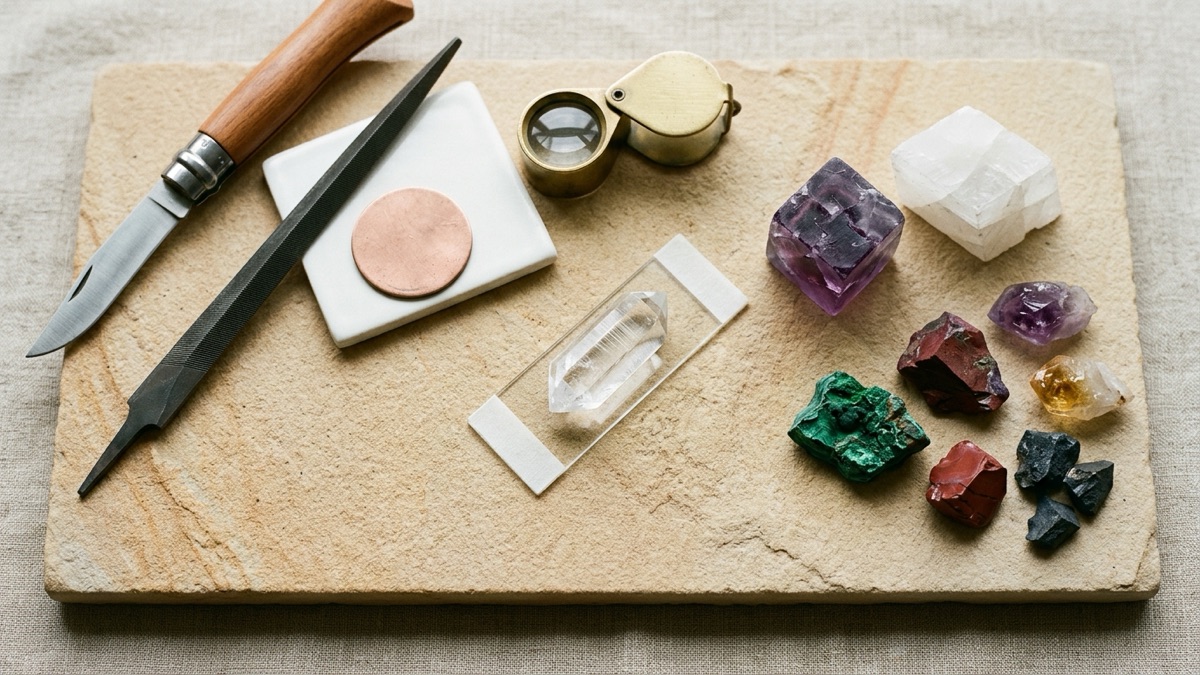
You picked up a glassy white stone, a purple crystal or a brassy little cube, and now you want to know what it is. One of the best clues costs nothing and takes a minute: try to scratch it. The Mohs hardness test is a scratch contest, and the winner tells you more than the color ever will.
Quick answer
The Mohs hardness test ranks minerals by what scratches what. Drag a sharp tester across a clean, smooth face, rub the line, and look with a lens. A groove that stays means the tester is harder. A fingernail is about 2.5, a copper coin about 3, a steel knife and window glass about 5.5, and quartz 7.
Key takeaways
- The Mohs scale ranks 10 reference minerals, from talc at 1 to diamond at 10. Each one scratches the minerals below it and cannot scratch the ones above it.
- You can start without a kit: a fingernail (about 2 to 2.5), copper (about 3), a steel knife (about 5 to 5.5), window glass (about 5.5) and a steel file (about 6.5) cover most finds.
- Always test both ways, then rub the mark. Powder wipes off; a scratch stays.
- The numbers are ranks, not measurements. Diamond is about four times harder than corundum, even though they sit one step apart.
- Hardness narrows the list of suspects. It rarely names a rock on its own, so pair it with streak, luster and weight.
What is the Mohs hardness scale?
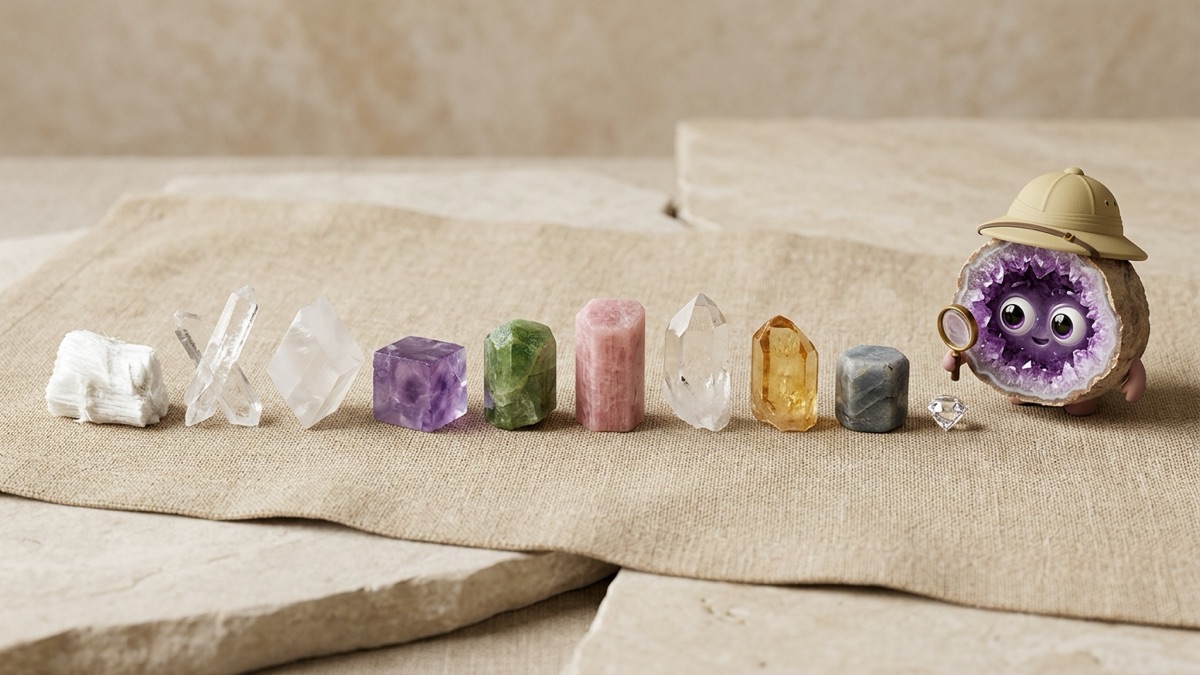
Hardness is how well a mineral resists being scratched. In 1822 the Austrian mineralogist Friedrich Mohs lined up ten familiar minerals from softest to hardest and numbered them 1 to 10. His rule was simple: each mineral scratches the ones below it on the list and cannot scratch the ones above it.
It is still the handiest hardness check there is, because it needs no lab: you compare your rock with things of known hardness and see which one gives way.
| Mohs | Reference mineral | Everyday match | What you notice |
|---|---|---|---|
| 1 | Talc | A fingernail scratches it easily | Soapy, greasy feel |
| 2 | Gypsum | A fingernail scratches it | Clear blades or white chalky masses |
| 3 | Calcite | A copper coin scratches it | Fizzes in dilute acid, breaks into slanted boxes |
| 4 | Fluorite | A knife scratches it, copper does not | Glassy cubes, often purple or green |
| 5 | Apatite | A knife just scratches it | Cannot scratch glass |
| 6 | Orthoclase feldspar | Just scratches glass | Flat, shiny cleavage faces |
| 7 | Quartz | Scratches glass and steel | Curved, shell-like breaks |
| 8 | Topaz | Scratches quartz | Rare in a backyard |
| 9 | Corundum | Scratches topaz | Ruby and sapphire are corundum |
| 10 | Diamond | Scratches everything else | The hardest known mineral |
Fun fact
The USGS version of the scale writes "feldspar" at 6 and "sapphire" at 9. It is the same scale: orthoclase is a feldspar, and sapphire is a gem variety of corundum.
What everyday things can you use as testers?
You probably own a decent hardness kit already. These are the classic field testers, with values from the Mineralogical Society of America's Mineral Identification Key and the University of Auckland. Where the two sources differ a little, the range covers both.
| Tester | Mohs, about | Good to know |
|---|---|---|
| Fingernail | 2 to 2.5 | Scratches talc and gypsum, not calcite |
| Copper coin or wire | 3 (some charts say 3.5) | Use a US cent from before 1983; newer cents are mostly zinc |
| Steel knife or nail | 5 to 5.5 | Blades vary, and hard tool steel can reach about 6.5 |
| Window glass | 5.5 | Anything that leaves a groove in it is harder than about 5.5 |
| Steel file | 6.5 | Covers the gap between glass and quartz |
| Unglazed porcelain (streak plate) | 6.5 to 7 | Quartz and harder minerals scratch it instead of streaking |
Knives deserve a warning of their own. The MSA key points out that the steel in a Swiss Army knife is harder than most cheap pocket knives, which can throw a test off. Before you trust any blade, try it on something you know: it should scratch calcite and fail on quartz. Our guide to glass and steel on the Mohs scale covers both testers in detail, and the Mohs hardness test kit guide shows how to build a full set from household items.
How do you do a Mohs scratch test?
The University of Auckland's method fits in one line: with moderate pressure, drag a sharp edge over a smooth surface, and if the surface is scratched, it is softer than the thing that scratched it. Here is that idea as a routine you can repeat.
1. Find a fresh, smooth surface
Weathered skins, rust stains and dirt give false results. The MSA key recommends testing a fresh, unweathered surface, and choosing an out-of-the-way spot instead of breaking a good crystal.
2. Scratch with firm, moderate pressure
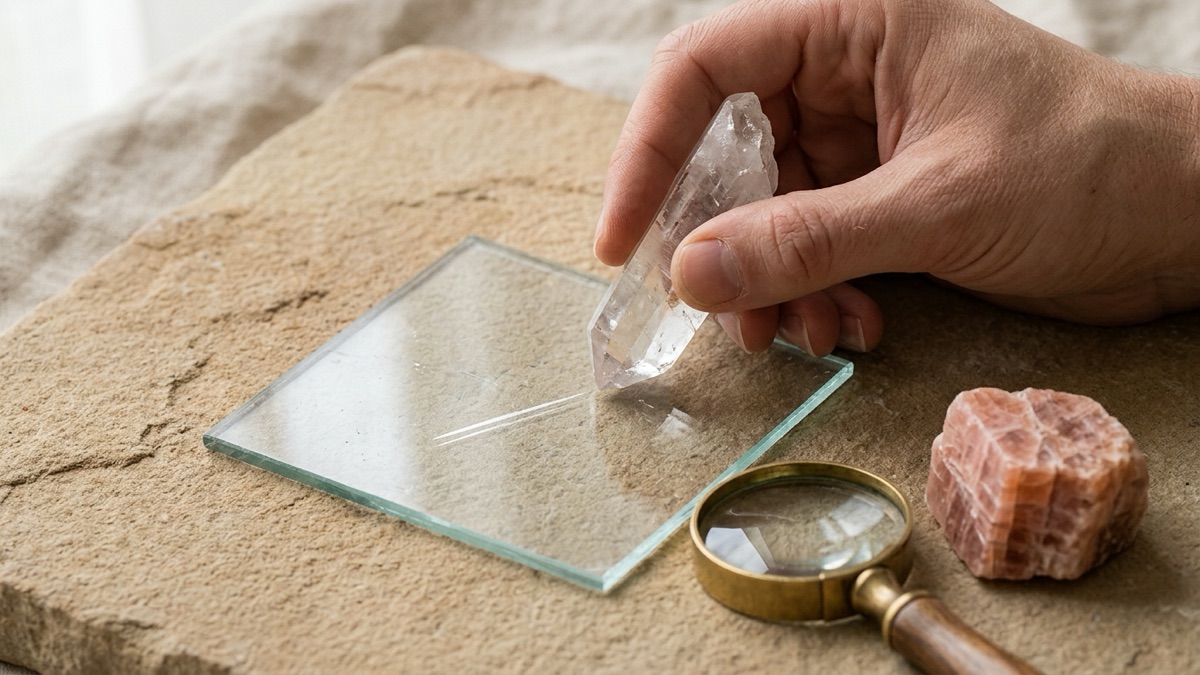
Rest the rock on a table instead of holding it in your palm. Press a sharp point or edge of the tester into the surface and drag a short line, about as long as a fingernail is wide.
3. Swap roles and scratch the other way
Now try to scratch the tester with a sharp edge or point of your rock. The MSA key says to test both ways whenever you can: scratch the crystal with the knife point, then try to scratch the knife blade with the crystal.
4. Rub the line and look closely
Wipe the mark with a wet finger, then look at it with a 10x hand lens. A real scratch is a groove. A line that wipes away was only powder.
5. Bracket the hardness
Work up and down your testers until you find the pair that sandwiches your rock. If a knife cannot scratch it but quartz can, Auckland's rule puts it between 5 and 7. Half steps work the same way: a mineral rated 6.5 scratches orthoclase but not quartz.
6. Repeat it
One try can mislead you. The MSA key notes that some samples take several attempts before you can safely call the hardness, so do it twice on different spots.
Is it a real scratch or just a mark that rubs off?
This is where most first tests go wrong. When a softer material rubs across a harder one, it leaves a line of its own powder that looks a lot like a scratch. The MSA key's advice is to rub the "scratch" with a finger: if powder comes off, the thing that made it is probably the softer of the two.
| What you see | What it means | What to do next |
|---|---|---|
| A line that wipes away | Powder from the softer tester | The tester is softer than your rock |
| A groove that stays after rubbing | A true scratch | The tester is harder than your rock |
| A gray metal smear on the rock | Metal worn off a coin or knife | Your rock is harder than that metal |
| Faint marks both ways | Nearly equal hardness | Call them about the same |
| Loose grains and crumbs | Grains pulled out, not scratched | Test one solid grain instead |
Tip
A gray line from a knife on a hard stone is the classic false alarm. The steel is the thing wearing away. Rub it off, look again with a lens, and then try scratching the blade with the stone.
What does your result tell you?
Once you know roughly where your rock sits, the list of suspects shrinks fast. These values come from our Mohs tool's sourced list.
| Your result | Mohs, about | Common suspects |
|---|---|---|
| A fingernail scratches it | 2.5 or less | Talc, gypsum, graphite, mica sheets, halite |
| Copper scratches it, a fingernail does not | 2.5 to 3 | Calcite, biotite, galena, native gold |
| A knife scratches it, copper does not | 3.5 to 5 | Fluorite, dolomite, malachite, chalcopyrite, apatite |
| Knife and glass are a close contest | 5 to 6 | Hematite, magnetite, opal, hornblende |
| It scratches glass | 6 to 7 | Feldspar, pyrite, quartz, agate, garnet |
| It scratches quartz | 7.5 and up | Beryl, topaz, corundum |
Rocks are trickier than minerals, because a rock is a mix of mineral grains. Granite is mostly quartz (7) and feldspar (6 to 6.5), so different grains give different answers. Marble is mostly calcite, which is why a steel blade scratches marble but not quartzite, its hard look-alike. Our guide to granite and marble hardness walks through the countertop version of this question.
Hardness is one of the seven checks in our guide to how to identify rocks, and usually the most useful one to do first.
Try it
Open the free Mohs hardness scale tool and use the scratch simulator: pick what you scratch with and what you scratch, and it tells you which one wins. The searchable list covers more than 90 minerals, gems, metals and rocks.
Why is the Mohs scale not linear?
The Mohs numbers are ranks, like finishing places in a race. They tell you who beat whom, not by how much. The University of Auckland calls the scale arbitrary and non-linear: the steps between the numbers are not equal.
The biggest gap is at the top. The Open University notes that on an absolute hardness scale, diamond is about four times harder than corundum, even though they are only one number apart. GIA makes the same point for gem buyers. Lower down, the steps are much smaller, which is why two minerals half a step apart can give you a faint, unclear result.
Hardness can even change with direction inside one crystal. The Handbook of Mineralogy gives kyanite about 5.5 along the length of its blades and 7 across them, so a knife scratches it one way and not the other. Muscovite mica does something similar: about 2 to 2.5 on its flat sheets and, according to the Handbook, about 4 across them.
Is a hard mineral also a tough one?
No. Hardness is resistance to scratching. Toughness is resistance to breaking. The MSA key points out that diamond is the hardest known mineral but has a perfect cleavage and breaks easily along it, and the Open University adds that diamond can shatter if dropped onto a hard surface.
So a high Mohs number does not make a stone knock-proof. That matters most for jewelry, where our gemstone hardness chart compares 40 gems and explains which ones chip.
What are the most common Mohs test mistakes?
- Testing a weathered crust. Scratch a fresh surface, not a rusty or chalky skin.
- Calling powder a scratch. Rub every mark and check it with a lens before you decide.
- Using a new penny. US cents from 1983 on are mostly zinc under a thin copper coat, so use an older cent or copper wire.
- Trusting a fancy knife. Hard steel can scratch minerals that a cheap blade cannot. Check your knife on calcite and quartz first.
- Testing a rock instead of a mineral. Pick a single grain or crystal. A crumbly rock can shed grains that feel like a soft result.
- Scratch testing jewelry. A scratch test leaves a mark by design. Never use it on a cut gem or a ring you care about.
Heads up
Wear safety glasses when you scratch or chip rocks. Lay glass flat on a table with its edges taped and scratch away from your hands. Wash your hands after handling lead ores such as galena, and never taste or lick an unknown mineral. Test only rocks you are allowed to have: national parks prohibit removing or disturbing minerals, BLM public land allows reasonable amounts for personal, noncommercial use outside closed areas, and private land needs the owner's permission.
How does hardness fit with the other tests?
Hardness is fast, but it shines brightest in combination. Brassy pyrite (6 to 6.5) scratches glass and most knife blades leave it unmarked, while real gold (2.5 to 3) is soft and bends. A white glassy chunk that scratches glass points to quartz; one that a coin scratches and that fizzes in acid points to calcite. Add a streak test, a look at luster and a heft in the hand, and a long list often shrinks to one or two candidates.
The RockhoundID app, coming soon, will suggest likely matches from a photo and tell you which test, often a quick scratch, would confirm them.
The takeaway
A Mohs hardness test is just a careful scratch contest. Use a fresh surface and a sharp point, test both ways, and rub every mark before you believe it. Bracket your rock between two testers, read the result as a range, and let it narrow the list of suspects. With a fingernail, an old penny, a knife and a piece of glass, you can place most rocks on the scale in a few minutes.
RockhoundID guides help you narrow down what you found. They suggest likely candidates, not certain identifications or appraisals. For anything valuable, rare or possibly from space, ask a museum, a university geology department or your state geological survey, and check the collecting rules for the land before you take anything home.
Questions rockhounds ask
What is the Mohs hardness test?
It is a scratch test that ranks minerals from 1 (talc) to 10 (diamond) by what scratches what. You scratch your rock with testers of known hardness, and scratch the testers with your rock, to find where it sits on the scale.
What household items can I use to test Mohs hardness?
A fingernail (about 2 to 2.5), a pre-1983 US cent or copper wire (about 3), a steel knife or nail (about 5 to 5.5), a piece of window glass (about 5.5), a steel file (about 6.5) and an unglazed porcelain tile (about 6.5 to 7).
What hardness is glass on the Mohs scale?
Ordinary window glass is about 5.5. A mineral that leaves a real groove in glass is harder than about 5.5, which rules out calcite, fluorite and many soft look-alikes.
Why is the Mohs scale not linear?
The numbers are a ranking, not a measurement. The steps are not equal: on an absolute hardness scale, diamond at 10 is about four times harder than corundum at 9.
Can a hardness test identify my rock?
Not on its own. Hardness narrows the list of candidates, and streak, luster, weight, cleavage and a magnet or acid test narrow it further. Some finds still need an expert to confirm.
Where these facts come from
- USGS: Gemstones, mineral gemstones and the Mohs scale: pubs.usgs.gov/gip/gemstones/mineral.html
- University of Auckland: hardness: rocksminerals.flexiblelearning.auckland.ac.nz/minerals/hardness.html
- Mineralogical Society of America, Mineral Identification Key: hardness: www.minsocam.org/MSA/collectors_corner/id/mineral_id_keyi4.htm
- Mineralogical Society of America, Mineral Identification Key: introduction: www.minsocam.org/MSA/collectors_corner/id/mineral_id_keyi1.htm
- Mineralogical Society of America, Mineral Identification Key: identification kit: www.minsocam.org/MSA/collectors_corner/id/mineral_id_keyi2.htm
- Mineralogical Society of America, Mineral Identification Key: streak: www.minsocam.org/MSA/collectors_corner/id/mineral_id_keyi5.htm
- The Open University, OpenLearn: Minerals and the crystalline state, 3.6 Hardness: www.open.edu/openlearn/science-maths-technology/minerals-and-the-crystalline-sta
- GIA: amethyst care and cleaning (Mohs steps are not evenly spaced): www.gia.edu/UK-EN/amethyst-care-cleaning
- Handbook of Mineralogy: kyanite: www.handbookofmineralogy.org/pdfs/kyanite.pdf
- Handbook of Mineralogy: muscovite: www.handbookofmineralogy.org/pdfs/muscovite.pdf
- University of Minnesota, Common Minerals: pyrite: commonminerals.esci.umn.edu/minerals-o-s/pyrite
- eCFR: 36 CFR 2.1, preservation of natural resources in national parks: www.ecfr.gov/current/title-36/chapter-I/part-2/section-2.1
- eCFR: 43 CFR 8365.1-5, rockhounding on BLM public lands: www.ecfr.gov/current/title-43/subtitle-B/chapter-II/subchapter-H/part-8360/subpa