How to Identify Petrified Wood: 6 Clues in the Stone
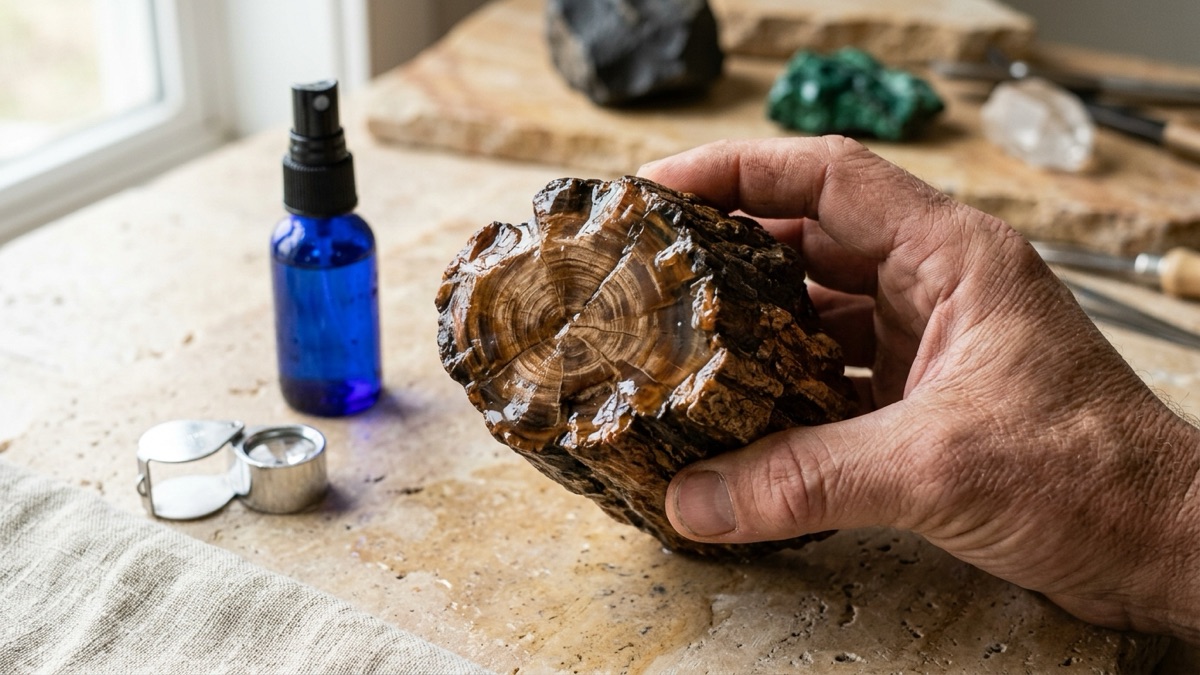
You found a stone that looks exactly like a chunk of old log. It has stripes, a rough rind and maybe a knot. It could be petrified wood, or it could be a very convincing piece of jasper. Six clues, a piece of glass and a bit of patience will usually tell you which.
Quick answer
To identify petrified wood, look for the tree: growth rings on the end, bark texture on the outside, straight wood grain along the sides, and knots. Then test the stone. Most petrified wood is quartz, so it scratches glass (Mohs 7) and feels as heavy as any rock. Jasper and banded agate lack real rings and grain together.
Key takeaways
- Petrified wood is fossil wood turned to mineral, usually quartz, so it keeps the tree's structure but gains the hardness of stone.
- The four "tree" clues are growth rings, bark, side grain and knots. Two or more together make a strong case.
- The two "stone" clues are hardness (most petrified wood scratches glass) and weight (it is far heavier than wood).
- Jasper, agate, chert and striped sandstone copy the colors or stripes, but not rings and grain together.
- On most BLM land you may keep 25 pounds plus one piece a day. In national parks, you may keep nothing.
What is petrified wood, in one minute?
Petrified wood is a tree that was buried quickly, then soaked in mineral-rich groundwater until minerals filled and replaced its tissue. The National Park Service says the wood at Petrified Forest National Park is almost solid quartz, colored by impurities such as iron, carbon and manganese.
The North Dakota Geological Survey puts the payoff nicely: sometimes the cell structure is lost and only a cast of the log remains, but other times growth rings, bark, knots and even cellular structure are preserved with remarkable fidelity. That is what you are looking for. For how it forms and how old it gets, see our petrified wood guide.
What are the 6 clues that a rock is petrified wood?
Work through them in order. Wet the stone first: water darkens the surface and makes rings and grain much easier to see.
1. Growth rings on the end
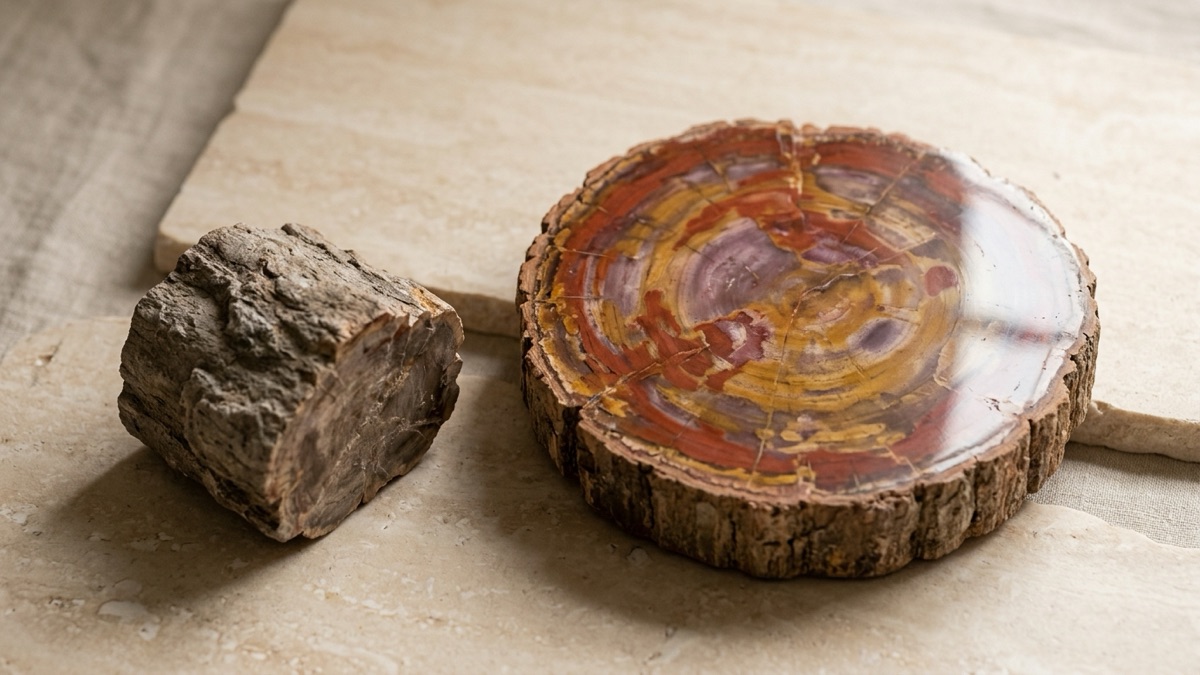
Look at any broken or cut end. Concentric rings, like a tree stump in miniature, are the single best clue. They may be faint, off-center or squashed into ovals: the North Dakota survey notes that logs were often compressed by overlying sediment, so many are oval in cross section.
2. Bark texture
The outside of a log piece often has a rougher, darker rind with the furrowed or scaly pattern of bark. Not every piece keeps its bark. Many chunks come from inside the trunk, so no bark is not a strike against you.
3. Wood grain on the sides
Turn the stone and look along its length. Petrified wood shows long, straight, fibrous lines running parallel, just like a plank. It also tends to break along that grain, leaving splintery-looking faces that feel smooth and hard to the touch.
4. Knots, branch scars and borings
Oval knots where branches grew out, with the grain bending around them, are a strong clue. So are tunnels. North Dakota's state fossil is Teredo-bored petrified wood: driftwood that small clams called teredos drilled full of holes before it petrified, according to the State Historical Society of North Dakota.
5. Hardness: it should scratch glass
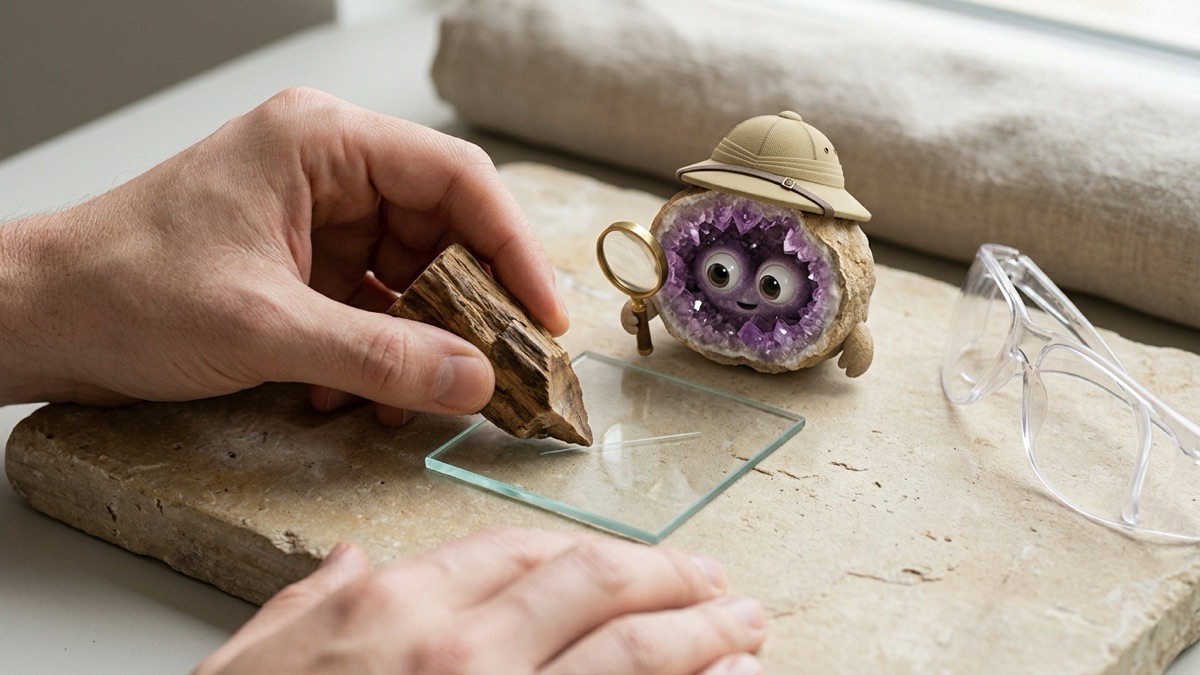
Most petrified wood is quartz, and quartz is 7 on the Mohs scale, harder than window glass (about 5.5) and a steel knife (about 5 to 5.5). Press a sharp edge firmly across a piece of glass and rub the mark with your finger. A groove that stays is a real scratch; powder that wipes away was the stone wearing down. The Mineralogical Society of America suggests testing both ways: try the knife on the stone too. Our Mohs hardness test guide shows the technique.
A few real petrified woods fail this test. A USGS mineral-site record describes opalized logs at Washington's Ginkgo Petrified Forest, and opal is only 5.5 to 6.5, so opalized wood may barely mark glass. George Mustoe of Western Washington University also describes fossil wood mineralized with calcium carbonate, which a knife scratches easily and which fizzes in acid. If the wood structure is perfect but the stone is soft, it can still be fossil wood.
6. Weight in the hand
Petrified wood weighs like a rock of its size, because it is one. Its density is about 2.6 times that of water, the same as agate and other quartz stones, while dry wood usually floats. If a "stone log" feels suspiciously light, it may be weathered wood, or coalified wood that turned to lignite instead of stone. The North Dakota survey notes that some pieces there grade from well silicified into coal within a single stump.
Tip
A 10x hand lens helps on a fresh, wet break. On well-preserved pieces you may see the grain as fine, parallel lines of tiny cells. Stripes that look sandy or grainy under the lens point to sandstone instead.
What looks like petrified wood but is not?
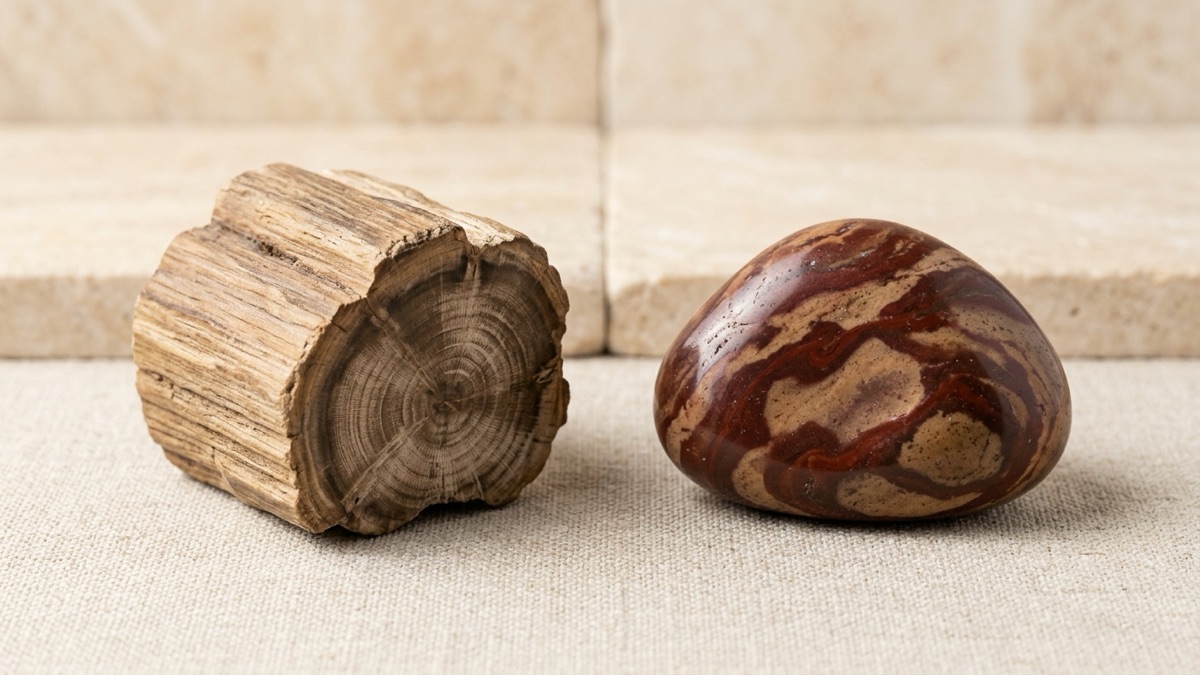
Plenty of rocks borrow one or two of petrified wood's looks. The trick is to demand rings and grain together, then check hardness and weight.
| Look-alike | How it fools you | How to tell |
|---|---|---|
| Wood-colored jasper | Same browns, reds and yellows; same hardness | Bands wander or swirl; no rings on the end and no straight grain on the side |
| Banded agate or chert | Stripes, waxy shine, hard | Agate bands curve around the stone's shape; thin edges often glow in a flashlight |
| Striped sandstone or siltstone | Layers that look like grain | Gritty surface under a lens; grains may rub off; layers are flat, not ringed |
| Weathered driftwood or bog wood | Real wood, gray and stony looking | Light in the hand; a knife dents it; it will not scratch glass |
| Coalified wood (lignite) | Real wood structure | Black, light, soft and crumbly; will not scratch glass |
Jasper is the most common impostor, because petrified wood is itself a kind of quartz with jasper-like colors. Our agate vs jasper guide explains the flashlight test that separates translucent agate from opaque jasper, and the agate stone hub covers the whole family.
What is the quickest test sequence?
Here is a two-minute routine you can do at a trailhead or kitchen table.
- Wet it with water or a spray bottle.
- Check the end for rings, and the sides for straight grain and knots.
- Look with a lens at a fresh break for fine parallel lines.
- Scratch glass with a sharp edge. Wear safety glasses, press firmly, and rub the mark to check it is a real groove.
- Heft it against a similar-sized ordinary rock. It should feel about the same, never light.
- If it fails the glass test but looks perfect, try a drop of vinegar. Fizzing means calcite, which can still be real fossil wood.
If you get two or more tree clues plus a pass on hardness and weight, petrified wood is the likely answer. If you only have color and stripes, keep an open mind.
Try it
Answer a few questions about texture, luster, hardness and banding in the free rock identifier. It suggests likely matches, from petrified wood to jasper and chert, and tells you the one test that separates them.
Can you keep petrified wood you find?
That depends entirely on who manages the land, and the rules for petrified wood are unusually specific. As of September 2026, when we checked:
| Where | Who manages it | Rule |
|---|---|---|
| Most BLM public land | Bureau of Land Management | Up to 25 pounds plus one piece per person per day, no more than 250 pounds a year, for personal use |
| Petrified Forest and other national parks | National Park Service | No collecting at all |
| State parks | State park agencies | Set park by park; Washington's Ginkgo Petrified Forest, for one, prohibits removal |
| Private land | The owner | Only with permission |
The BLM limits come from federal regulation 43 CFR 3622.4. You may not pool your allowance with friends to take bigger pieces, you may not use explosives or power equipment, and the wood may not be sold or bartered to commercial dealers. Some BLM areas are closed or posted, so check with the local field office before you go.
Heads up
Petrified Forest National Park is strictly hands-off. Federal rule 36 CFR 2.1 bans removing fossils and minerals from national parks, and the park's FAQ answers "What can I take from the park?" with "Pictures and memories!" The petrified wood sold in its gift shop and local rock shops comes from private land outside the park.
Two more things to leave where you find them. The BLM says arrowheads and other stone tools are protected artifacts, and people made tools from petrified wood for thousands of years, so leave any piece that has been flaked into a point or scraper. And fossils with bones or teeth may not be collected on BLM land. Our rock collecting rules guide covers forests, state land and beaches.
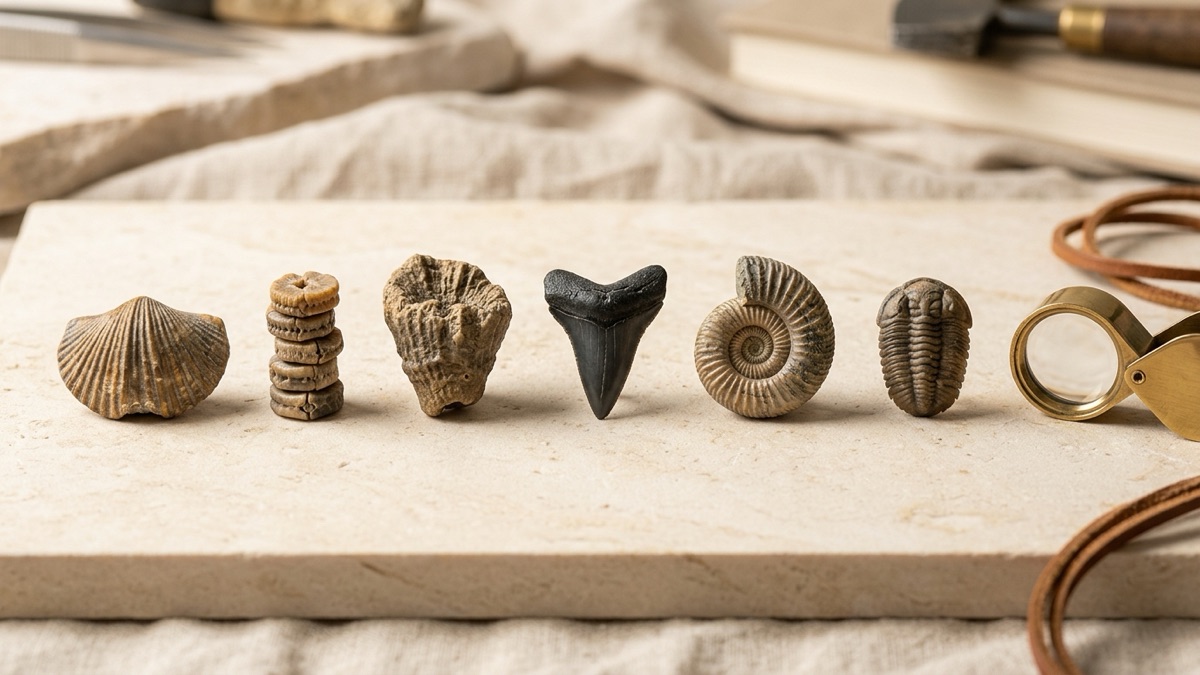
If you are wondering what a piece might be worth, our guide to petrified wood value covers what collectors look for. No one can price a piece from a photo. If you would rather polish a small piece, petrified wood is classic tumbling rough, and our rock tumbler guide walks through the four stages. Petrified wood is a plant fossil, so our fossil identification hub covers the other common fossils, from shells and corals to shark teeth.
The RockhoundID app, coming soon, will suggest likely matches from a photo and tell you which test confirms them.
The takeaway
Petrified wood gives itself away with the tree it used to be. Look for rings on the end, bark on the outside, grain along the sides and knots, then prove the stone with a glass scratch and a heft in your hand. Color and stripes alone are not enough, because jasper and agate can fake both. Find two tree clues plus a hard, heavy stone, and you are very likely holding a fossil forest in your palm.
The pictures in this guide are AI-generated illustrations of what to look for; real specimens vary, so trust the tests over any picture. RockhoundID guides help you narrow down what you found. They suggest likely candidates, not certain identifications or appraisals. For anything valuable, rare or possibly from space, ask a museum, a university geology department or your state geological survey, and check the collecting rules for the land before you take anything home.
Questions rockhounds ask
How do you identify petrified wood?
You identify petrified wood by finding the tree first, then testing the stone. Wet the piece and look for growth rings on the end, straight grain along the sides, bark texture and knots; two or more together make a strong case. Then try to scratch glass with a sharp edge and heft it, because most petrified wood is quartz, so it scratches glass and feels as heavy as any rock. Color and stripes alone are not enough, since jasper and banded agate can copy both.
How can you tell if a rock is petrified wood?
Look for the tree first: growth rings on a broken end, bark texture on the outside, straight grain along the sides and knots. Then test the stone. Most petrified wood is quartz, so it scratches glass and feels as heavy as any other rock.
Does petrified wood scratch glass?
Usually, yes. Most petrified wood is quartz, which is Mohs 7, harder than window glass at about 5.5. Opalized wood is a little softer and may only just mark glass, and fossil wood mineralized with calcite cannot scratch it at all.
What rocks look like petrified wood?
Brown, red and yellow jasper, banded agate and chert, and striped sandstone are the usual suspects. They can copy the colors or the stripes, but not growth rings and side grain together.
Is petrified wood heavier than regular wood?
Much heavier. Dry wood usually floats, while petrified wood is about 2.6 times as dense as water, like other quartz rocks. A piece that feels light for its size may be weathered wood or coalified wood instead.
Can I keep petrified wood I find?
On most BLM land, yes, within limits: 25 pounds plus one piece a day and 250 pounds a year, for personal use. National parks allow no collecting at all, and private land needs the owner's permission.
Where these facts come from
- National Park Service, Petrified Forest: petrified wood: www.nps.gov/pefo/learn/nature/petrified-wood.htm
- National Park Service, Petrified Forest: frequently asked questions: www.nps.gov/pefo/faqs.htm
- North Dakota Geological Survey: North Dakota's petrified wood (John P. Bluemle): dmr.nd.gov/ndgs/ndnotes/ndn3.asp
- North Dakota Studies (State Historical Society of North Dakota): state symbols: www.ndstudies.gov/gr4/node/513
- Mustoe (2017), Wood petrifaction: a new view of permineralization and replacement, Geosciences (Western Washington University): doi.org/10.3390/geosciences7040119
- USGS ScienceBase: Ginkgo Petrified Forest State Park mineral site record (opalized logs): www.sciencebase.gov/catalog/item/51f83d1ee4b02e26443aaf9a
- USGS, Gemstones (mineral gemstones: quartz, opal): pubs.usgs.gov/gip/gemstones/mineral.html
- University of Auckland, minerals: Quartz: rocksminerals.flexiblelearning.auckland.ac.nz/minerals/quartz.html
- Mineralogical Society of America: Mineral Identification Key, hardness: www.minsocam.org/MSA/collectors_corner/id/mineral_id_keyi4.htm
- eCFR: 43 CFR 3622.4, petrified wood collection rules: www.ecfr.gov/current/title-43/section-3622.4
- BLM: Can I keep this?: www.blm.gov/learn/can-i-keep-this
- eCFR: 36 CFR 2.1, preservation of natural resources in national parks: www.ecfr.gov/current/title-36/chapter-I/part-2/section-2.1