Petoskey Stone: How to Find, Identify and Polish One
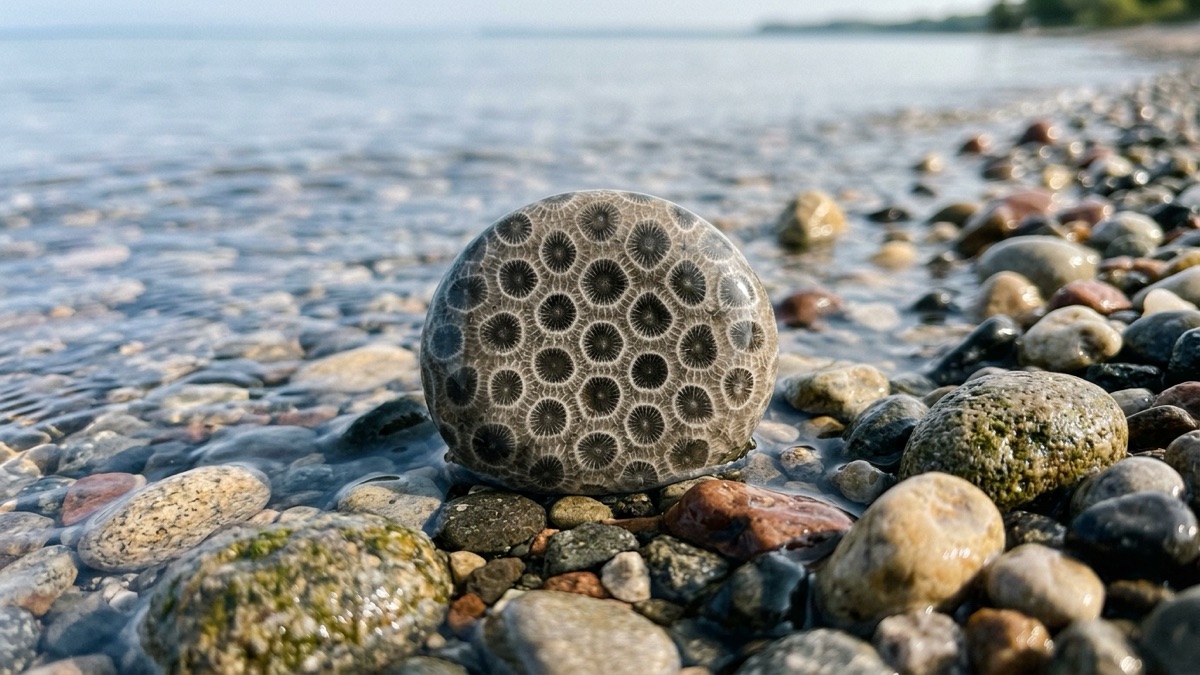
The pebble in your hand looks like plain gray limestone. Dip it in the lake and a honeycomb of little sunbursts appears, each cell with a dark eye at its center. You have found a Petoskey stone, and once you have seen the pattern you will never walk a northern Michigan beach the same way again.
Quick answer
A Petoskey stone is a fossil colonial coral, Hexagonaria, from a Devonian sea about 350 million years ago. Each six-sided cell shows a dark center with rays like spokes, visible only when the stone is wet or polished. They are found on Lake Michigan beaches around Petoskey, and Michigan allows 25 pounds per person per year on state land.
Key takeaways
- A Petoskey stone is a piece of fossil coral, not a mineral. It has been Michigan's official state stone since 1965.
- The tell is the pattern: six-sided cells, each with a dark center and radiating lines, that appear when the stone is wet.
- The best beaches are around Petoskey and Little Traverse Bay, and the best time is right after a storm or a misty rain.
- Michigan state land allows 25 pounds of rocks per person per year. Sleeping Bear Dunes National Lakeshore allows none.
- The stone is calcite, so you can polish one at home with wet sandpaper and a scrap of velvet.
What is a Petoskey stone?
A Petoskey stone is a fossil, and a fairly grand one. Michigan State University's Geography of Michigan project describes it as a fossil colonial coral that lived in the warm Michigan seas during the Devonian period, around 350 million years ago, with the scientific name Hexagonaria percarinata. The Digital Atlas of Ancient Life files Hexagonaria under the rugose corals, an extinct group that reached its peak diversity in the Devonian, and explains that Petoskey stones are glacially rounded chunks of this colonial coral.
Each cell in the pattern was one coral animal, called a polyp, living shoulder to shoulder with its neighbors in a colony. The dark spot at the center of each cell is where the polyp's mouth sat, and the fine lines radiating out from it, which the Digital Atlas compares to bicycle spokes, are the septa, the thin walls that divided the animal's cup. Michigan State University explains that calcite, silica and other minerals replaced the original coral, which is why the fossil survived.
The bedrock that holds these corals belongs to the Traverse Group of Devonian age. Michigan State University notes that Pleistocene glaciers plucked Petoskey stones from that bedrock and spread them across Michigan and the surrounding region, and Lake Michigan's waves have been tumbling them into smooth pebbles ever since.
Fun fact
Michigan adopted the Petoskey stone as its official state stone in Act 89 of 1965. The stone and the town are named for Chief Petosegay, whose name Michigan State University translates as "rising sun" or "rays of dawn", a fitting name for a fossil full of little sunbursts.
How do you identify a Petoskey stone?
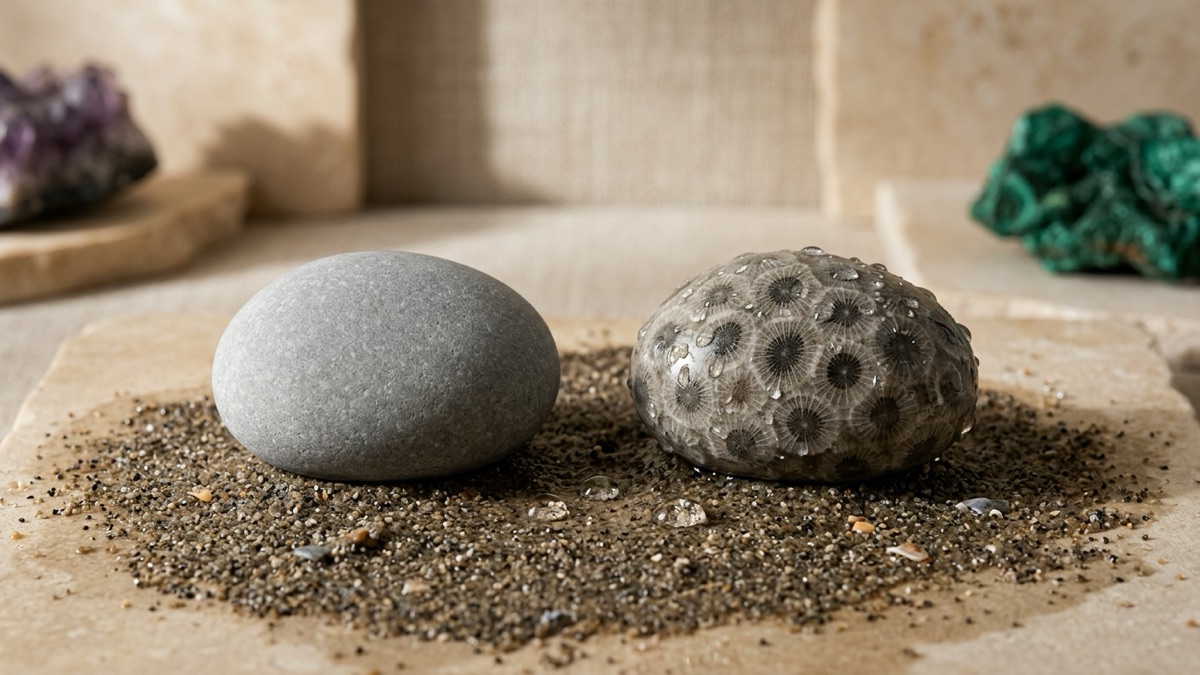
Dry, a Petoskey stone is a smooth gray or tan pebble that looks like any other piece of limestone on the beach. The whole trick is water. Michigan State University's advice is to hunt after a wind storm or a misty rain, when the wetness makes the fossil pattern more visible. Carry a water bottle and splash any promising gray stone.
| Condition | What you see | What to check |
|---|---|---|
| Dry | Plain gray or tan pebble, pattern faint or invisible | Faint hexagons or a mottled look |
| Wet | Six-sided cells with dark centers and radiating lines | Cells fit together like a honeycomb |
| Polished | Crisp cells, dark eyes, a soft glassy shine | Pattern runs through the whole stone |
Three checks confirm the find:
- The cells are six-sided and packed together. Hexagonaria means six-sided, and the cells fit like tiles with no gaps. Cell size varies from stone to stone, but within one stone the cells are fairly even.
- Each cell has a dark center with rays. Look for the eye in the middle and the spoke-like lines running out to the cell wall. That radiating pattern separates a Petoskey stone from other fossil corals, some of which have much smaller cells with no obvious rays, and from plain mottled limestone.
- It is soft and it fizzes. The stone is mostly calcite, which the Handbook of Mineralogy puts at 3 on the Mohs scale, so a copper coin or a knife scratches it easily, and a drop of vinegar makes it fizz. The University of Auckland's limestone page explains that fizz: calcite reacts with dilute acid. A pebble that scratches glass is not a Petoskey stone.
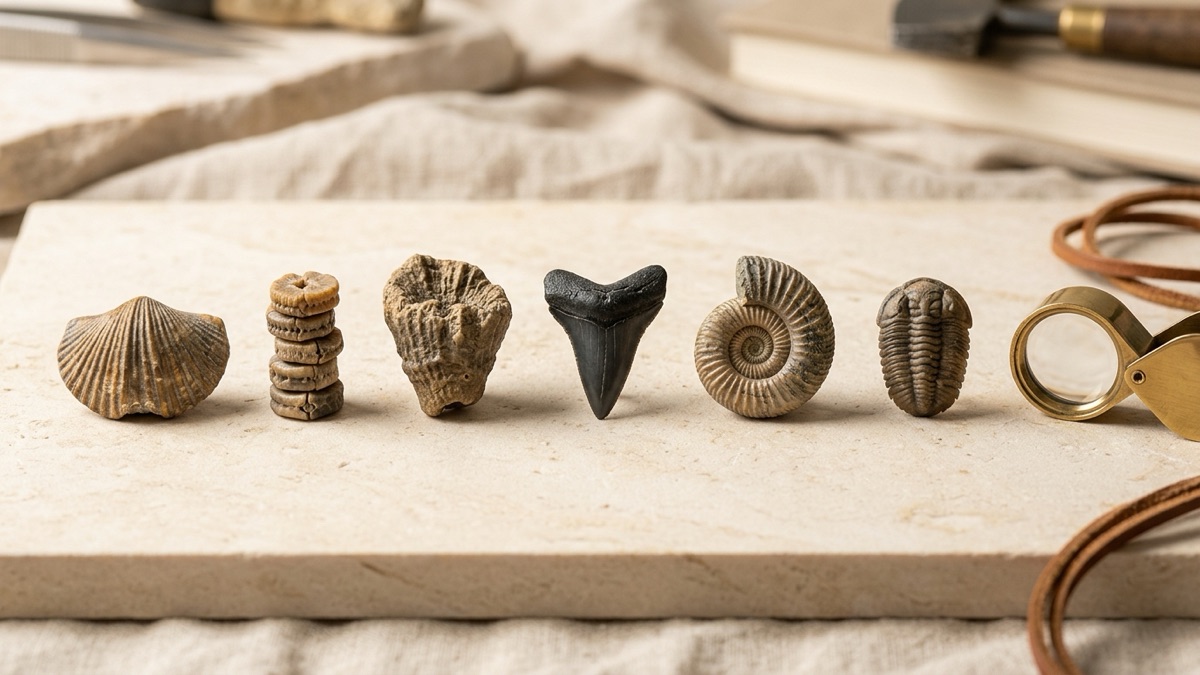
Two look-alikes trip people up. Pieces of old concrete and worn brick can show a mottled surface, but they crumble, have no cell pattern and often carry sand grains. And Petoskey stones are only one of several fossil corals on these beaches; the ones with tiny honeycomb cells and no central rays are different corals, worth keeping but not the state stone. Our guide to brachiopod and horn coral fossils covers the other Devonian neighbors you will find in the same gravel, and our fossil identification guide walks through the general checks.
Try it
Not sure whether your gray pebble is a fossil, a plain limestone or something else? Run it through the free rock identifier for likely candidates, and use the Mohs hardness scale to see what a coin and a knife should do to calcite.
Where do you find Petoskey stones?
The name gives it away. Michigan State University says the biggest concentrations are around the town of Petoskey, on Little Traverse Bay in the northwest corner of the Lower Peninsula, and that the stones are also found in gravel pits and along beaches from the Traverse City area across the state to Alpena. That band follows the Devonian bedrock the glaciers scraped, so beaches, creek mouths and gravel exposures anywhere along it are worth a look.
A few practical tips for the hunt:
- Go early in the season. Spring beaches, freshly rearranged by winter ice and storms, give up stones that were buried all summer.
- Go after weather. Michigan State University's advice to hunt after a wind storm holds all year: waves turn the gravel over and leave fresh stones at the waterline.
- Walk the waterline and the wet gravel. Stones at the edge of the surf are already wet and show their pattern; dry gravel higher up needs a splash.
- Check gravel bars in creeks and rivers that cut through the same bedrock, where permitted, and look at gravel wherever it has been dug.
Who manages the beach decides what you can take. The Michigan Geological Survey and Michigan EGLE both state the rule for state land: a total of 25 pounds of rocks, minerals and invertebrate fossils per person per year, for personal use only, with no selling or trading. That covers state parks and recreation areas, state forests and Great Lakes beaches below the ordinary high water mark. Petoskey stones and other invertebrate fossils count toward the limit.
Sleeping Bear Dunes National Lakeshore, on the Lake Michigan shore west of Traverse City, is a different story. The National Park Service says it is illegal under federal law to remove stones from the lakeshore and asks visitors to leave what they see for others to discover, and the same federal rule, 36 CFR 2.1, closes every national park unit to rock collecting. Enjoy the Petoskey stones there, photograph them, and put them back in the lake. Private beaches need the owner's permission first. Our guide to rock collecting rules covers every land type, and our guide to rockhounding in Michigan covers the rest of the state.
Heads up
The 25 pound limit is per person per year across all your trips combined, not per visit. A bucket of wet stones is heavier than it looks, so weigh your haul. And never wade out on spring ice shelves or into cold surf for a stone; the beach will give you another one tomorrow.
How do you polish a Petoskey stone by hand?
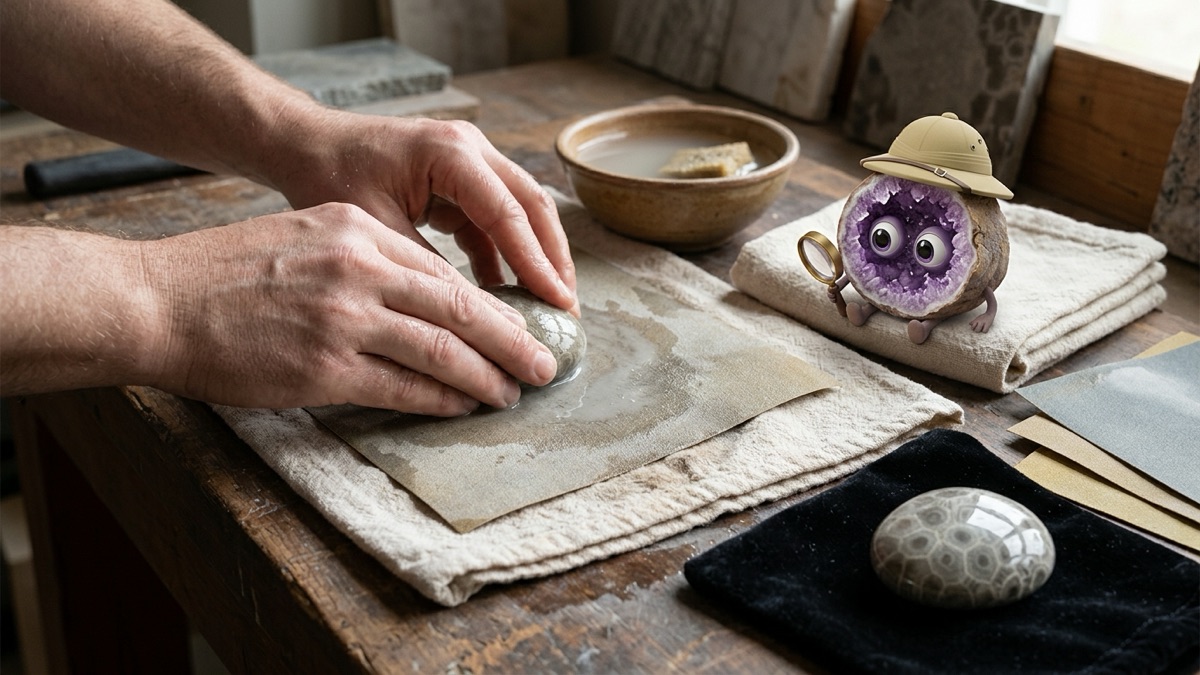
Because the stone is calcite, at only 3 on the Mohs scale, it is soft enough to polish with nothing more than sandpaper and patience. Michigan State University lays out the method. You need wet-or-dry sandpaper in 220, 400 and 600 grit, a towel or newspaper to work on, a scrap of corduroy or velvet, polishing powder and water.
- Shape and sand with 220 grit. Keep the stone and paper wet, and rub in circles with steady pressure until the surface is even and any chips are gone. Rinse and dry the stone to check.
- Sand with 400 grit. This removes the coarse scratches from the first paper. Rinse again and look at the surface in raking light for any leftover marks.
- Sand with 600 grit. Work until the stone is smooth and scratch free, then keep going a while longer than you think you need to. Rinse and dry.
- Polish. Sprinkle polishing powder on the damp corduroy or velvet and rub the stone with short, rotating strokes until it shines. Rinse in clean water and dry.
Expect an hour or two for a small stone if you are new to it. Many people finish with a thin coat of mineral oil or a clear wax to deepen the pattern between polishes, and some skip the powder and use a fine automotive polish on cloth. A rotary rock tumbler works too, but calcite is soft and wears fast, so run it with other soft stones and short cycles.
Are Petoskey stones valuable?
Petoskey stones are common along their home beaches, and most are inexpensive keepsakes rather than investments. Size, pattern and polish drive the price: a fist-sized stone with crisp, evenly spaced cells and a mirror polish costs far more than a rough pebble. Because they are so easy to hand polish, most collectors keep and polish their own.
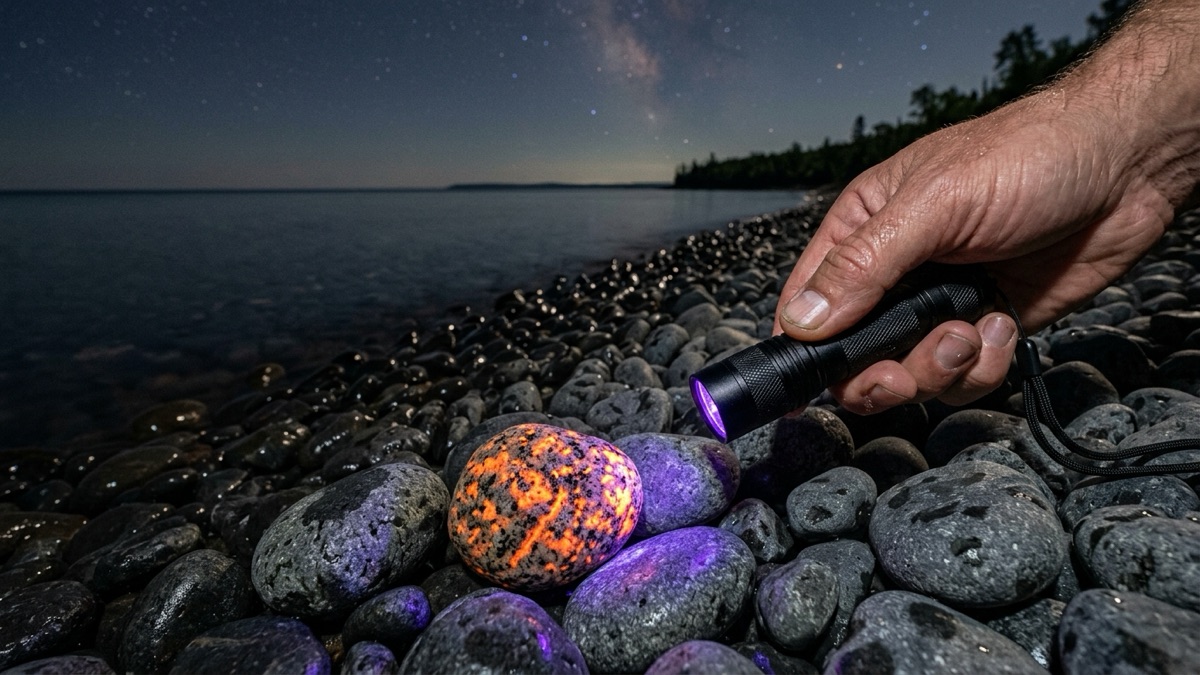
Two cautions. Rocks collected on Michigan state land are for personal use and may not be sold or traded, so anything sold legally should come from private land with permission. And no one can value a stone from a photo; compare yours with polished stones of similar size in shops around Petoskey and Traverse City. Our agate stone hub covers the other Michigan beach treasure, and our guide to yooperlites covers the one you hunt at night. The RockhoundID app, coming soon, will suggest likely matches from a photo and tell you which test confirms them.
The takeaway
A Petoskey stone is a piece of a 350-million-year-old coral reef, rounded by glaciers and waves and waiting on a Lake Michigan beach for someone with a water bottle. Look for six-sided cells with dark eyes and radiating lines, confirm with a scratch and a fizz, and hunt the wet gravel around Petoskey after a storm. Keep to Michigan's 25 pound yearly limit, leave the stones inside Sleeping Bear Dunes where they lie, and spend a rainy afternoon with three grades of sandpaper. The polish is the moment the reef comes back.
The pictures in this guide are AI-generated illustrations of what to look for; real specimens vary, so trust the tests over any picture. RockhoundID guides help you narrow down what you found. They suggest likely candidates, not certain identifications or appraisals. For anything valuable, rare or possibly from space, ask a museum, a university geology department or your state geological survey, and check the collecting rules for the land before you take anything home.
Questions rockhounds ask
What is a Petoskey stone?
A Petoskey stone is a fossil colonial coral, Hexagonaria, that lived in the warm sea over Michigan during the Devonian period, around 350 million years ago. Glaciers later plucked chunks from the bedrock, and waves rounded them into the pebbles found on beaches today.
Where are Petoskey stones found?
Mostly along the Lake Michigan shore of the northern Lower Peninsula, with the biggest concentrations around Petoskey and Little Traverse Bay. Michigan State University notes they also turn up in gravel pits and on beaches from the Traverse City area across the state to Alpena.
How many Petoskey stones can you take home?
On Michigan state land, including state park beaches and Great Lakes shoreline below the ordinary high water mark, the limit is 25 pounds of rocks per person per year for personal use. Inside Sleeping Bear Dunes National Lakeshore it is illegal to remove any stones.
How do you polish a Petoskey stone by hand?
Wet sand it with 220 grit sandpaper, then 400, then 600, rinsing between grits, until every scratch is gone. Finish by rubbing it with polishing powder on damp corduroy or velvet. The stone is calcite, soft enough that hand sanding works.
Are Petoskey stones worth money?
Most are inexpensive keepsakes, and prices depend on size, pattern and polish rather than rarity. Large, well-patterned polished stones cost the most. No one can put a value on yours from a photo, so compare with what shops near Petoskey are asking.
Where these facts come from
- Michigan Compiled Laws, Act 89 of 1965: State stone: www.legislature.mi.gov/Laws/MCL?objectName=mcl-2-16
- Michigan State University, Geography of Michigan: The Petoskey stone: project.geo.msu.edu/geogmich/petoskystone.html
- Digital Atlas of Ancient Life (Paleontological Research Institution): Rugosa: www.digitalatlasofancientlife.org/learn/cnidaria/anthozoa/rugosa/
- Michigan Geological Survey (Western Michigan University): MGS Rockhounds: mgs.wmich.edu/education-and-outreach/corekids/mgs-rockhounds/
- Michigan EGLE: Rockhounding in Michigan: www.michigan.gov/egle/public/learn/geology/rockhounding
- National Park Service, Sleeping Bear Dunes: Beaches: www.nps.gov/slbe/learn/nature/beaches.htm
- National Park Service: Recreational collection of rocks and minerals, legal instruments: www.nps.gov/articles/recreational-collection-of-rocks-and-minerals-legal-instrum
- Handbook of Mineralogy: Calcite: www.handbookofmineralogy.org/pdfs/calcite.pdf
- University of Auckland: Limestone: rocksminerals.flexiblelearning.auckland.ac.nz/rocks/limestone.html
- University of Auckland: Hardness: rocksminerals.flexiblelearning.auckland.ac.nz/minerals/hardness.html
Read next
rockhounding
Where to Find Geodes: The Best Places in the US