Yooperlite: How to Find and Identify Glowing Rocks
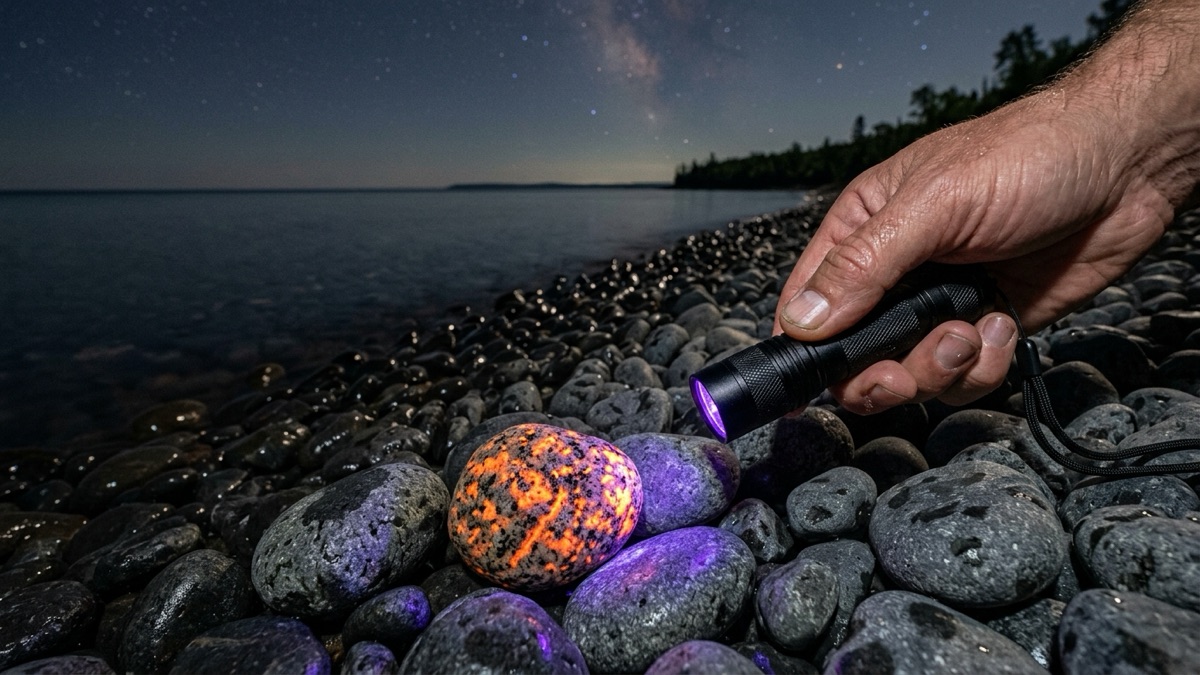
You are on a Lake Superior beach at midnight, sweeping a purple flashlight across wet gravel, and a plain gray pebble lights up orange like a coal in a campfire. That is a yooperlite. By day it looks like nothing. By night it is the most talked-about rock in Michigan.
Quick answer
A yooperlite is a pebble of syenite, a granite-like rock, that holds grains of the mineral sodalite. Under a long-wave UV flashlight the sodalite fluoresces bright orange; in daylight the rock looks gray and speckled. They are found on Lake Superior beaches in Michigan's Upper Peninsula, where state land allows 25 pounds per person per year.
Key takeaways
- Yooperlite is a nickname, not a mineral: it is syenite with fluorescent sodalite, named after "Yoopers", the people of Michigan's Upper Peninsula.
- Only a UV flashlight shows the glow. In daylight the stones look like ordinary gray granite.
- Erik Rintamaki found the first ones on Lake Superior beaches in 2017, and Michigan Tech confirmed the sodalite.
- The best hunting is at night on Lake Superior beaches between Whitefish Point and Grand Marais and on the Keweenaw Peninsula.
- On Michigan state land you may keep 25 pounds per person per year. National lakeshores allow no collecting at all.
What is a yooperlite?
A yooperlite is a rock, not a single mineral. The rock is syenite, a coarse-grained igneous rock that the University of Auckland describes as mostly alkali feldspar, with quartz typically absent. Think of granite without the glassy quartz grains. On the beach it is a gray to pinkish, speckled cobble that you would walk straight past.
The magic ingredient is sodalite, scattered through the syenite as small grains and veins. The Handbook of Mineralogy lists sodalite as a sodium aluminum silicate with chlorine, formed in nepheline syenites and related rocks, with a hardness of 5.5 to 6 and a white streak. In daylight sodalite can be colorless, white, yellowish, greenish or blue, so the grains often hide in plain sight against the feldspar.
Rock & Gem magazine describes yooperlites simply as syenite rocks containing fluorescent sodalite, and notes that the Michigan finds were the first verified and documented sodalite from the state.
Why do yooperlites glow?
Fluorescence is a mineral absorbing ultraviolet light, which your eyes cannot see, and giving some of it back as visible light. The Handbook of Mineralogy says sodalite shows bright red-orange fluorescence under both long-wave and short-wave UV, with a yellowish phosphorescence, which is a brief afterglow once the lamp goes off. That is the fiery orange you see in photos.
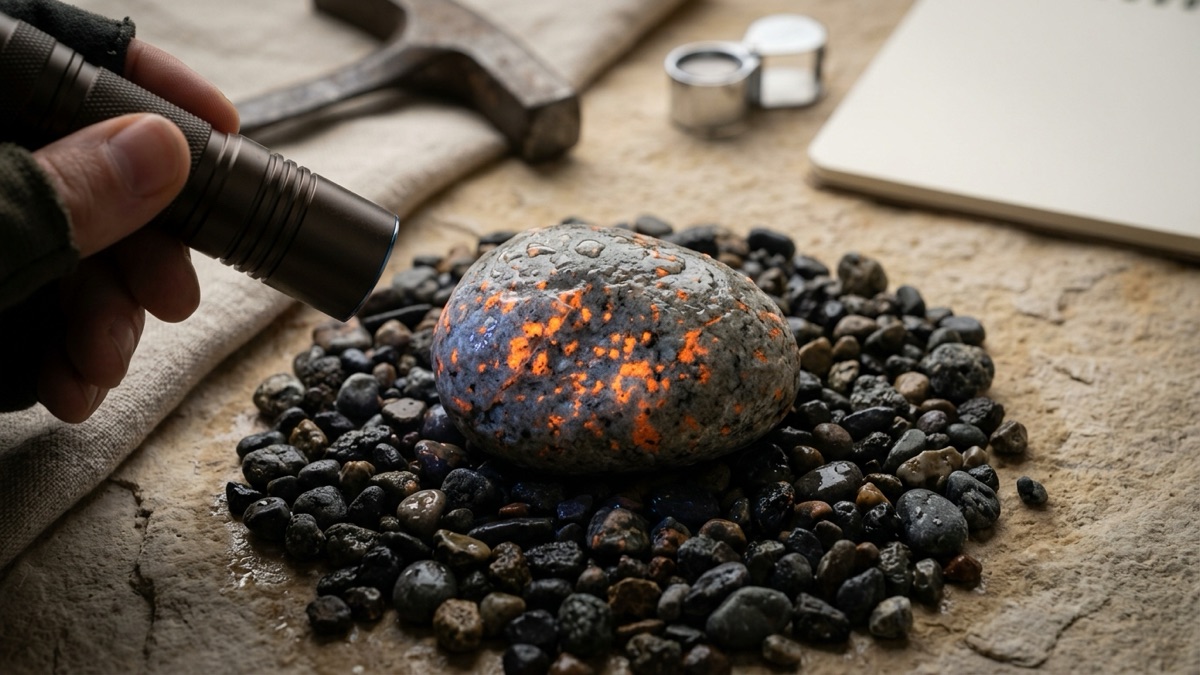
The glow comes only from the sodalite, so a yooperlite lights up in flecks, blotches and veins rather than all over. Some are peppered with tiny sparks; the prized ones have thick orange bands running through a dark rock. The feldspar and other minerals stay black under the lamp, which is what makes the pattern so striking.
Fun fact
The Handbook of Mineralogy notes that sodalite may give off the odor of hydrogen sulfide, the rotten-egg gas, when it is freshly broken. If you crack a yooperlite and catch a faint whiff of sulfur, that is the mineral talking.
Who discovered yooperlites?
The story is recent enough that the discoverer still leads beach tours. In 2017, Erik Rintamaki, a rockhound from Michigan's Upper Peninsula, went out on Lake Superior beaches with a UV flashlight after reading that collectors used them to spot fluorescent minerals. Rock & Gem dates the find to June 2017, and The Debrief reports he was teaching his brother-in-law to hunt agates at the time.
Rintamaki sold a few of the stones to Michigan Technological University, which had them analyzed. Geologists identified them as syenite carrying fluorescent sodalite, and the discovery was published in Mineral News in 2018, as reported by WDIV in Detroit. Rintamaki named them yooperlites after "Yoopers", the nickname for people of the Upper Peninsula (the U.P.).
Where did the sodalite come from? Rintamaki told WDIV he believes the rocks were brought down from Canada by glaciers, and The Debrief reports the likely source as an alkaline igneous complex in Ontario, north of Lake Superior. The lake has been rolling them into pebbles ever since.
Where do you find yooperlites?
The Lake Superior shoreline of Michigan's Upper Peninsula is the home ground. WDIV reported the main hunting area as the beaches between Whitefish Point and Grand Marais, plus the Keweenaw Peninsula, and Rock & Gem names Chippewa County, Luce County and the Keweenaw as the areas where most are found.
Before you go, know who manages the beach. Michigan's rules are generous, but federal lakeshores are closed to collecting, and the two sit side by side on the same coast: Pictured Rocks National Lakeshore runs along the shoreline west of Grand Marais.
| Land | Manager | Rule (checked September 2026) |
|---|---|---|
| State parks, recreation areas and state forests | Michigan DNR | Up to 25 pounds per person per year, personal use only, no selling or trading |
| Great Lakes beaches below the ordinary high water mark | State of Michigan (public trust) | Same 25 pound yearly limit, personal use only |
| Pictured Rocks National Lakeshore, Isle Royale | National Park Service | No collecting of rocks or minerals at all |
| Hiawatha and Ottawa National Forests | US Forest Service | Ask the ranger district; small personal amounts generally need a free use permit |
| Private beach | The owner | Permission first, every time |
The Michigan Geological Survey and Michigan EGLE both state the 25 pound per person per year limit, which covers every rock, mineral and invertebrate fossil you take from state-owned land and public trust shoreline combined. The National Park Service applies the federal ban in 36 CFR 2.1 to Pictured Rocks and Isle Royale. Our guide to rock collecting rules explains each land type, and our guide to rockhounding in Michigan covers the rest of the state.
Heads up
Rock hunting at night on Lake Superior means cold water, slippery cobbles and waves you cannot see coming. Carry a white flashlight as well as the UV lamp, tell someone where you are going, stay well back from the surf, and never look into a UV beam or point it at anyone's face. UV-blocking glasses are cheap and worth wearing all night.
What UV flashlight do you need?
Long-wave UV. Rock & Gem recommends a longwave ultraviolet flashlight, and the Handbook of Mineralogy confirms sodalite fluoresces under long-wave as well as short-wave UV. Long-wave lamps are the affordable, battery-powered kind sold for beach hunting; short-wave lamps are pricier lab tools with more eye risk, and you do not need one for yooperlites.
A few practical points make a big difference:
- Hunt after dark. Rock & Gem's advice is to search after sunset and scan the beach with the UV light. Any daylight, even dusk, drowns the glow.
- Pick a dark night. Bright moonlight washes out the smaller flecks.
- Sweep slowly and low. Hold the lamp a foot or two above the gravel and walk at a crawl. Yooperlites show as sudden orange sparks.
- Wet is fine. Wet stones glow just as well, so the water's edge is fair game if the lake is calm.
- Mark, then check. When something lights up, put your white light on it. Plastic, fishing line and sunscreen smears glow too.
Tip
Pack a small mesh bag and a luggage scale. Michigan's limit is 25 pounds per person per year, and a good night can add up faster than you think.
How do you identify a yooperlite in daylight?
Without a lamp, a yooperlite is just a syenite cobble, so daylight identification is about ruling things in and out. Look for a medium to coarse-grained rock in gray, dark gray or pinkish gray, with a salt-and-pepper texture of feldspar and darker minerals. Because syenite lacks quartz, you should not see the glassy, gray, slightly transparent grains that make granite sparkle.
The sodalite itself may show as dull grayish, greenish or faintly blue patches, but it blends in well. Streak is white for sodalite and for the feldspar, so a streak plate will not settle it. The only quick, reliable test is the UV lamp. If you have a candidate in the daytime, cup it in your hands with the lamp, or carry a small dark bag, and check on the spot.
Try it
If you found a speckled cobble and want likely candidates before dark, answer a few questions in the free rock identifier, and use the Mohs hardness scale to check that the feldspar in it scratches glass.
What glows but is not a yooperlite?
Plenty of things light up under UV, and a first night out can feel like the whole beach is fluorescent. A few look-alikes cause most of the confusion.
| What glows | Under long-wave UV | In daylight | How to tell |
|---|---|---|---|
| Yooperlite (sodalite in syenite) | Orange flecks, blotches or veins in a dark rock | Gray, speckled, granite-like | Orange glow sits inside a coarse-grained rock |
| Fluorite | Often blue or violet, sometimes other colors | Glassy cubes, purple, green or clear | Hardness 4: a knife scratches it easily |
| Calcite | May fluoresce red, blue, yellow or other colors | White to cream, cleaves into rhombs | Fizzes in vinegar; a copper coin scratches it |
| Plastic, fishing line, sunscreen | Bright white or blue-white | Obviously not rock once lit | The white flashlight ends the argument |
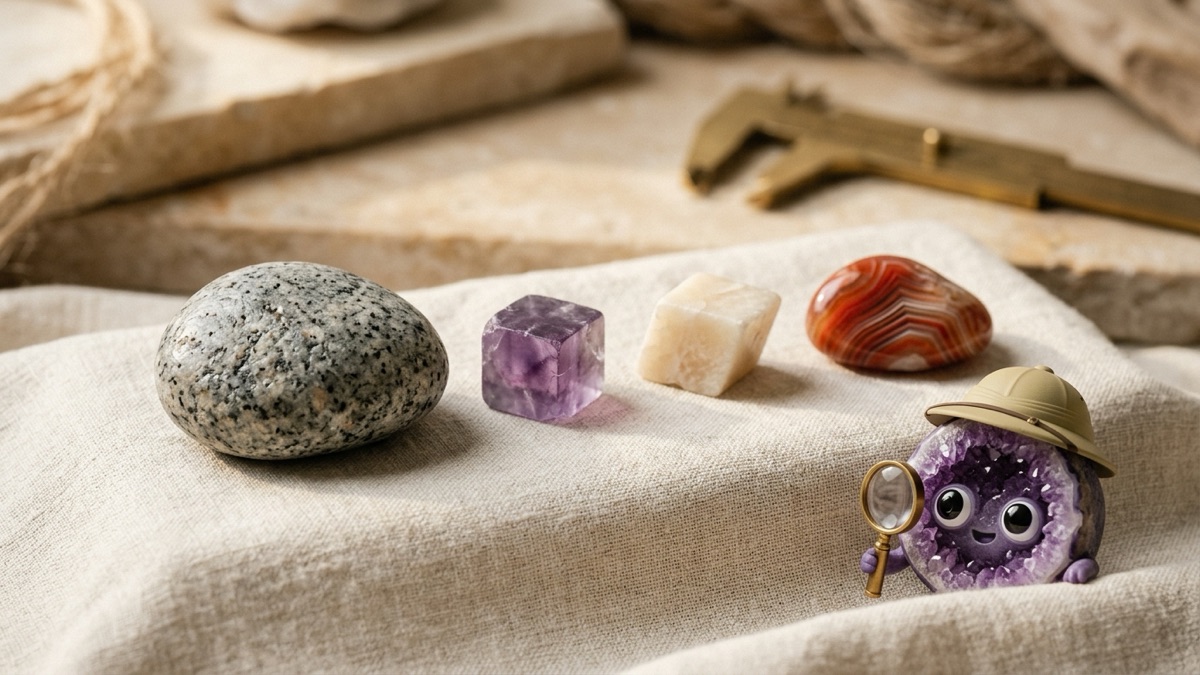
The University of Auckland notes that fluorite is frequently fluorescent under UV, and the Handbook of Mineralogy says calcite may fluoresce red, blue, yellow and other colors under either long-wave or short-wave UV. Neither looks like syenite once you switch to white light: fluorite is glassy and soft, calcite is pale and fizzes. If you are sorting a bucket of beach finds, our guide to Lake Superior agates covers the other stone everyone on that shoreline is hunting, and our agate stone hub explains how banded quartz differs from every look-alike.
Can you sell or polish yooperlites?
Polish, yes. Sodalite and feldspar are hard enough to take a shine in a rock tumbler, and a polished yooperlite glows just as brightly because the sodalite runs all the way through. Our guide to thunder eggs covers another stone that hides its best side until it is cut.
Selling is a different matter. Michigan's state land rule is for personal, non-commercial use, and the Michigan Geological Survey states plainly that selling or trading collected material is not allowed. Yooperlites sold legally come from private land with the owner's permission. The RockhoundID app, coming soon, will suggest likely matches from a photo and tell you which test confirms them, but for a yooperlite the confirming test will always be a UV lamp on a dark beach.
The takeaway
A yooperlite is a gray syenite pebble that hides orange sodalite until a long-wave UV flashlight finds it. Hunt Lake Superior beaches between Whitefish Point and Grand Marais or on the Keweenaw, go after dark on a moonless night, and carry a white light for the plastic and sunscreen that glow too. Stay off national lakeshore beaches, keep to Michigan's 25 pound yearly limit on state land, and ask before you step onto a private beach. Then enjoy the strange pleasure of a rock that looks like nothing all day and lights up like a coal at night.
The pictures in this guide are AI-generated illustrations of what to look for; real specimens vary, so trust the tests over any picture. RockhoundID guides help you narrow down what you found. They suggest likely candidates, not certain identifications or appraisals. For anything valuable, rare or possibly from space, ask a museum, a university geology department or your state geological survey, and check the collecting rules for the land before you take anything home.
Questions rockhounds ask
What is a yooperlite made of?
A yooperlite is a pebble of syenite, a coarse igneous rock made mostly of feldspar, that contains grains of the mineral sodalite. The sodalite is what fluoresces orange under ultraviolet light; the rest of the rock stays dark.
What UV light do you need for yooperlites?
A long-wave ultraviolet flashlight. The Handbook of Mineralogy says sodalite fluoresces under both long-wave and short-wave UV, and long-wave is the kind sold for beach hunting. Never look into the beam, and wear UV-blocking glasses.
Where are yooperlites found?
Mainly on Lake Superior beaches in Michigan's Upper Peninsula: the shoreline between Whitefish Point and Grand Marais, and the Keweenaw Peninsula. Rock & Gem names Chippewa County, Luce County and the Keweenaw as the main areas.
Is it legal to collect yooperlites in Michigan?
On Michigan state land, including state park beaches and Great Lakes shoreline below the ordinary high water mark, you may keep up to 25 pounds of rocks per person per year for personal use. National lakeshores such as Pictured Rocks allow no collecting at all.
Do yooperlites glow in the dark without a UV light?
No. Yooperlites do not glow on their own. They fluoresce only while a UV light is shining on them, though the Handbook of Mineralogy notes sodalite can show a brief yellowish afterglow, called phosphorescence, when the light switches off.
Where these facts come from
- Handbook of Mineralogy: Sodalite: www.handbookofmineralogy.org/pdfs/sodalite.pdf
- Rock & Gem: Yooperlites, what and where to find them (June 10, 2026): www.rockngem.com/yooperlites-appeal-part-1
- WDIV ClickOnDetroit: Man credited with discovering glowing rocks in Michigan (September 7, 2018): clickondetroit.com/all-about-michigan/2018/09/07/man-credited-with-discovering-g
- The Debrief: These enigmatic Yooperlites found in Michigan (May 8, 2024): thedebrief.org/these-enigmatic-yooperlites-found-in-michigan-reveal-a-luminous-s
- Michigan Geological Survey (Western Michigan University): MGS Rockhounds: mgs.wmich.edu/education-and-outreach/corekids/mgs-rockhounds/
- Michigan EGLE: Rockhounding in Michigan: www.michigan.gov/egle/public/learn/geology/rockhounding
- National Park Service: Recreational collection of rocks and minerals, legal instruments: www.nps.gov/articles/recreational-collection-of-rocks-and-minerals-legal-instrum
- USDA Forest Service: Rockhounding Guide, FS-1091 (June 2017): www.fs.usda.gov/media/229394
- University of Auckland: Syenite: rocksminerals.flexiblelearning.auckland.ac.nz/rocks/syenite.html
- University of Auckland: Fluorite: rocksminerals.flexiblelearning.auckland.ac.nz/minerals/fluorite.html
- University of Auckland: Streak: rocksminerals.flexiblelearning.auckland.ac.nz/minerals/streak.html
- Handbook of Mineralogy: Calcite: www.handbookofmineralogy.org/pdfs/calcite.pdf