
Free tool
Mohs hardness scale
The ten reference minerals, the everyday things you can scratch with, a simulator that tells you what scratches what, and a searchable list of more than 90 minerals, gems, metals and rocks.
What the Mohs scale is
The Mohs scale ranks minerals by how easily they scratch. The Austrian mineralogist Friedrich Mohs picked ten reference minerals in 1822, from talc (1) to diamond (10). Each one scratches the minerals below it and is scratched by the ones above it. It is a ranking, not a ruler: the step from corundum (9) to diamond (10) is far bigger than the step from talc (1) to gypsum (2).
| Mohs | Reference mineral | Everyday comparison |
|---|---|---|
| 1 | Talc | Feels soapy; a fingernail scratches it easily |
| 2 | Gypsum | A fingernail (about 2 to 2.5) scratches it |
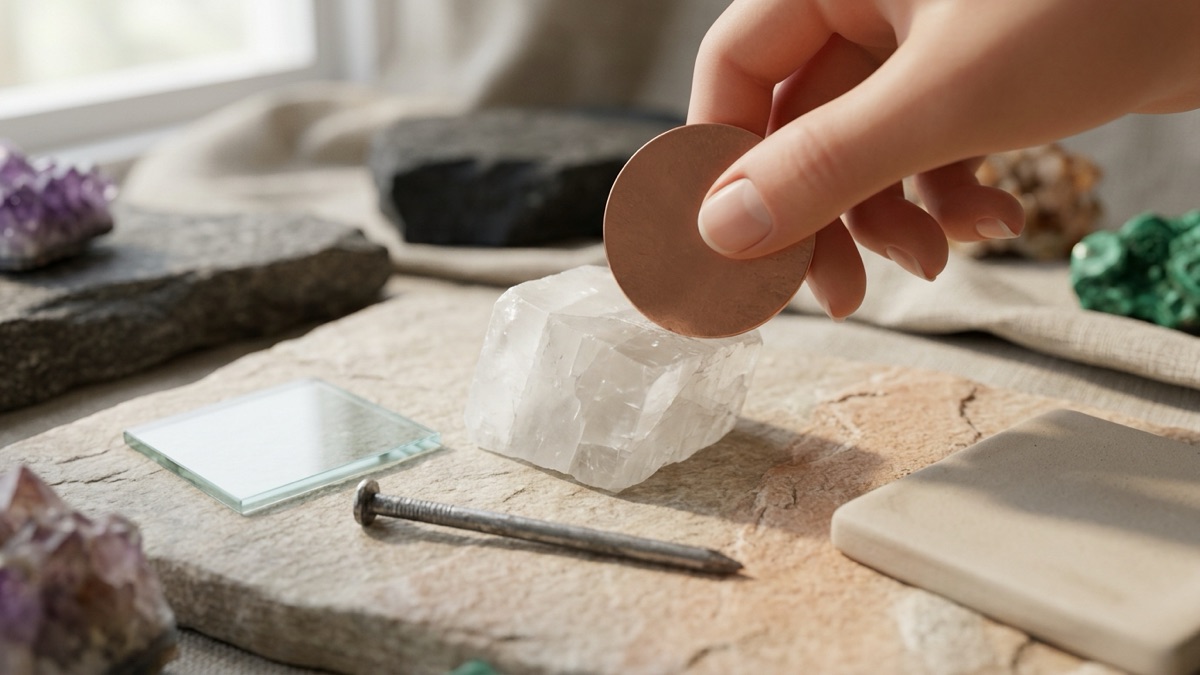
| 3 | Calcite | A copper coin (about 3 to 3.5) scratches it |
| 4 | Fluorite | A steel knife scratches it easily |
| 5 | Apatite | A steel knife (about 5 to 5.5) just scratches it |
| 6 | Orthoclase | Scratches window glass (about 5.5) |
| 7 | Quartz | Scratches glass and steel; about as hard as a streak plate |
| 8 | Topaz | Scratches quartz |
| 9 | Corundum | Ruby and sapphire; scratches topaz |
| 10 | Diamond | Scratches everything else |
How to do a scratch test
- Find a clean, smooth spot on the specimen, away from cracks and crumbly edges.
- Press and drag a sharp point of the tester (a fingernail, a copper coin, a steel knife) firmly across that spot.
- Rub the mark with a wet finger. A real scratch is a groove that stays. A line that wipes away is powder from the softer tester.
- Test both ways. Also try to scratch the tester, or a piece of glass, with a sharp edge of the specimen.
- Bracket it. If a knife cannot scratch it but it cannot scratch glass either, its hardness sits between about 5.5 and 6.
Tip
For the copper test, use a pre-1983 US cent or a piece of copper wire. Newer US cents are mostly zinc under a thin copper coat.
Where these numbers come from
The reference scale and gem hardness follow the USGS Gemstones publication, the tester values follow the Mineralogical Society of America's Mineral Identification Key and the University of Auckland hardness page, and mineral values come from the Handbook of Mineralogy. Ranges show where sources or specimens differ. Rocks are mixtures of minerals, so their values are estimates from their main minerals and are marked that way.
Heads up
Hardness is not toughness. Diamond is the hardest natural mineral, but it can still chip or split along its cleavage if it is knocked hard. Emerald and opal are known for chipping in rings.
Questions
What is the Mohs hardness scale?
A ranking of minerals by how easily they scratch, from talc (1) to diamond (10). Each reference mineral scratches the ones below it and is scratched by the ones above it.
What is the hardness of glass, a knife and a fingernail?
Window glass is about 5.5, a pocket knife about 5 to 5.5 (steel varies), a steel file about 6.5 and a fingernail about 2 to 2.5, according to the Mineralogical Society of America's identification key.
What is harder, quartz or glass?
Quartz. It is 7 on the Mohs scale and glass is about 5.5, so quartz scratches glass. That is why the glass test separates quartz from look-alikes such as calcite and glass itself.
Is the Mohs scale linear?
No. It only ranks minerals. The gap between corundum (9) and diamond (10) is much larger than the gap between the lower steps.
How hard is a diamond compared with a sapphire?
Diamond is 10 and sapphire (corundum) is 9. Diamond scratches sapphire, and sapphire scratches everything below 9, including topaz and quartz.