Gemstone Hardness Chart: 40 Gems on the Mohs Scale
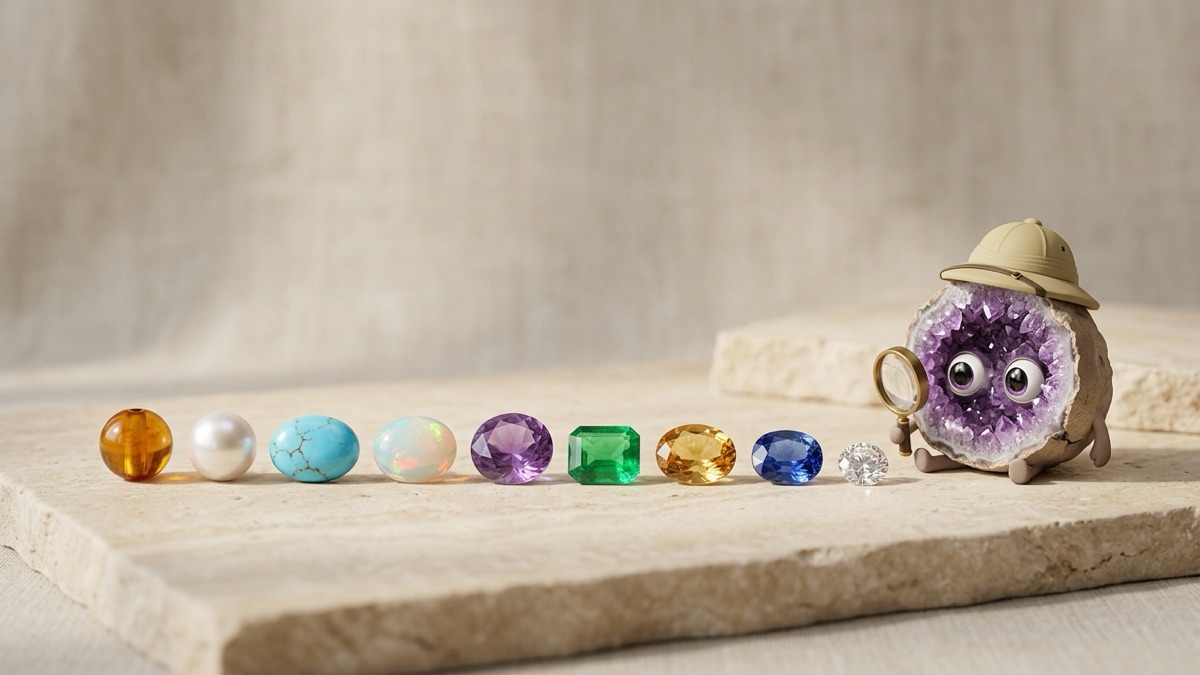
Your ring has been through dishes, gardening and a slammed car door. Whether its stone still sparkles after all that depends a lot on one number, the Mohs hardness. Here are 40 mineral gems and four organic gems in one chart, sorted so you can see at a glance which ones shrug off daily life and which ones need a little babying.
Quick answer
Gemstone hardness is measured on the Mohs scale. Diamond is 10, ruby and sapphire 9, topaz and spinel 8, emerald and aquamarine 7.5 to 8, quartz gems 7, opal 5.5 to 6.5, turquoise 5 to 6, pearl 2.5 to 4.5 and amber 2 to 2.5. Gems below 7 scratch more easily, because dust is mostly quartz.
Key takeaways
- Hardness is resistance to scratching. This chart groups 40 mineral gems into hard (8 and up), medium (5.5 to 8) and soft (below 5.5), plus four organic gems.
- Quartz, at 7, is the number to remember. GIA notes that sand and dust are mostly quartz, so softer gems slowly lose their polish.
- Hard is not the same as tough. Diamond can be cleaved by a hard blow, while jade is softer but very tough.
- Rings take the most knocks. GIA suggests earrings and necklaces for softer gems.
- These values help you care for a gem. They are not a way to identify one: never scratch test a cut stone.
How is gemstone hardness measured?
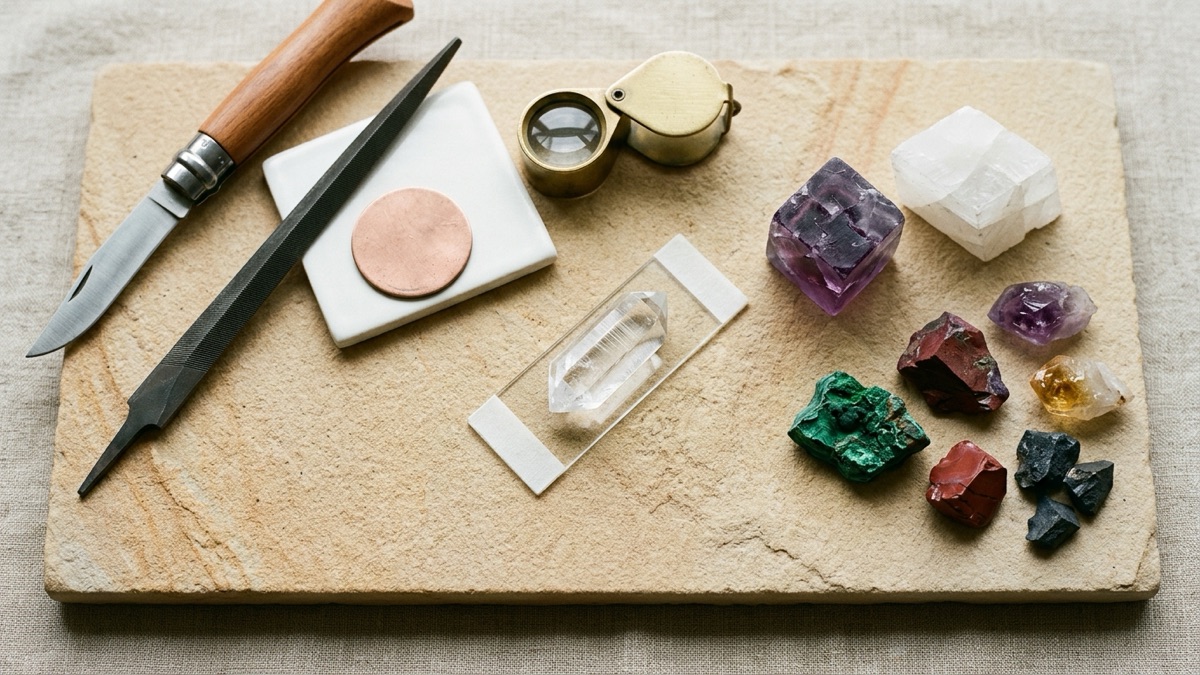
The USGS describes a gem's hardness as its resistance to scratching, measured against the Mohs scale that the German mineralogist Friedrich Mohs set up in 1812. The scale runs from talc (1) to diamond (10), and each mineral scratches the ones below it. Our guide to the Mohs hardness test explains how the scratch test works.
Two things to keep in mind as you read the chart. First, the numbers are ranks, not measurements: the Open University notes that diamond is about four times harder than corundum on an absolute scale, even though they sit one step apart. Second, many gems show a range, such as 6.5 to 7.5 for garnet, because sources and specimens differ. The values here match the RockhoundID Mohs tool, which uses the USGS Gemstones publication and the Handbook of Mineralogy.
Gemstone hardness chart: the hard gems (8 and up)
These are the gems that shrug off everyday grit. Every one of them scratches quartz.
| Gem | Mineral | Mohs | Wear notes |
|---|---|---|---|
| Diamond | Diamond | 10 | Hardest natural mineral, but it can split along cleavage |
| Ruby | Corundum | 9 | Red corundum |
| Sapphire | Corundum | 9 | Blue and many other colors |
| Alexandrite and chrysoberyl | Chrysoberyl | 8.5 | Alexandrite changes color under different light |
| Topaz | Topaz | 8 | Perfect cleavage: a hard knock can split it |
| Spinel | Spinel | 8 | Red, purple, orange, blue or green |
The medium gems (5.5 to 8)
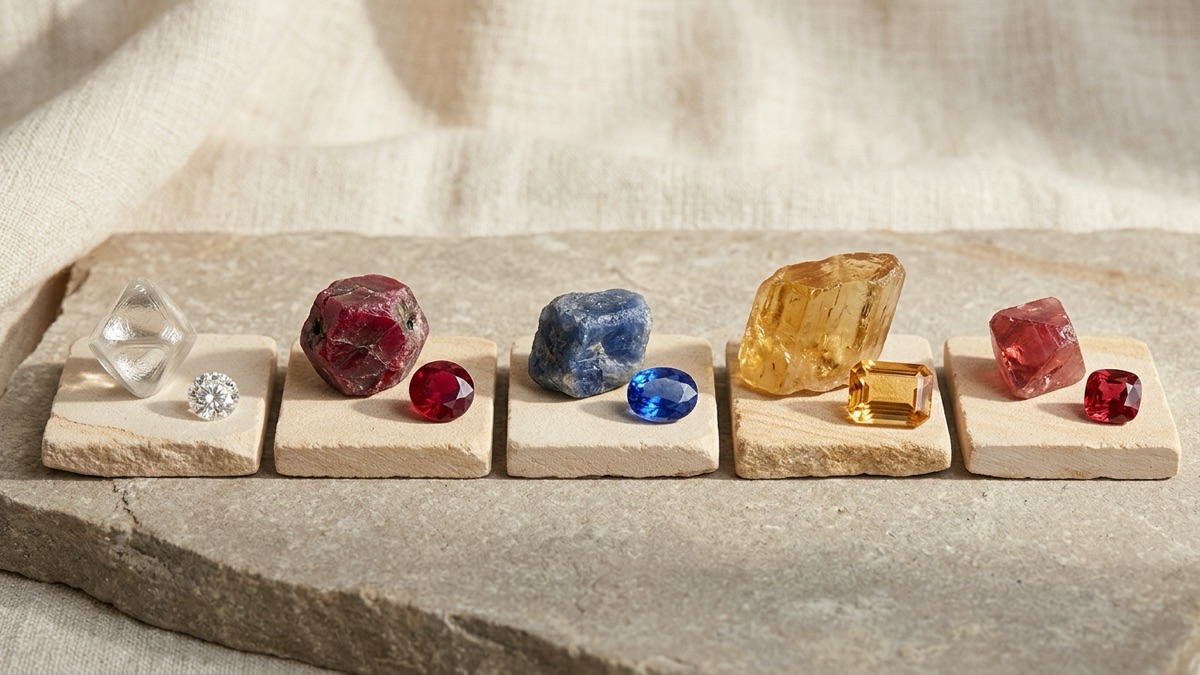
Most of the gems people actually wear live here. The line to watch is 7: at 7 and above, a gem resists the quartz grit in everyday dust.
Medium-hard: 7 and up
| Gem | Mineral | Mohs | Wear notes |
|---|---|---|---|
| Emerald | Beryl | 7.5 to 8 | Inclusions make it prone to chipping |
| Aquamarine | Beryl | 7.5 to 8 | Blue beryl |
| Morganite | Beryl | 7.5 to 8 | Pink beryl |
| Zircon | Zircon | 7.5 | GIA gives colorless zircon 6 to 7.5 and calls it brittle |
| Tourmaline | Tourmaline | 7 to 7.5 | Many colors |
| Quartz (rock crystal) | Quartz | 7 | Scratches glass and steel |
| Amethyst | Quartz | 7 | Purple quartz with good toughness |
| Citrine | Quartz | 7 | Yellow quartz |
| Rose quartz | Quartz | 7 | Pink quartz |
| Smoky quartz | Quartz | 7 | Gray to brown quartz |
| Tiger's eye | Quartz | 7 | Takes the hardness of quartz |
Medium: 5.5 to 7
| Gem | Mineral | Mohs | Wear notes |
|---|---|---|---|
| Garnet | Garnet group | 6.5 to 7.5 | Depends on the garnet species |
| Peridot | Olivine | 6.5 to 7 | USGS lists 7; Auckland gives 6.5 to 7 |
| Agate | Chalcedony | 6.5 to 7 | Banded, a touch below crystal quartz |
| Onyx | Chalcedony | 6.5 to 7 | Black and white banded chalcedony |
| Carnelian | Chalcedony | 6.5 to 7 | Orange-red chalcedony |
| Jasper | Chalcedony | 6.5 to 7 | Opaque chalcedony |
| Chalcedony | Chalcedony | 6.5 to 7 | Microcrystalline quartz |
| Kunzite | Spodumene | 6.5 to 7 | Sudden temperature changes can damage it |
| Tanzanite | Zoisite | 6 to 7 | Sudden temperature changes can damage it |
| Jadeite jade | Jadeite | 6 to 7 | USGS lists jade at 6; very tough |
| Nephrite jade | Nephrite | 6 | Very tough |
| Moonstone | Feldspar | 6 to 6.5 | Feldspar gems scuff more than quartz |
| Labradorite | Feldspar | 6 to 6.5 | Blue flash |
| Sunstone | Feldspar | 6 to 6.5 | Glittery spangles |
| Amazonite | Feldspar (microcline) | 6 to 6.5 | Green feldspar |
| Opal | Opal | 5.5 to 6.5 | Can crack if it dries out or heats up |
| Sodalite | Sodalite | 5.5 to 6 | Royal blue with white veins |
| Rhodonite | Rhodonite | 5.5 to 6.5 | Rose pink, often with black patches |
The soft gems (below 5.5)
These need the most care. A steel blade scratches most of them, and several are soft enough for a copper coin. The USGS notes that organic gems in particular are not as durable as mineral gems.
| Gem | What it is | Mohs | Wear notes |
|---|---|---|---|
| Turquoise | Turquoise | 5 to 6 | Softer end is easy to scuff |
| Lapis lazuli | Rock of lazurite, calcite and pyrite | 5 to 5.5 | Its white calcite patches are softer |
| Larimar | Pectolite | 4.5 to 5 | Keep away from knocks |
| Malachite | Malachite | 3.5 to 4 | Scratches easily in a ring |
| Rhodochrosite | Rhodochrosite | 3.5 to 4 | Pink and soft |
| Pearl | Organic | 2.5 to 4.5 | Chlorine, perfume and makeup harm it |
| Coral | Organic | 3.5 to 4 | A steel blade scratches it |
| Jet | Organic | 2.5 to 4 | A steel blade scratches it |
| Amber | Fossil resin | 2 to 2.5 | A fingernail can mark it |
What are the hardest gemstones?
Diamond is the hardest, at 10. Ruby and sapphire, both corundum, come next at 9, followed by chrysoberyl and alexandrite at 8.5, and topaz and spinel at 8. Our guides to diamond hardness and sapphire and ruby hardness go deeper on the top of the scale.
Lab-made stones often sold as diamond alternatives are not on the chart above, because they are not natural gems. GIA lists synthetic moissanite at 9.25 and cubic zirconia at 8.5, and notes that cubic zirconia scratches more easily than diamond.
What does hardness mean for rings, pendants and earrings?
Here is the everyday problem. GIA points out that sand and dust are made mostly of quartz, which is 7 on the Mohs scale. Anything softer than 7 can be scratched by the grit it meets every day, and wiping a dusty gem can do it too. Over years, that slowly dulls the polish.
Rings and bracelets meet the most grit and the most hard surfaces. GIA's advice is to save softer gems for earrings and necklaces, where there is less risk of hitting a hard surface. It also says amethyst, at 7, works in all jewelry, rings included, as long as the wearer knows its limits. Our amethyst hardness guide covers that stone in detail.
A rough rule of thumb, built from those points:
| Mohs | Everyday ring | Pendant or earrings |
|---|---|---|
| 8 and up | Good choice | Good choice |
| 7 to 8 | Fine with some care | Good choice |
| 5.5 to 7 | Expect scuffs over time | Good choice |
| Below 5.5 | Best for occasional wear | Fine with care |
Hardness is not the only thing to watch. GIA also rates stability, a gem's resistance to chemicals, light, heat and humidity. It warns that a sudden change from very warm to very cold can damage opal, tanzanite, kunzite, apatite and iolite, that opal can crack or craze if it dries out, and that pearl jewelry should be the last thing you put on and the first thing you take off.
Why is toughness different from hardness?
Hardness is resistance to scratching. Toughness is resistance to breaking and chipping, and the two do not always travel together.
- Diamond is the hardest gem, but GIA notes it is not necessarily the toughest: a hard blow can cleave or fracture it. The Mineralogical Society of America adds that diamond has a perfect cleavage and breaks easily along it.
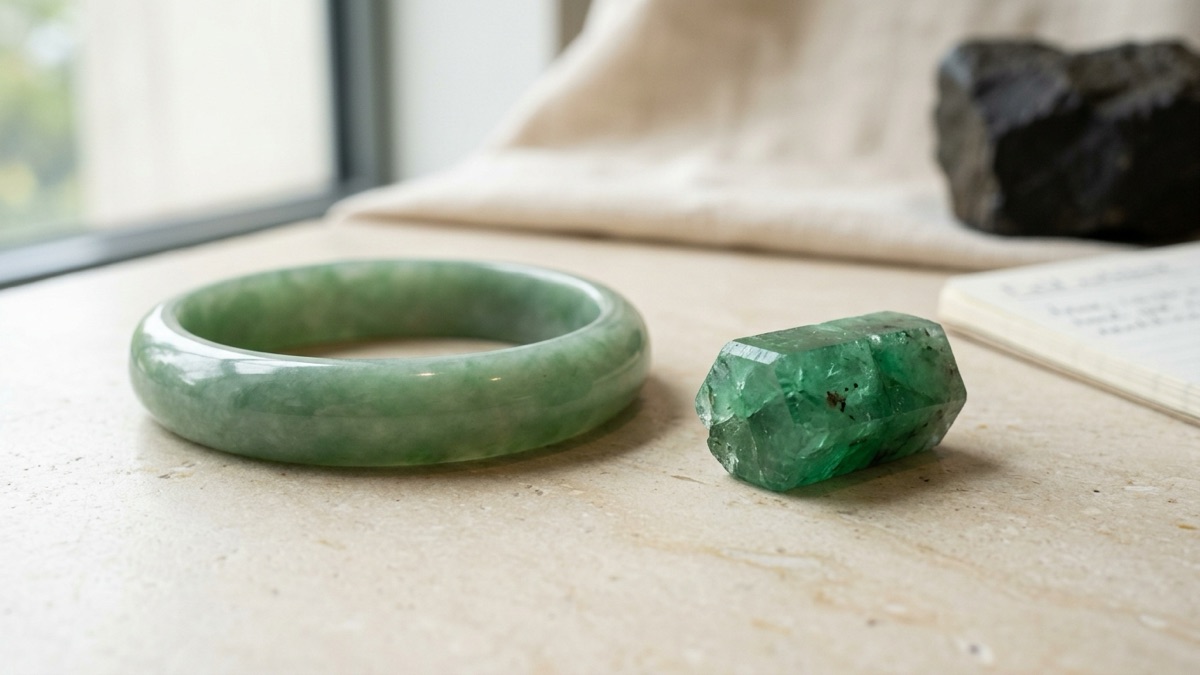
- Jade is only about 6 to 7, yet GIA calls both nephrite and jadeite very tough gems. That toughness is why jade holds up so well to knocks.
- Emerald sits at 7.5 to 8, harder than quartz, but GIA says emeralds are not tough gems to begin with and are often treated with oil or resin. See our emerald hardness guide for how to wear one safely.
- Topaz is a hard 8, but its perfect cleavage means a sharp knock can split it.
Can you use this chart to identify a gem?
Not by scratching it. A scratch test leaves a mark by design, and many gems share nearly the same hardness, so it would damage the stone without settling the question. A qualified gemologist can identify a cut gem with tests that do not harm it; our guide to gemstone identification explains the options. For rough stones you are free to test, the chart tells you what to expect.
Try it
Search any gem in the free Mohs hardness scale tool. Its list shows each gem's hardness, whether it scratches glass and whether a knife scratches it, with the source for every value.
The RockhoundID app, coming soon, will suggest likely matches for rough stones from a photo and tell you which test would confirm them.
The takeaway
Think of 7 as the magic number. Gems at 8 and up (diamond, ruby, sapphire, chrysoberyl, topaz, spinel) handle daily wear best. Gems from 7 to 8, including emerald, aquamarine and the quartz family, do well with a little care. Below 7, and especially below 5.5, save the stone for pendants, earrings and special occasions. And remember that hardness is only half the story: a hard gem can still chip, and a soft one like jade can be remarkably tough.
The pictures in this guide are AI-generated illustrations of what to look for; real specimens vary, so trust the tests over any picture. RockhoundID guides help you narrow down what you found. They suggest likely candidates, not certain identifications or appraisals. For anything valuable, rare or possibly from space, ask a museum, a university geology department or your state geological survey, and check the collecting rules for the land before you take anything home.
Questions rockhounds ask
What is the hardest gemstone?
Diamond, at 10 on the Mohs scale. Ruby and sapphire (both corundum) come next at 9, then chrysoberyl at 8.5 and topaz and spinel at 8. Among lab-made stones, GIA lists synthetic moissanite at 9.25.
Which gemstones are too soft for an everyday ring?
Gems below about 5.5, such as turquoise, lapis lazuli, malachite, pearl and amber, scratch easily in a ring. GIA suggests earrings or necklaces for softer gems, where knocks are less likely.
Is emerald harder than quartz?
Yes, a little. Emerald is beryl at 7.5 to 8 and quartz is 7. But emerald is not a tough gem and often has inclusions, so it chips more easily than its hardness suggests.
What is the difference between hardness and toughness?
Hardness is resistance to scratching. Toughness is resistance to breaking and chipping. Jade is only about 6 to 7 but very tough, while diamond is the hardest gem yet can be cleaved by a hard blow.
Can I scratch test my gemstone to identify it?
Please do not. A scratch test damages the stone, and many gems share similar hardness. A qualified gemologist can test a cut gem without harming it.
Where these facts come from
- USGS: Gemstones, mineral gemstones: pubs.usgs.gov/gip/gemstones/mineral.html
- USGS: Gemstones, organic gemstones: pubs.usgs.gov/gip/gemstones/organic.html
- Handbook of Mineralogy (Mineralogical Society of America): www.handbookofmineralogy.org/
- Handbook of Mineralogy: spodumene (kunzite): www.handbookofmineralogy.org/pdfs/spodumene.pdf
- Handbook of Mineralogy: zoisite (tanzanite): www.handbookofmineralogy.org/pdfs/zoisite.pdf
- Handbook of Mineralogy: jadeite: www.handbookofmineralogy.org/pdfs/jadeite.pdf
- Handbook of Mineralogy: pectolite (larimar): www.handbookofmineralogy.org/pdfs/pectolite.pdf
- University of Auckland: olivine: rocksminerals.flexiblelearning.auckland.ac.nz/minerals/olivine.html
- GIA 4Cs: More than the Mohs scale, understanding gem durability: 4cs.gia.edu/en-us/blog/more-than-mohs-scale-gem-durabil/
- GIA: amethyst care and cleaning: www.gia.edu/UK-EN/amethyst-care-cleaning
- GIA 4Cs: What are simulated diamonds?: 4cs.gia.edu/en-us/blog/what-are-simulated-diamonds/
- Mineralogical Society of America, Mineral Identification Key: hardness: www.minsocam.org/MSA/collectors_corner/id/mineral_id_keyi4.htm
- The Open University, OpenLearn: Minerals and the crystalline state, 3.6 Hardness: www.open.edu/openlearn/science-maths-technology/minerals-and-the-crystalline-sta
Read next
identification
Streak Test: What Your Rock's Streak Color Means