
Blog identification
Crystal Identification: How to Tell What Crystal You Have
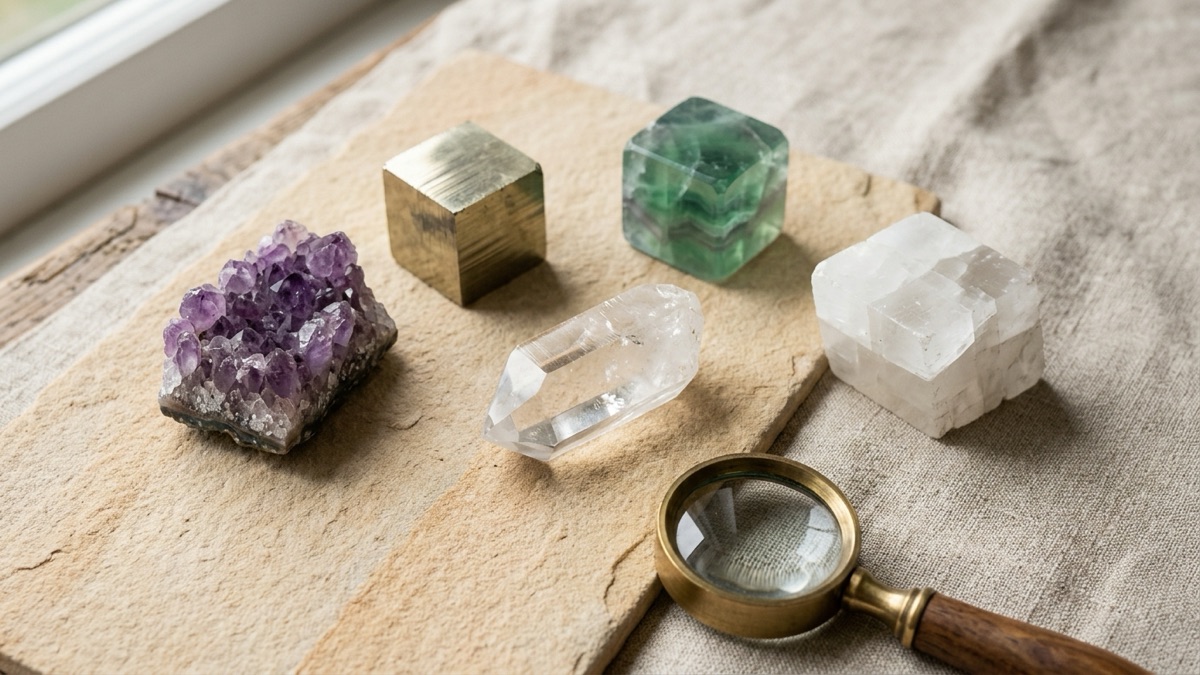
Maybe it came out of a geode you cracked open. Maybe it was in a gift shop bowl, or in a drawer of Grandma's treasures with no label at all. Either way, you are holding a glassy something with flat, shiny faces, and you would love to know its name.
Quick answer
Start with shape, then hardness. Six-sided points that scratch glass are almost always quartz. Glassy cubes that a knife scratches are usually fluorite; brassy cubes that scratch glass are pyrite. Slanted boxes a copper coin scratches are calcite, and soft clear blades your fingernail marks are selenite. Round bubbles inside suggest glass.
Key takeaways
- Crystal shape is your best first clue, as long as the natural faces are still there and not cut or polished.
- Hardness splits most look-alikes: fingernail, copper coin, steel knife and a piece of glass cover the range that matters.
- How a crystal breaks (flat cleavage or curved fracture) is often the tie-breaker.
- Color is the least reliable clue. Quartz and fluorite each come in a rainbow of colors.
- Glass, dyed and coated stones are common in shops, and a 10x lens plus a scratch test catches many of them.
What makes a crystal a crystal?
A crystal is a mineral that grew with its atoms stacked in a regular, repeating pattern, and that inner order shows up on the outside as flat faces meeting at set angles. That is why quartz grows as six-sided columns and pyrite as cubes. The shape is the mineral's signature.
One catch before you start: many shop crystals are cut and polished. A polished "point" or sphere has man-made faces, so its shape tells you nothing. For those, skip straight to hardness, luster and what you can see inside. For natural rough crystals, shape comes first.
Step 1: What shape is your crystal?
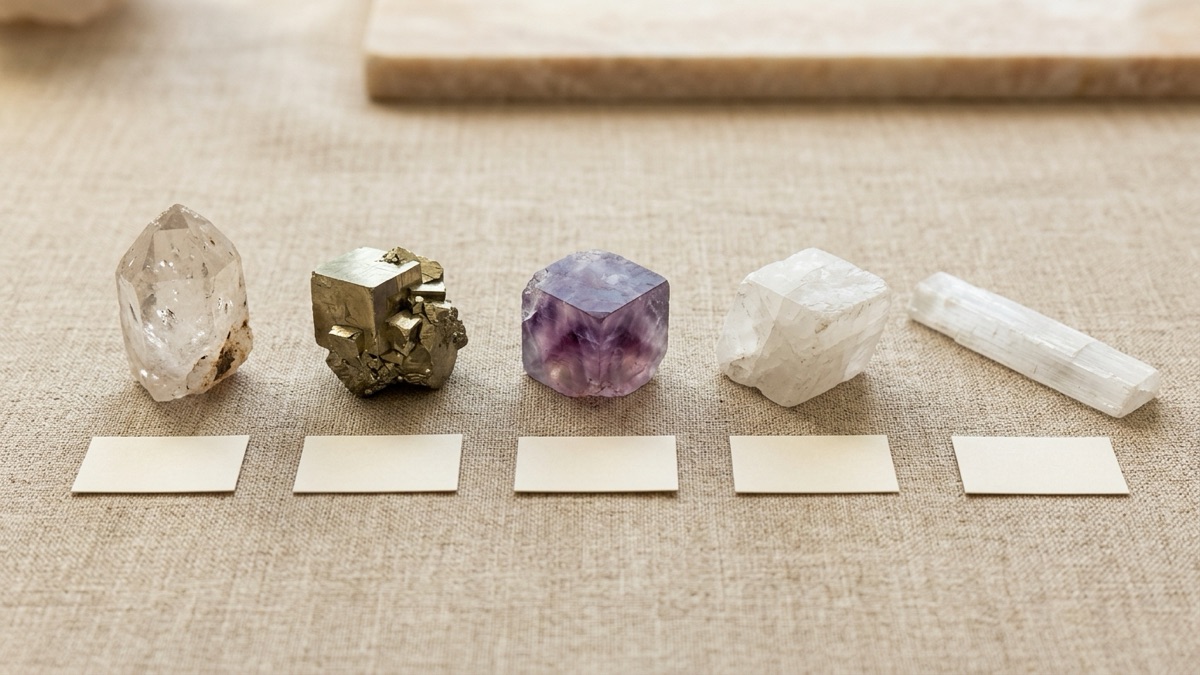
Look at the crystal from every side, especially the ends. Here are the shapes you will meet most often.
- Six-sided column with a pointed tip: quartz. The University of Auckland describes it as a hexagonal prism topped with a six-sided pyramid. Look for fine horizontal lines across the long side faces, a quartz habit noted in the Handbook of Mineralogy.
- Six-sided column that is not quartz: apatite also grows six-sided columns, but at Mohs 5 it cannot scratch glass. Beryl grows six-sided prisms with flat ends and is hard enough (7.5 to 8) to scratch quartz.
- Cube: pyrite if brassy and metallic, often with striped faces; fluorite if glassy and colored; halite (rock salt) if soft and clear to white. Never taste a mineral to check: drop a chip of halite in water instead and it dissolves.
- Eight-sided double pyramid (octahedron): often fluorite, which grows as cubes and octahedrons and splits along octahedral planes.
- Slanted box (rhomb): calcite. Break a piece of calcite and it tends to split into more slanted boxes.
- Flat blades, clear and bendy: selenite, the crystal form of gypsum.
- Long black column with grooves along its length: black tourmaline, whose cross section looks like a rounded triangle.
Our rock identification chart lists these and other common finds side by side.
Step 2: How hard is it?
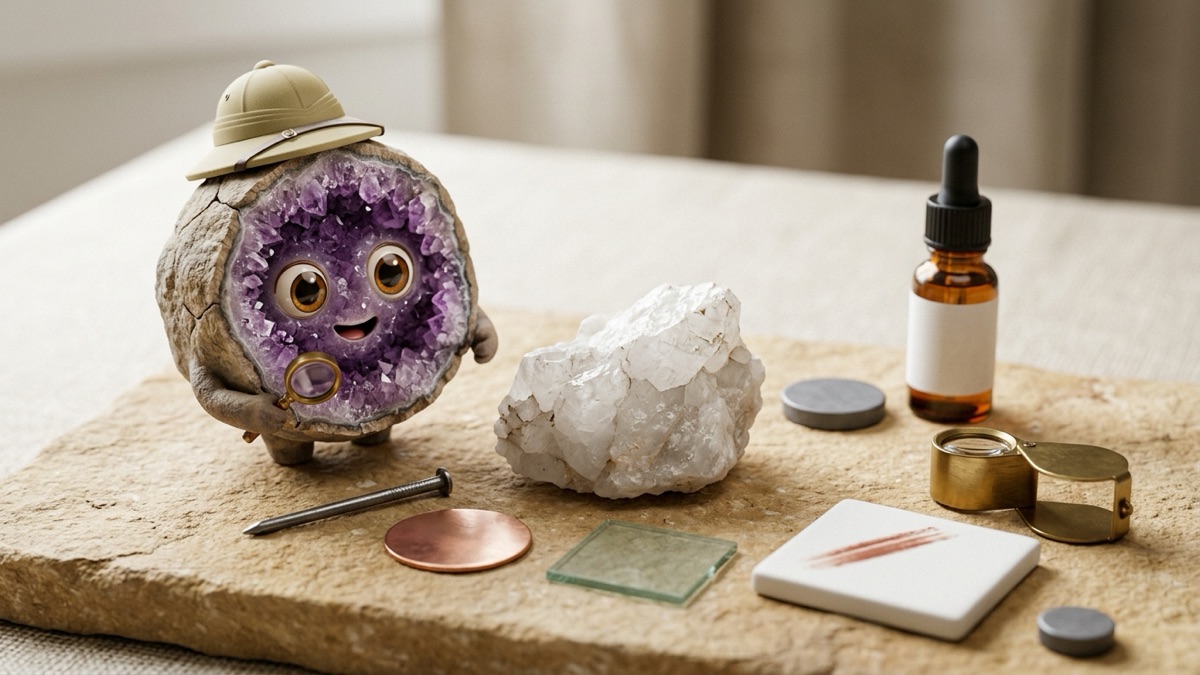
Hardness is how easily a mineral scratches, measured on the Mohs scale from 1 (talc) to 10 (diamond). You do not need a kit. Four everyday testers cover the crystals you are likely to meet:
- Fingernail, about 2 to 2.5: scratches selenite and other gypsum.
- Copper coin (a pre-1983 US penny, or copper wire), about 3: scratches selenite and calcite.
- Steel knife or nail, about 5 to 5.5: scratches calcite, fluorite and apatite.
- Window glass, about 5.5: quartz, topaz and pyrite scratch it; calcite and fluorite do not, and glass fakes struggle to.
Test on a hidden spot, press firmly, and rub the mark with your finger to make sure it is a real groove and not powder from the softer material. The Mineralogical Society of America suggests testing both ways: the crystal on the tester, then the tester on the crystal. Wear safety glasses, because crystal edges chip.
Try it
Pick your crystal and a tester in the free Mohs hardness scale tool and its scratch simulator tells you which one should win, along with the hardness of more than 90 minerals, gems and metals.
Step 3: Does it break flat or curved?
When a crystal breaks, it does one of two things. Cleavage means it splits along flat, shiny planes where its atomic bonds are weakest, and it will do it again and again along the same directions. Fracture means it breaks with no preferred direction, often along curved, shell-like surfaces called conchoidal fracture (the same curved break you see on the edge of broken glass).
This is a great tie-breaker:
- Quartz has no cleavage worth mentioning and breaks with conchoidal fracture.
- Calcite has perfect cleavage in three directions at slanted angles, which is why it breaks into rhombs.
- Fluorite has perfect cleavage in four directions, so broken pieces often have triangular corners and eight-sided shapes.
- Selenite has one perfect cleavage and peels into thin clear sheets. The Handbook of Mineralogy calls gypsum flexible but inelastic: a thin sheet bends and stays bent. Mica sheets, by contrast, spring back.
Look for tiny steps and flat reflective flashes along chipped edges. Those are cleavage planes catching the light.
Step 4: What do luster and light tell you?
Luster is how the surface reflects light. Quartz, fluorite and calcite look glassy (vitreous). Selenite looks pearly on its flat cleavage faces, and satin spar gypsum is silky. Pyrite is metallic, and its streak (the color of its powder on an unglazed tile) is greenish black, not gold. See the streak test guide for how to do it.
Two more light tricks:
- Double image: lay a clear crystal on a printed page. If the letters appear doubled, it is very likely calcite. The University of Auckland lists this double refraction as one of calcite's classic tells.
- Glow under UV: fluorite is frequently fluorescent, meaning it glows under an ultraviolet lamp. Many other minerals glow too, so treat it as a hint, not a verdict.
Fun fact
Apatite's name comes from the Greek for "to deceive," according to the Handbook of Mineralogy, because it was so easily confused with other minerals. Its six-sided green, yellow or blue crystals still fool people, until a knife scratches them.
Crystal identification chart
Use this chart after you have checked shape and hardness. Hardness values come from the Handbook of Mineralogy, the University of Auckland and the USGS.
| Crystal | Shape to look for | Mohs hardness | How it breaks | Quick test |
|---|---|---|---|---|
| Quartz (clear, amethyst, citrine, smoky, rose) | Six-sided column with a point | 7 | Curved fracture, no cleavage | Scratches glass easily |
| Calcite | Slanted boxes (rhombs) | 3 | Perfect, 3 directions | Knife and coin scratch it; double image; fizzes in vinegar |
| Fluorite | Cubes or octahedrons, often purple, green or zoned | 4 | Perfect, 4 directions | Knife scratches it, coin does not |
| Selenite (gypsum) | Clear flat blades | 1.5 to 2 | Perfect, 1 direction, bendy sheets | Fingernail scratches it |
| Pyrite | Brassy cubes with striped faces | 6 to 6.5 | Uneven or curved | Greenish black streak; scratches glass |
| Apatite | Six-sided column, green, yellow or blue | 5 | Poor cleavage | Knife just scratches it; will not scratch glass |
| Halite | Clear to white cubes | 2 to 2.5 | Perfect, 3 directions at right angles | Dissolves in water |
| Black tourmaline | Long grooved black columns | 7 to 7.5 | Very poor cleavage, uneven break | Scratches glass; rounded triangle end |
| Glass imitation | Any shape, often molded | about 5.5 | Curved fracture | Bubbles or swirls under a lens |
If your crystal came out of a geode, the list gets shorter. The Iowa Geological Survey says quartz dominates the insides of Iowa geodes and calcite is common too, and amethyst (purple quartz) is a classic geode lining elsewhere. Our guide to geodes covers the rest.
How do you spot glass, dyed and coated fakes?
Not every shop crystal is what its label says. The Gemological Institute of America (GIA) notes that glass comes in virtually any color and is used to imitate stones such as amethyst, aquamarine and peridot. GIA also describes several treatments you will run into:
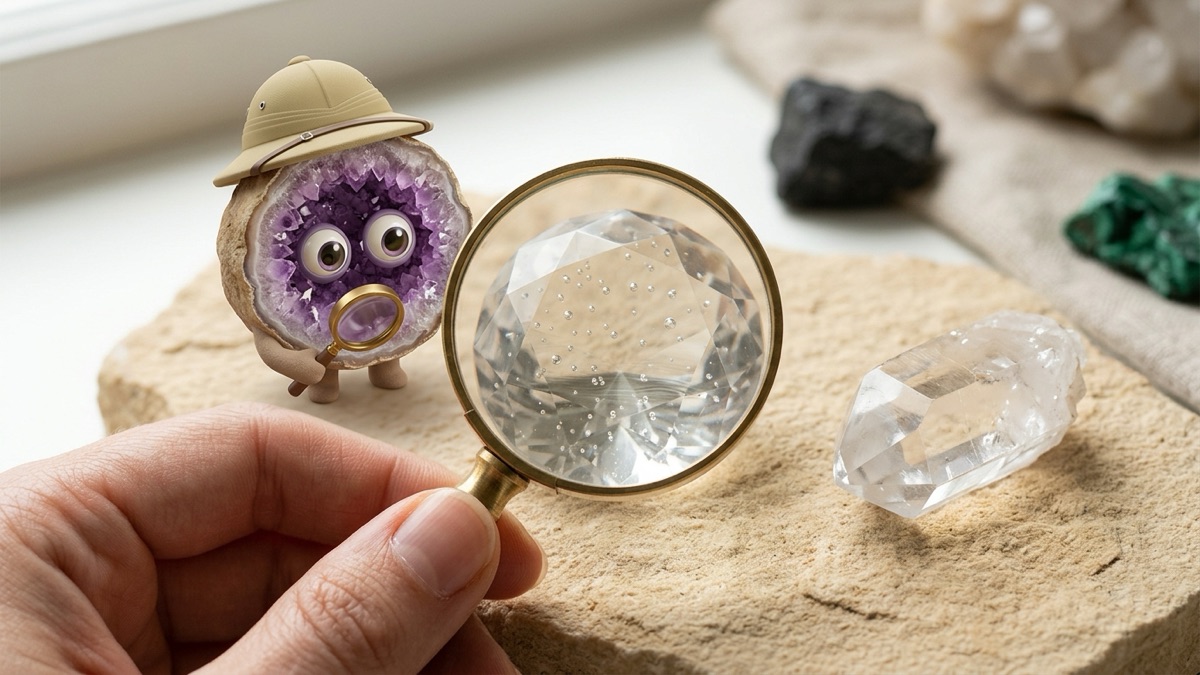
- Glass: look with a 10x lens for round gas bubbles and swirly flow lines, the features GIA's lab cited when it identified a molded glass imitation. Glass is only about 5.5 on the Mohs scale, like window glass, so it struggles to scratch a windowpane, while quartz cuts one easily.
- Dyed stones: GIA lists chalcedony and quartz among materials that are dyed, sometimes after heating cracks into them so the dye can seep in. Color that pools in cracks, or colors that look too bright to be natural, are clues. GIA notes some dyes fade or come off with solvents such as alcohol or acetone.
- Coated quartz: GIA says quartz is occasionally coated with metal oxides to create colors rarely seen in natural quartz, and that coatings are vulnerable to scratching. An unusual metallic sheen on a clear point is a hint.
- Heated amethyst: GIA notes that some amethyst can be heated and turned into citrine. It is still real quartz, just with a helping hand.
Heads up
Never taste or lick a crystal to test it, and keep scratch tests to a hidden spot. If a crystal matters to you or cost real money, a gemologist can test it without damage.
What if you still cannot tell?
Some crystals are genuinely tricky, and that is fine. Our step-by-step guide to identifying rocks adds weight, streak and magnet checks, and the rock identifier asks what you see and test, then narrows it down to a few candidates. Photo apps can suggest names too, and our look at rock identification apps explains what they can and cannot see. The RockhoundID app, coming soon, will suggest likely matches from a photo and tell you which quick test confirms them.
The takeaway
Crystal identification is a short checklist: shape first, then hardness, then how it breaks, then luster and light. Six-sided and harder than glass means quartz. Cubes split into pyrite, fluorite and halite with a scratch and a drop of water. Rhombs mean calcite, bendy blades mean selenite. And if it has bubbles inside, it was probably born in a furnace, not in the ground.
RockhoundID guides help you narrow down what you found. They suggest likely candidates, not certain identifications or appraisals. For anything valuable, rare or possibly from space, ask a museum, a university geology department or your state geological survey, and check the collecting rules for the land before you take anything home.
Questions rockhounds ask
How can I tell if my crystal is quartz or glass?
Try to scratch a piece of window glass with a sharp edge of the crystal. Quartz (Mohs 7) cuts a clear groove, while glass (about 5.5) barely marks glass of the same hardness. Under a 10x lens, round gas bubbles and swirly flow lines point to glass.
What crystal is shaped like a cube?
The common cube-shaped crystals are pyrite (brassy, metallic, scratches glass), fluorite (glassy, often purple or green, scratched by a knife) and halite (rock salt, soft and dissolves in water). A quick scratch test tells them apart.
Is selenite the same as gypsum?
Yes. Selenite is the name for clear, bladed crystals of gypsum, and satin spar is the silky, fibrous form. Both are so soft (Mohs 1.5 to 2) that a fingernail scratches them.
Why does my clear crystal make everything behind it look double?
That is double refraction, and a clear crystal that shows it strongly is very likely calcite. Calcite also breaks into slanted boxes and is soft enough for a copper coin or knife to scratch.
Can you identify a crystal by its color?
Not reliably. Quartz alone comes in colorless, white, pink, yellow, green, blue, violet, brown and black, and fluorite comes in almost every color. Use color as a hint, then check shape, hardness and cleavage.
Where these facts come from
- University of Auckland: quartz: rocksminerals.flexiblelearning.auckland.ac.nz/minerals/quartz.html
- University of Auckland: calcite: rocksminerals.flexiblelearning.auckland.ac.nz/minerals/calcite.html
- University of Auckland: fluorite: rocksminerals.flexiblelearning.auckland.ac.nz/minerals/fluorite.html
- University of Auckland: gypsum: rocksminerals.flexiblelearning.auckland.ac.nz/minerals/gypsum.html
- Handbook of Mineralogy: Quartz: www.handbookofmineralogy.org/pdfs/quartz.pdf
- Handbook of Mineralogy: Pyrite: www.handbookofmineralogy.org/pdfs/pyrite.pdf
- Handbook of Mineralogy: Fluorite: www.handbookofmineralogy.org/pdfs/fluorite.pdf
- Handbook of Mineralogy: Gypsum: www.handbookofmineralogy.org/pdfs/gypsum.pdf
- Handbook of Mineralogy: Fluorapatite (apatite): www.handbookofmineralogy.org/pdfs/fluorapatite.pdf
- Handbook of Mineralogy: Halite: www.handbookofmineralogy.org/pdfs/halite.pdf
- Handbook of Mineralogy: Schorl (black tourmaline): www.handbookofmineralogy.org/pdfs/schorl.pdf
- USGS: Gemstones (mineral gemstones): pubs.usgs.gov/gip/gemstones/mineral.html
- GIA: An Introduction to Simulants or Imitation Gem Materials: www.gia.edu/gem-imitation
- GIA: An Introduction to Gem Treatments: www.gia.edu/gem-treatment
- GIA Gems & Gemology, Fall 2021 Lab Notes: Glass imitation of star sapphire: www.gia.edu/gems-gemology/fall-2021-glass-imitation-star-sapphire
- Iowa Geological Survey: Iowa geodes: iowageologicalsurvey.uiowa.edu/iowa-geology/popular-interest/iowa-geodes
- Mineralogical Society of America: Mineral Identification Key, hardness: www.minsocam.org/MSA/collectors_corner/id/mineral_id_keyi4.htm
Read next
identification
How to Identify Rocks: A Simple 7-Test Method
identification
Rock Identification Chart: Match Your Find in 5 Steps
identification
Rock Identification Apps: What a Photo Can Really Tell
identification
Streak Test: What Your Rock's Streak Color Means