
Blog identification
Rock Identification Apps: What a Photo Can Really Tell
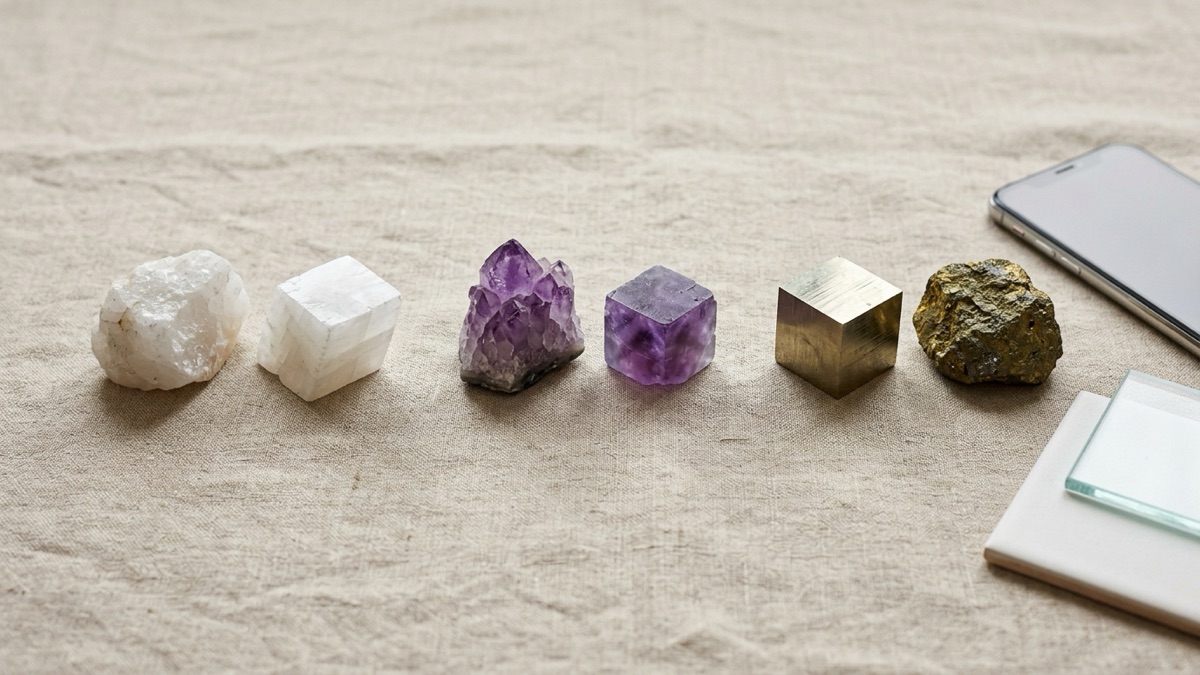
You picked up a rock, pointed your phone at it, and an app gave you a name in seconds. Then a second app gave you a completely different name. So which one is right, and how much can a photo really tell anyone?
Quick answer
A rock identifier app compares your photo with images it has learned from and suggests the closest-looking names. It can read color, crystal shape, banding and grain size, but not hardness, streak, weight or magnetism. Treat the result as a shortlist of candidates, then confirm it with a scratch test and a streak test.
Key takeaways
- A photo shows what a rock looks like, not what it is made of, and many different rocks look alike.
- Apps are good at narrowing the field. They cannot scratch, streak, weigh or magnet-test anything.
- Two apps disagree because they learned from different pictures and because your photo may hide the clues that matter.
- A good photo helps: daylight, something for scale, the whole rock plus a fresh broken face.
- Two quick tests settle most arguments: a scratch test on glass and a streak test on an unglazed tile.
How does a rock identifier app work?
You take or upload a picture, the app compares it with the rocks and minerals it has learned to recognize, and it returns the names that look most similar. Some show one answer and some show several: the App Store listing for Geology Toolkit, for example, says it shows confidence scores and alternatives for tricky specimens.
That is pattern matching, and it is genuinely handy. But the app only ever sees light bouncing off the surface of your rock. It never touches it. A geologist looks first, then tests: scratch it, streak it, heft it, try a magnet. Our complete guide to identifying rocks walks through those checks in order.
What can a photo actually show?
A sharp photo carries more information than you might expect:
- Color. The first thing anyone notices, and the least reliable. The Handbook of Mineralogy lists quartz as colorless or white, and, thanks to impurities, also pink, yellow, green, blue, violet, brown or black.
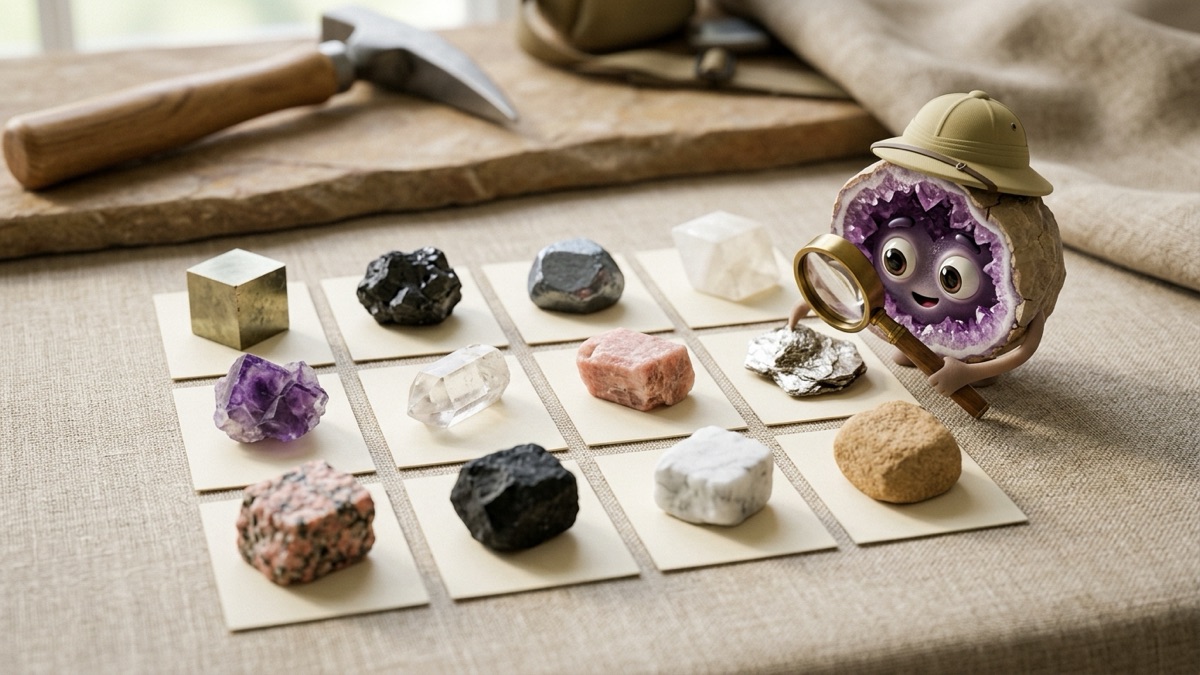
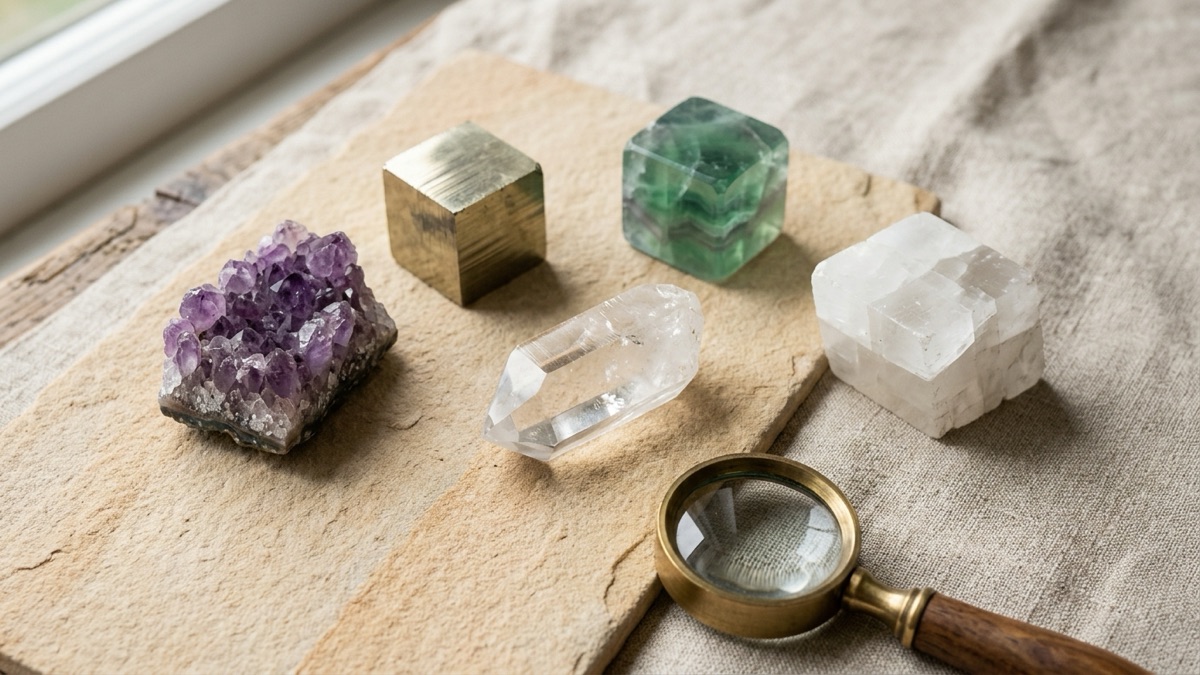
- Crystal shape. A six-sided point, a cube, a slanted box. Our crystal identification guide covers the common shapes.
- Texture and grain size. Big interlocking grains (granite), grains too small to see (basalt), sand grains (sandstone) or none at all (obsidian).
- Banding. Curved rings in agate, flat layers in shale, stripes in gneiss.
- Luster, partly. Luster is how a surface reflects light: glassy, metallic, pearly, dull. The University of Auckland's geology pages note that it has to be seen in person, because photos do not show it well.
What can't a photo show?
The properties that separate look-alikes are mostly invisible to a camera.
| Property | Can a photo show it? | How to check it at home |
|---|---|---|
| Color | Yes, but it misleads | Compare a fresh broken face, dry and wet |
| Crystal shape | Often, if the faces survive | Look at the rock from several sides |
| Grain size and texture | Often, in a sharp close-up | A 10x hand lens |
| Luster | Only partly | Tilt it under a lamp |
| Hardness | No | Scratch test with glass, a steel knife or a copper coin |
| Streak | No | Rub it on the back of an unglazed white tile |
| Weight for its size | No | Heft it next to a similar-sized rock |
| Magnetism | No | A cheap fridge magnet |
| Fizz in acid | No | A drop of vinegar |
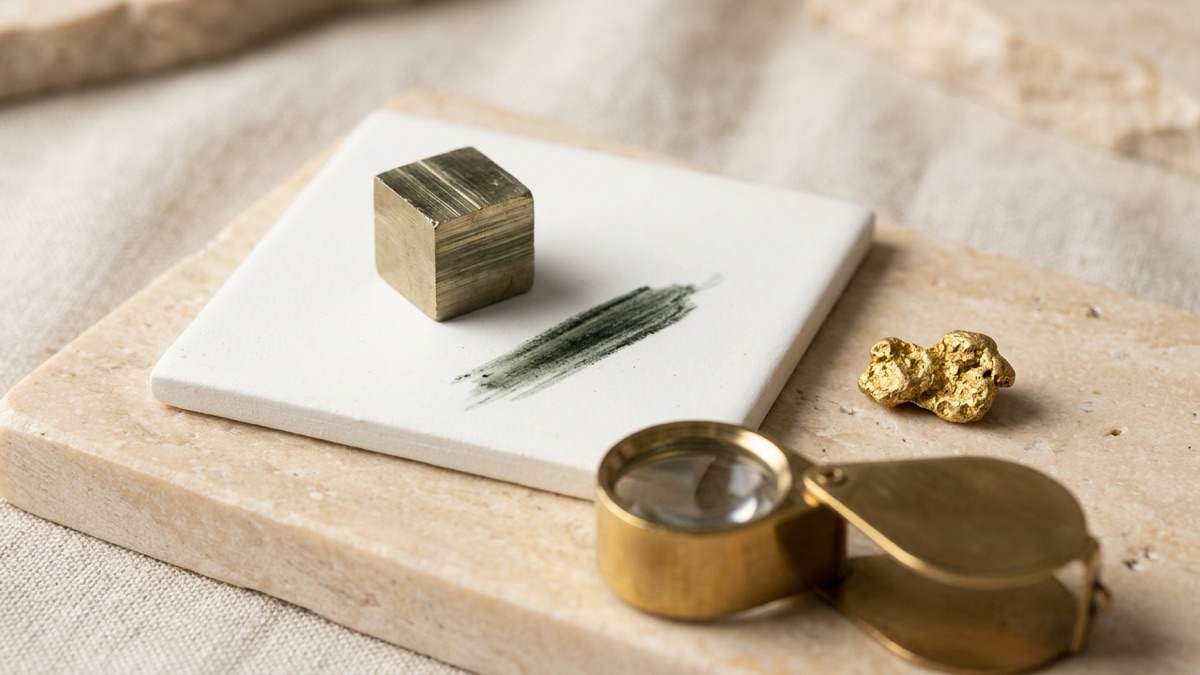
This is why pyrite and gold trip up photo apps, and people too. Both look yellow and metallic. In your hand, pyrite (Mohs 6 to 6.5) scratches glass and streaks greenish black, while gold (Mohs 2.5 to 3) is soft, dents instead of crumbling and is enormously heavy for its size.
Why do two apps give different answers?
Usually neither app is broken. Four things push the results apart:
- Look-alikes are everywhere. White quartz and white calcite, amethyst and purple fluorite, pyrite and chalcopyrite can look almost identical in a photo. What separates them (hardness, cleavage, streak) is exactly what a camera cannot capture.
- Each app learned from different pictures. Every app has its own example images and its own list of names, so the same photo can land closest to different matches.
- Your photo changes the answer. Warm indoor light shifts colors, a wet surface looks glossier, and a weathered skin hides the fresh rock inside.
- An app has to say something. A person can say "I would need to scratch it first." An app shows a name, even for a mixture or a weathered chunk.
Meteorites are the extreme case. Randy Korotev, a retired lunar geochemist at Washington University in St. Louis, has spent years answering questions about rock photos from the public. His site says meteorites cannot be reliably identified from photos, even by experienced finders, and one page is titled "AI (artificial intelligence) image apps cannot identify meteorites."
His reasoning: there are far more high-quality meteorite photos online than well-labeled photos of ordinary look-alikes such as basalt or iron-oxide lumps, so a "looks like" comparison tilts toward "meteorite." In one test he describes, asking an image tool about the same photo three times gave three answers: granite, a meteorite and a bubbly volcanic rock.
Heads up
If an app says "meteorite," do not clean the rock with a wire brush, acid or a torch, and do not pay for lab tests yet. Run the free meteorite checker first. No fusion crust (a thin, dark, glassy skin) and no pull on a cheap fridge magnet means it is almost certainly an Earth rock.
What do the popular apps say they do?
Here is what well-known photo apps say about themselves, taken only from their own US App Store listings as we found them on September 30, 2026. They are listed alphabetically, not ranked, and we have not tested them against each other. Listings change, so check the current page.
RockhoundID is made by Viral Labs and is not affiliated with any other app, museum, lab or dealer named here.
| App (developer) | What its listing says it does | Cost model on the listing |
|---|---|---|
| Geology Toolkit: Field Guide (Laurence Wayne) | Identifies rocks, minerals, crystals and pebbles from photos, explains how they formed, and shows confidence scores and alternatives | Free download; subscription for unlimited identifications |
| Rock & Crystal Identifier (Crystal Council LLC) | Photo identification of rocks, crystals and stones, a collection log, expert chat and a built-in shop | Free download; premium subscription |
| Rock ID - Stone Identifier (AIBY Incorporated) | Snap a picture for an AI suggestion, read a profile, and keep collections and an identification history | Free download; subscription billed weekly, monthly or yearly |
| Rock Identifier: Stone ID (Next Vision Limited) | Take or upload a photo; results include name, chemical formula, hardness, colors and localities; a collection feature and email help | Free download; premium in-app purchases |
| Rockd (University of Wisconsin-Madison Shared Apps) | Geologic maps and summaries for where you stand, plus a field notebook; it is not a photo identifier | Free; no in-app purchases listed |
| Stone Identifier (AppSLabs OU) | Take a photo or pick one from your gallery for a suggestion, and record your finds | Free download; in-app purchases |
Is there a truly free rock identification app? Every photo app above is free to download, but the listings say full or unlimited use needs a subscription or in-app purchase, so read the terms first.
And the best rock identification app? We have not run a side-by-side test, so we will not crown one. The best result from any of them is the one you check with a scratch test. The same goes for a crystal identification app: a photo cannot tell amethyst from purple fluorite, but a piece of glass can.
Try it
The free rock identifier skips the photo entirely. It asks what you can see and test (color, luster, hardness, streak, magnetism) and narrows 66 common rocks, minerals and look-alikes down to a few candidates, each with the one test that confirms it.
How do you take a photo an app can use?
Better photos give better shortlists:
- Use soft daylight and skip the flash, which adds glare and hides texture.
- Add a coin or small ruler for scale.
- Shoot the whole rock, then a close-up of a fresh broken face, since a weathered outside often looks nothing like the inside.
- Try it dry and wet, and skip filters and heavy zoom.
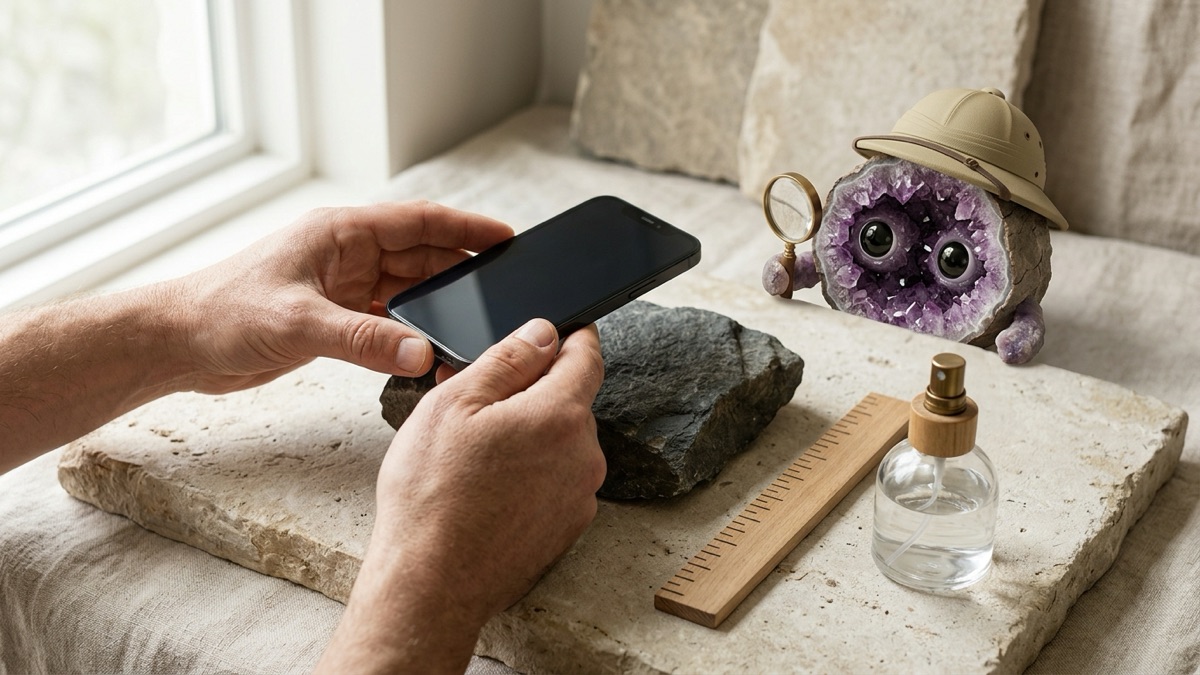
Our guide to photographing a rock for identification covers what experts ask to see.
How do you confirm an app's answer with two quick tests?
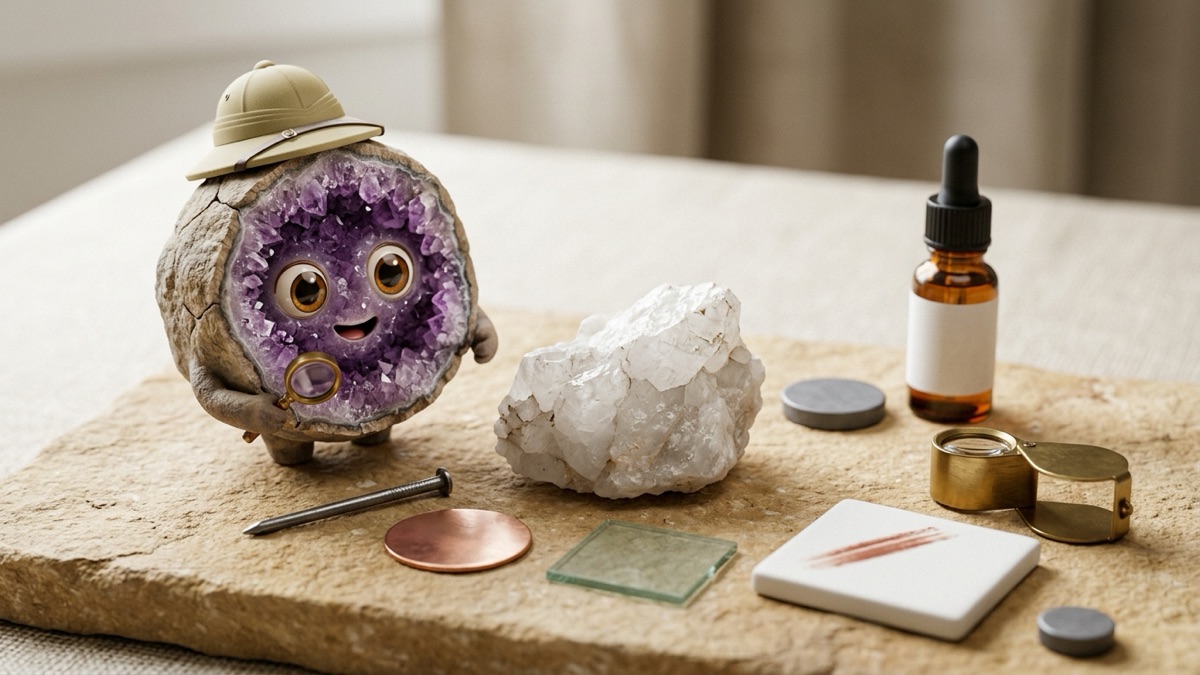
Take the app's top suggestions and look up how they differ. Very often, hardness or streak splits them. Wear safety glasses when you scratch, and test on a hidden spot.
Test 1: the scratch test
Hardness runs on the Mohs scale from 1 (talc) to 10 (diamond). Two everyday testers do most of the work: window glass (about 5.5) and a steel knife or nail (about 5 to 5.5). Press a sharp edge of the rock firmly across the glass. Quartz (7) cuts a clear groove; calcite (3) and fluorite (4) cannot, and a steel blade scratches both. Rub the mark with a finger, because a soft rock can leave a powder line that looks like a scratch. The Mineralogical Society of America suggests testing both ways.
Our Mohs hardness test guide has the full method, and the Mohs hardness scale tool lists more than 90 minerals, gems, metals and rocks.
Test 2: the streak test
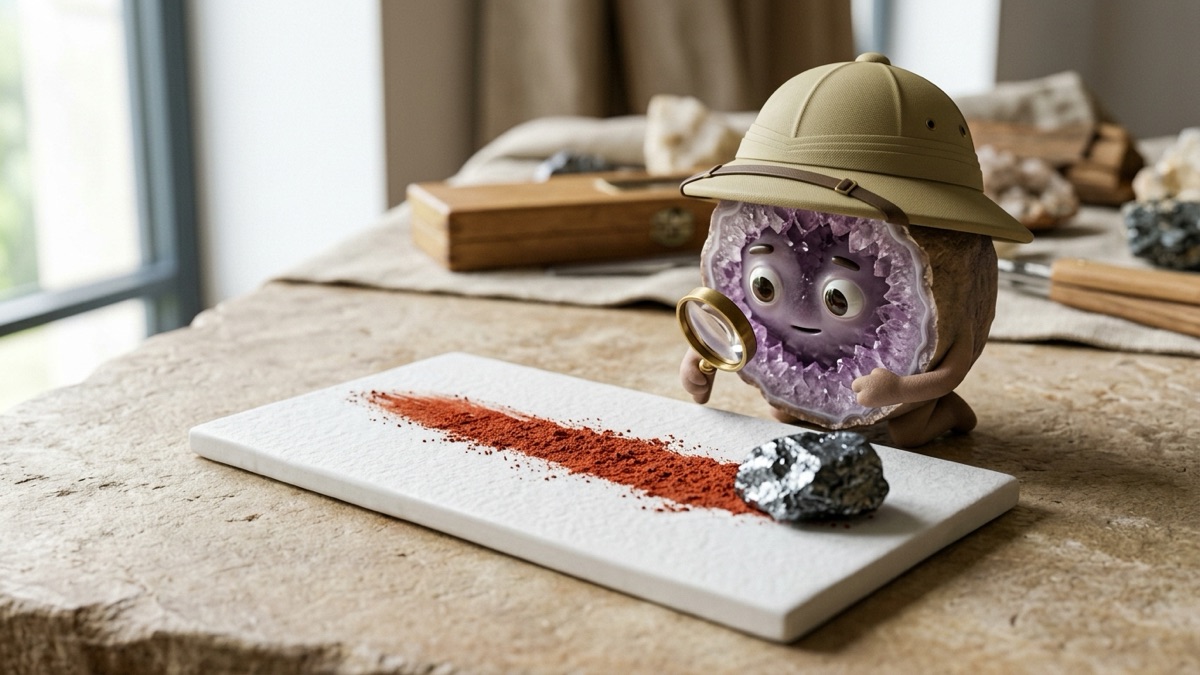
Rub the rock on the back of an unglazed white tile and look at the powder. Pyrite streaks greenish black, hematite red to reddish brown, and most pale minerals white. Minerals harder than about 6.5 leave no streak at all, which is a clue in itself. The streak test guide has a full color key.
A quick example: an app says your glassy yellow crystal is "citrine or calcite." Citrine is quartz, so it scratches glass. Calcite does not, a knife scratches it easily and it breaks into slanted boxes. One scratch and the argument is over. Our rock identification chart lists hardness and streak for common rocks side by side.
When should you ask a person instead?
Whenever the stakes are real. A possible meteorite, a stone you might sell or a crystal you are about to spend serious money on deserves more than a photo match. For meteorites, Arizona State University's meteorite center suggests a state geological survey, a local university geology department or a natural history museum. For value, ask a certified appraiser or a reputable dealer; for gemstones, a gemologist.
An app is a quick first guess that points you at the right tests, not a final answer. The RockhoundID app, coming soon, is built around that idea: it will suggest likely matches from a photo and tell you which quick test confirms them.
The takeaway
A rock identifier app is a good starting point and a poor finishing line. It reads color, shape, banding and grain, then guesses. The properties that settle the question (hardness, streak, weight, magnetism) need your hands, a piece of glass and a white tile. Build a shortlist with the app, run two quick tests, and you will know more about your rock than any photo can tell you.
RockhoundID guides help you narrow down what you found. They suggest likely candidates, not certain identifications or appraisals. For anything valuable, rare or possibly from space, ask a museum, a university geology department or your state geological survey, and check the collecting rules for the land before you take anything home.
Questions rockhounds ask
Are rock identifier apps accurate?
They are useful for narrowing a rock down to a few look-alike candidates, but no app can promise a correct answer from a photo. A photo cannot show hardness, streak, weight or magnetism, which are the properties that separate most look-alikes, so confirm any result with a scratch test and a streak test.
Is there a free rock identification app?
The photo apps we checked on the US App Store on September 30, 2026 were all free to download, and most sell subscriptions for unlimited identifications or full features. RockhoundID's rock identifier, Mohs scale and meteorite checker are free and run in your browser, and they ask questions instead of reading a photo.
Why do two rock apps give different answers for the same rock?
Each app learned from its own collection of example photos and its own list of names, and your photo may hide the clues that matter. Many rocks and minerals also look nearly identical in a picture, so the apps land on different look-alikes.
Can an app tell if my rock is a meteorite?
No. Randy Korotev of Washington University in St. Louis writes that meteorites cannot be reliably identified from photos even by experienced finders. Check for a fusion crust and test with a cheap magnet, then ask a state geological survey, university geology department or natural history museum.
Can a rock app tell me what my rock is worth?
Treat any value an app shows as a rough guess at best. Value depends on the exact identity, quality, size, damage and demand, which need a person to examine the stone. For anything you think is valuable, ask a certified appraiser or a reputable dealer.
Where these facts come from
- Washington University in St. Louis: AI image apps cannot identify meteorites (Randy L. Korotev): sites.wustl.edu/meteoritesite/items/ai-image-apps-cannot-identify-meteorites/
- Washington University in St. Louis: It looks like a meteorite: sites.wustl.edu/meteoritesite/items/it-looks-like-a-meteorite-to-me/
- Washington University in St. Louis: What to do if you think that you have found a meteorite: sites.wustl.edu/meteoritesite/items/what_to_do/
- Handbook of Mineralogy: Quartz: www.handbookofmineralogy.org/pdfs/quartz.pdf
- University of Auckland: lustre: rocksminerals.flexiblelearning.auckland.ac.nz/minerals/lustre.html
- University of Auckland: streak: rocksminerals.flexiblelearning.auckland.ac.nz/minerals/streak.html
- Mineralogical Society of America: Mineral Identification Key, hardness: www.minsocam.org/MSA/collectors_corner/id/mineral_id_keyi4.htm
- App Store: Geology Toolkit: Field Guide (Laurence Wayne), checked 2026-09-30: apps.apple.com/us/app/geology-toolkit-field-guide/id6745966254
- App Store: Rock & Crystal Identifier (Crystal Council LLC), checked 2026-09-30: apps.apple.com/us/app/rock-crystal-identifier/id1553800023
- App Store: Rock ID - Stone Identifier (AIBY Incorporated), checked 2026-09-30: apps.apple.com/us/app/rock-id-stone-identifier/id6469999508
- App Store: Rock Identifier: Stone ID (Next Vision Limited), checked 2026-09-30: apps.apple.com/us/app/rock-identifier-stone-id/id1546796934
- App Store: Rockd (University of Wisconsin-Madison Shared Apps), checked 2026-09-30: apps.apple.com/us/app/rockd/id1153056624
- App Store: Stone Identifier (AppSLabs OU), checked 2026-09-30: apps.apple.com/us/app/stone-identifier/id6443684085
- Arizona State University Buseck Center for Meteorite Studies: sample identification FAQ: meteorites.asu.edu/faq/faq-sample-identification
Read next
identification
How to Identify Rocks: A Simple 7-Test Method
identification
Rock Identification Chart: Match Your Find in 5 Steps
identification
Streak Test: What Your Rock's Streak Color Means