
Blog rock types
The 3 Types of Rocks: Igneous, Sedimentary, Metamorphic
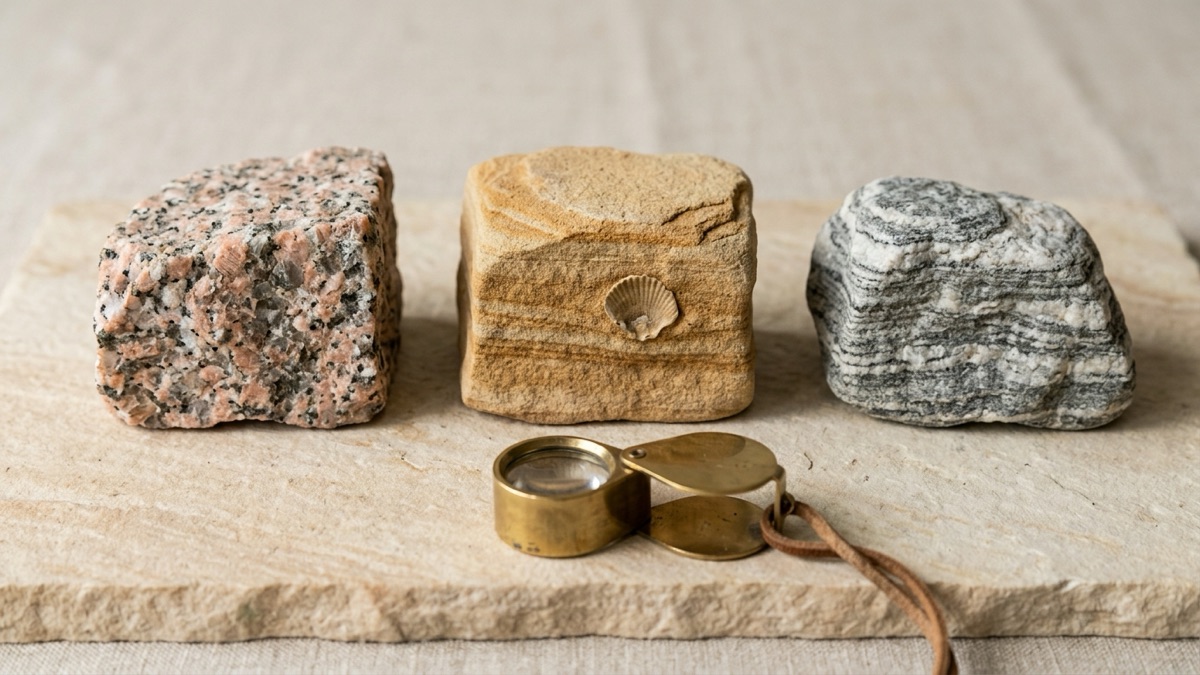
You picked up a rock, and someone asked the classic school question: igneous, sedimentary or metamorphic? It sounds like a quiz with no clues. In fact, most rocks carry the story of how they were made right on their surface, if you know where to look.
Quick answer
The 3 types of rocks are igneous, sedimentary and metamorphic. Igneous rocks form when molten rock cools and hardens. Sedimentary rocks form from pieces of older rock, shells or minerals laid down and cemented, often in layers. Metamorphic rocks are older rocks changed by heat and pressure without melting.
Key takeaways
- Igneous rocks cooled from magma or lava. Look for interlocking crystals, natural glass or gas bubbles.
- Sedimentary rocks are built from sediment. Look for layers, sand grains or pebbles, and fossils.
- Metamorphic rocks were squeezed and heated without melting. Look for bands, flat sheets and lined-up sparkly mica.
- Any rock can become any other type over time. That slow loop is the rock cycle.
- Two quick checks sort many finds: a drop of vinegar (limestone and marble fizz) and a scratch on glass.
What are the 3 types of rocks?
The University of Auckland defines a rock as "a bound aggregate of minerals, mineraloids, or fragments of other rocks." Minerals are the ingredients; a rock is the recipe. Geologists sort rocks into three families by how they formed, and that leaves clues you can see with a hand lens.
Here are the USGS definitions in plain words:
- Igneous (from the Latin word for fire): hot, molten rock crystallizes and solidifies.
- Sedimentary: pieces of older rocks or of once-living organisms pile up at Earth's surface, get buried, lose water and become cemented into rock.
- Metamorphic: a rock that started as igneous, sedimentary or older metamorphic rock and was substantially changed by high heat, high pressure or hot mineral-rich fluids, without melting.
| Type | How it forms | What to look for in the hand | Common examples |
|---|---|---|---|
| Igneous | Molten rock cools and hardens | Interlocking crystals, glass or gas bubbles | Granite, basalt, obsidian, pumice |
| Sedimentary | Sediment is buried, compacted and cemented, or minerals settle out of water | Layers, sand grains or pebbles, fossils, fizz | Sandstone, shale, limestone, conglomerate |
| Metamorphic | Heat, pressure and fluids change an existing rock | Bands, flat sheets, lined-up sparkly mica, garnets | Slate, schist, gneiss, marble |
How do igneous rocks form?
Igneous rocks start as molten rock. Underground it is called magma; once it erupts onto the surface it is called lava, as the USGS volcano glossary puts it. As the melt cools, mineral crystals grow and lock together. If it cools fast enough, it freezes into glass before crystals can form.
Where it cools decides how it looks. The USGS says magma trapped deep underground cools very slowly, over thousands or millions of years, so the mineral grains grow large. These are intrusive rocks, such as granite, diorite, gabbro and peridotite. Lava at the surface cools quickly, which gives a very fine-grained or even glassy texture: extrusive rocks such as rhyolite, andesite, basalt and obsidian.
What to look for in an igneous rock
- Interlocking crystals. In granite, separate grains fit together like a jigsaw, with no sand or cement between them.
- Glass. Obsidian is natural glass that breaks with smooth, curved, shell-like surfaces (conchoidal fracture).
- Bubbles. Gas escaping from lava leaves holes called vesicles, formed by expanding gas while the lava was still fluid, as the National Park Service describes them.
- No fossils and no layers of rounded grains. Those belong to the sedimentary family.
Four igneous rocks you are likely to meet
- Granite: light colored and coarse, like a speckled countertop, with glassy gray quartz, pink or white feldspar and small black specks.
- Basalt: dark gray to black and fine grained, with grains too small to see. The University of Auckland calls it the most widespread of all igneous rocks. Look for scattered bubbles or tiny green olivine grains.
- Obsidian: black to brown glass with razor-sharp curved edges. The USGS says it is usually rhyolitic in composition, the same chemistry as pale rhyolite, even though it looks dark.
- Pumice: pale, frothy and so full of bubbles that rhyolitic pumice is typically light enough to float on water, according to the USGS.
Our guide to igneous rocks covers texture words and twelve common examples.
How do sedimentary rocks form?
Sedimentary rocks are nature's recycling. The USGS explains that sediment carried in rivers settles in lakes and oceans, gets buried, loses water and becomes cemented into rock. The National Park Service splits the results into three kinds: clastic rocks made of broken bits of older rock, biologic rocks made from the remains of living things, and chemical rocks made of minerals that come out of solution in water.
Clastic rocks are named by grain size. From smallest to largest, the USGS lists clay, silt, sand and pebbles, with pebbles larger than 2 millimeters. That is why sandstone feels gritty and mudstone feels smooth.
What to look for in a sedimentary rock
- Layers. Sedimentary rocks "often have distinctive layering or bedding," says the USGS. Look along the side for stripes of different color or grain size.
- Grains and pebbles. Rub the surface. Sand grains that come off on your fingers, or rounded pebbles cemented together, point to a sedimentary rock.
- Fossils. Shells, leaf prints and tracks. The USGS notes that most fossils occur in sedimentary rocks, including shale, limestone and sandstone.
- Fizz. Limestone is mostly calcite, so it bubbles in dilute acid. A drop of vinegar is the kitchen version, and our vinegar test guide shows how to read the result.
Four sedimentary rocks you are likely to meet
- Sandstone: tan, red, yellow, gray or white, and it feels like sandpaper. The University of Auckland puts its grains at 0.06 to 2 mm, big enough to see, mostly quartz and feldspar held together by a natural cement.
- Shale and mudstone: smooth, with no grains you can see. Shale is the kind that splits into thin layers, and it gives a dull thud when you tap it.
- Limestone: gray to cream, often with bits of shell or whole fossils. It is more than half calcite, which is why it fizzes.
- Conglomerate: rounded pebbles cemented together, like natural concrete. If the chunks are sharp and angular instead, the rock is called breccia.
Fun fact
The National Park Service explains that sedimentary rock holds fossils because it was built up layer upon layer, trapping animals, plants and even footprints. That is why fossil hunters skip granite. Our fossil identification guide shows what to look for.
For more kinds and how to tell them apart, see our guide to types of sedimentary rocks.
How do metamorphic rocks form?
Metamorphic rocks are rocks that got a makeover. The USGS describes them as rocks that started out as another type and were substantially changed by high heat, high pressure, hot mineral-rich fluids or, most often, some combination. The key point is in the USGS's own words: "The process of metamorphism does not melt the rocks." Instead, minerals rearrange or new ones grow, and the rock usually becomes denser and more compact.
This happens deep underground, where tectonic plates collide, or next to hot magma that bakes the rock around it.
What to look for in a metamorphic rock
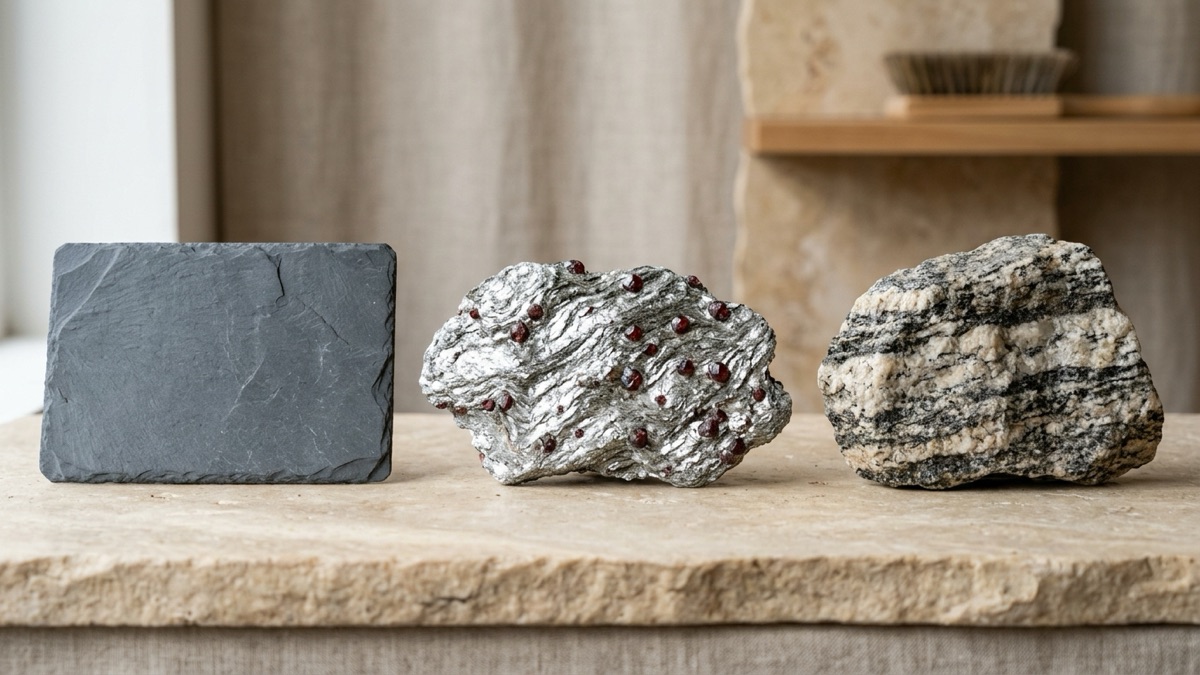
- Foliation, meaning bands and sheets. Pressure squeezes flat or long minerals so they line up, says the USGS, making flat sheets, sparkly wavy layers or light and dark stripes.
- Sparkle from lined-up mica. Tilt the rock under a lamp. If a whole surface flashes at once, the mica flakes all face the same way.
- New crystals. Garnets, small round crystals with many faces, are common in schist, according to the University of Auckland.
- A sugary texture with no layers. Non-foliated rocks such as marble and quartzite form from minerals that do not line up, so they look like packed sugar.
Four metamorphic rocks you are likely to meet
- Slate: fine grained, in gray, black, green or red, and it splits into flat, smooth sheets. It forms from mudstone or shale, and it rings when struck where shale gives a dull thud.
- Schist: shiny and flaky along wavy layers of mica, often dotted with garnets. It forms when mudstone or shale is changed further than slate.
- Gneiss (say "nice"): coarse grained, with alternating light and dark bands that are often wavy. The University of Auckland says it forms from granite or sedimentary rock at higher temperatures and pressures than schist, and unlike schist it does not split along its bands.
- Marble: limestone recrystallized into a sugary mass of calcite crystals, white or softly colored. A steel blade scratches it, and it fizzes in dilute acid.
Marble has a twin that fools everyone: quartzite, which forms from quartz-rich sandstone. It looks just as sugary, but it does not fizz, a steel blade will not scratch it, and it breaks across its grains instead of around them. Our guide to types of metamorphic rocks goes through more of the family.
What is the rock cycle?
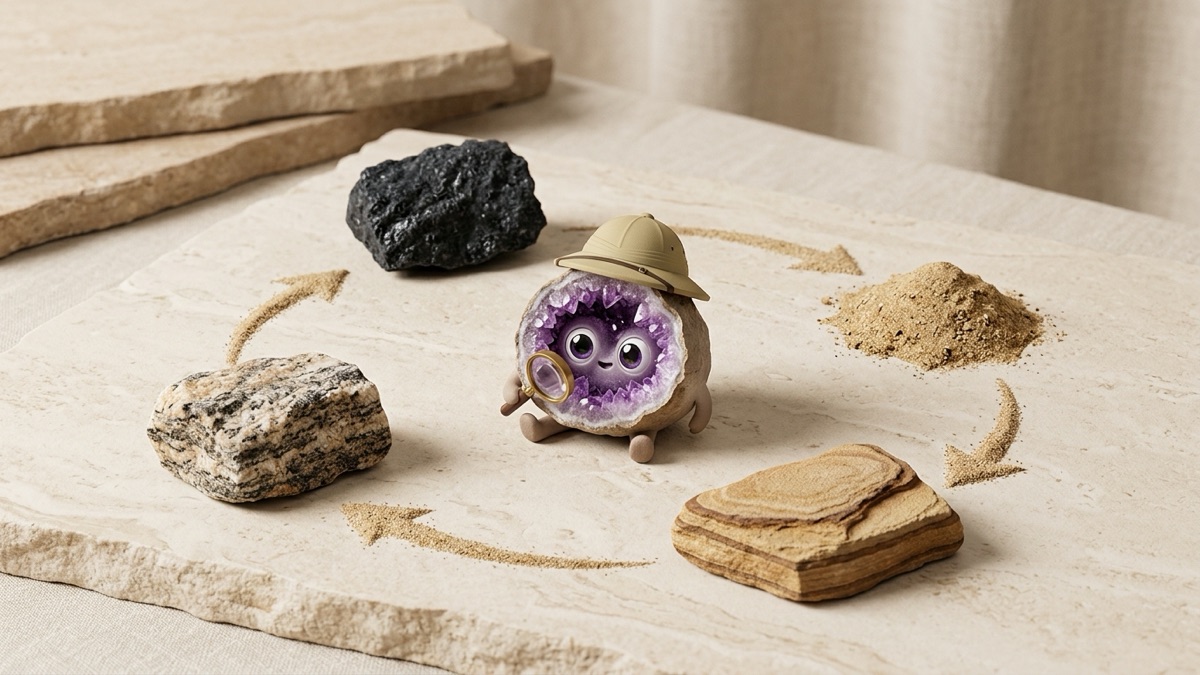
The rock cycle is how the three types turn into one another. The USGS puts it simply: "Any rock can become another rock," like the water cycle but much, much slower, with no fixed starting point.
Picture the diagram as a triangle of the three rock types over a pool of molten rock, with arrows between them:
- Molten rock cools and crystallizes into igneous rock, slowly underground or quickly at a volcano.
- Uplift brings rock to the surface, where it weathers and erodes into sediment: sand, mud and pebbles.
- Sediment is buried, compacted and cemented into sedimentary rock.
- Deep burial or colliding plates add heat and pressure, turning igneous or sedimentary rock into metamorphic rock without melting it.
- Even more heat melts any of them, making new magma, and the loop starts again.
Shortcuts are allowed: UC Berkeley's Understanding Global Change project shows arrows running every which way, driven by uplift, heat and erosion.
How can you tell which type of rock you have?
Work from what you can see to what you can test. Start on a fresh, clean face, because weathered crusts, lichen and dirt hide the clues. Then check, in order: glass or bubbles, how the grains fit together (interlocking crystals or cemented grains), layers and fossils, and lined-up minerals. Our guide on how to identify rocks walks through the full seven-test method.
| What you notice | Likely type | Check next |
|---|---|---|
| Speckled, interlocking crystals | Igneous (intrusive) | Look for glassy quartz and blocky feldspar |
| Black glass or frothy bubbles | Igneous (volcanic) | Rule out man-made slag |
| Sandpaper feel, visible grains | Sedimentary | Rub for loose grains |
| Shells, leaf prints, thin beds | Sedimentary | Vinegar drop on shelly rock |
| Flat sheets that ring when tapped | Metamorphic (slate) | Compare with shale's thud |
| Sparkly, wavy mica layers | Metamorphic (schist) | Hunt for garnets |
| Sugary crystals that fizz | Metamorphic (marble) | A knife scratches it |
Some rocks are honestly tricky. Tuff, made of volcanic ash, can feel gritty like a sedimentary rock, and flow-banded rhyolite can look striped like gneiss. When a rock sits on the fence, write down what you saw and ask a local rock club, a university geology department or your state geological survey.
Try it
Not sure which family your find belongs to? The free rock identifier asks about color, grain, luster, layers and fizz, then suggests likely candidates from 66 common rocks and minerals, each with the one test that separates it. It runs in your browser and uploads no photo.
Tip
A steel knife is about 5 to 5.5 on the Mohs scale and window glass about 5.5. The Mohs hardness scale tool shows which everyday testers will scratch your rock.
Where can you find examples of each type?
Almost anywhere: river gravel and beaches mix all three types, and road cuts show layers. Before you pick anything up, know who manages the land.
- National parks: look and photograph, but do not collect. Federal rules (36 CFR 2.1) prohibit removing rocks, minerals and fossils.
- Bureau of Land Management (BLM) land: you may collect reasonable amounts of rocks and mineral specimens for personal, noncommercial use, except on developed recreation sites or where collecting is prohibited and posted, and without motorized or mechanical digging tools. Check with the local BLM office first.
- Private land: always ask the owner. State parks, national forests and beaches set their own rules, so check the managing agency's page.
Heads up
Wear safety glasses when you break or scratch rocks, because chips fly. Stay off loose road cuts, never climb into old mines, and carry plenty of water in hot, dry country.
The takeaway
Three families, three stories. Crystals, glass and bubbles say the rock was once molten. Layers, grains and fossils say it was built from sediment. Bands, sheets and sparkle say it was squeezed and heated without melting. Look at a fresh face with a lens, add a vinegar drop and a glass scratch when you need them, and most rocks will tell you which family they belong to. The RockhoundID app, coming soon, will suggest likely matches from a photo and tell you which test confirms them.
RockhoundID guides help you narrow down what you found. They suggest likely candidates, not certain identifications or appraisals. For anything valuable, rare or possibly from space, ask a museum, a university geology department or your state geological survey, and check the collecting rules for the land before you take anything home.
Questions rockhounds ask
What are the 3 types of rocks?
Igneous, sedimentary and metamorphic. Igneous rocks cool from molten rock, sedimentary rocks form from sediment that is buried and cemented, and metamorphic rocks are older rocks changed by heat and pressure without melting.
Which type of rock has fossils?
Sedimentary rock. The USGS notes that most fossils occur in sedimentary rocks such as shale, limestone and sandstone, because layers of sediment bury and preserve plants, animals and tracks.
Is obsidian igneous, sedimentary or metamorphic?
Obsidian is igneous. It is natural volcanic glass that forms when lava cools too fast for crystals to grow.
Can one type of rock turn into another?
Yes. That is the rock cycle. Rocks weather into sediment that becomes sedimentary rock, heat and pressure turn rocks metamorphic, and melting makes magma that cools into igneous rock. It just takes a very long time.
How can I tell what type of rock I found?
Look at a fresh broken face with a hand lens. Interlocking crystals, glass or gas bubbles suggest igneous; layers, sand grains or fossils suggest sedimentary; bands, flat sheets or lined-up sparkly mica suggest metamorphic.
Where these facts come from
- USGS: What are igneous rocks?: www.usgs.gov/faqs/what-are-igneous-rocks
- USGS: What are sedimentary rocks?: www.usgs.gov/faqs/what-are-sedimentary-rocks
- USGS: What are metamorphic rocks?: www.usgs.gov/faqs/what-are-metamorphic-rocks
- USGS Educational Resources: the rock cycle ('Any rock can become another rock'): www.usgs.gov/educational-resources/whats-new-weeks-9-12
- USGS Volcano Hazards Program glossary (magma, lava, obsidian, pumice): www.usgs.gov/glossary/volcano-hazards-program-glossary
- USGS image: sandstone block with a large fossil palm leaf (where most fossils occur): www.usgs.gov/media/images/sandstone-block-large-fossil-palm-leaf
- National Park Service: Igneous rocks: www.nps.gov/subjects/geology/igneous.htm
- National Park Service: Sedimentary rocks: www.nps.gov/subjects/geology/sedimentary.htm
- National Park Service: Metamorphic rocks: www.nps.gov/subjects/geology/metamorphic.htm
- National Park Service, Grand Canyon: Fossils: www.nps.gov/grca/learn/nature/fossils.htm
- UC Berkeley, Understanding Global Change: Rock cycle: ugc.berkeley.edu/background-content/rock-cycle/
- University of Auckland: Rocks (the three rock types): rocksminerals.flexiblelearning.auckland.ac.nz/rocks/index.html
- University of Auckland, rocks: Granite: rocksminerals.flexiblelearning.auckland.ac.nz/rocks/granite.html
- University of Auckland, rocks: Basalt: rocksminerals.flexiblelearning.auckland.ac.nz/rocks/basalt.html
- University of Auckland, rocks: Sandstone: rocksminerals.flexiblelearning.auckland.ac.nz/rocks/sandstone.html
- University of Auckland, rocks: Mudstone and shale: rocksminerals.flexiblelearning.auckland.ac.nz/rocks/mudstone.html
- University of Auckland, rocks: Limestone: rocksminerals.flexiblelearning.auckland.ac.nz/rocks/limestone.html
- University of Auckland, rocks: Conglomerate: rocksminerals.flexiblelearning.auckland.ac.nz/rocks/conglomerate.html
- University of Auckland, rocks: Slate: rocksminerals.flexiblelearning.auckland.ac.nz/rocks/slate.html
- University of Auckland, rocks: Schist: rocksminerals.flexiblelearning.auckland.ac.nz/rocks/schist.html
- University of Auckland, rocks: Gneiss: rocksminerals.flexiblelearning.auckland.ac.nz/rocks/gneiss.html
- University of Auckland, rocks: Marble: rocksminerals.flexiblelearning.auckland.ac.nz/rocks/marble.html
- University of Auckland, rocks: Quartzite: rocksminerals.flexiblelearning.auckland.ac.nz/rocks/quartzite.html
- eCFR: 43 CFR 8365.1-5, collecting on BLM public lands: www.ecfr.gov/current/title-43/subtitle-B/chapter-II/subchapter-H/part-8360/subpa
- eCFR: 36 CFR 2.1, preservation of natural resources in national parks: www.ecfr.gov/current/title-36/chapter-I/part-2/section-2.1
- Bureau of Land Management: Rockhounding: www.blm.gov/programs/recreation/rockhounding