Pyrite vs Gold: 6 Tests to Spot Fool's Gold
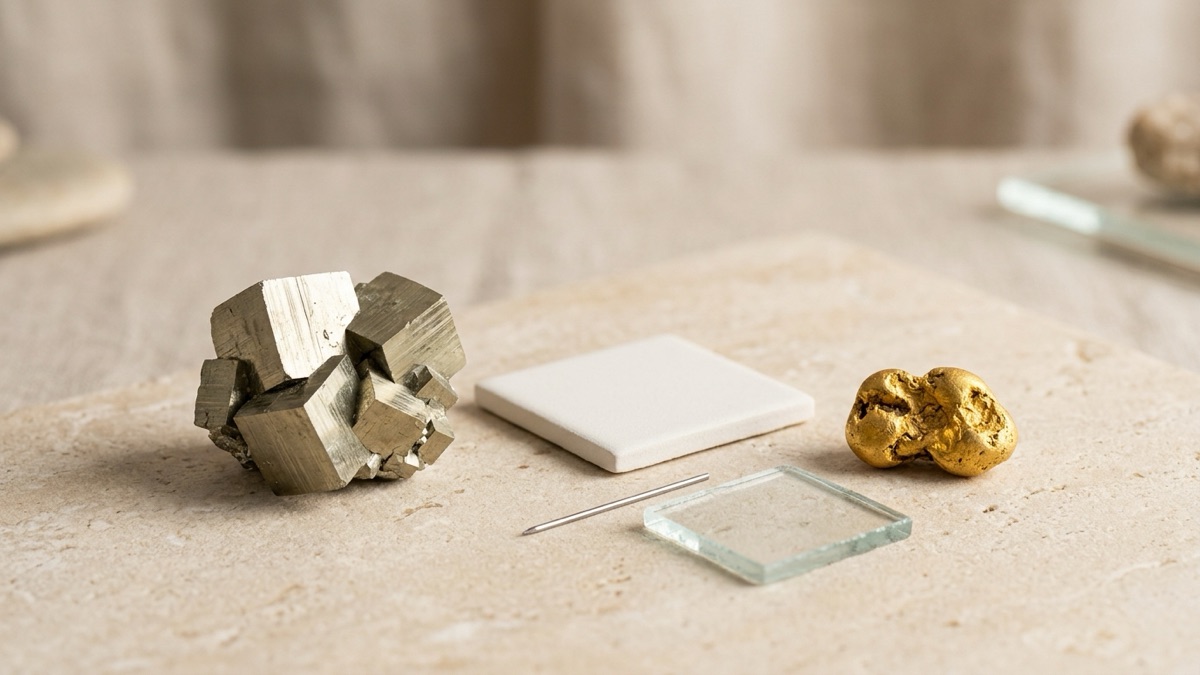
Sunlight hits the gravel in your pan, or a seam in a roadside rock, and something flashes yellow. Your heart does the thing. Then the sensible voice says: probably pyrite. The good news is that you can settle it in a minute with a tile, a pin and a piece of glass, and none of the tests need a lab.
Quick answer
Gold is soft, heavy and yellow through and through: it dents under a pin, leaves a golden yellow streak, and will not scratch glass. Pyrite is hard and brittle: it scratches glass, crumbles under a pin, leaves a greenish black streak and often forms cubes. Chalcopyrite and mica also fool people; both streak the wrong color for gold.
Key takeaways
- The streak test settles most cases: gold streaks golden yellow, pyrite and chalcopyrite greenish black, mica white.
- Gold is soft (Mohs 2.5 to 3) and dents; pyrite is hard (6 to 6.5) and scratches glass.
- Gold is extremely dense, with a specific gravity of 19.3, three to four times that of pyrite.
- Pyrite grows as cubes with striped faces; gold comes as flakes, grains, wires and nuggets, almost never as crystals.
- The USGS names three fool's gold minerals: pyrite, chalcopyrite and weathered mica.
Why does pyrite fool so many people?
Pyrite is iron sulfide, and it is everywhere. The Handbook of Mineralogy calls it the most abundant and widespread sulfide, formed in everything from hot-water veins to sedimentary rocks. It is pale brass-yellow with a bright metallic luster, and a fresh surface in the sun throws off a flash that looks, for a second, like the real thing. Gold is rare and usually shows up as tiny flakes, so most yellow glints in rocks and pans are not gold.
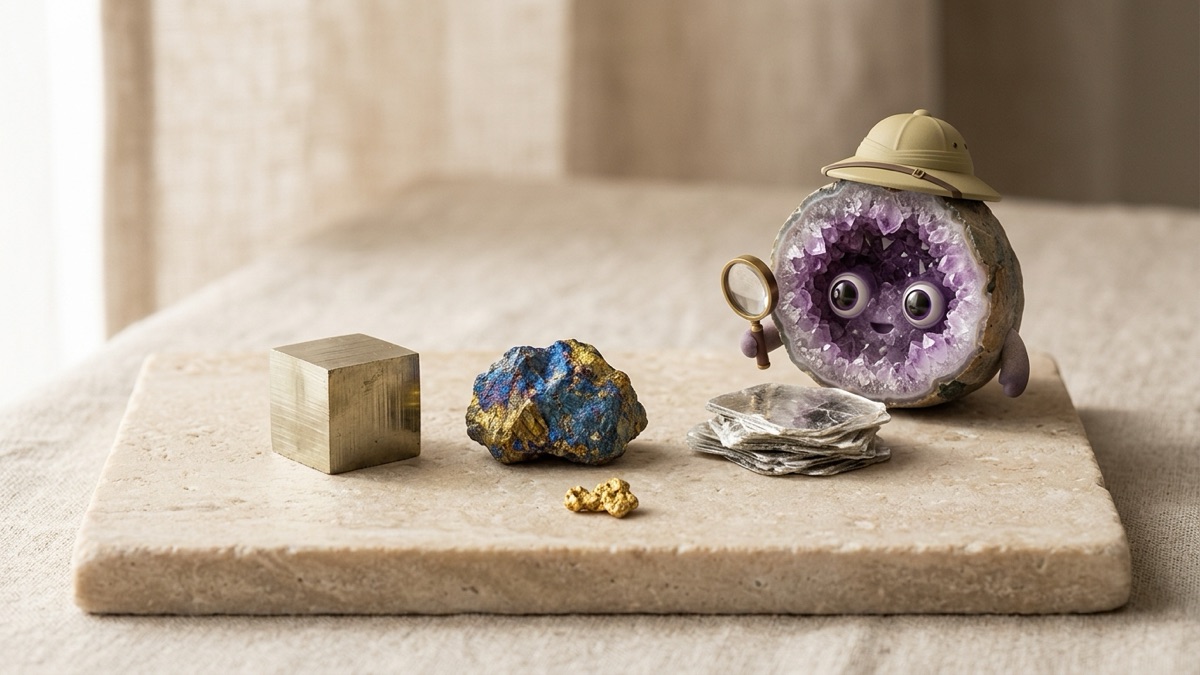
The USGS answers the question "what is fool's gold" with three minerals: pyrite, the most common, plus chalcopyrite (a copper iron sulfide) and weathered mica. Below are six tests, in the order that settles the question fastest, followed by the two extra impostors.
Test 1: What color is the streak?
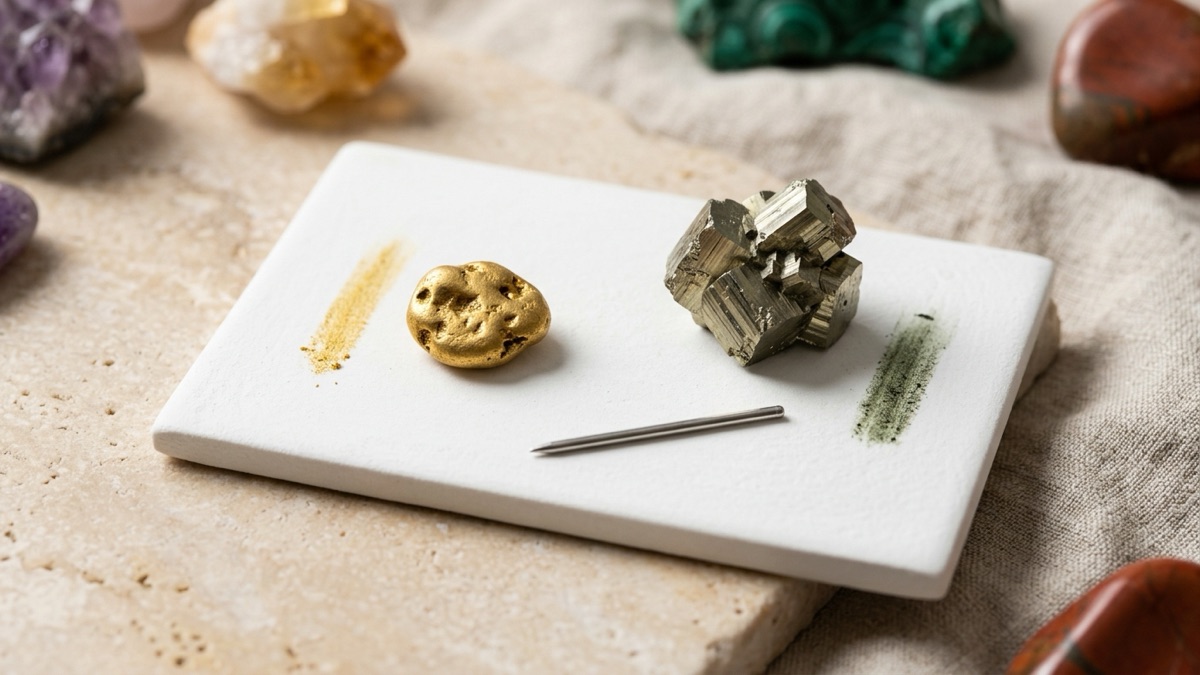
Streak is the color of a mineral's powder, and you get it by rubbing the specimen on an unglazed white porcelain tile (the back of a bathroom tile works). The University of Auckland's streak page makes the point with this exact pair: pyrite is gold colored but streaks greenish black. The USGS says gold leaves a golden yellow streak, pyrite and chalcopyrite leave a dark green to black streak, and the common micas leave a white streak.
That is the whole test. Yellow streak, you may have gold. Greenish black or brownish black, pyrite or chalcopyrite. White, mica. Our streak test guide has the details, including why pyrite, at 6 to 6.5, is right at the limit of what a tile can powder, so press firmly with a corner of the specimen.
Test 2: Does it scratch glass?
Hardness is the next fastest check. The Handbook of Mineralogy gives pyrite a hardness of 6 to 6.5 and gold 2.5 to 3. Window glass sits at about 5.5, so pyrite scratches glass and gold does not come close. The USGS puts it another way: pure gold is about as hard as a penny. The University of Minnesota notes that most knife blades leave pyrite unmarked, while a knife cuts into gold easily.
Do the test both ways, as the Mineralogical Society of America's identification key suggests: try to scratch glass with the specimen, then try to scratch the specimen with a steel knife. Pyrite scratches the glass and shrugs off the knife. Gold does neither. Our Mohs hardness test guide shows how to tell a scratch from a smear.
Test 3: Does it dent or crumble?
This is the prospector's classic, and the USGS describes it plainly: compared with real gold, the fool's gold minerals flake, powder or crumble when poked with a metal point, whereas gold gouges or indents like soft lead. The Handbook of Mineralogy calls gold very malleable and ductile, and the USGS calls it the most malleable and ductile of metals. Pyrite is brittle, with a conchoidal to uneven fracture.
Take a steel pin or the tip of a knife and press into the specimen on a spot that does not matter. Gold takes a dent and keeps its shine inside the dent. Pyrite chips, and the chips are angular and bright.
Tip
On a flake in a gold pan, the pin test is easier than the streak test. Hold the flake down with the pin point and drag: gold smears and flattens, pyrite skids or breaks.
Test 4: What shape is it?
Pyrite loves to crystallize. The Handbook of Mineralogy describes its typical forms as cubes, pyritohedra (twelve-sided crystals with five-sided faces) and octahedra, often with striated faces, meaning fine parallel lines running across each face. If your specimen has sharp square faces or any hint of stripes on those faces, that alone is a very strong pyrite sign. Pyrite also forms granular masses and globular lumps.
Gold almost never shows crystals in the wild. The University of Minnesota says flatly that gold does not exhibit crystals in the way pyrite does. Native gold comes as flakes, grains, wires and rounded nuggets, with what the Handbook calls a hackly fracture: jagged, torn-looking edges rather than clean breaks. Well-formed gold crystals exist, but they are collector rarities. A yellow cube is pyrite.
Test 5: How heavy is it?
Gold is astonishingly dense. The USGS gives pure gold a specific gravity of 19.3, compared with 11.4 for lead, and says impure natural gold runs about 16 to 18 while the waste rock around it is about 2.5. The Handbook of Mineralogy gives pyrite a measured density of about 5.0 and chalcopyrite 4.1 to 4.3. Muscovite mica is under 3.
Specific gravity is simply how many times heavier a mineral is than the same volume of water, and you can feel a difference this large. A gold nugget the size of a pea is a surprising little weight in the palm; a pyrite cube the same size feels like an ordinary heavy rock. In a gold pan the difference does the sorting for you: the USGS explains that gold's density is what lets it be concentrated by gravity, settling to the bottom while lighter grains wash away.
| Property | Gold | Pyrite | Chalcopyrite | Mica (muscovite) |
|---|---|---|---|---|
| Streak | Golden yellow | Greenish black to brownish black | Greenish black | White |
| Mohs hardness | 2.5 to 3 | 6 to 6.5 | 3.5 to 4 | 2 to 2.5 |
| Under a pin | Dents, smears | Chips, crumbles | Crumbles | Splits into flexible flakes |
| Specific gravity | 19.3 (natural 16 to 18) | About 5.0 | 4.1 to 4.3 | About 2.8 |
| Typical form | Flakes, grains, wires, nuggets | Cubes with striped faces, masses | Masses, rare crystals | Thin sheets and flakes |
| Tarnish | None | Darker, sometimes iridescent | Rainbow blues and purples | Dulls and browns on weathering |
Hardness values are from the Handbook of Mineralogy; the free Mohs hardness scale lists all of them.
Test 6: What color is it in the shade?
Color is the least reliable test, which is why it comes last, but it still helps once you know what to look for. The USGS describes pure gold as sun yellow, with a metallic luster, and explains that gold is a noble metal that does not oxidize under ordinary conditions. Pyrite, per the Handbook of Mineralogy, is pale brass-yellow and tarnishes darker and iridescent; the University of Minnesota calls it pale brassy yellow.
So step out of direct sun, or cup the specimen in your hand. Gold's warm yellow is the color of the metal itself and stays the same at any angle. Pyrite's yellow is paler and brassier, closer to a new brass fitting than to a wedding ring, and much of its flash comes from its metallic luster reflecting light; turn it from the sun and the flash fades. Any dark, brown or rainbow tarnish is a point against gold, because gold does not oxidize.
Fun fact
The Handbook of Mineralogy says pyrite takes its name from the Greek word for fire, because sparks can be struck from it. A rock that makes sparks when hit with steel is telling you it is hard and brittle, two things gold never is.
What about chalcopyrite and mica?
Pyrite is the famous impostor, but the USGS lists two more, and each catches people in a different setting.
Chalcopyrite is a copper iron sulfide and a very common copper ore. The Handbook of Mineralogy describes it as brass-yellow, often tarnished and iridescent, with a greenish black streak and a hardness of only 3.5 to 4. That softness is the trap: chalcopyrite, like gold, can be scratched with a knife, so the hardness test alone does not separate them. Use the streak (greenish black, not yellow), the pin test (it crumbles rather than dents), the rainbow tarnish that gold never shows, and the heft: chalcopyrite's specific gravity is about 4, a fraction of gold's.
Mica, especially weathered muscovite and biotite, is the flake that fools people in a gold pan or a sunny creek bed. Tiny flakes of mica catch the light and glitter gold or silver. But the University of Auckland notes that muscovite splits into thin, flexible, elastic sheets, and it is only 2 to 2.5 on the Mohs scale. Push a mica flake with a pin and it bends, springs back or splits into thinner flakes; it does not dent like metal. Its streak is white, and it is so light that it washes out of the pan easily while gold sits stubbornly at the bottom.
Is it pyrite or gold in quartz?
Both can turn up as yellow specks in white quartz, so the host rock alone settles nothing. The University of Minnesota's mineral pages say pyrite occurs in most hydrothermal veins and is commonly found in quartz and calcite veins with chalcopyrite and other sulfides. They also note that vein pyrite can hint that gold or chalcopyrite is nearby, which is why prospectors look twice at it.
You can still test the specks without breaking them out of the quartz:
- Shape. The same University of Minnesota page says gold does not form crystals the way pyrite does, while pyrite often shows flat crystal faces. Neat little cubes or sharp faces in the quartz point to pyrite.
- The pin test. Press a steel pin into one yellow grain. The USGS says gold gouges or indents, while pyrite flakes, powders or crumbles.
- Shade. Turn the specimen away from the sun. Gold keeps the same warm yellow at any angle, while pyrite's paler, brassier flash fades (Test 6).
- Not the heft. In a quartz specimen, the quartz makes up most of the weight, so how heavy it feels tells you little about the specks.
If the specks dent and stay yellow in the shade, the specimen deserves a closer look from a club, a rock shop or your state geological survey before you hammer it apart.
What if it passes every test?
If your specimen leaves a yellow streak, dents under a pin, will not scratch glass, feels far too heavy for its size and shows no tarnish, you may have gold, and it is time for a careful next step rather than a celebration post. Gold in a pan is often mixed with black sand and other heavy minerals, so keep testing individual grains. Our guide to gold panning for beginners covers how to work a pan and where you are allowed to do it.
Where you found it matters as much as what it is: gold on a mining claim belongs to the claim holder, and national parks allow no collecting at all. Our rocks worth money hub explains how value is judged, and our guide to how much pyrite is worth covers the consolation prize: good pyrite cubes have a market of their own.
Try it
Not sure which yellow mineral you are looking at? Answer a few questions about streak, hardness and weight in the free rock identifier and it will suggest likely candidates. A photo alone cannot separate gold from pyrite; the tile and the pin can.
The RockhoundID app, coming soon, will suggest likely matches from a photo and tell you which test confirms them.
The takeaway
Gold is soft, heavy and yellow all the way through. Pyrite is hard, brittle and brassy, and it loves to grow cubes. Streak it, press it with a pin, try it on glass, look at its shape, feel its weight and check its color in the shade, and fool's gold will not fool you for more than a minute. Then remember the two understudies: chalcopyrite with its rainbow tarnish, and mica with its bendy, glittering flakes.
The pictures in this guide are AI-generated illustrations of what to look for; real specimens vary, so trust the tests over any picture. RockhoundID guides help you narrow down what you found. They suggest likely candidates, not certain identifications or appraisals. For anything valuable, rare or possibly from space, ask a museum, a university geology department or your state geological survey, and check the collecting rules for the land before you take anything home.
Questions rockhounds ask
What is the fastest way to tell pyrite from gold?
Rub it on an unglazed white tile. Gold leaves a golden yellow streak; pyrite leaves a greenish black to brownish black one. If you have no tile, press a steel pin into it: gold dents like soft lead, pyrite flakes or crumbles.
Is fool's gold worth anything?
Pyrite has no value as a precious metal, but good crystal specimens, especially sharp cubes, sell to collectors. Pyrite is also the most abundant sulfide mineral, so ordinary pieces are cheap. It is worth keeping for the crystals, not the shine.
Does pyrite scratch glass?
Yes. Pyrite is 6 to 6.5 on the Mohs scale, harder than window glass at about 5.5. Gold is only 2.5 to 3, about the hardness of a copper penny, and will not scratch glass. Chalcopyrite, at 3.5 to 4, does not scratch glass either.
Why does gold feel so heavy?
Pure gold has a specific gravity of 19.3, meaning it weighs more than 19 times as much as the same volume of water. Pyrite is about 5, chalcopyrite about 4, and mica under 3. A gold flake of the same size as a pyrite grain is three to four times heavier.
Can chalcopyrite be mistaken for gold?
Yes, and the USGS lists it as one of the three fool's gold minerals, along with pyrite and weathered mica. Chalcopyrite is brass-yellow, often with a rainbow tarnish, and is soft enough for a knife to scratch, which gold is too, so use the streak test: chalcopyrite streaks greenish black.
Where these facts come from
- USGS FAQ: What is fool's gold?: www.usgs.gov/faqs/what-fools-gold
- USGS: Gold (general interest publication): pubs.usgs.gov/gip/prospect1/goldgip.html
- Handbook of Mineralogy: Gold: www.handbookofmineralogy.org/pdfs/gold.pdf
- Handbook of Mineralogy: Pyrite: www.handbookofmineralogy.org/pdfs/pyrite.pdf
- Handbook of Mineralogy: Chalcopyrite: www.handbookofmineralogy.org/pdfs/chalcopyrite.pdf
- Handbook of Mineralogy: Muscovite: www.handbookofmineralogy.org/pdfs/muscovite.pdf
- University of Minnesota, Common Minerals: Pyrite: commonminerals.esci.umn.edu/minerals-o-s/pyrite
- Kansas Geological Survey: Kansas rocks and minerals, minerals: www.kgs.ku.edu/Publications/Bulletins/ED2/04_mine.html
- University of Auckland: Streak: rocksminerals.flexiblelearning.auckland.ac.nz/minerals/streak.html
- University of Auckland: Muscovite: rocksminerals.flexiblelearning.auckland.ac.nz/minerals/muscovite.html
- Mineralogical Society of America: Mineral identification key, hardness: www.minsocam.org/MSA/collectors_corner/id/mineral_id_keyi4.htm