Guides fossils
Fossil Identification: How to Name the Fossils You Find
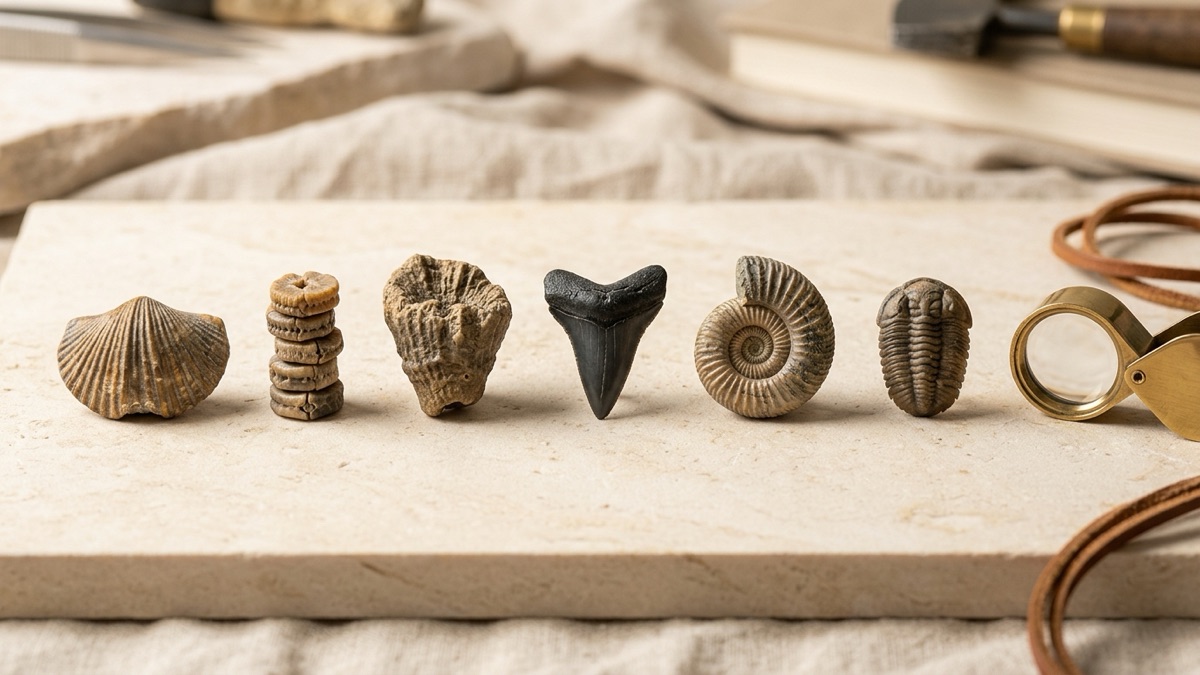
You flip over a slab of gray limestone on a creek bank and there it is: a tiny ribbed shell, a stack of stone disks, a little stone horn. Something lived here once. The fun part is working out what.
Quick answer
Most fossils you will find are ordinary seafloor animals: brachiopod shells, crinoid stem disks, horn corals and shark teeth. Identify them by shape first (symmetry, rings, radiating ridges, serrated edges), then check the rock they came from. Most fossils come from sedimentary rocks such as limestone and shale. Concretions and mineral stains are the usual look-alikes.
Key takeaways
- A fossil is evidence of past life preserved in rock or sediment: a shell, bone, tooth, leaf, track or burrow.
- Shape does most of the work. The common fossils can usually be sorted into their group with a few careful observations.
- Look where fossils form: sedimentary rocks such as limestone, shale and sandstone. Volcanic rock rarely holds them.
- Round lumps with rings inside, cracked "turtle shells" and black fern-like stains are usually concretions or mineral growths, not fossils.
- On BLM land and in national forests you may collect reasonable amounts of common invertebrate and plant fossils. Vertebrate fossils on federal land need a permit, and national parks allow no collecting at all.
What counts as a fossil?
The National Park Service puts it simply: a fossil is evidence of past life found in a geologic setting, such as a sedimentary rock, a cave or even a lava flow. That covers two big groups. Body fossils are parts of the organism itself (shells, bones, teeth, wood, leaves) plus the molds and casts they left behind. Trace fossils are signs of what an animal did: footprints, trails, burrows and fossil dung.
Most fossils are no longer the original material. Minerals carried by groundwater fill the tiny pores in bone, wood and shell, which geologists call permineralization, or take the place of hard parts that dissolved away, called replacement. That is why a fossil shell can be made of quartz and a fossil tooth can be jet black.
The NPS also flags things that only look alive. Manganese dendrites, the black fern-like patterns you see on rock faces, are mineral coatings. They are pretty, but they carry no evidence of life, so they are not fossils.
Where do fossils turn up?
Fossils come from sedimentary rocks and loose sediments: limestone, shale, sandstone, clay and sand laid down in old seas, lakes and rivers. The Missouri Geological Survey notes that fossils are often found in limestone, and the Florida Museum explains that fossil shark teeth come from sediments that were first laid down on the seafloor. If you are not sure what kind of rock you are holding, our guide to the three types of rocks shows how to tell sedimentary layers from igneous and metamorphic rock.
Your best clues are where you stand and what the rock looks like. Creek beds, beaches, road cuts and eroding bluffs expose fresh layers. A geologic map (the USGS keeps a national database of them) tells you how old the local rock is, which rules whole groups in or out. No dinosaur has ever been found in Kentucky, for example, because almost all of the state's rock is older than the dinosaurs.
Common fossil identification chart
These are the finds that fill most beginner collections, with the clue that gives each one away. The age ranges come from the museum and survey pages in our sources list.
| Fossil | What to look for | When it lived |
|---|---|---|
| Brachiopod | Two unequal shells; each shell is symmetrical down its middle | Cambrian to today; most common in the Paleozoic |
| Crinoid stem | Small stone disks, generally under 1 cm, often with a round or star-shaped hole; may be stacked like poker chips | Ordovician to today; the Mississippian is called the Age of Crinoids |
| Horn coral | A stone horn or cone, wrinkled outside, with a cup of radiating ridges | Ordovician to the end of the Permian |
| Shark tooth | A shiny blade-shaped crown on a duller root; edges smooth or serrated | Many ages; megalodon lived about 20 to 3 million years ago |
| Trilobite | Three lobes running head to tail; a head, a segmented body and a tail, usually 1 to 2 inches long | About 540 to 250 million years ago |
| Ammonite (ammonoid) | A coiled, chambered shell with wavy, complex suture lines | Ammonoids: Devonian to the end of the Cretaceous |
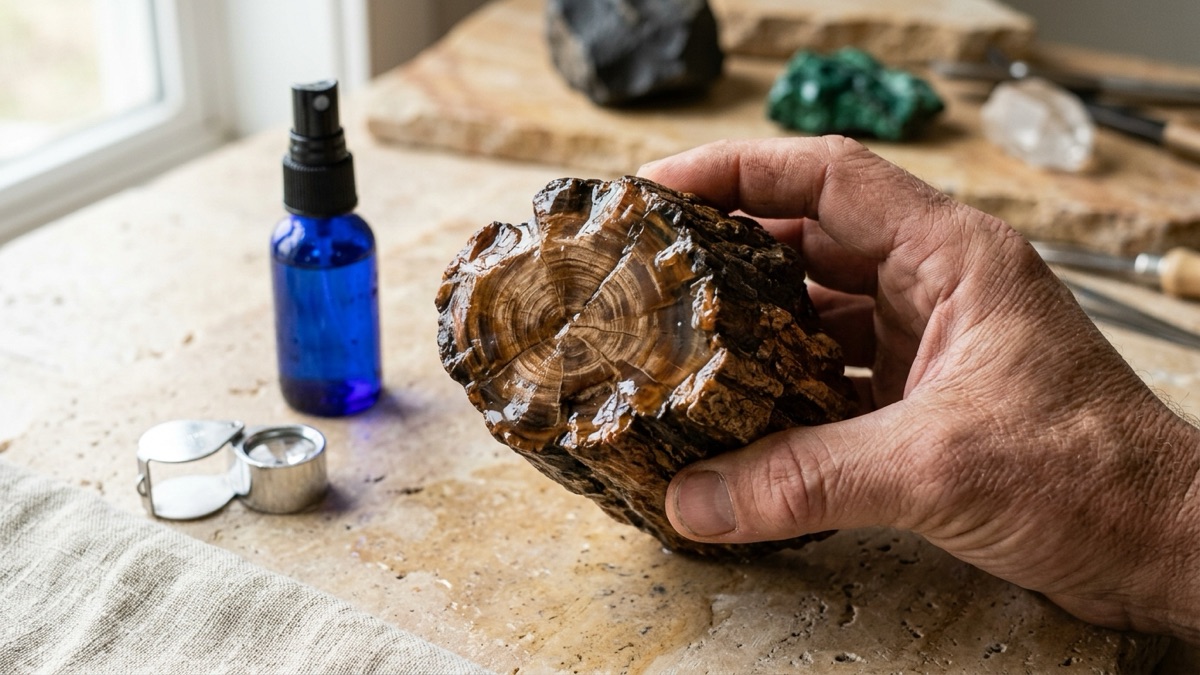
| Petrified wood | Grain, rings and bark turned to stone, usually quartz | Many ages; Petrified Forest logs were buried more than 200 million years ago |
| Leaf and bark prints | Dark carbon films on gray shale, often near coal seams | Many ages |
Shells and horns: brachiopods and horn corals
The Kentucky Geological Survey calls brachiopods probably the most commonly collected fossils in the state. They look like clams, but the symmetry is different: a clam's two shells mirror each other, while a brachiopod's two shells differ and each one is symmetrical down its middle. Horn corals are extinct solitary corals shaped like a bull's horn, with a cup of ridges at the wide end. Our guide to brachiopod and horn coral fossils shows both side by side with their look-alikes.
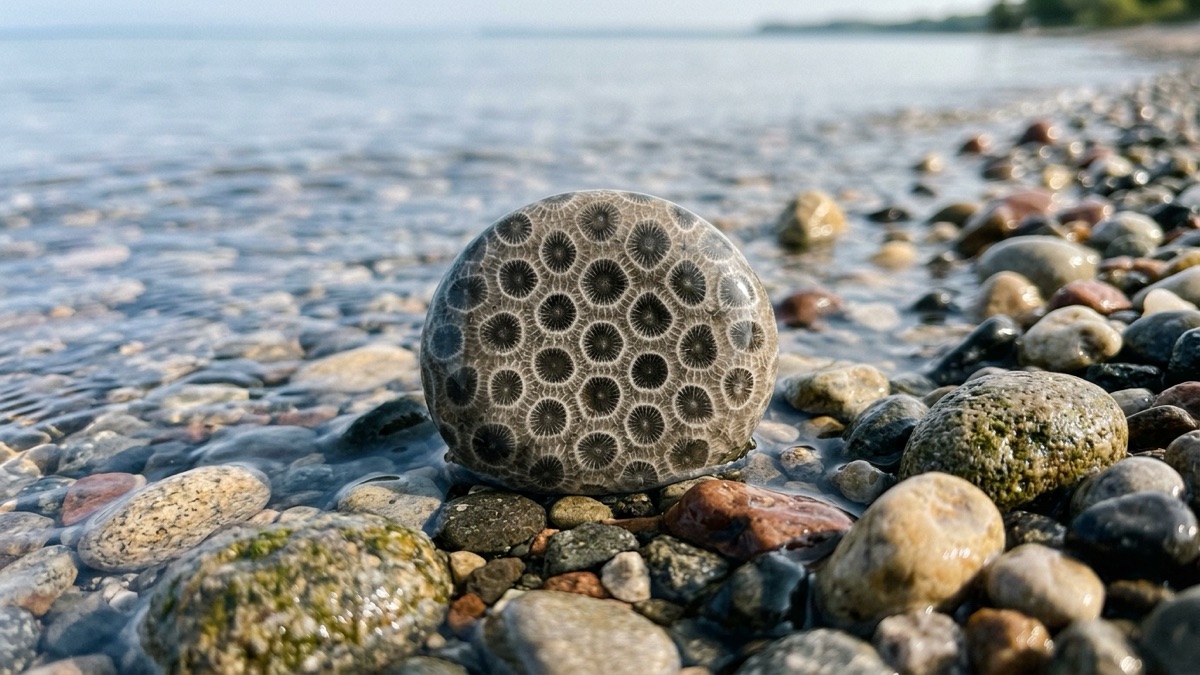
Not every fossil coral lived alone. Colonial corals grew as many joined cells, and Michigan's Petoskey stone is the famous example: a Devonian colonial coral, Hexagonaria, whose six-sided cells show up when the stone is wet or polished.
Disks and stems: crinoids
Crinoids, or sea lilies, were relatives of starfish that stood on a long stem made of stacked disks. When they died, the stems fell apart, so the loose disks are among the most common Paleozoic fossils, and Missouri calls the crinoid its most common fossil. Collectors long called them "Indian beads". See our crinoid fossils guide for the round, star-centered and stacked kinds.
Teeth and bones
Sharks have skeletons of cartilage, which rarely fossilizes, so their teeth are what usually survive. Fossil teeth are usually darker (gray, black, brown or reddish), while modern teeth are typically white. Our shark tooth fossil identification guide walks through the shape clues for megalodon, mako, tiger and sand tiger sharks.
Bone is rarer, yet it is one of the fossils people most often think they have found. The giveaway is a spongy, honeycomb texture inside a broken end. Our guide to fossil bone or just a rock covers the real test and the rocks that fool people.
Trilobites, ammonites and plants
Trilobites were sea arthropods with a body in three lengthwise lobes, and the Missouri Geological Survey dates them to about 540 to 250 million years ago. Ammonites are coiled shells whose chamber walls leave wavy suture lines, very different from the gentle curves on a nautilus. Plant fossils, from leaf prints to bark, are common in shale near coal seams. The Kentucky survey notes that supposed "dinosaur skin" usually turns out to be the scaly bark of ancient scale trees.
Petrified wood rounds out the list. At Petrified Forest the wood is almost solid quartz, so it scratches glass while still showing rings and grain.
How do you identify a fossil, step by step?
Work from the big picture to the small details. Most finds give themselves away by step three.
- Note where it came from. Write down the place, the rock type and whether the piece was loose or still in a layer. A pebble on a beach may have traveled a long way.
- Read the shape. Paleontologists sort fossils by shape: bead, cup, horn, fan, spiral, shell. Check for symmetry, because living things tend to have it and random lumps do not.
- Look closer with a 10x hand lens. Radiating ridges suggest coral. A star-shaped hole suggests a crinoid. Fine growth lines suggest a shell. A spongy texture suggests bone. Neat rings of mineral suggest a concretion.
- Test the material. Many fossil shells and crinoids are calcite, so a drop of vinegar may fizz slowly and a steel knife scratches them. Fossils replaced by quartz will not fizz, and they scratch glass.
- Compare with local references. Your state geological survey's fossil pages cover the rocks near you, which narrows the list fast.
Try it
Scratch a spare fragment or the rock around your fossil, never the best face, and compare the result on our free Mohs hardness scale. Calcite shells sit at 3, while quartz replacements sit at 7.
Fossil or concretion?
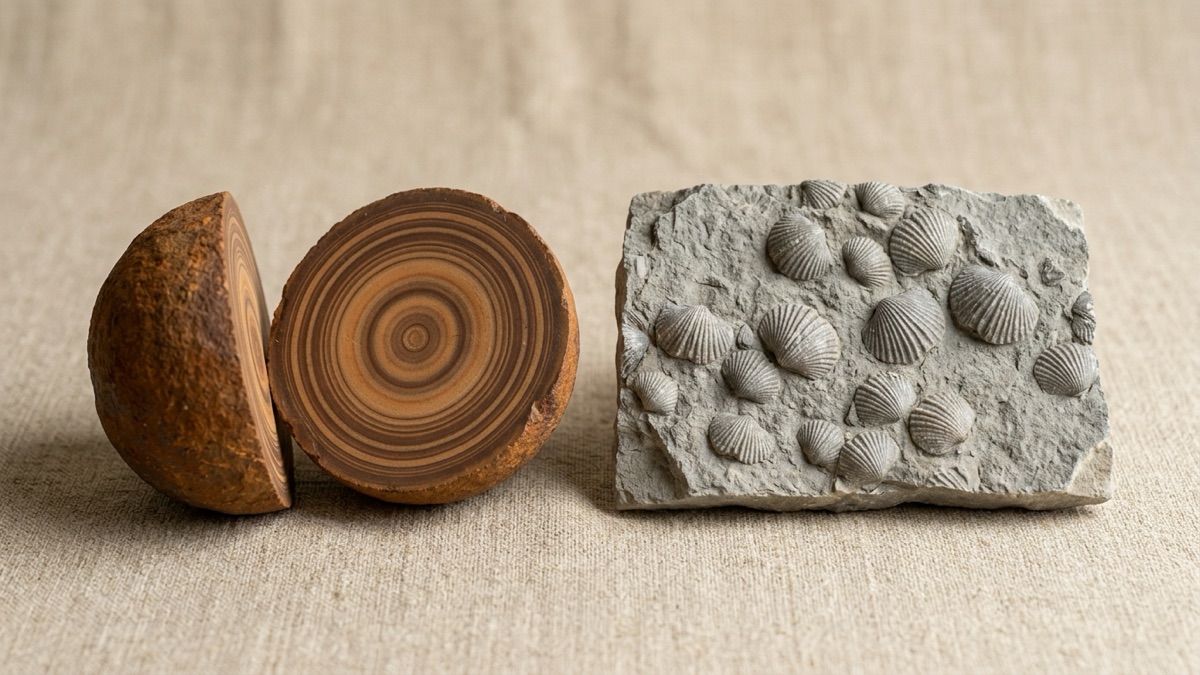
This is the big one. The Kentucky Geological Survey explains that concretions are mineral deposits that grow in layers around a particle in soft sediment, often into round or oval lumps. Over time they turn to stone along with the rock around them. Some crack into polygon patterns that look like turtle shells or cracked eggs.
The survey has heard plenty of these claims. Every "fossil egg" and "fossil turtle shell" reported to it so far has turned out to be a concretion or a man-made object. Siderite, an iron carbonate mineral, forms red, orange or brown concretions and can fill old burrows and root holes, making tubes that look like bones.
Here is how to tell them apart:
- Inside: a concretion is solid, grainy like the surrounding rock, or layered in rings. A fossil shows biology: shell layers, ridges, chambers or spongy bone.
- Outside: fossils have repeating structures, such as ribs, growth lines, segments or septa. Concretions have smooth or knobby surfaces with no plan to them.
- Shape: fossils have specific shapes. A concretion is more of a vague blob, or a shape that follows a burrow.
Can you identify a fossil from a photo?
Often, yes, at least to the group. A clear photo can show a brachiopod's ribs, a crinoid disk's star, or a horn coral's ridges. Naming a species is another matter. It usually needs a specialist, the age of the rock and features that a photo cannot show, such as weight, hardness or whether it fizzes.
Give any photo, and any person looking at it, the best chance:
- Put a ruler next to the fossil for scale.
- Shoot the top, the bottom, the side and any broken end.
- Include one wider shot of the rock or layer it came from.
- Use soft daylight at a low angle, which throws ridges and lines into relief.
- Record exactly where you found it.
Our guide to photographing a rock for identification covers light, angles and backgrounds in more detail. The same tips work for fossils.
Where is it legal to collect fossils?
Who manages the land decides what you can take. Here are the federal rules as written, checked in September 2026, plus the common state and private cases.
| Land | Invertebrate and plant fossils | Vertebrate fossils (bones, teeth, tracks) |
|---|---|---|
| BLM land | Yes, without a permit: a reasonable amount, up to 25 pounds a day, personal use only, hand tools only, no selling | Only with a research permit |
| National forests | Yes where not closed: up to 25 pounds a day and 100 pounds a year, no selling | Only with a permit |
| Bureau of Reclamation land | Only in designated special use areas | Only with a permit |
| National parks and wildlife refuges | No collecting | No collecting |
| State land | Varies by state; ask the managing agency | Often restricted |
| Private land | With the owner's permission | With the owner's permission |
A few details matter. The BLM counts common invertebrates such as mollusks and trilobites, plant fossils and petrified wood as fair game for personal collecting. Petrified wood on public lands has its own limit: 25 pounds plus one piece a day, and no more than 250 pounds a year. Our guide on how to identify petrified wood shows how to tell the real thing from banded look-alikes.
Some areas are closed or have tighter local limits, so check with the local office before you go. Our rock collecting rules guide covers each land type in detail.
State rules vary. Florida, for example, requires a permit to collect vertebrate fossils on state lands, excludes shark and ray teeth from that rule, and allows no collecting at all inside state parks.
Heads up
On BLM land it is illegal to dig, remove, collect or even make a mold or cast of a vertebrate fossil without a research permit, and permits go to researchers. Fossils collected under a permit stay the property of the United States. If you find a bone or a track on federal land, leave it where it is, photograph it and report the location to the land office.
Who can confirm what you found?
For an expert opinion, start with your state geological survey, a university geology department or a natural history museum. The Kentucky Geological Survey invites people to email photos of interesting finds, and the Utah Geological Survey encourages people to report every fossil they find in Utah. In Florida, the Florida Museum of Natural History is the state repository for vertebrate fossils, and permit holders report their finds to it.
Send clear photos, the exact location and what rock the fossil came from. That context often matters as much as the fossil itself. The RockhoundID app, coming soon, will suggest likely matches from a photo and tell you which quick check narrows them down.
Tip
Label each find in the field with a number, then write the place, date and rock layer in a notebook under the same number. A fossil with no location is a curiosity. A fossil with a location is a data point.
The takeaway
Fossil identification starts with the rock, not the fossil. Know where it came from, read the shape, look closer with a lens, and rule out concretions before you celebrate. Most finds turn out to be brachiopods, crinoids, horn corals or shark teeth, and each one has a clear tell. Check who manages the land before you collect, leave vertebrate fossils on public land where they are, and your collection will be both legal and meaningful.
The pictures in this guide are AI-generated illustrations of what to look for; real specimens vary, so trust the tests over any picture. RockhoundID guides help you narrow down what you found. They suggest likely candidates, not certain identifications or appraisals. For anything valuable, rare or possibly from space, ask a museum, a university geology department or your state geological survey, and check the collecting rules for the land before you take anything home.
Questions rockhounds ask
How can I tell if a rock is a fossil?
Look for evidence of life: a symmetrical shell, growth lines, ribs, a cup of radiating ridges, a star-shaped hole or the spongy texture of bone. Round lumps with rings inside and black fern-like stains on a rock face are usually concretions and mineral dendrites, not fossils.
What are the most common fossils people find?
In the old limestone and shale of the Midwest and Kentucky, the everyday finds are seafloor animals: brachiopods, crinoid stem pieces, horn corals, bryozoans, snails and clams. Where younger marine sediments are exposed, such as parts of the Florida and Maryland coasts, fossil shark teeth are common too.
Is it legal to collect fossils?
It depends on who manages the land. BLM land and most national forests allow personal collecting of reasonable amounts of common invertebrate and plant fossils, vertebrate fossils such as bones and teeth need a permit on federal land, national parks allow no collecting, and private land needs the owner's permission.
Can you identify a fossil from a photo?
Often you can narrow it to a group, such as brachiopod, crinoid or horn coral. Naming the species usually takes a specialist, the age of the rock and details a photo cannot show, so treat any photo result as a starting point.
Who can identify a fossil I found?
Your state geological survey, a university geology department or a natural history museum. Many surveys accept emailed photos. Send several angles with a ruler for scale, plus exactly where you found it and what rock it came from.
Where these facts come from
- National Park Service: What is a fossil?: www.nps.gov/subjects/fossils/what-is-a-fossil.htm
- National Park Service: Body fossils: www.nps.gov/subjects/fossils/body-fossils.htm
- National Park Service: Fossil protection: www.nps.gov/subjects/fossils/fossil-protection.htm
- Kentucky Geological Survey: Identifying unknown fossils: www.uky.edu/KGS/fossils/fossilid.php
- Kentucky Geological Survey: Kinds of fossils found in Kentucky: www.uky.edu/KGS/fossils/fossil-kinds-found-in-ky.php
- Kentucky Geological Survey: Fossil egg or turtle shell (concretions): www.uky.edu/KGS/fossils/fossil-did-i-find-fossil-egg-turtle-shell.php
- Kentucky Geological Survey: Fossil rib, leg or arm bones?: www.uky.edu/KGS/fossils/fossil-did-i-find-fossil-rib-leg-arm-bones.php
- Handbook of Mineralogy: Siderite: www.handbookofmineralogy.org/pdfs/siderite.pdf
- Kentucky Geological Survey: Fossil collecting regulations: www.uky.edu/KGS/fossils/fossil-regulations.php
- Kentucky Geological Survey: Did I find a dinosaur fossil?: www.uky.edu/KGS/fossils/fossil-did-i-find-dinosaur-fossil.php
- Kentucky Geological Survey: Brachiopods: www.uky.edu/KGS/fossils/fossil-brachs.php
- Missouri Department of Natural Resources: Fossils: dnr.mo.gov/land-geology/geology/fossils
- Missouri Geological Survey: Trilobite: dnr.mo.gov/document-search/trilobite-pub2921/pub2921
- Missouri Geological Survey: Crinoid, Missouri's official state fossil: dnr.mo.gov/document-search/crinoid-missouris-official-state-fossil-pub0660/pub06
- Digital Atlas of Ancient Life (Paleontological Research Institution): Brachiopoda: www.digitalatlasofancientlife.org/learn/brachiopoda/
- Digital Atlas of Ancient Life: Rugose corals: www.digitalatlasofancientlife.org/learn/cnidaria/anthozoa/rugosa/
- Digital Atlas of Ancient Life: Ammonoids: www.digitalatlasofancientlife.org/learn/mollusca/cephalopoda/ammonoidea/
- Digital Atlas of Ancient Life: Crinoids: www.digitalatlasofancientlife.org/learn/echinodermata/crinoidea/
- Florida Museum of Natural History: Fossil shark teeth: www.floridamuseum.ufl.edu/discover-fish/sharks/fossil/shark-teeth/
- Florida Museum of Natural History: Five facts about megalodon: www.floridamuseum.ufl.edu/science/five-facts-megalodon/
- Florida Museum of Natural History: Florida Fossil Permit: www.floridamuseum.ufl.edu/florida-fossil-permit
- Florida Museum of Natural History: Florida Fossil Permit FAQ: www.floridamuseum.ufl.edu/florida-fossil-permit/faq
- National Park Service, Petrified Forest: Petrified wood: www.nps.gov/pefo/learn/nature/petrified-wood.htm
- Bureau of Land Management: Collecting fossils: www.blm.gov/programs/paleontology/collecting-fossils
- 43 CFR 49.810: What is casual collecting? (Cornell LII): www.law.cornell.edu/cfr/text/43/49.810
- 43 CFR 49.805: Where is casual collecting allowed? (Cornell LII): www.law.cornell.edu/cfr/text/43/49.805
- 43 CFR 49.800: Casual collecting on NPS and FWS lands (Cornell LII): www.law.cornell.edu/cfr/text/43/49.800
- 36 CFR 291.5: Forest Service paleontology definitions (Cornell LII): www.law.cornell.edu/cfr/text/36/291.5
- 36 CFR 291.11: Casual collecting on National Forest System lands (Cornell LII): www.law.cornell.edu/cfr/text/36/291.11
- 16 U.S.C. 470aaa-3: Collection of paleontological resources (Cornell LII): www.law.cornell.edu/uscode/text/16/470aaa-3
- Utah Geological Survey: What should you do if you find a fossil?: geology.utah.gov/map-pub/survey-notes/glad-you-asked/if-you-find-a-fossil/
- USGS National Geologic Map Database: ngmdb.usgs.gov/ngmdb/ngmdb_home.html