
Free tool
Rock identifier
Answer any of six quick questions and watch the likely candidates line up, each with the reasons it fits, what does not fit, and the one test that would settle it. No photo upload, no account.
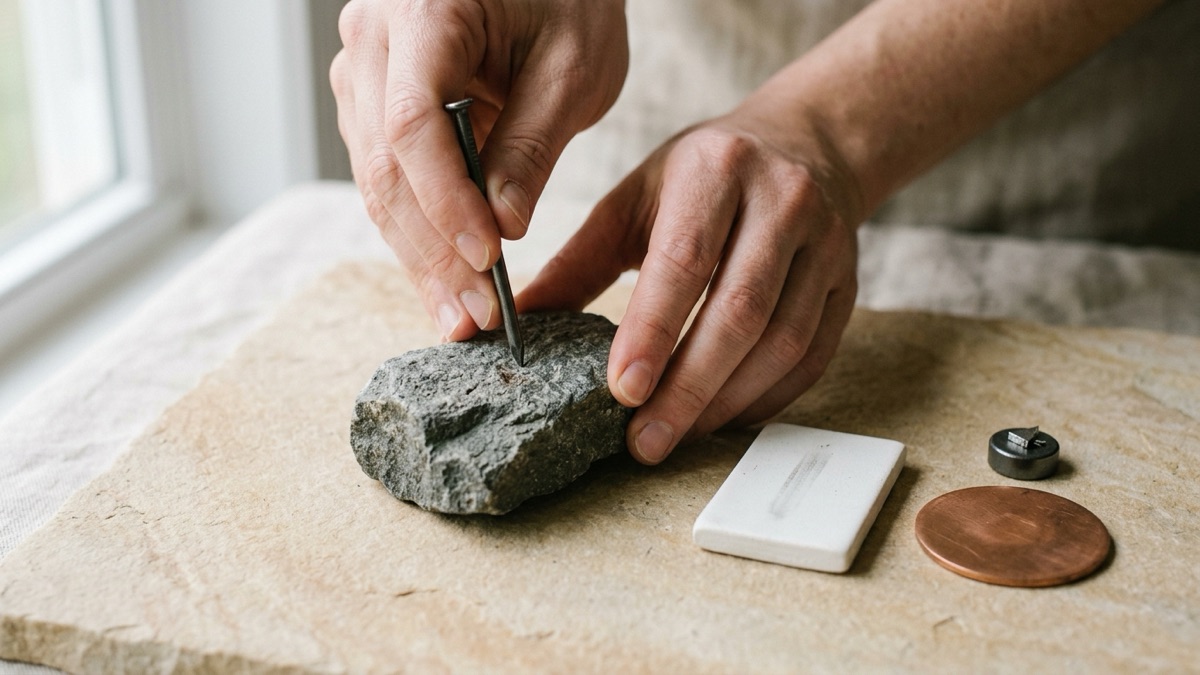
How to use the rock identifier
- Clean a small spot. Scrub off dirt and look at a fresh, broken face if you can. Weathered skins change color and luster.
- Start with the reliable tests. Hardness and streak count the most in the scoring, color the least. You can answer the questions in any order and skip any of them.
- Do the scratch test. Press a fingernail, then a copper coin, then a steel knife into a smooth spot, and finally try to scratch a piece of glass with the rock. Rub each mark: a real scratch stays, a smear of metal wipes off.
- Do the streak test. Rub the rock hard across the unglazed back of a white bathroom tile and note the color of the powder.
- Try the two household tricks. Hold a cheap fridge magnet to it, and put one drop of white vinegar on a clean spot and watch for bubbles.
- Read the candidates. Each one shows why it fits, what does not fit, its tell-tale clue and what to test next. The panel at the top suggests the single test that best separates your top matches.
Tip
Wet the rock before you judge its color. Water shows the true color and pattern the way a polish would, then dries off without a trace.
What each question tells you
| Clue | How to test it | Why it matters |
|---|---|---|
| Hardness | Fingernail (about 2.5), copper coin (about 3), steel knife (about 5 to 5.5), glass (about 5.5) | The most reliable property you can test at home |
| Streak | Rub on an unglazed white tile | Hematite, magnetite and pyrite all look dark but streak differently |
| Luster | Tilt it under a lamp | Separates metallic ores from glassy and earthy minerals |
| Texture | Look with a 10x hand lens | Tells glass from fine-grained and coarse-grained rocks |
| Magnet, vinegar, weight | Fridge magnet, a drop of vinegar, heft it | Quick yes or no clues for magnetite, calcite, barite and pumice |
| Color | Wet the rock and look | Least reliable: quartz comes in almost every color |
Where the data comes from
The key covers common rocks, minerals and the usual look-alikes (slag, magnetite and iron meteorites among them). Every entry lists its sources, which you can open under each result: the Handbook of Mineralogy published by the Mineralogical Society of America, the University of Auckland rocks and minerals pages, the USGS Gemstones publication and Volcano Hazards glossary, the Washington University in St. Louis meteorite pages, and state geological survey pages. Hardness ranges for rocks, which are mixtures, are estimated from their main minerals and marked that way.
Heads up
The results are likely candidates, not a certain identification. Two rocks can pass every home test and still be different things. For anything that might be valuable, rare or a meteorite, get a second opinion from a rock club, a museum or your state geological survey.
Safety and the rules
Wear safety glasses when you break or scratch rocks, and never taste or lick an unknown mineral. Some minerals in the key, such as galena, contain lead, so wash your hands after handling them. Before you take a rock home, check who manages the land: collecting is not allowed in national parks, and other public lands have limits.
Questions
How do I identify a rock I found?
Test what you can at home: hardness with a fingernail, a copper coin, a steel knife and glass; streak on the back of a white tile; luster under a lamp; and a magnet and a drop of vinegar. The rock identifier turns those answers into a ranked list of likely candidates.
Is this rock identifier free?
Yes. It is free, needs no account and runs in your browser. It asks questions instead of taking a photo, so nothing is uploaded.
Can a rock identifier be wrong?
Yes. Many minerals share colors and rocks are mixtures, so any quiz or photo tool can be wrong. Treat the results as likely candidates and confirm the top one with the test it suggests.
What is the most reliable test for identifying minerals?
Hardness and streak. Color is the least reliable, because the same mineral can come in many colors while its hardness and streak stay nearly the same.
How do I know if my rock is valuable?
First find out what it is, then compare it with sold listings or ask a rock club, a reputable dealer or an appraiser. Most common rocks are worth little in money, but rare minerals, fine crystals, gold and meteorites can be.