
Blog identification
Rock Identification Chart: Match Your Find in 5 Steps
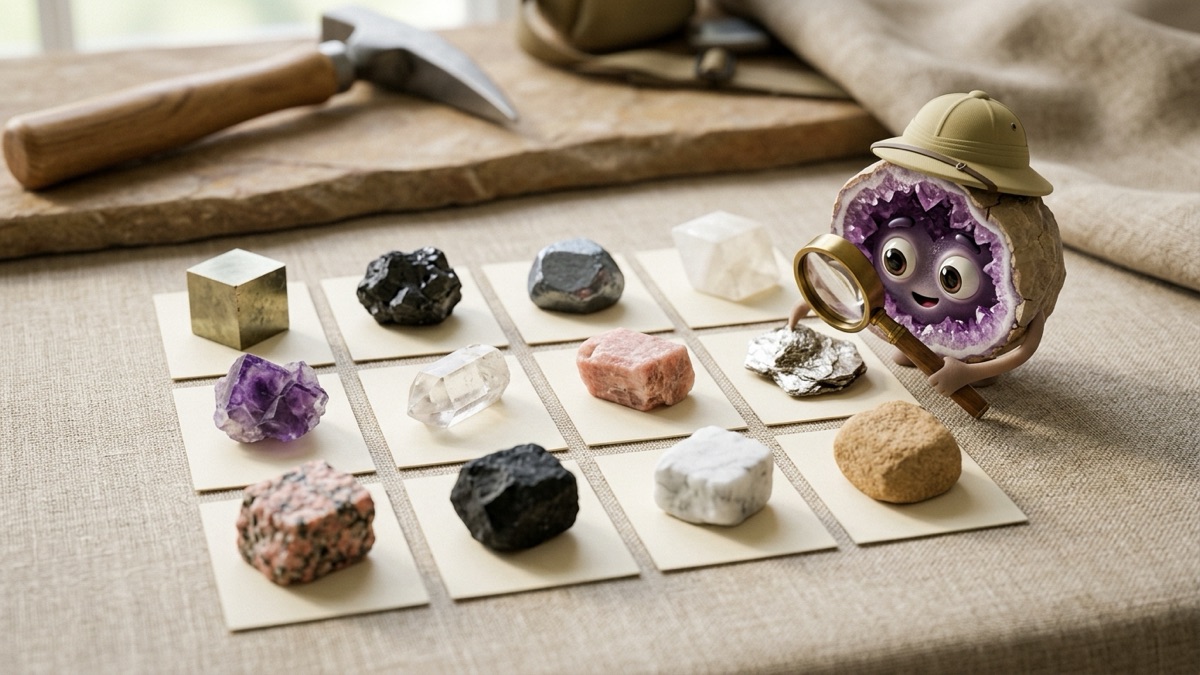
Most rock charts online are one big image: tiny photos, bright colors and no hint of which columns actually matter. This one is a real table you can read on your phone at the creek, with the test that settles each match.
Quick answer
A rock identification chart lists common rocks and minerals with the properties that tell them apart: luster, hardness, streak and a tell-tale clue. To use one, test a fresh surface, decide whether it looks metallic, find its hardness with a scratch test, check its streak, then confirm with the clue. Match several columns, never color alone.
Key takeaways
- Read the chart with tests, not pictures: luster first, then hardness, streak and the tell-tale clue.
- Hardness and streak narrow the list fastest. Color is a tiebreaker at best.
- Minerals have one set of values; rocks are mixtures, so the rock chart lists what each rock is made of and a quick test instead.
- Charts fail on weathered surfaces, fine-grained mixtures and man-made look-alikes such as slag and glass.
- Every value comes from the Handbook of Mineralogy, the University of Auckland or the USGS, the same sources behind our free rock identifier.
How do you use a rock identification chart in 5 steps?
You need a steel nail, a copper coin, a piece of glass, the unglazed back of a white bathroom tile, a fridge magnet and a drop of vinegar. Then work down this list.
- Find a fresh surface. Scrub off dirt and look at a clean, ideally broken face. If you see grains of several different minerals, jump to the rock chart. If it looks like one material, use the mineral charts.
- Decide: metallic or not? Tilt it under a lamp. If it shines like polished metal, use the metallic chart. Glassy, pearly, silky, waxy or dull means the non-metallic chart.
- Find the hardness. Try a fingernail (about 2 to 2.5), a copper coin (about 3), a steel nail (about 5 to 5.5), then see whether the rock scratches glass (about 5.5). Rub each mark to be sure it is a real scratch and not a smear of metal.
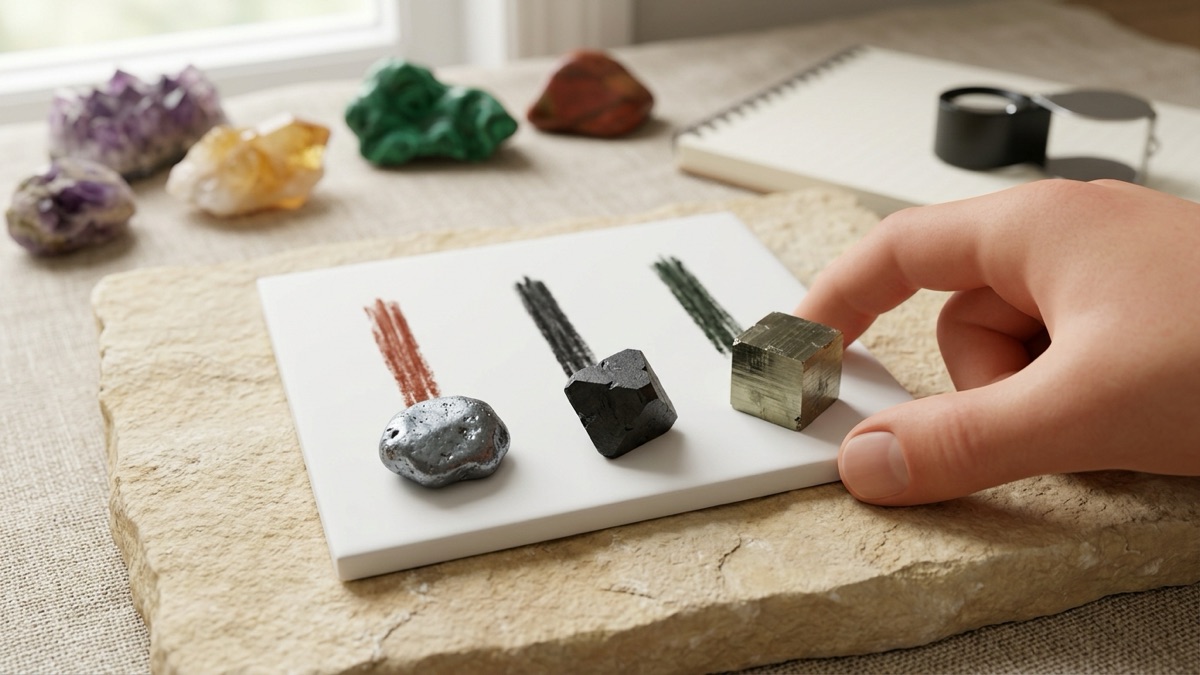
- Check the streak. Rub it hard across the unglazed tile and note the powder color.
- Confirm with the tell-tale clue. For the two or three rows still standing, run the test in the last column: a magnet, a drop of vinegar, a look at how it breaks.
Tip
Jot your answers down as you go (metallic, knife scratches it, greenish black streak). It is much easier to scan a chart with three facts in hand than with a rock in one hand and your phone in the other.
Mineral chart, part 1: metallic minerals
These shine like metal. They tend to feel heavy, and their streak is almost always dark, which makes the streak column especially useful here.
| Mineral | Color and luster | Hardness | Streak | Tell-tale clue |
|---|---|---|---|---|
| Pyrite | Brassy yellow, metallic | 6 to 6.5 | Greenish black | Scratches glass; often cubes with striped faces |
| Chalcopyrite | Brass yellow, often with a blue and purple tarnish | 3.5 to 4 | Greenish black | A steel nail scratches it, while pyrite resists |
| Native gold | Gold-yellow, metallic | 2.5 to 3 | Skip it (see clue) | Soft and malleable: a pin dents it instead of chipping it; extremely heavy |
| Galena | Lead-gray, metallic | 2.5 to 2.75 | Lead-gray | Very heavy and breaks into little cubes; a lead mineral, so wash your hands |
| Hematite | Steel-gray, black or dull red; metallic to dull | 5 to 6 | Red to reddish brown | The red-brown streak, whatever the rock looks like |
| Magnetite | Black, metallic | 5.5 to 6.5 | Black | Strongly attracts a cheap fridge magnet |
Mineral chart, part 2: non-metallic minerals
These look glassy, pearly, silky, waxy or dull. They are ordered from softest to hardest, so the hardness column reads top to bottom.
| Mineral | Color and luster | Hardness | Streak | Tell-tale clue |
|---|---|---|---|---|
| Talc | White, green or gray; pearly to greasy | 1 | White | Feels soapy; a fingernail scratches it easily |
| Gypsum | Clear, white or gray; glassy to pearly or silky | About 2 | White | A fingernail scratches it |
| Muscovite mica | Silvery, clear or pale; pearly | 2 to 2.5 | White | Peels into thin, flexible sheets |
| Halite (rock salt) | Clear to white; glassy | 2 to 2.5 | White | Cube-shaped crystals that dissolve in water |
| Biotite mica | Black to brown; glassy to pearly | 2.5 to 3 | Very pale brown | Peels into thin, dark sheets |
| Calcite | White or clear, sometimes tinted; glassy | 3 | White | Fizzes in vinegar; breaks into slanted boxes |
| Fluorite | Purple, green, yellow or clear; glassy | 4 | White | A steel nail scratches it, a coin does not; often cubes |
| Hornblende | Dark green to black; glassy | 5 to 6 | Dark green | Two cleavages at about 56 and 124 degrees |
| Potassium feldspar (orthoclase) | Pink, salmon or white; glassy | 6 to 6.5 | White | Blocky, shiny faces that meet at right angles |
| Plagioclase feldspar | White to gray; glassy | 6 to 6.5 | White | Fine parallel lines on its flat faces |
| Quartz | Clear, white, gray, smoky, purple or pink; glassy | 7 | White or none | Scratches glass; breaks with curved, shell-like surfaces |
| Garnet | Red to reddish brown; glassy | 6.5 to 7.5 | White or none | Ball-shaped crystals with many faces, often in schist |
Why "white or none" for quartz and garnet? A streak plate is unglazed porcelain, and minerals harder than about 6.5 are harder than the plate, so they scratch it instead of leaving powder. Our streak test guide covers that and other streak surprises.
Rock chart: common rocks
Rocks are mixtures of minerals (or glass), so a single hardness or streak value makes little sense. This chart lists what each rock is made of and the quick test that separates it from its look-alikes.
| Rock | What you see | Made of | Quick test |
|---|---|---|---|
| Granite | Coarse speckles: gray glassy grains, pink or white blocks, black specks | Orthoclase, plagioclase and quartz, often with biotite, muscovite or hornblende | A lens shows three kinds of grains; the quartz grains scratch glass |
| Basalt | Dark gray to black, grains too small to see, sometimes gas bubbles | Mostly pyroxene (augite), plagioclase and olivine | A lens shows tiny grains, bubbles or green olivine specks |
| Obsidian | Black to brown natural glass with sharp, curved breaks | Volcanic glass, no crystals | Only smooth glass under a lens; handle the edges with care |
| Sandstone | Tan, red or gray; feels like sandpaper | Sand grains, mostly quartz and feldspar, cemented together | Rub it: grains may come loose; it breaks around the grains |
| Limestone | Gray to cream, often with shell bits | More than half calcite | Fizzes in vinegar |
| Marble | Sugary interlocking crystals, white or softly colored | Recrystallized calcite | Fizzes, and a steel blade scratches it |
| Quartzite | Sugary and glassy; breaks right through the grains | Quartz | Scratches glass and does not fizz |
Marble and quartzite are the classic pair: they can look almost identical, yet the University of Auckland notes that marble can be scratched by a metal blade and fizzes in dilute acid, while quartzite does neither. If you want the bigger picture of how these rocks form, our hub on types of rocks explains igneous, sedimentary and metamorphic rocks, and rock vs mineral explains why the rock chart looks different.
How do you read the chart top to bottom?
Treat each column as a gate, and only look at the next column for the rows that made it through.
Example 1: a brassy, metallic nugget. The metallic chart has three brassy rows: pyrite, chalcopyrite and gold. A steel nail cannot scratch it, which rules out chalcopyrite (3.5 to 4) and gold (2.5 to 3). The streak is greenish black, which fits pyrite and not gold. Result: pyrite, also known as fool's gold. Real gold is soft, dents under a pin and is far heavier (a density of 19.3, against about 5 for pyrite).
Example 2: a heavy, black, metallic lump. Hematite and magnetite both fit the first three columns. The streak splits them instantly: reddish brown means hematite, black means magnetite. The fridge magnet confirms it, because magnetite grabs a magnet and pure hematite does not.
Example 3: a white, sugary rock. Grains you can see send you to the rock chart. Marble and quartzite both fit. One drop of vinegar and one scratch against glass decide it.
Notice that color did almost no work in any of these examples. Our how to identify rocks guide explains the full order of tests and why color comes last, and the Mohs hardness test guide covers scratch testing in detail.
When does a rock identification chart fail?
A chart is only as good as the surface you test and the list it covers. These are the usual trouble spots.
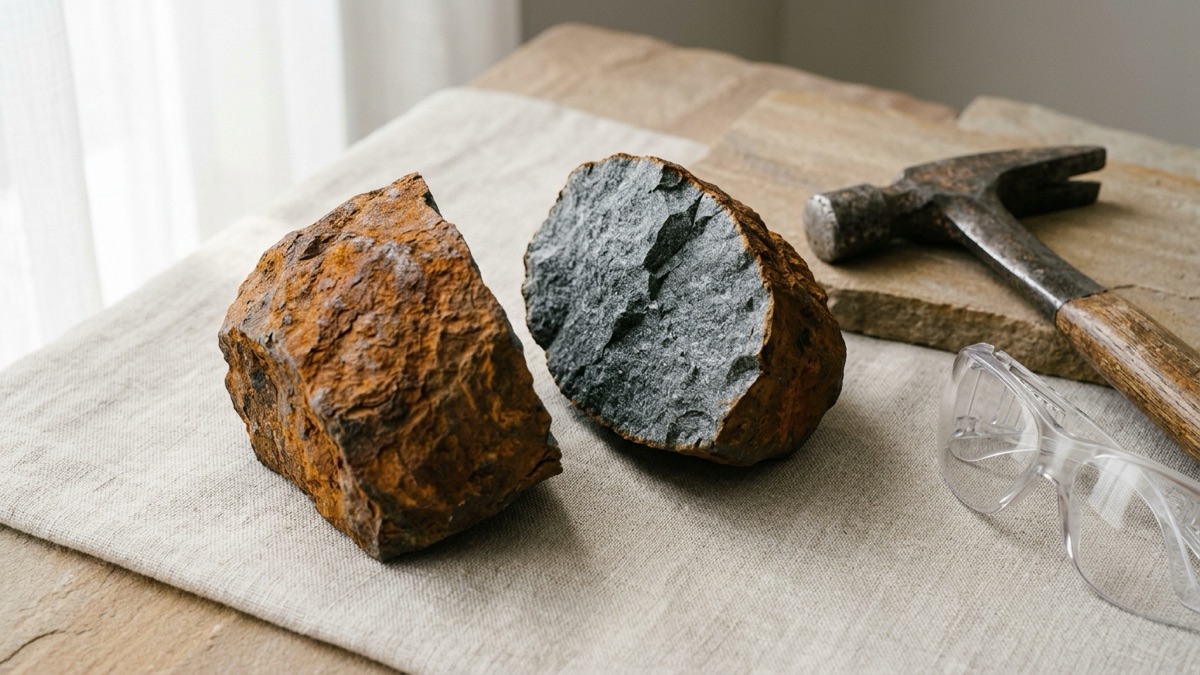
- Weathered surfaces. Rust stains, dark desert varnish, lichen and chalky rinds hide the real color and luster. Test a fresh, broken face instead, and wear safety glasses when you break it.
- Mixtures. A scratch test on granite gives a different answer depending on which grain you hit. Test single grains with a hand lens.
- Grains too small to see. Basalt, chert and shale are made of grains you cannot test one by one, so lean on texture, weight and the quick tests.
- Colors that vary. The same mineral comes in many colors. Quartz alone appears clear, white, purple, pink, yellow and smoky.
- Things that are not on the chart. Slag (glassy, bubbly furnace waste), concrete, brick and bottle glass all turn up in gardens and gravel. A possible meteorite belongs in the free meteorite checker, not a rock chart.
- Rarer minerals. Far more minerals exist than any chart can hold. This one covers the ones beginners find most.
Try it
The free rock identifier is this chart turned into a guided key. Answer any of six questions about color, luster, hardness, streak, texture and special properties, and it ranks 66 common rocks, minerals and look-alikes, shows why each one fits and suggests the single test that best separates your top matches.
Heads up
Galena contains lead, so wash your hands after handling it. Never taste or lick a mineral to test it, even one you think is salt.
The RockhoundID app, coming soon, will suggest likely matches from a photo and tell you which test on this chart confirms them.
The takeaway
A good rock identification chart is really a checklist. Decide metallic or not, find the hardness, check the streak, then use the tell-tale clue to settle the last two or three candidates. When nothing matches, look for a fresh surface, think about mixtures and man-made look-alikes, and remember that a chart gives you likely candidates, not a final verdict.
RockhoundID guides help you narrow down what you found. They suggest likely candidates, not certain identifications or appraisals. For anything valuable, rare or possibly from space, ask a museum, a university geology department or your state geological survey, and check the collecting rules for the land before you take anything home.
Questions rockhounds ask
How do you use a rock identification chart?
Work across the columns with tests, not pictures. Decide whether the luster is metallic, find the hardness with a scratch test, check the streak on an unglazed tile, then confirm the rows that are left with their tell-tale clue.
Which column on a rock chart is the most reliable?
Hardness and streak narrow the list fastest, because you can test them at home and they do not change much from one specimen to the next. Color is the least reliable column, since impurities change it.
Why doesn't my rock match any row on the chart?
It may be a rock that mixes several minerals, a weathered surface hiding the real color and luster, a mineral the chart does not cover, or something man-made such as slag, glass or concrete. Test a fresh broken face and try again.
What is the difference between a rock chart and a mineral chart?
A mineral has one set of properties, so a mineral chart can list its hardness and streak. A rock is a mixture of minerals, so a rock chart lists what it is made of and a quick test instead.
Can a rock identification chart tell me what my rock is worth?
No. A chart suggests likely candidates, not value. For a possibly valuable find, ask a rock club, a museum or a qualified appraiser.
Where these facts come from
- University of Auckland: Streak: rocksminerals.flexiblelearning.auckland.ac.nz/minerals/streak.html
- University of Auckland: Hardness: rocksminerals.flexiblelearning.auckland.ac.nz/minerals/hardness.html
- University of Auckland: Cleavage and fracture: rocksminerals.flexiblelearning.auckland.ac.nz/minerals/fracture.html
- University of Auckland: Quartz: rocksminerals.flexiblelearning.auckland.ac.nz/minerals/quartz.html
- University of Auckland: Orthoclase: rocksminerals.flexiblelearning.auckland.ac.nz/minerals/orthoclase.html
- University of Auckland: Plagioclase: rocksminerals.flexiblelearning.auckland.ac.nz/minerals/plagioclase.html
- University of Auckland: Calcite: rocksminerals.flexiblelearning.auckland.ac.nz/minerals/calcite.html
- University of Auckland: Fluorite: rocksminerals.flexiblelearning.auckland.ac.nz/minerals/fluorite.html
- University of Auckland: Biotite: rocksminerals.flexiblelearning.auckland.ac.nz/minerals/biotite.html
- University of Auckland: Hornblende: rocksminerals.flexiblelearning.auckland.ac.nz/minerals/hornblende.html
- University of Auckland: Talc: rocksminerals.flexiblelearning.auckland.ac.nz/minerals/talc.html
- University of Auckland: Pyrite: rocksminerals.flexiblelearning.auckland.ac.nz/minerals/pyrite.html
- University of Auckland: Magnetite: rocksminerals.flexiblelearning.auckland.ac.nz/minerals/magnetite.html
- Handbook of Mineralogy: Chalcopyrite: www.handbookofmineralogy.org/pdfs/chalcopyrite.pdf
- Handbook of Mineralogy: Gold: www.handbookofmineralogy.org/pdfs/gold.pdf
- Handbook of Mineralogy: Galena: www.handbookofmineralogy.org/pdfs/galena.pdf
- Handbook of Mineralogy: Hematite: www.handbookofmineralogy.org/pdfs/hematite.pdf
- Handbook of Mineralogy: Halite: www.handbookofmineralogy.org/pdfs/halite.pdf
- University of Auckland: Granite: rocksminerals.flexiblelearning.auckland.ac.nz/rocks/granite.html
- University of Auckland: Basalt: rocksminerals.flexiblelearning.auckland.ac.nz/rocks/basalt.html
- University of Auckland: Sandstone: rocksminerals.flexiblelearning.auckland.ac.nz/rocks/sandstone.html
- University of Auckland: Limestone: rocksminerals.flexiblelearning.auckland.ac.nz/rocks/limestone.html
- University of Auckland: Marble: rocksminerals.flexiblelearning.auckland.ac.nz/rocks/marble.html
- University of Auckland: Quartzite: rocksminerals.flexiblelearning.auckland.ac.nz/rocks/quartzite.html
- University of Auckland: Colour: rocksminerals.flexiblelearning.auckland.ac.nz/minerals/colour.html
- Washington University in St. Louis: magnetic attraction: sites.wustl.edu/meteoritesite/items/magnetic_attraction/
- USGS Volcano Hazards Program glossary (obsidian): www.usgs.gov/glossary/volcano-hazards-program-glossary
Read next
identification
How to Identify Rocks: A Simple 7-Test Method
identification
Rock Identification Apps: What a Photo Can Really Tell
identification
Streak Test: What Your Rock's Streak Color Means