Blog identification
Streak Test: What Your Rock's Streak Color Means
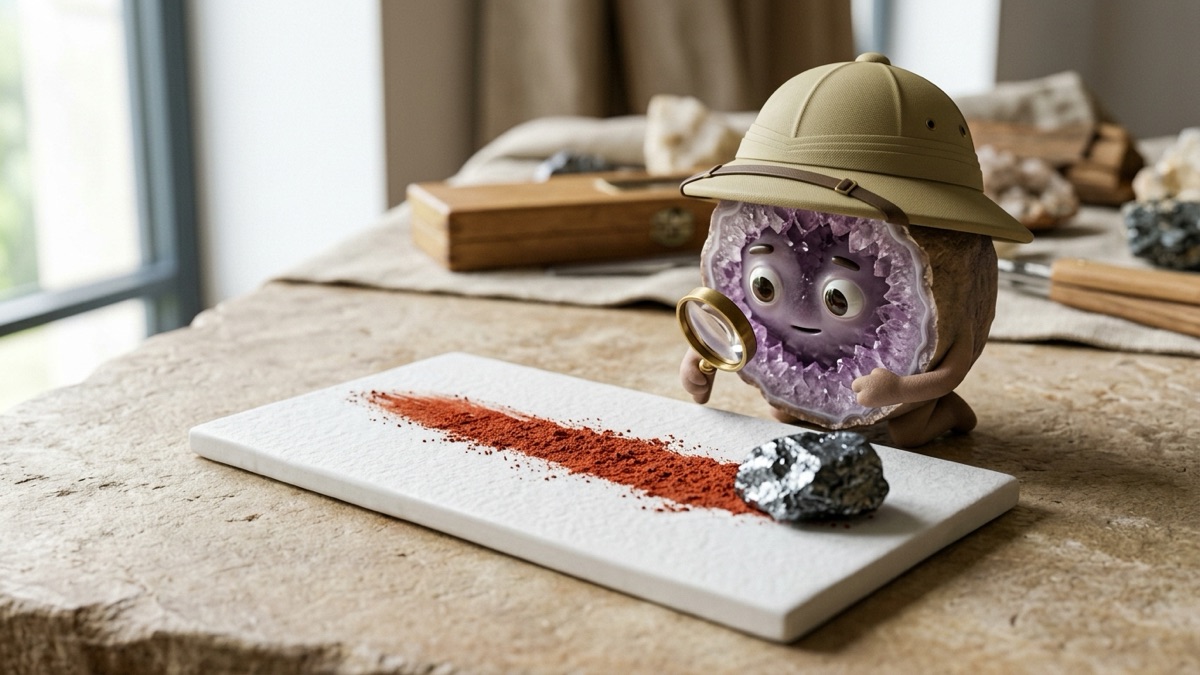
Here is a small party trick. Rub a shiny, silver-black rock across the back of a white tile, and the line it leaves may be the color of rust. That line is a streak, and it can tell you more about your rock than the color you see on the outside.
Quick answer
A streak test shows the color of a mineral's powder. Rub a sharp edge of the rock across unglazed white porcelain, such as the plain back of a bathroom tile, and look at the line. Hematite streaks red-brown, magnetite black, pyrite greenish black and limonite yellow-brown. Minerals harder than about 6.5 leave no streak at all.
Key takeaways
- Streak is the color of a mineral's powder, and it is often steadier than the color of the rock itself.
- You need unglazed white porcelain: a streak plate, or the plain unglazed back of a white tile.
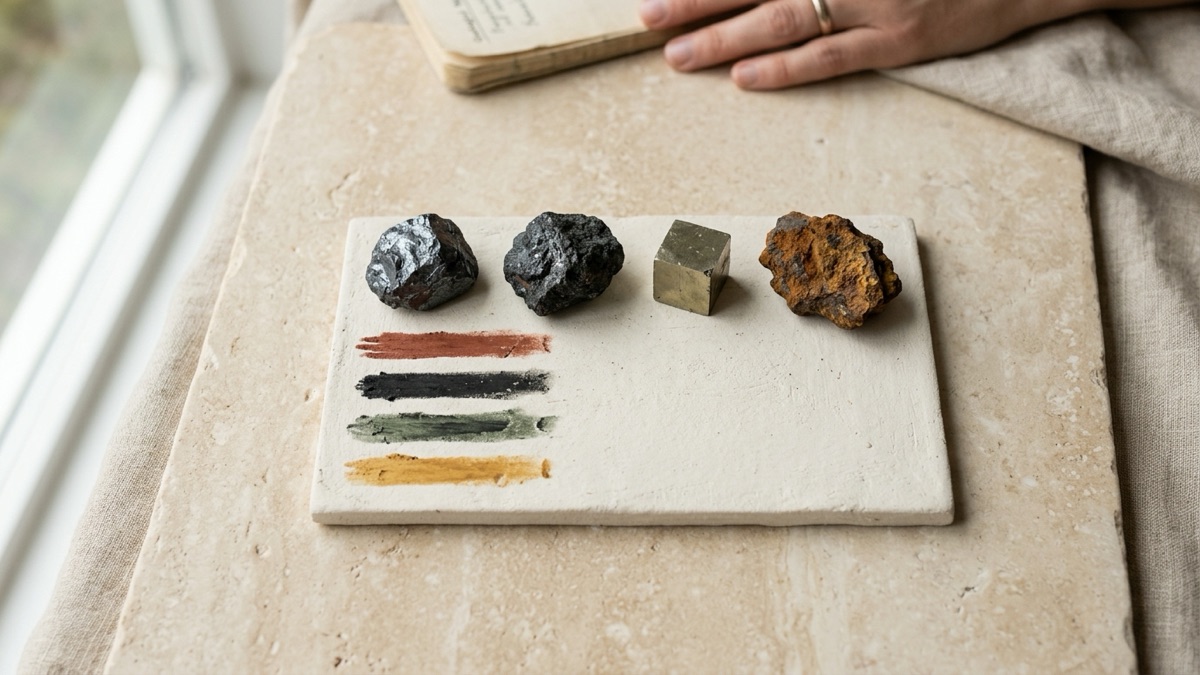
- The big four clues: hematite red-brown, magnetite black, pyrite greenish black, limonite yellow-brown.
- Most pale or see-through minerals streak white, and anything harder than the plate just scratches it.
- Streak works best on dark, metallic and earthy minerals, and best of all next to a hardness test.
What is a streak test?
A mineral's streak is the color of its powder, seen against unglazed white porcelain. That is the University of Auckland's definition, and the whole test is built on it: grind a little powder off your rock and look at it on a white background.
Why bother, when you can just look at the rock? Because color lies. The Kansas Geological Survey notes that impurities often change a mineral's color, and weathering, tarnish and coatings change it more. The powder is much more consistent. The Mineralogical Society of America's identification key adds that many minerals have a different color when powdered, sometimes a completely different one, and that quite a few leave a powder lighter than the solid piece.
Auckland also points out where streak helps most: with opaque minerals, whose streak can differ sharply from their apparent color. Its example is pyrite, which is gold colored but leaves a greenish black streak.
How do you do a streak test at home?
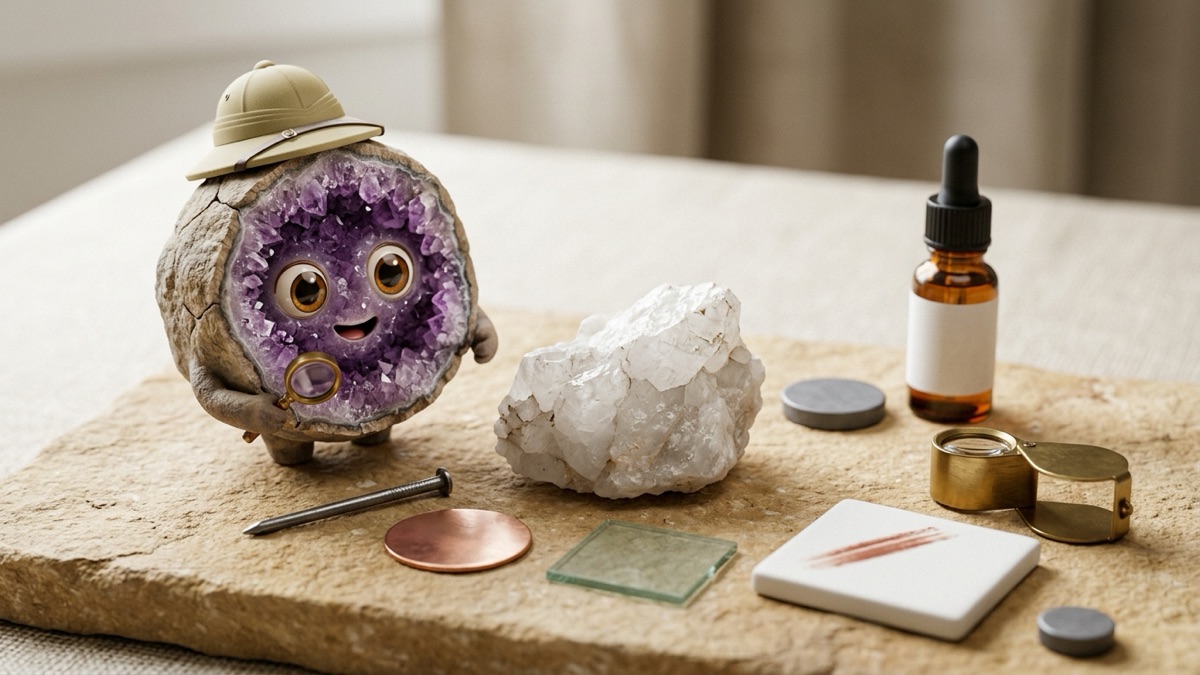
You need a streak plate, which is nothing fancier than unglazed porcelain. The MSA key says a piece of unglazed porcelain tile, the kind used in bathrooms and kitchens, works fine, and warns that if you buy one at a home improvement store you should make sure it really is unglazed porcelain and not plastic.
Many plain white tiles have an unglazed back. If yours is white, smooth to slightly gritty, and not shiny, it will do. The Washington University in St. Louis meteorite site also suggests the unglazed ring on the bottom of a white coffee cup. Then:
- Lay the tile flat on a table, unglazed side up. Do not hold it in the air.
- Find a sharp edge or point on your rock. The MSA key says to use a sharp edge, grain or crystal point rather than dragging any old face across the plate.
- Press and draw a short line, about the length of your thumb.
- Blow away loose grit and look at the finest powder, not the chunky bits, in good daylight.
- Repeat on a fresh spot of the plate. Some minerals take a few tries to give a good streak.
- Clean up afterwards. The MSA key suggests refreshing a used plate with fine emery sandpaper, 220 grit or finer.
Tip
Test a small edge or a broken corner, not the best face of a nice specimen. The MSA key also recommends testing a fresh, unweathered surface, because a rusty skin can give a streak that has nothing to do with the mineral inside.
Why does hematite streak red when it looks black?
Hematite is the star of the streak test. It comes in two very different outfits. The University of Minnesota's Common Minerals site describes it as black to silver-gray when metallic, and red to brown in its earthy form. Yet every variety leaves the same reddish-brown streak, which the Handbook of Mineralogy calls cherry-red or reddish brown.
That matters because shiny hematite is easy to confuse with magnetite, and the two often occur together. Magnetite leaves a black streak and strongly attracts a magnet. Minnesota adds a useful warning: some hematite contains enough magnetite to be weakly magnetic, so check the streak rather than trusting the magnet alone. Ilmenite, another heavy black mineral, streaks black like magnetite but is not magnetic when pure.
Fun fact
Hematite takes its name from the Greek word for blood, a nod to the color of its powder.
What do the common streak colors mean?
This table covers the streaks you are most likely to meet. Streak colors come from the Handbook of Mineralogy, the Kansas Geological Survey and the Missouri Geological Survey; hardness values match the RockhoundID Mohs tool.
| Streak | Mineral | Mohs | What to check next |
|---|---|---|---|
| Red to reddish brown | Hematite | 5 to 6 | Not magnetic, or only weakly |
| Black | Magnetite | 5.5 to 6.5 | Strongly attracts a magnet |
| Greenish black | Pyrite | 6 to 6.5 | Brassy and scratches glass |
| Greenish black | Chalcopyrite | 3.5 to 4 | Brassy, but a knife scratches it |
| Yellow | Native gold | 2.5 to 3 | Soft, bends, very heavy |
| Yellowish brown | Limonite and goethite | Goethite 5 to 5.5; limonite varies | Rusty, earthy crusts and lumps |
| Lead gray | Galena | 2.5 to 2.75 | Very heavy, breaks into cubes |
| Black to steel gray | Graphite | 1 to 2 | Marks paper, feels slippery |
| Scarlet | Cinnabar | 2 to 2.5 | Red and very heavy |
| Pale green | Malachite | 3.5 to 4 | Banded bright green |
| Pale blue | Azurite | 3.5 to 4 | Deep blue crystals |
| Bright blue | Lazurite in lapis lazuli | 5 to 5.5 | Sodalite looks similar but streaks white |
| White to pale greenish blue | Turquoise | 5 to 6 | Waxy, sky blue to green |
| Pale yellow, brown or white | Sphalerite | 3.5 to 4 | Streak is much lighter than the stone |
| White | Quartz, calcite, gypsum, feldspar | Varies | Use hardness instead |
A few notes on the tricky rows. The Missouri Geological Survey describes limonite as a group of iron oxide minerals with a distinctive yellowish-brown streak, whose hardness ranges from chalky to almost as hard as steel. It often forms as a weathering product of iron minerals, which is why rusty crusts streak yellow-brown so often. Pyrite and chalcopyrite share a greenish black streak, so hardness settles that one: Minnesota notes that a nail or knife scratches chalcopyrite, while pyrite is harder than most metal tools.
The white row is the honest one. Auckland notes that most pale-colored or transparent minerals have a white streak that does not tell you much. When you get white, switch to the Mohs hardness test: quartz scratches glass, calcite does not.
Why do some minerals leave no streak?
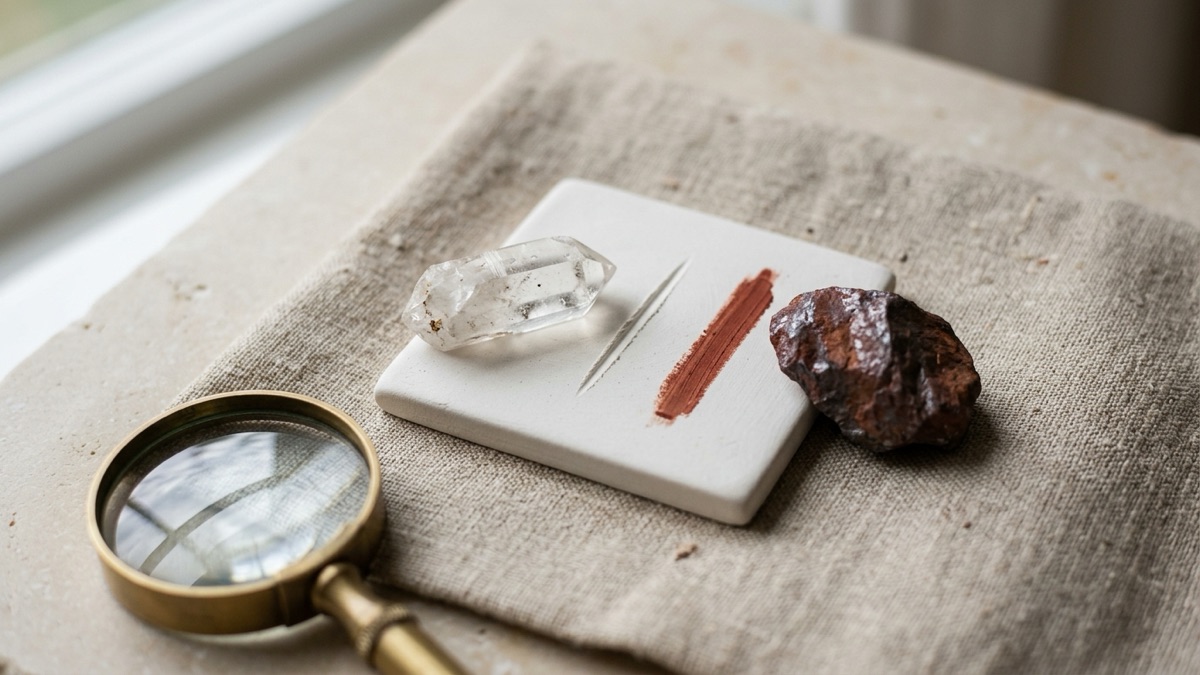
Because they win the fight with the plate. Auckland notes that minerals harder than about 6.5 leave no streak, since they are harder than unglazed porcelain. The MSA key rates a porcelain plate at about 6.5 and says minerals of that hardness and above will only scratch it. Some geologists use a steel file to get the streak of minerals around 6 to 6.5.
So if you drag a quartz point, a garnet or a piece of agate across the plate, you get a groove, maybe with a little white porcelain dust in it, and no colored powder. That is a result too: it tells you the mineral is hard.
What does streak tell you about a possible meteorite?
Streak is one of the fastest ways to rule out a "meteorite." The Washington University in St. Louis meteorite site explains that rocks made of iron oxides such as hematite and magnetite are often mistaken for meteorites because they are denser than most rocks. Hematite leaves a rust-red streak and magnetite a dark gray one, while meteorites give no streak, or a weak grayish one if you press hard.
The reverse does not work, though. The same site notes that Earth's igneous rocks give no streak either, so a blank plate does not make a rock a meteorite.
If your heavy black rock leaves a bold red-brown or black line, it is very likely an Earth rock. Our guide to black rocks and minerals covers the usual suspects, and meteorite or meteorwrong walks through the other checks. The free meteorite checker runs through them one by one.
What are the most common streak test mistakes?
- Using the glazed side. Shiny glaze does not grab powder. Use the dull, unglazed side.
- Streaking a weathered skin. Rust coatings give a yellow-brown streak on many rocks. Test a fresh edge.
- Reading the groove instead of the powder. White dust in a scratch is porcelain, not your mineral.
- Judging color in dim light. Red-brown and black look alike under a yellow lamp. Use daylight.
- Streaking a whole rock. A rock is a mix of minerals. Streak one grain or crystal at a time.
- Stopping at streak. Pyrite and chalcopyrite share a streak; hardness splits them.
Heads up
Galena is a lead mineral and cinnabar is a mercury mineral. Handle them briefly, wash your hands afterwards, and never taste, lick or heat an unknown mineral. Wear safety glasses if you chip a fresh edge with a hammer.
Where does streak fit with the other tests?
Streak is one of the seven checks in our guide to how to identify rocks, and it pairs best with hardness and luster. Metallic minerals are where it shines. For a side-by-side view of color, luster, hardness and streak for common finds, see the rock identification chart.
Try it
The free rock identifier asks for your rock's streak along with its luster, hardness and texture, then suggests likely matches with the test that tells them apart.
The RockhoundID app, coming soon, will suggest likely matches from a photo and tell you whether a streak test or a scratch test would confirm them.
The takeaway
A streak test is ten seconds of work with a plain white tile. Use the unglazed side and a sharp edge, look at the finest powder in daylight, and read the color against the table above. Red-brown points to hematite, black to magnetite, greenish black to pyrite or chalcopyrite, yellow-brown to limonite, and no streak at all means your mineral is harder than the plate. Then let a scratch test finish the job.
RockhoundID guides help you narrow down what you found. They suggest likely candidates, not certain identifications or appraisals. For anything valuable, rare or possibly from space, ask a museum, a university geology department or your state geological survey, and check the collecting rules for the land before you take anything home.
Questions rockhounds ask
What color streak does hematite leave?
Red to reddish brown, even when the hematite itself is shiny and silver-black. That rusty powder is the quickest way to tell it from magnetite, which leaves a black streak.
Can I use a bathroom tile for a streak test?
Yes, if you use an unglazed white surface. The plain back of a white tile often works; the shiny glazed face does not. If you buy a tile, make sure it is unglazed porcelain, not plastic.
Why does my rock not leave a streak?
It is probably harder than the plate. Unglazed porcelain is about 6.5 to 7 on the Mohs scale, so quartz, topaz and other hard minerals only scratch it. Test their hardness instead.
What streak does pyrite have?
Greenish black to brownish black, even though pyrite looks brassy gold. Real gold leaves a yellow streak and is far softer.
Do meteorites leave a streak?
Usually no streak or only a weak grayish one. A strong red-brown or black streak points to hematite or magnetite, two of the most common meteorite look-alikes.
Where these facts come from
- University of Auckland: streak: rocksminerals.flexiblelearning.auckland.ac.nz/minerals/streak.html
- Mineralogical Society of America, Mineral Identification Key: streak: www.minsocam.org/MSA/collectors_corner/id/mineral_id_keyi5.htm
- Mineralogical Society of America, Mineral Identification Key: introduction: www.minsocam.org/MSA/collectors_corner/id/mineral_id_keyi1.htm
- University of Minnesota, Common Minerals: hematite: commonminerals.esci.umn.edu/minerals-g-m/hematite
- University of Minnesota, Common Minerals: magnetite: commonminerals.esci.umn.edu/minerals-g-m/magnetite
- University of Minnesota, Common Minerals: pyrite: commonminerals.esci.umn.edu/minerals-o-s/pyrite
- Kansas Geological Survey: Kansas rocks and minerals, minerals: www.kgs.ku.edu/Publications/Bulletins/ED2/04_mine.html
- Missouri Geological Survey: limonite fact sheet (PUB2930): dnr.mo.gov/print/document-search/pub2930
- Handbook of Mineralogy: hematite: www.handbookofmineralogy.org/pdfs/hematite.pdf
- Handbook of Mineralogy: pyrite: www.handbookofmineralogy.org/pdfs/pyrite.pdf
- Handbook of Mineralogy: goethite: www.handbookofmineralogy.org/pdfs/goethite.pdf
- Handbook of Mineralogy: magnetite: www.handbookofmineralogy.org/pdfs/magnetite.pdf
- Handbook of Mineralogy: chalcopyrite: www.handbookofmineralogy.org/pdfs/chalcopyrite.pdf
- Handbook of Mineralogy: galena: www.handbookofmineralogy.org/pdfs/galena.pdf
- Handbook of Mineralogy: graphite: www.handbookofmineralogy.org/pdfs/graphite.pdf
- Handbook of Mineralogy: malachite: www.handbookofmineralogy.org/pdfs/malachite.pdf
- Handbook of Mineralogy: azurite: www.handbookofmineralogy.org/pdfs/azurite.pdf
- Handbook of Mineralogy: sodalite: www.handbookofmineralogy.org/pdfs/sodalite.pdf
- Handbook of Mineralogy: cinnabar: www.handbookofmineralogy.org/pdfs/cinnabar.pdf
- Handbook of Mineralogy: sphalerite: www.handbookofmineralogy.org/pdfs/sphalerite.pdf
- Handbook of Mineralogy: lazurite: www.handbookofmineralogy.org/pdfs/lazurite.pdf
- Handbook of Mineralogy: turquoise: www.handbookofmineralogy.org/pdfs/turquoise.pdf
- Washington University in St. Louis, meteorite site: streak: sites.wustl.edu/meteoritesite/items/streak/
Read next
identification
How to Identify Rocks: A Simple 7-Test Method
identification
Rock Identification Chart: Match Your Find in 5 Steps
identification
Rock Identification Apps: What a Photo Can Really Tell