Blog identification
How to Identify Rocks: A Simple 7-Test Method
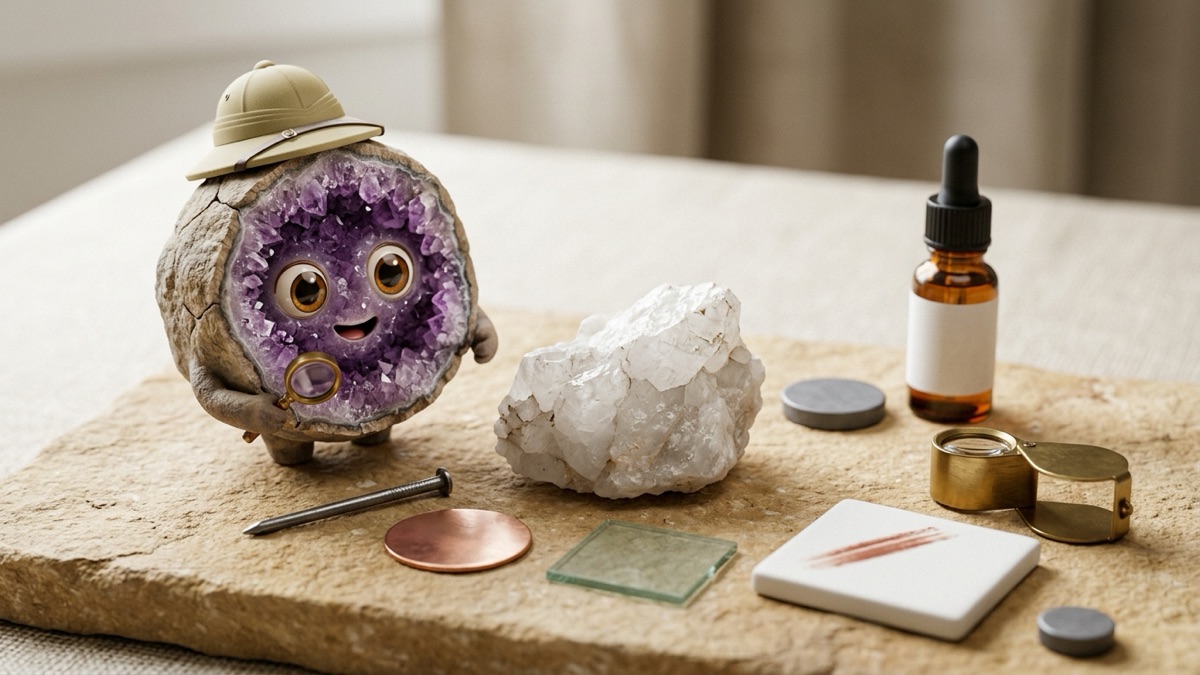
You picked up a rock on a hike, and now it sits on your kitchen table waiting for a name. Good news: you do not need a lab. A nail, a coin, an old bathroom tile and ten minutes will tell you more than any amount of squinting at its color.
Quick answer
To identify a rock, test it in order of reliability: hardness (what scratches it), streak (the color of its powder), luster, weight in the hand, crystal shape and cleavage, then special tests like a fridge magnet and a drop of vinegar. Look at color last, because it misleads. Together, these narrow most finds to a few likely candidates.
Key takeaways
- Hardness and streak are the two most reliable clues you can test at home. Color is the least reliable.
- A mineral is one natural substance with a set recipe and structure; a rock is a mix. The tests work best on single minerals or single grains.
- Everything you need fits in a shoebox: a steel nail, a copper coin, glass, an unglazed tile, a fridge magnet, vinegar and a hand lens.
- Always test a clean, fresh surface. A weathered skin can hide the real color and luster.
- The tests narrow your find to likely candidates, not a certain answer. For anything rare, valuable or possibly from space, get a second opinion.
Is it a rock or a mineral?
The USGS defines a mineral as a naturally occurring inorganic element or compound with an orderly internal structure and a characteristic chemical composition, crystal form and physical properties, like quartz or calcite. A rock is an aggregate of one or more minerals, like granite, basalt, limestone or sandstone.
Why care? The tests below measure mineral properties. Quartz has one hardness and one streak, while granite mixes quartz, feldspar and dark minerals, so the answer depends on which grain you scratch. Our guide to rock vs mineral goes deeper, with easy examples.
What do you need to identify rocks at home?
No special kit required. Most of this is already in a kitchen drawer or the garage.
| Item | What it tests | Good to know |
|---|---|---|
| Your fingernail | Hardness about 2 to 2.5 | Always with you |
| Copper coin or copper wire | Hardness about 3 | Use a US cent from before 1983; newer cents are mostly zinc |
| Steel nail or cheap pocket knife | Hardness about 5 to 5.5 | Hard tool steel can be harder and throw the test off |
| Glass (a jar or a small pane with taped edges) | Hardness about 5.5 | Tape sharp edges first |
| Back of a white bathroom tile | Streak | Use the rough, unglazed side |
| Cheap fridge magnet | Magnetism | Not a strong rare-earth magnet |
| White vinegar and a dropper | Fizz from carbonate minerals | Supermarket vinegar works |
| 10x hand lens | Grains, cleavage, luster | The best small upgrade you can buy |
Add safety glasses whenever you scratch, chip or break a rock. The Mineralogical Society of America's identification kit is built on the same everyday testers.
Tip
Scrub the rock and, if you can, look at a freshly broken face. Then wet it before you judge the color: water shows the true color and pattern, then dries off without a trace.
The seven tests, from most to least reliable
The Mineralogical Society of America calls luster, streak, hardness and cleavage the most important properties. Hardness goes first here because it gives the clearest yes or no; color goes last because it fools everyone.
1. Hardness: what scratches it?
Hardness is measured on the Mohs scale, devised by the Austrian mineralogist Friedrich Mohs in 1822. It runs from 1 (talc) to 10 (diamond), and each mineral scratches the ones below it. The steps are not equal, so think of it as a ranking rather than a ruler.
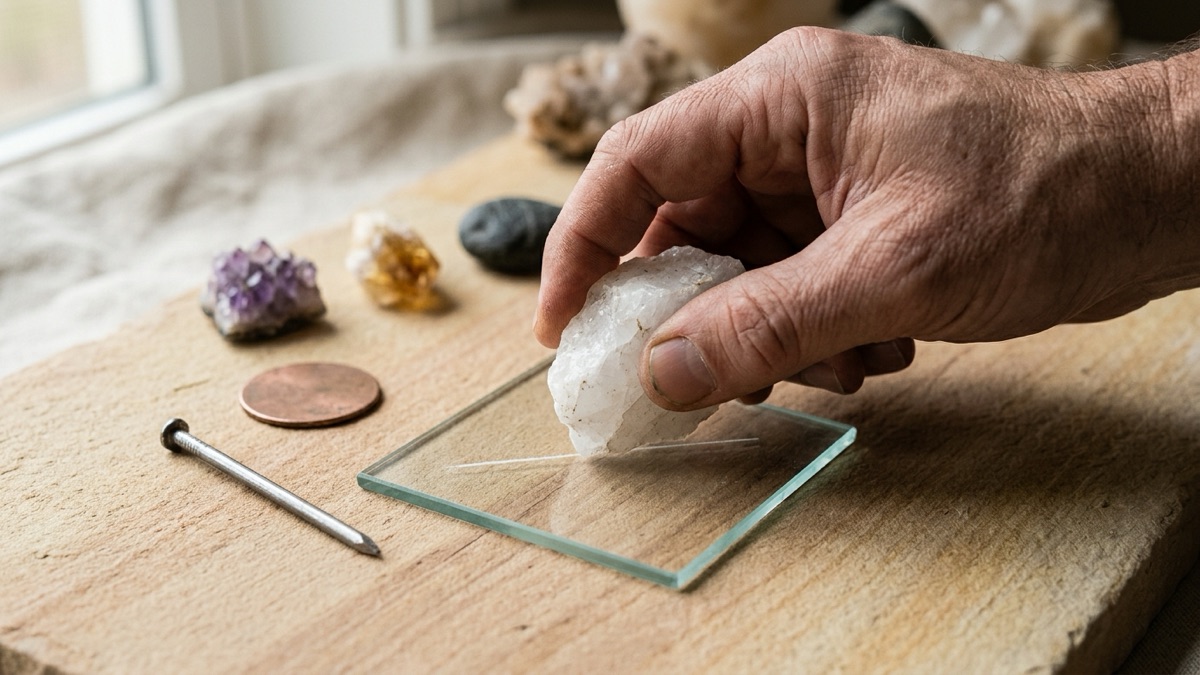
Press firmly and drag a sharp edge across a smooth spot. Then rub the mark with your thumb: a real scratch stays, while a line of powder or a smear of metal from the tester wipes away. Whenever you can, test both ways: scratch the rock with the tester, then try to scratch the tester with the rock.
- Your fingernail scratches it: about 2.5 or less. Think talc, gypsum or mica.
- A copper coin scratches it, a fingernail does not: about 3. Calcite is the classic.
- A steel nail or knife scratches it, a coin does not: roughly 3.5 to 5.5. Fluorite and apatite live here.
- Nothing scratches it, and it scratches glass: about 5.5 or harder. Feldspar and quartz are the usual suspects.
Our Mohs hardness test guide has the full scale and the everyday testers.
2. Streak: what color is its powder?
Rub the rock firmly across the unglazed back of a white tile and look at the powder. Streak is often more honest than the rock's color. Pyrite looks gold but leaves a greenish black streak, and hematite leaves a red to reddish brown streak whether it looks silver, black or rusty.
Two limits: most pale or clear minerals streak white, and minerals harder than about 6.5 leave no streak at all, because they are harder than the porcelain. Our streak test guide lists the streak colors worth knowing.
3. Luster: how does it shine?
Luster is the way light reflects off a surface, and it is not the same as color: brassy pyrite and gray galena are both metallic. Start with the big split, metallic or not, then narrow it down. Non-metallic lusters include glassy (vitreous), pearly, silky, greasy or waxy, adamantine (diamond-like) and earthy or dull, like unglazed pottery.
Tilt the rock under a lamp and watch a flat face catch the light. Luster really needs to be seen in person, because photos flatten it.
4. Weight: is it heavy for its size?
Geologists measure specific gravity: how heavy a mineral is compared with the same volume of water. Quartz (2.65) and calcite (about 2.7) are average. Barite (about 4.5) feels surprisingly heavy for a pale mineral, magnetite comes in at 5.2, galena at about 7.6 and gold at 19.3.
You do not need a scale. Hold your find in one hand and an ordinary rock of the same size in the other. A big difference is a real clue, and it works the other way too: pumice often floats.
5. Crystal shape and cleavage: how does it break?
Cleavage is a mineral's habit of breaking along flat, often shiny planes set by its crystal structure. Fracture is any other kind of break, and conchoidal fracture means smooth, curved, shell-like surfaces, like chipped glass. How a mineral breaks is one of the best tie-breakers there is:
- Quartz: no cleavage, curved conchoidal breaks.
- Feldspar: two cleavages that meet at right angles, giving blocky, shiny faces.
- Calcite: three cleavages that are not at right angles, so it breaks into slanted boxes (rhombs).
- Mica: one perfect cleavage, so it peels into thin sheets.
- Hornblende: two cleavages at about 56 and 124 degrees.
If you have whole crystals, their shape helps too: six-sided quartz points, brassy pyrite cubes, ball-shaped garnets. Our guide to crystal identification covers the common shapes.
6. Special tests: a magnet and a drop of vinegar
The magnet. The Mineralogical Society of America notes that magnetite is the only strongly magnetic mineral most collectors will meet, while pyrrhotite and ilmenite may be weakly magnetic. Use a cheap fridge magnet: a strong rare-earth magnet pulls on many ordinary rocks. About 95 percent of meteorites attract a cheap magnet too, which is why a magnetic rock gets people excited, but most turn out to be magnetite or slag, as our guide to magnetic rocks explains.
The vinegar drop. Carbonate minerals react with acid and give off bubbles of carbon dioxide. Ordinary white vinegar (5 percent acidity) is a weak acid, so the University of Florida describes its reaction with calcite as a weak fizz, but you can usually see it with a lens. Limestone is mostly calcite and marble is recrystallized calcite, so both fizz. Dolomite reacts so slowly that it usually has to be powdered first. See our vinegar fizz test for the method.
7. Color: last, because it lies
Color is the first thing you notice and the last thing you should trust. The University of Auckland notes that tiny amounts of impurities can change a mineral's color dramatically: quartz, normally colorless, also comes in violet (amethyst), pink (rose quartz), yellow and smoky brown. The Mineralogical Society of America agrees that color should never be taken as diagnostic by itself.
Color still helps once the other tests have shortened the list. Our rock identification by color guides start from what you see and point you to the test that settles it.
A worked example: the white, glassy chunk
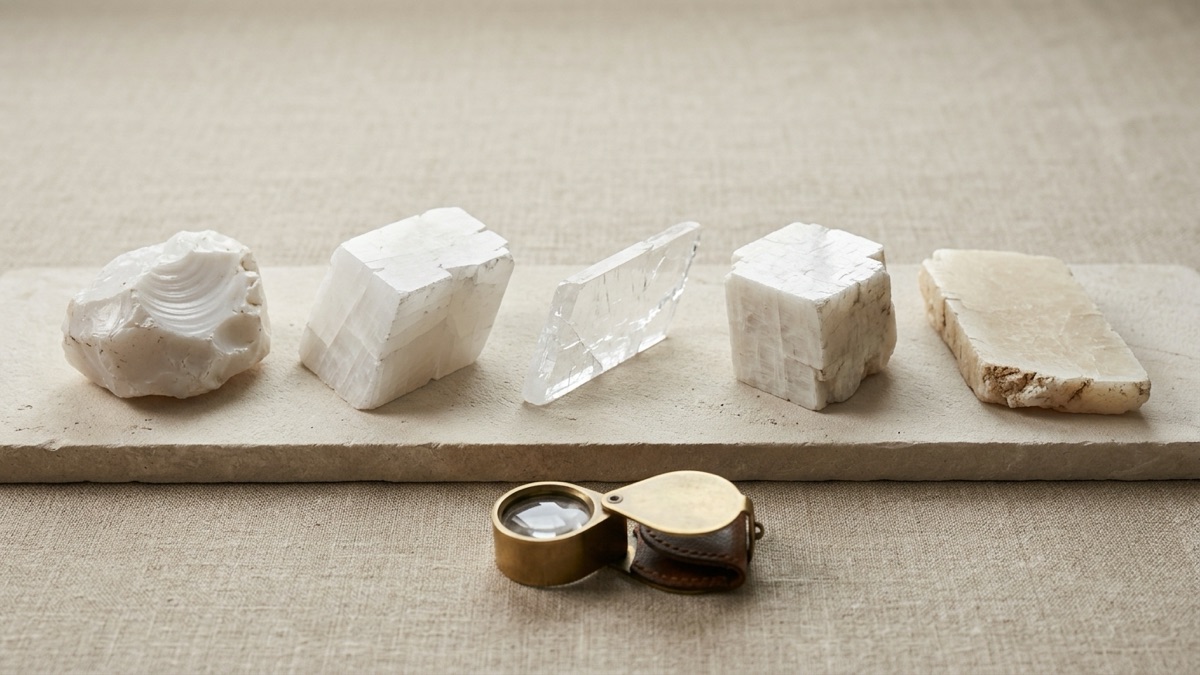
Say you found a white, glassy chunk about the size of a walnut in a creek bed. Five common minerals could look like that: quartz, calcite, gypsum, feldspar and barite. Here is how the tests knock them out one by one.
| Test | What happened | Who is out |
|---|---|---|
| Fingernail | No mark | Gypsum (about 2) |
| Steel nail | No scratch | Calcite (3) and barite (3 to 3.5) |
| Glass | The chunk scratched the glass | Nobody new: quartz (7) and feldspar (6 to 6.5) both can |
| Vinegar | No bubbles | Confirms it is not calcite |
| Weight | Felt like an ordinary rock | Confirms it is not barite, which feels heavy |
| Streak tile | No real streak | Nobody: pale minerals streak white or not at all |
| Broken edge under a lens | Curved, shell-like surfaces, no flat shiny faces | Feldspar, which breaks along flat faces at right angles |
That leaves quartz, and everything fits: hardness 7, glassy luster, normal weight, no streak and conchoidal fracture. Streak did not help here, which is normal for white minerals and why you run several tests, not one.
Put the same answers into our free rock identifier (white, glassy, scratches glass, white or no streak) and quartz tops the list, with quartzite and the two feldspars close behind. Its "test next" hint is to look at a fresh broken face with a hand lens, the very step that settled it here.
Try it
Open the free rock identifier, answer any of its six questions in any order, and watch the likely candidates line up with the reasons they fit, what does not fit and the one test that would settle it. It runs in your browser, with no photo upload and no account.
How do you identify a rock that is a mix of minerals?
With a rock, look at the grains before you test anything. Grab the hand lens: how big are the grains, and are they arranged in any pattern?
- Interlocking crystals you can see, like the gray quartz, pink or white feldspar and black specks of granite, point to an igneous rock that cooled underground.
- Grains too small to see, glass or gas bubbles, as in basalt, obsidian and pumice, point to lava that cooled fast at the surface.
- Sand, pebbles, layers or shell bits point to sedimentary rocks such as sandstone, conglomerate and limestone.
- Sparkly mica layers, stripes or a sugary texture point to metamorphic rocks such as schist, gneiss, marble and quartzite.
Then test individual grains: a quartz grain in granite scratches glass even though the mica beside it is soft. Our hub on types of rocks explains igneous, sedimentary and metamorphic rocks, and the rock identification chart puts the common rocks and minerals side by side.
What if it might be a meteorite, a fossil or worth money?
A possible meteorite. Look for a thin, dark fusion crust (a melted skin, rarely more than 1 to 2 mm thick), a pull on a cheap magnet and shiny metal specks on a broken face. The usual look-alikes are slag, magnetite and hematite. Our guide to how to identify a meteorite and the free meteorite checker walk through the checks.
A possible fossil. Shell shapes, leaf prints and bone texture are clues that something once lived here. Start with our fossil identification guide.
Something valuable. Most finds are worth more as a story than as cash, but some, like good agate, are prized by collectors. Our guides to agate and other popular stones and rocks worth money explain what makes a stone valuable. Nobody can tell you what a rock is worth from a quiz or a photo, including us.
Heads up
Check who manages the land before you take anything home. Collecting rocks and minerals is prohibited in national parks. On BLM (Bureau of Land Management) land, you may collect reasonable amounts for personal, noncommercial use, except where posted closed. On private land, ask the owner first. Wear safety glasses when you hammer or scratch, and never taste or lick an unknown mineral.
Where should you go next?
Caught the bug? Our guide to rockhounding for beginners covers where to look, what to bring and the rules, and the rock tumbler guide shows how to polish your finds. Weighing up photo apps? Our look at rock identification apps explains what a picture can and cannot tell you.
The RockhoundID app, coming soon, will suggest likely matches from a photo and tell you which quick test confirms them.
The takeaway
Identifying a rock is a process of elimination, not one magic test. Scratch it, streak it, check its shine, feel its weight, study how it breaks, then try a magnet and a drop of vinegar. Save color for last. You will usually end with one or two likely candidates and a good reason for each, which is how geologists work in the field too.
RockhoundID guides help you narrow down what you found. They suggest likely candidates, not certain identifications or appraisals. For anything valuable, rare or possibly from space, ask a museum, a university geology department or your state geological survey, and check the collecting rules for the land before you take anything home.
Questions rockhounds ask
What is the easiest way to identify a rock?
Start with a scratch test and a streak test, because hardness and streak color are the most reliable clues you can check at home. Then look at luster, weight and how it breaks, try a magnet and a drop of vinegar, and leave color for last.
Can you identify a rock from a photo?
A photo can suggest likely candidates, but it cannot show hardness, streak or weight, and it rarely shows luster well. Use a photo to shorten the list, then confirm with one or two quick tests in person.
What household items do I need to identify rocks?
A steel nail or cheap pocket knife, a copper coin or piece of copper wire, a piece of glass, the unglazed back of a white bathroom tile, a fridge magnet, white vinegar and a hand lens. Add safety glasses for scratching and breaking.
Why is color the least reliable clue?
Tiny amounts of impurities can change a mineral's color completely. Quartz, for example, can be clear, white, purple, pink, yellow or smoky brown, so color on its own rarely settles anything.
Who can confirm what my rock is?
A local rock club, a natural history museum, a university geology department or your state geological survey can give a second opinion. Bring your test results along with the rock.
Where these facts come from
- USGS: What is the difference between a rock and a mineral?: www.usgs.gov/faqs/what-difference-between-a-rock-and-a-mineral
- University of Auckland: Hardness: rocksminerals.flexiblelearning.auckland.ac.nz/minerals/hardness.html
- University of Auckland: Streak: rocksminerals.flexiblelearning.auckland.ac.nz/minerals/streak.html
- University of Auckland: Lustre: rocksminerals.flexiblelearning.auckland.ac.nz/minerals/lustre.html
- University of Auckland: Specific gravity: rocksminerals.flexiblelearning.auckland.ac.nz/minerals/gravity.html
- University of Auckland: Cleavage and fracture: rocksminerals.flexiblelearning.auckland.ac.nz/minerals/fracture.html
- University of Auckland: Colour: rocksminerals.flexiblelearning.auckland.ac.nz/minerals/colour.html
- Mineralogical Society of America, Mineral Identification Key: identification kit: www.minsocam.org/MSA/collectors_corner/id/mineral_id_keyi2.htm
- Mineralogical Society of America, Mineral Identification Key: mineral properties and luster: www.minsocam.org/MSA/collectors_corner/id/mineral_id_keyi3.htm
- Mineralogical Society of America, Mineral Identification Key: color: www.minsocam.org/MSA/collectors_corner/id/mineral_id_keyi10.htm
- Mineralogical Society of America, Mineral Identification Key: magnetism and acids: www.minsocam.org/MSA/collectors_corner/id/mineral_id_keyi11.htm
- University of Florida IFAS: the common vinegar test: ask.ifas.ufl.edu/publication/HS1262
- Washington University in St. Louis: magnetic attraction: sites.wustl.edu/meteoritesite/items/magnetic_attraction/
- eCFR: 43 CFR 8365.1-5 (BLM rockhounding rule): www.ecfr.gov/current/title-43/subtitle-B/chapter-II/subchapter-H/part-8360/subpa
- eCFR: 36 CFR 2.1 (national parks): www.ecfr.gov/current/title-36/chapter-I/part-2/section-2.1
Read next
identification
Rock Identification Chart: Match Your Find in 5 Steps
identification
Rock Identification Apps: What a Photo Can Really Tell