Blog meteorites
How to Identify a Meteorite: 8 Checks Before You Get Excited
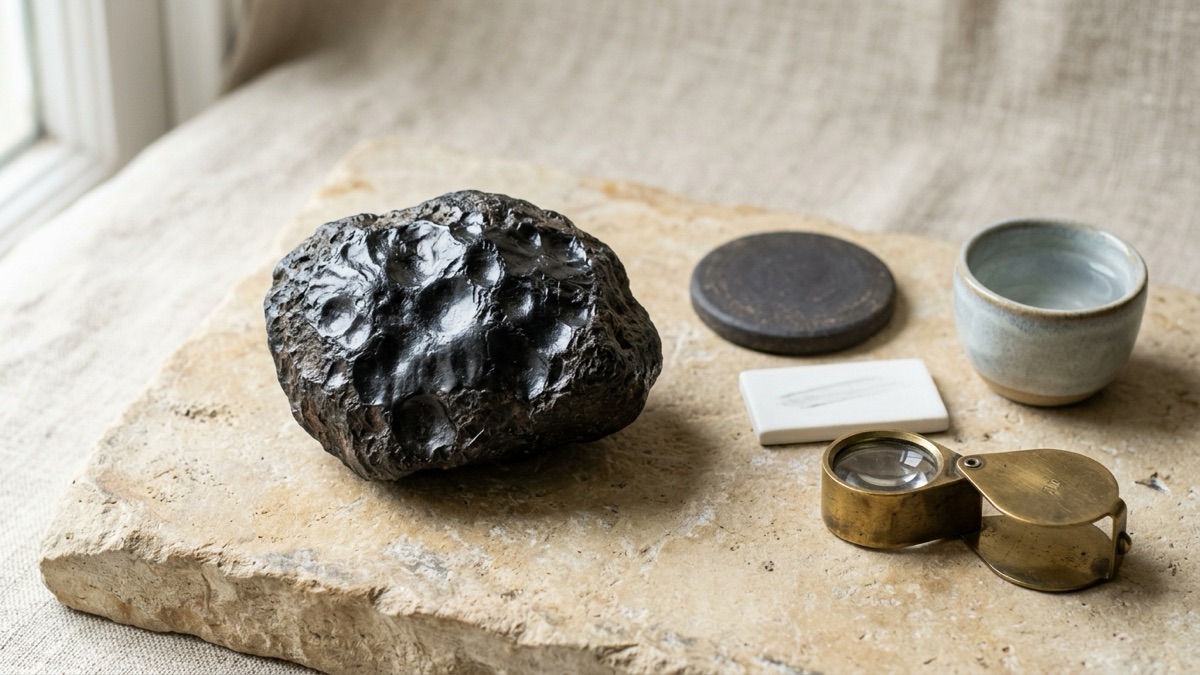
You picked up a dark, heavy rock and a little voice in your head said "space." Maybe it tugs on a magnet, maybe it looks scorched. Before you call a museum, run it through the same checks meteorite experts use, in roughly the order they use them.
Quick answer
Start with the outside: a real meteorite almost always has a thin, dark fusion crust. Then check that a cheap fridge magnet sticks, look for shiny metal flecks on a cut face, and rule out bubbles and a red or gray streak. Where you found it matters too. Only a lab can confirm one.
Key takeaways
- A fusion crust comes first. It is a thin, dark skin, rarely more than 1 to 2 mm thick, and without one a rock is probably not a meteorite.
- Use a cheap fridge magnet, never a rare-earth magnet. About 95 percent of meteorites attract a cheap one.
- If a rock pulls on a magnet but shows no shiny metal grains on a cut face, it is not a meteorite.
- Bubbles, a red or dark gray streak, layers, or a find spot on a beach, riverbed or railroad all point to a meteor-wrong.
- Nobody can confirm a meteorite from a photo or a checklist. Classification takes a specialist lab.
What are the odds your rock is a meteorite?
Low, and it helps to know that going in. Randy Korotev of Washington University in St. Louis, whose meteorite pages are the backbone of this guide, counts about 1,862 meteorites found in all of North America from 1900 through 2024. That works out to about 15 a year for a whole continent.
Freshly fallen ones are rarer still. In the same stretch only 854 falls were recognized worldwide, and just 147 of them in North America. Korotev says he receives photos of dozens of meteor-wrongs every week (the hobby's word for an Earth rock or a piece of industrial junk mistaken for a space rock).
None of that means your rock is not one. It means each check below is built to rule things out fast, because that is what usually happens. You will need a cheap fridge magnet, a white tile with an unglazed back, a cup of water, a hand lens and, for check 3, a saw or a friendly rock shop.
What are the 8 checks, at a glance?
| Check | A meteorite usually | A meteor-wrong often |
|---|---|---|
| 1. Fusion crust | Thin dark skin, lighter inside | Same color through, or a thick rind |
| 2. Cheap magnet | Sticks or pulls clearly | Nothing, or only a rare-earth magnet pulls |
| 3. Metal inside | Shiny silver flecks on a cut face | No metal, or yellow specks (pyrite) |
| 4. Weight | Heavier than common rocks | Normal, or very heavy (iron ore) |
| 5. Bubbles | Solid, no holes | Full of holes (slag, lava rock) |
| 6. Streak | None, or faint gray | Red-brown (hematite) or dark gray (magnetite) |
| 7. Shape | Rounded edges, thumbprint dents | Sharp corners, layers, perfect spheres |
| 8. Find spot | Desert, dry lake bed, plowed field | Beach, stream bed, road, railroad |
1. Does it have a fusion crust?
This is the check that matters most. As a space rock tears through the air, its outside melts and is swept away, over and over. When it finally slows, the last melt cools into a thin, glassy skin called a fusion crust. Korotev's rule is blunt: if it does not have a fusion crust, it is probably not a meteorite.
What a real fusion crust looks like:
- Thin. Rarely more than 1 to 2 mm thick. A thick rind is something else.
- Darker than the inside. The crust is almost always darker than the wet interior (carbonaceous chondrites, a rare carbon-rich kind, are the exception).
- Smooth, and glassy when fresh. The Meteoritical Society describes a fresh crust as black, glassy and smooth. Older finds weather to brown or rusty.
- Finely cracked or flaking. Tiny contraction cracks form as the glass cools, and old crusts can flake off in patches.
The classic fake is desert varnish, a dark coating that builds up on rocks in dry country and can look remarkably like a crust. It is only about a micrometer thick and not glassy. Beach-polished basalt can shine too. Chip a corner: if the inside is the same color and shade as the outside, you are looking at a coating or a polish, not a fusion crust.
Tip
Judge color only on a wet surface. Dry dust makes everything look gray, and wetting a small chipped spot shows you in seconds whether the skin is darker than what is underneath.
2. Does a cheap magnet stick?
About 95 percent of meteorites attract a cheap magnet, because they contain iron-nickel metal. Use a weak ceramic fridge magnet or a compass. A strong rare-earth (neodymium) magnet is the wrong tool: it pulls on many ordinary Earth rocks and makes everything look interesting.
A neat trick from Korotev's pages: stand a round ceramic magnet on its edge on a hard, flat table. If your rock attracts it, you can make the magnet roll toward the rock.
A rock that ignores the magnet could still be a meteorite, but it probably is not. The metal-poor kinds, called achondrites, are rare: only 2.5 percent of the roughly 1,500 stony meteorites found in the United States. Our guide to magnetic rocks covers the Earth rocks that pull, starting with magnetite.
3. Can you see shiny metal inside?
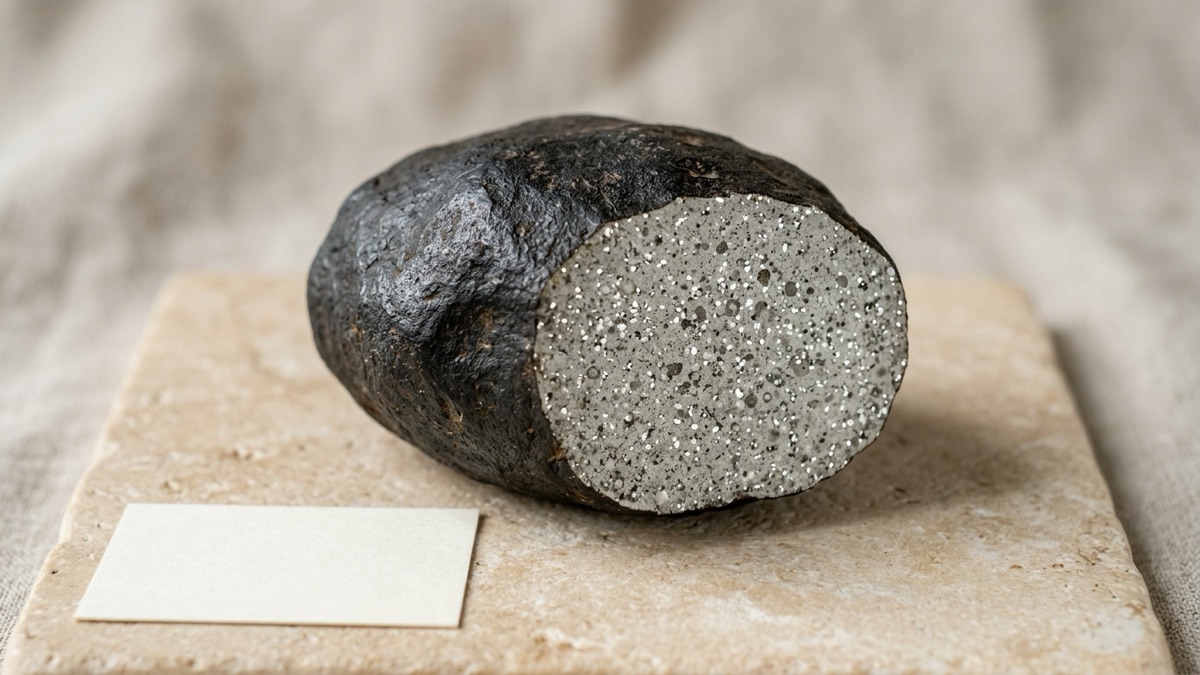
This rule retires most magnetic meteor-wrongs: if a rock attracts a magnet but you cannot see shiny metal grains on a sawn or broken surface, it is not a meteorite. Earth rocks pull on magnets because of magnetite, an iron oxide mineral, not iron-nickel metal. Slag pulls because of leftover furnace iron.
Close to nine in ten stony meteorites are ordinary chondrites, and their metal is easy to spot on a sawn face: bright silver specks, often smaller than a millimeter. Korotev suggests sawing off an end with a tile saw or a rock shop's lapidary saw (not a file or an abrasive rotary tool). Sawing does not necessarily lower a meteorite's value, since every meteorite has to be cut to be classified.
Shiny is not always metal. If the "metal" is yellowish it is pyrite, and shiny bits in a rock that ignores a magnet are not metal at all.
4. Is it heavy for its size?
Metal makes most meteorites denser than common rocks. Most ordinary chondrites have a specific gravity (weight compared with the same volume of water) of about 3.0 to 3.7, while granite is about 2.7 to 2.8 and limestone 2.6 or less. Iron meteorites run about 7 to 8.
The catch: rocks made of hematite or magnetite are heavier than any stony meteorite, about 4.5 to 5. Korotev's bottom line is that a nonmetallic rock with a specific gravity above 4.0 is not a meteorite, and one below 3.0 almost certainly is not. On its own, "heavy" proves very little.
5. Is it free of bubbles and holes?
Very few stony meteorites have vesicles (gas bubbles frozen into rock that was once molten), and when they do, the holes are small and sparse. Most meteorites were never molten inside. A rock full of holes is far more likely to be lava rock or slag, and a rock that is both glassy and bubbly is almost always slag.
6. What color is the streak?
Scrape a sharp edge firmly across the unglazed back of a white tile. Meteorites give no streak, or a weak grayish one. Hematite leaves a rust-red to red-brown streak and magnetite a dark gray one, and both mean Earth rock. No streak proves nothing, since plenty of Earth rocks leave none. The streak test guide shows how to do it cleanly.
7. What shape and surface does it have?
On the way down, edges and corners melt away first, so meteorites end up rounded but irregular, like a half-melted ice cube. Many larger ones carry regmaglypts: smooth, shallow dents like thumbprints pressed into clay. Dents only count as regmaglypts on a rock that also has a fusion crust.
These shapes and features point away from space:
- Sharp edges, points, or a rough, frothy surface
- Layers, stripes or straight parallel veins
- Perfect spheres, flat slabs, long thin shapes or hollow insides
- Fossils, or crystals of quartz you can see
A quick bonus test: meteorites hold no visible quartz, so they cannot cut a deep scratch in glass. If a sharp edge of your rock bites into a piece of glass, it is not a meteorite. The Mohs hardness scale explains why glass makes such a handy tester.
Fun fact
Meteorites are smaller than most people imagine. Korotev's numbers from the Meteoritical Society database show half of stony meteorites weigh less than about 283 grams (10 ounces) in total, and the 78 individual stones he tallied from the 2012 Sutter's Mill fall in California had a median mass of just 7.1 grams.
8. Where did you find it?
Location is evidence. About two thirds of US meteorite finds come from arid parts of California, Nevada, Arizona, New Mexico, Texas and Kansas, and successful hunters search open ground with few other rocks, like deserts and dry lake beds. A rock from a beach, a stream bed, a gravel road or a railroad bed is almost never a meteorite, and slag sometimes ends up in road beds and landscaping gravel.
One story comes up again and again: "I saw it fall." If you saw a meteor and later found a rock, the rock is not the meteorite. Surviving pieces land tens to hundreds of miles from where observers see the light, and they are not hot when they land. Our guide to meteor vs meteorite explains what you actually saw in the sky.
What are the most common meteor-wrongs?
Korotev says iron-oxide concretions (lumpy, heavy nodules of hematite and related minerals) are the most common meteor-wrong people send him, and industrial slag comes second. After those come magnetite-rich rocks, bubbly lava rock such as basalt and scoria, and man-made iron that has rusted convincingly. Each one, with the test that exposes it, is in our field guide to meteorite or meteor-wrong.
What should you never do to a possible meteorite?
Heads up
Do not clean or "test" a possible meteorite with a wire brush, abrasives, acid, other chemicals or a blow torch. Wear safety glasses whenever you chip or saw a rock, and let a rock shop run the saw if you have never used one.
Think about the rules before you keep it, too. In the United States, meteorites generally belong to the owner of the land they are found on, as both the Meteoritical Society and the Bureau of Land Management (BLM, which manages much of the public land in the West) note. On private land, get the owner's permission first.
National parks allow no collecting at all, and metal detectors there must stay broken down and stowed. BLM public lands have their own meteorite limits, which our meteorite metal detector guide walks through.
Who can check your rock, and what does it take?
Start with the free Washington University self-test checklist; its author asks people to work through it before writing. Most rocks are settled right there. If yours still passes, here is the path:
- Take good photos. Sharp, well-lit pictures of the whole rock (not just close-ups), with a coin or ruler for scale, plus a cut or chipped face if you have one.
- Ask locally. Arizona State University's Buseck Center for Meteorite Studies stopped identifying samples for the public in 2010 and suggests your state geological survey, a local university geology department or a natural history museum.
- Try a meteorite lab by email. Some university labs, such as the Cascadia Meteorite Laboratory at Portland State University, will look at emailed photos once you have done your homework. Read their instructions first, never mail a sample unasked, and be patient: its staff volunteer their time.
- Classification is the last step. A stony meteorite is classified from a thin section (a slice of rock ground thin enough for light to pass through), a petrographic microscope and electron microprobe work. An iron needs a lab analysis for iron, nickel, chromium and manganese. Korotev says classification will likely cost several hundred dollars, so get an expert opinion from photos before you pay.
Only after classification does a meteorite get an approved name in the Meteoritical Society's Meteoritical Bulletin. Be wary of shortcuts: Korotev notes that photo apps and image searches are nearly always wrong when they call a rock a meteorite. If a real one does turn up, our guide to what a meteorite is worth covers what sets the price.
Try it
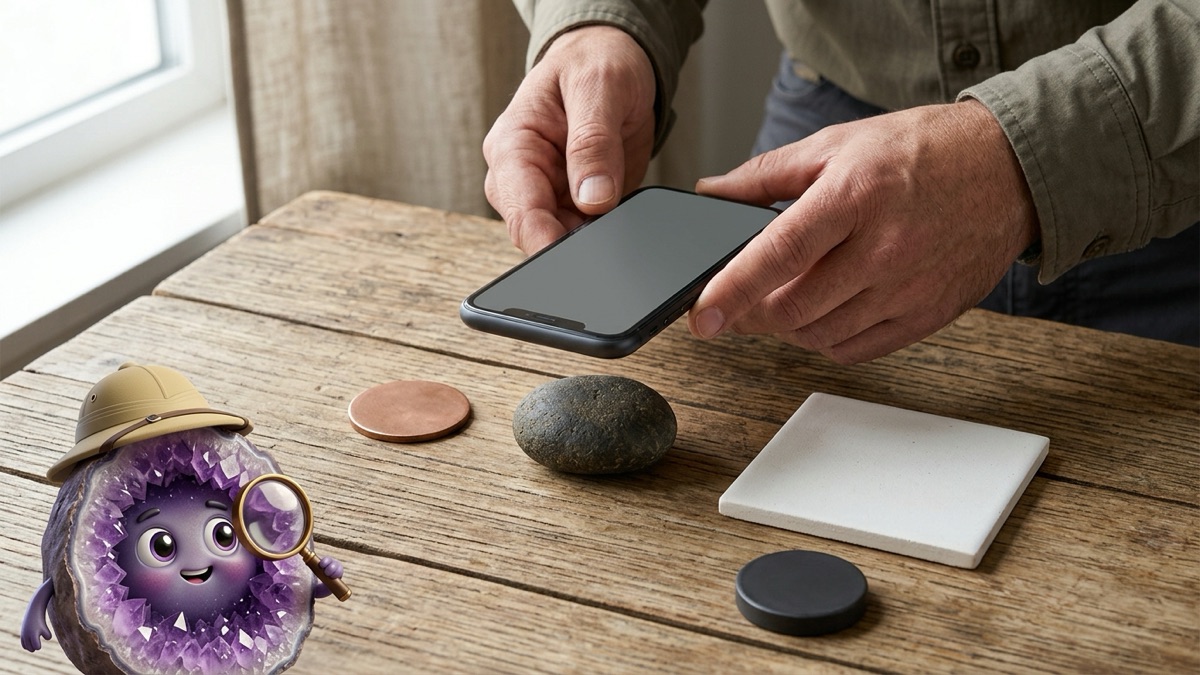
Run your rock through the free meteorite checker. It asks nine quick questions built on these checks, gives an honest verdict from "very unlikely" to "worth asking an expert," and lists the look-alikes your answers point to. It runs in your browser and needs no photo.
The takeaway
Identifying a meteorite is mostly a process of elimination. Look for a thin, dark fusion crust, test with a cheap magnet, find metal inside, and rule out bubbles, a colored streak, odd shapes and a suspicious find spot. The RockhoundID app, coming soon, will suggest likely matches from a photo and walk you through the meteorite checks a photo cannot settle. Whatever the answer, you will know your rock a lot better than when you picked it up.
RockhoundID guides help you narrow down what you found. They suggest likely candidates, not certain identifications or appraisals. For anything valuable, rare or possibly from space, ask a museum, a university geology department or your state geological survey, and check the collecting rules for the land before you take anything home.
Questions rockhounds ask
What is the easiest way to tell if a rock is a meteorite?
Look for a fusion crust first: a thin, dark skin, rarely more than 1 to 2 mm thick, that is darker than the inside. Then check that a cheap fridge magnet sticks and that a cut face shows shiny metal flecks. A rock that fails the crust check is probably not a meteorite.
Do all meteorites stick to a magnet?
No, but about 95 percent attract a cheap ceramic magnet because they contain iron-nickel metal. The exceptions are rare achondrites, which are only about 2.5 percent of the stony meteorites found in the United States. Do not use a strong rare-earth magnet, which pulls on many Earth rocks too.
Can a meteorite be identified from a photo?
No. A photo can help an expert say a rock does not look like a meteorite, but confirming one takes laboratory work. Stony meteorites are classified from a thin section under a microscope and microprobe analysis, and iron meteorites need a chemical analysis for nickel and other elements.
Who can tell me if my rock is a meteorite?
Work through the Washington University in St. Louis self-test checklist first. Then try your state geological survey, a university geology department or a natural history museum, which is what Arizona State University's meteorite center recommends. Some university meteorite labs will look at emailed photos.
Are meteorites hot when they land?
No. Meteorites lose their cosmic speed high in the atmosphere and fall the last miles in darkness at a few hundred miles per hour. They land at or only slightly above air temperature, so a hot or scorched-looking rock is not a sign of a meteorite.
Where these facts come from
- Washington University in St. Louis (Randy Korotev): Some meteorite realities: sites.wustl.edu/meteoritesite/items/some-meteorite-realities/
- Washington University in St. Louis: Meteorite fusion crust: sites.wustl.edu/meteoritesite/items/meteorite-fusion-crust/
- Washington University in St. Louis: Magnetic attraction: sites.wustl.edu/meteoritesite/items/magnetic_attraction/
- Washington University in St. Louis: Metal in ordinary chondrites: sites.wustl.edu/meteoritesite/items/ordinary-chondrites/
- Washington University in St. Louis: Metal, iron and nickel: sites.wustl.edu/meteoritesite/items/metal-iron-nickel/
- Washington University in St. Louis: Density and specific gravity: sites.wustl.edu/meteoritesite/items/density-specific-gravity/
- Washington University in St. Louis: Streak: sites.wustl.edu/meteoritesite/items/streak/
- Washington University in St. Louis: Scratch test: sites.wustl.edu/meteoritesite/items/scratch-test/
- Washington University in St. Louis: Terrestrial rinds, coatings and crusts: sites.wustl.edu/meteoritesite/items/rinds-and-coatings/
- Washington University in St. Louis: How big are meteorites?: sites.wustl.edu/meteoritesite/items/how-big-are-meteorites/
- Washington University in St. Louis: Self-test checklist: sites.wustl.edu/meteoritesite/items/self-test-check-list/
- Washington University in St. Louis: What to do if you think you have found a meteorite: sites.wustl.edu/meteoritesite/items/what_to_do/
- Washington University in St. Louis: Meteorite testing: sites.wustl.edu/meteoritesite/items/meteorite-testing/
- Arizona State University, Buseck Center for Meteorite Studies: sample identification FAQ: meteorites.asu.edu/faq/faq-sample-identification
- Cascadia Meteorite Laboratory, Portland State University: Think you have a meteorite?: meteorites.pdx.edu/possible-met.htm
- Cascadia Meteorite Laboratory: Meteorite identification: meteorites.pdx.edu/meteoriteid.htm
- The Meteoritical Society: Meteorites: meteoritical.org/meteorites
- BLM Instruction Memorandum 2012-182: Collection of Meteorites on Public Land: www.blm.gov/policy/im-2012-182
- 36 CFR 2.1, National Park Service: preservation of natural resources: www.ecfr.gov/current/title-36/chapter-I/part-2/section-2.1