How Much Is Jade Worth? Jadeite, Nephrite and Fakes
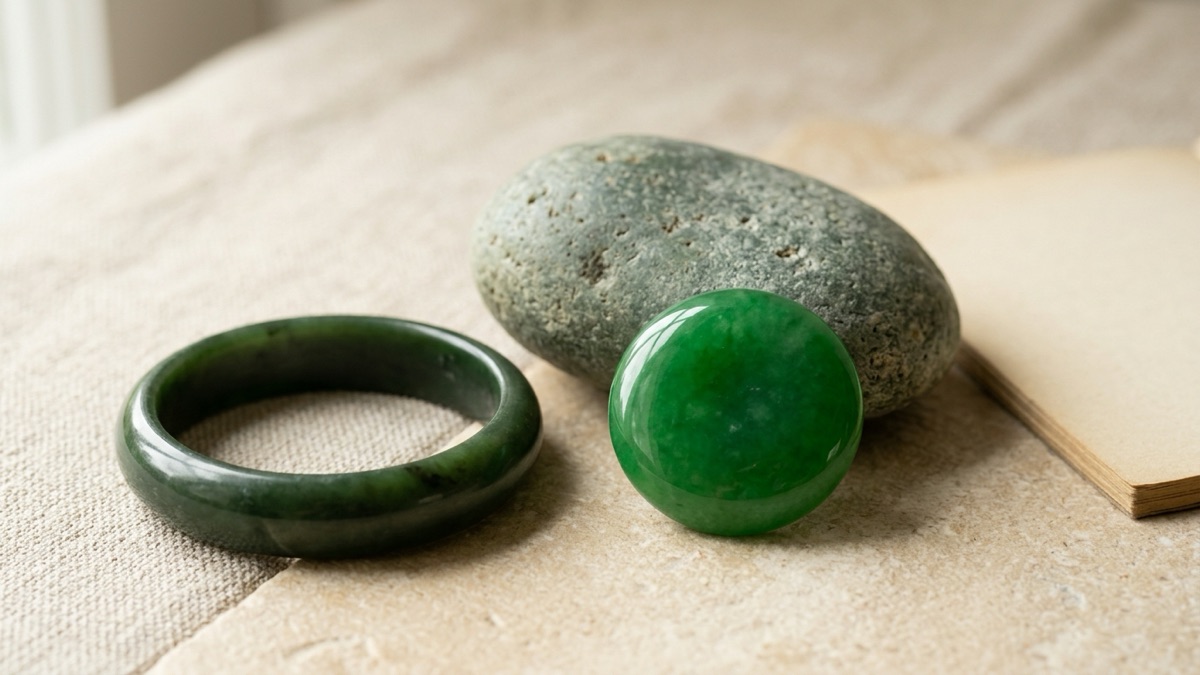
Jade can be worth anything from a few dollars to millions, and the gap comes down to which jade it is, nephrite or jadeite, and what has been done to it. Color, transparency, texture, size and treatment set the price, so an honest estimate for a beach pebble or a family bangle starts there.
Quick answer
Jade ranges from a few dollars for a small polished nephrite piece to millions for top jadeite. As of September 2026, FossilEra listed nephrite hearts from $8 and Canadian nephrite slabs at $125 to $345, while Bonhams sold a jadeite bead necklace for HK$1,274,000 in 2024. Color, transparency, texture, size and treatment set the price.
Key takeaways
- "Jade" covers two minerals: jadeite (harder, rarer, more vivid) and nephrite (more common, more muted). Fine jadeite is worth far more.
- Color is the biggest value factor. GIA calls vivid, almost transparent green "imperial jade," one of the world's most expensive gems. Lavender comes next.
- Treatment can wipe out value. Bleached and polymer-filled "B jade" and dyed "C jade" are common, and only a lab can rule them out.
- Real jade scratches glass, feels heavy and shrugs off a steel knife. Serpentine, glass and plastic do not.
- Nobody can appraise jade from a photo. For a real number, get a gem lab report, then a qualified appraiser.
What is jade, exactly?
GIA describes jade as a generic term for two different minerals, nephrite and jadeite, plus, under certain conditions, green omphacite. Jadeite is a pyroxene, and nephrite is a dense, felted mass of amphibole fibers in the tremolite-actinolite series. They look alike to most people, but they are not the same stone, and the market treats them very differently.
Both are only moderately hard. GIA puts jadeite at 6.5 to 7 and nephrite at 6 to 6.5 on the Mohs scale, and the Handbook of Mineralogy gives jadeite 6 to 7. What makes jade special is toughness, its resistance to breaking. GIA says both types are extremely tough, tough enough that Neolithic knives and axe heads were often made of nephrite. On GIA's toughness scale, nephrite scores about 225,000 and jadeite about 120,000, against roughly 5,000 to 8,000 for diamond. That is why thin jade bangles survive decades of wear.
| Jadeite | Nephrite | |
|---|---|---|
| Mohs hardness (GIA) | 6.5 to 7 | 6 to 6.5 |
| Density (Handbook of Mineralogy) | 3.24 to 3.43 | 3.03 to 3.24 (actinolite) |
| Typical colors (GIA) | Greens, lavender, white, yellow, reddish orange, gray, black, brown | Light to dark green, white, yellow, brown, gray, black |
| Transparency (GIA) | Semi-transparent to opaque | Translucent to opaque |
| Where it sits in the market | Rare, top prices | Common, mostly modest prices |
How much is jade worth? Real, dated prices
Dealer prices are what a seller was asking when we checked in September 2026. Auction prices are what a buyer paid, including the buyer's premium, on the date shown. None of them is an appraisal of your piece.
| What sold or was offered | Details | Price | Source and date |
|---|---|---|---|
| Polished nephrite hearts | 1.6 in, small polished pieces | $8 each | FossilEra, September 2026 |
| Polished nephrite palm stones, Afghanistan | 1.55 to 2.5 in | $19 to $39 | FossilEra, September 2026 |
| Polished Canadian nephrite slabs, British Columbia | 6.1 to 9.9 in | $125 to $345 | FossilEra, September 2026 |
| Nephrite sculpture of a woman, British Columbia | 30 x 24 x 16 in, about 200 lb, boulder rind kept | $1,211.25 | Bonhams, August 2020 |
| Jadeite bead necklace, mottled translucent celadon | 6.6 to 6.9 mm beads, natural, no resin per lab report | £1,216 | Bonhams London, July 2025 |
| Carved jadeite handle, translucent green | 66.99 carats, GIA report noting natural green color, impregnated | $5,888 | Bonhams online, November 2025 |
| Nephrite table top from a 26 ton British Columbia boulder | Nearly 11 ft long, about 2,200 lb of jade | $31,250 | Bonhams, December 2016 |
| Jadeite and diamond necklace, 81 intense emerald green beads | 8.2 to 9.77 mm beads, natural, no resin (A jade) | HK$1,274,000 | Bonhams Hong Kong, November 2024 |
| Hutton-Mdivani jadeite necklace, 27 beads | 15.4 to 19.2 mm beads, Cartier clasp | $27.44 million (HK$214 million) | Sotheby's Hong Kong, April 2014 |
Two things jump out. First, the bead necklaces: the celadon strand sold for about the price of a nice dinner, while the emerald green strand sold for a fortune, and the gap is almost all color and transparency. Second, weight barely matters on its own. A 200 pound nephrite sculpture brought $1,211.25, while a 67 carat jadeite handle brought $5,888. Anyone quoting a flat "jade price per gram" is guessing. The Hutton-Mdivani necklace, which Guinness World Records lists as the most expensive jade jewelry sold at auction, is the ceiling, not a benchmark.
What decides the value of jade?
GIA's quality factors for jadeite rank the drivers clearly. They apply to nephrite too, at a lower price level.
Color
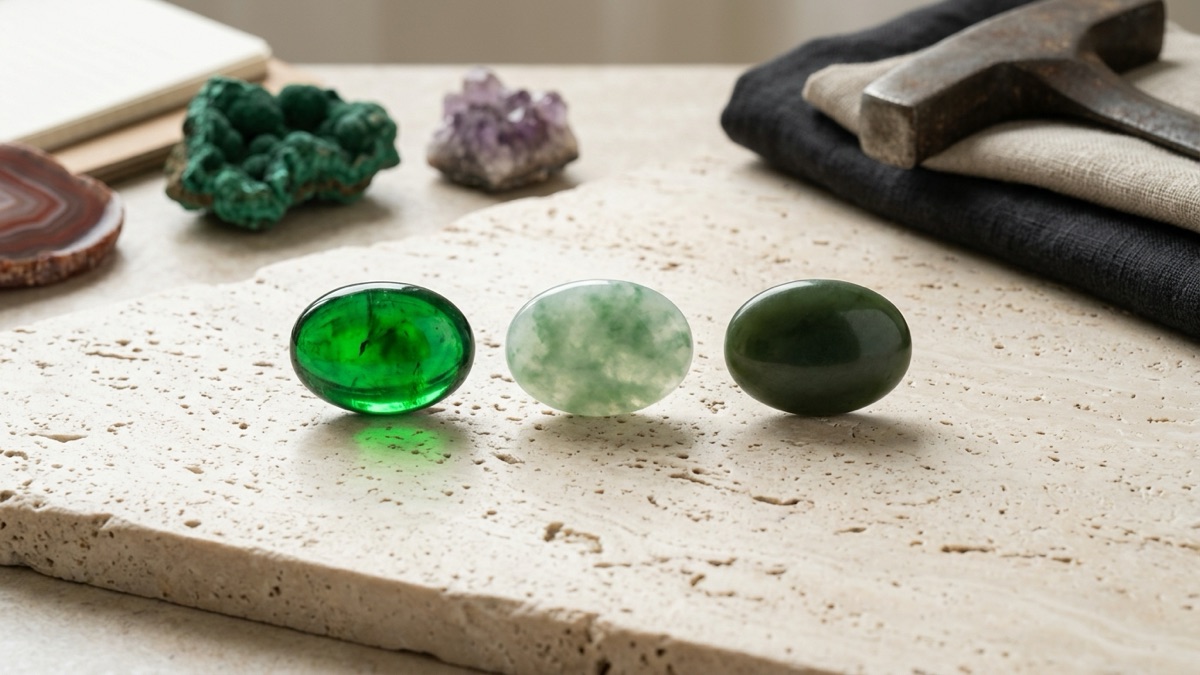
GIA says color is jadeite's most important value factor. The most valuable green is pure and penetrating, a vivid hue with no hint of gray. Almost transparent stone in that vibrant emerald green earns the name imperial jade, and GIA calls it one of the world's most expensive gems. Lavender is the next most valuable color, and intense colors of any kind command a substantial premium.
Nephrite runs a similar ladder in a quieter key. The Wyoming State Geological Survey says jade quality rests on uniformity of texture and lack of inclusions, combined with color intensity and translucency, and that only about 10 percent of most nephrite deposits are considered gem quality.
Transparency and texture
GIA says the best jadeite is semitransparent: text read through it would be slightly blurred. Good transparency can even make up for uneven color, while opaque or cloudy patches reduce desirability. Hold your piece over printed text and see how much light gets through. Texture ranks third: fine-grained jadeite has a smooth surface and high luster, while coarse, grainy material polishes less brightly and sells for less.
Size and cut
GIA says the value of cabochons, beads and bangles rises with size, and that with top-quality imperial jadeite, slight differences in size make large differences in value. For cabochons, symmetry, proportion and thickness matter most. A bangle cut from one flawless piece is worth more than the same weight in small beads.
Treatment
This is the factor that catches people out. GIA lists dyeing, bleaching and impregnation, coatings and heat as jade treatments, and the trade uses letters for them:
| Trade term | What was done | Effect on value |
|---|---|---|
| A jade | Natural, no resin | Full value |
| B jade | Bleached in acid, then filled with polymer | Much lower |
| C jade | Dyed | Much lower |
| B plus C jade | Bleached, filled and dyed | Lowest |
GIA's Gems & Gemology described "bleaching" back in 1992 as a two-step process: a brown or gray component, probably iron compounds in fractures, is removed chemically, and the whitened material is then impregnated with a polymer. The study found infrared spectroscopy was the only method that gave conclusive evidence of polymer in every case. A 2015 GIA lab note adds that lower-quality jadeite is often treated with acid bleaching, polymer impregnation and dyes to reach the sought-after deep green, and that dye tends to concentrate in the gaps between grains.
Notice that both Bonhams necklaces above came with Hong Kong Jade & Stone Laboratory reports stating "no resin detected," and the carved handle's GIA report noted it had been impregnated. Serious buyers pay for that paperwork, and so should you.
Is my jade real? Home checks
No home test proves jade, but a few checks rule out the usual fakes: glass and ceramics (the Mineralogical Society of America notes both have been sold as jade), plastic (GIA), and serpentine, a waxy green mineral that is the most common natural stand-in.
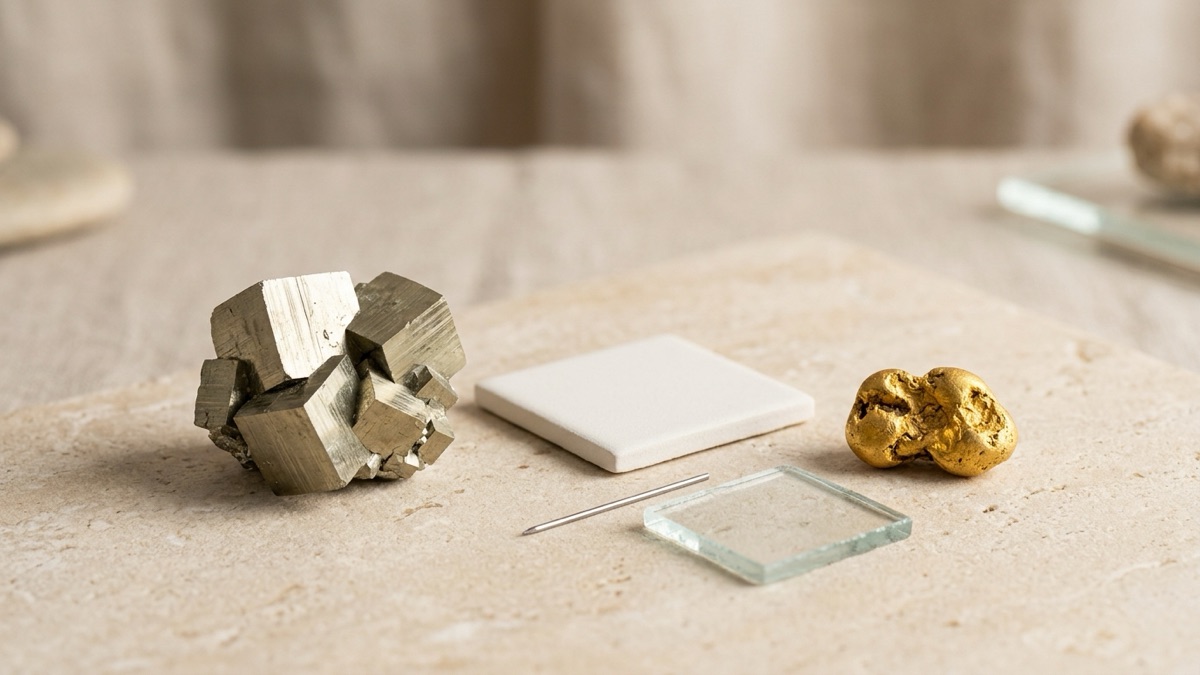
- Scratch glass with a hidden edge. Nephrite (6 to 6.5) and jadeite (6.5 to 7) are harder than window glass (about 5.5), so real jade should scratch it. Serpentine, at roughly 2.5 to 3.5, will not.
- Try a steel knife on the back. A knife (about 5 to 5.5) should not mark jade. If it bites easily, you have serpentine, soapstone or plastic.
- Feel the weight. Jade's density of about 3.0 to 3.4 makes it noticeably heavier than glass or quartz of the same size.
- Look at the color with a hand lens. Dye pooling in cracks and along grain boundaries is a warning sign, as GIA's lab note describes.
- Check for bubbles. Round bubbles inside mean glass.
These checks say "not jade" with confidence and "maybe jade" at best. They cannot separate jadeite from nephrite, and they cannot detect polymer. Our rocks worth money hub explains why a lab report is the only thing a serious buyer trusts.
Try it
Compare jade, serpentine and glass on the free Mohs hardness scale, which includes a scratch simulator, then work through the rock identifier for a green stone you found. Both run in your browser and never upload a photo.
Heads up
Do not scratch the polished face of a piece that might be valuable. Use the back or the drill hole, press lightly, and rub the mark to be sure it is a scratch and not powder from the tester.
Where does jade come from?
The Handbook of Mineralogy names Tawmaw, in Kachin State, Myanmar, as the classic jadeite locality, and GIA notes Guatemala as a jadeite source as well. For nephrite, the Handbook lists deposits near Lander, Wyoming, Monterey County, California, and Jade Mountain, Alaska. The Wyoming State Geological Survey says most of the state's high-quality jade has come from alluvial deposits in and around the Granite Mountains, in colors from white to black with green the most common. British Columbia and Afghanistan supply much of the polished nephrite sold by dealers today, and the Bonhams table above was cut from a 26 ton British Columbia boulder.
Can you collect your own? One well-documented place is Jade Cove on the Big Sur coast of California. Rules for the Monterey Bay National Marine Sanctuary (15 CFR 922.132) allow people to collect jade that is already loose from the seabed between south Sand Dollar Beach and Cape San Martin, from the mean high tide line out to a depth of 90 feet, using hand tools, and each person may take only what they can individually carry. The land above the tide line is Los Padres National Forest, so check with the Forest Service before you touch anything up the slope. In Wyoming, confirm land ownership with the local BLM office and get written permission on private ground. Our guide to rock collecting rules covers every land type.
How do you find out what your jade is worth?
- Rule out the fakes with the checks above. If a knife scratches it, stop here.
- Get a lab report. GIA and the Hong Kong Jade & Stone Laboratory issue reports that state the species (jadeite or nephrite) and whether polymer or dye is present. This is the step that separates a $20 stone from a $20,000 one.
- Photograph it well on a plain background in daylight, plus a shot over printed text to show transparency.
- Compare with dated sales of similar color, transparency, size and treatment, like the table above, and remember that a dealer's asking price is not a selling price.
- Hire an appraiser for insurance, an estate or a sale. The American Society of Appraisers lists members under Gems and Jewelry, and a jewelry appraiser who handles jade regularly is worth the fee.
Green stones fool people in both directions: some "jade" is dyed quartz, and some dull river cobbles are real nephrite. The same caution applies to shiny finds; see pyrite vs gold. For other stones with a wide price range, read how much amethyst is worth and petrified wood value.
The takeaway
Jade is worth anything from a few dollars to a fortune, and the difference comes down to jadeite or nephrite, color, transparency, texture, size and, above all, treatment. Do the home checks to weed out glass and serpentine, then let a lab and an appraiser put a number on the real thing. The RockhoundID app, coming soon, will suggest likely matches from a photo and tell you which quick test to try next.
The pictures in this guide are AI-generated illustrations of what to look for; real specimens vary, so trust the tests over any picture. RockhoundID guides help you narrow down what you found. They suggest likely candidates, not certain identifications or appraisals. For anything valuable, rare or possibly from space, ask a museum, a university geology department or your state geological survey, and check the collecting rules for the land before you take anything home.
Questions rockhounds ask
How much is jade worth per gram?
There is no single price per gram. Ordinary nephrite sells by the piece for a few dollars to a few hundred, while top jadeite is priced per bead or per carving and can reach millions at auction. Color, transparency, texture, size and treatment set the price, not weight alone.
Is jadeite or nephrite more valuable?
Fine jadeite, especially vivid green imperial jade, sells for far more than nephrite. Nephrite is more common, and GIA describes its colors as more muted. Both are extremely tough, and a large or finely carved nephrite piece can still bring thousands.
How can I tell if my jade is real?
Real jade is hard enough to scratch glass, feels heavy for its size and cannot be marked by a steel knife. Serpentine, plastic and many dyed stones fail those checks. Only a gem lab can confirm the species and whether it has been bleached, polymer-filled or dyed.
What is A jade, B jade and C jade?
Trade terms for treatment. A jade is natural jadeite with no resin. B jade has been bleached in acid and filled with polymer. C jade has been dyed. B plus C means both. Lab reports state which one you have, and untreated A jade is worth the most.
Where does jade come from?
The classic jadeite source is Kachin State in Myanmar, and Guatemala also produces jadeite. Nephrite comes from British Columbia, Wyoming, Alaska, California, Siberia, Afghanistan and elsewhere. A known origin helps value, but a lab report matters more.
Where these facts come from
- GIA: Jade (what jade is, hardness, toughness, imperial jade): www.gia.edu/jade
- GIA: Jade quality factors (color, transparency, texture, size): www.gia.edu/jade-quality-factor
- GIA: Jade description (jadeite and nephrite colors): www.gia.edu/jade-description
- GIA: Jade care and cleaning (hardness, treatments): www.gia.edu/jade-care-cleaning
- GIA 4Cs blog: More than the Mohs scale, gem durability (toughness figures): 4cs.gia.edu/en-us/blog/more-than-mohs-scale-gem-durability/
- GIA Gems & Gemology, Fall 1992: Identification of bleached and polymer-impregnated jadeite: gia.edu/gems-gemology/fall-1992-bleaching-jadeite-fritsch
- GIA Gems & Gemology, Fall 2015 Lab Notes: Dyed and natural green jadeite: www.gia.edu/gems-gemology/fall-2015-labnotes-dyed-natural-green-jadeite
- GIA: An introduction to imitation gems (plastic and glass imitate jade): www.gia.edu/gem-imitation
- Handbook of Mineralogy: Jadeite: www.handbookofmineralogy.org/pdfs/jadeite.pdf
- Handbook of Mineralogy: Actinolite (nephrite jade): www.handbookofmineralogy.org/pdfs/actinolite.pdf
- Wyoming State Geological Survey: Jade: main.wsgs.wyo.gov/mineral-resources/gemstones/jade
- Mineralogical Society of America FAQ: Gems (glass and ceramics sold as jade): www.minsocam.org/MSA/collectors_corner/faq/faqgem.htm
- Guinness World Records: Most expensive jade jewellery sold at auction (Hutton-Mdivani necklace, Sotheby's Hong Kong, April 2014): www.guinnessworldrecords.com/world-records/780290-most-expensive-jade-jewellery-
- Bonhams: Attractive jadeite and diamond necklace, Hong Kong (November 2024): www.bonhams.com/auction/30002/lot/599/attractive-jadeite-and-diamond-necklace
- Bonhams: Carved jadeite jade handle, Los Angeles online (November 2025): www.bonhams.com/auction/31060/lot/1114/carved-jadeite-jade
- Bonhams: Jadeite necklace, London Knightsbridge (July 2025): www.bonhams.com/auction/30684/lot/1109/jadeite-necklace
- Bonhams: Nephrite jade woman sculpture, British Columbia (August 2020): www.bonhams.com/auction/26081/lot/298/nephrite-jade-woman-sculpture
- Bonhams: Exceptional nephrite jade table, British Columbia (December 2016): www.bonhams.com/auction/23475/lot/109/exceptional-nephrite-jade-table-on-custom-
- FossilEra: Jade for sale (asking prices checked September 2026): www.fossilera.com/minerals-for-sale/jade
- 15 CFR 922.132: Monterey Bay National Marine Sanctuary, jade collection at Jade Cove: www.law.cornell.edu/cfr/text/15/922.132
- American Society of Appraisers: Find an appraiser: myaccount.appraisers.org/Directories/Find-An-Appraiser