Meteorite Impact Glass: Tektites, Moldavite and Fakes
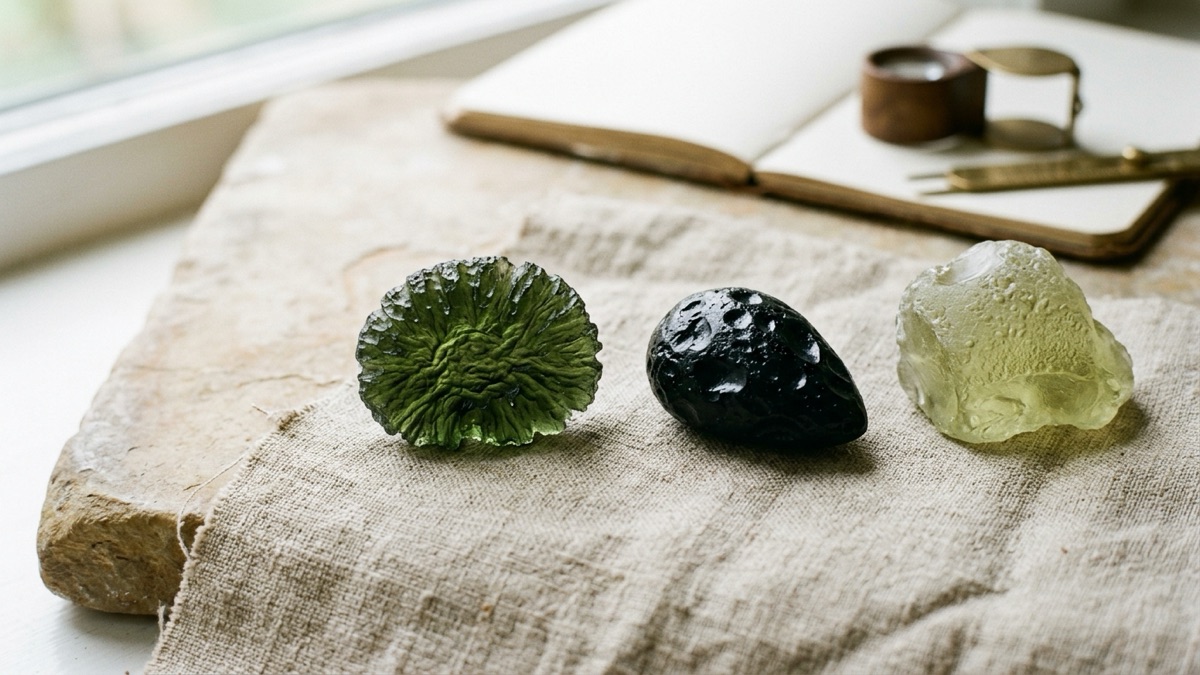
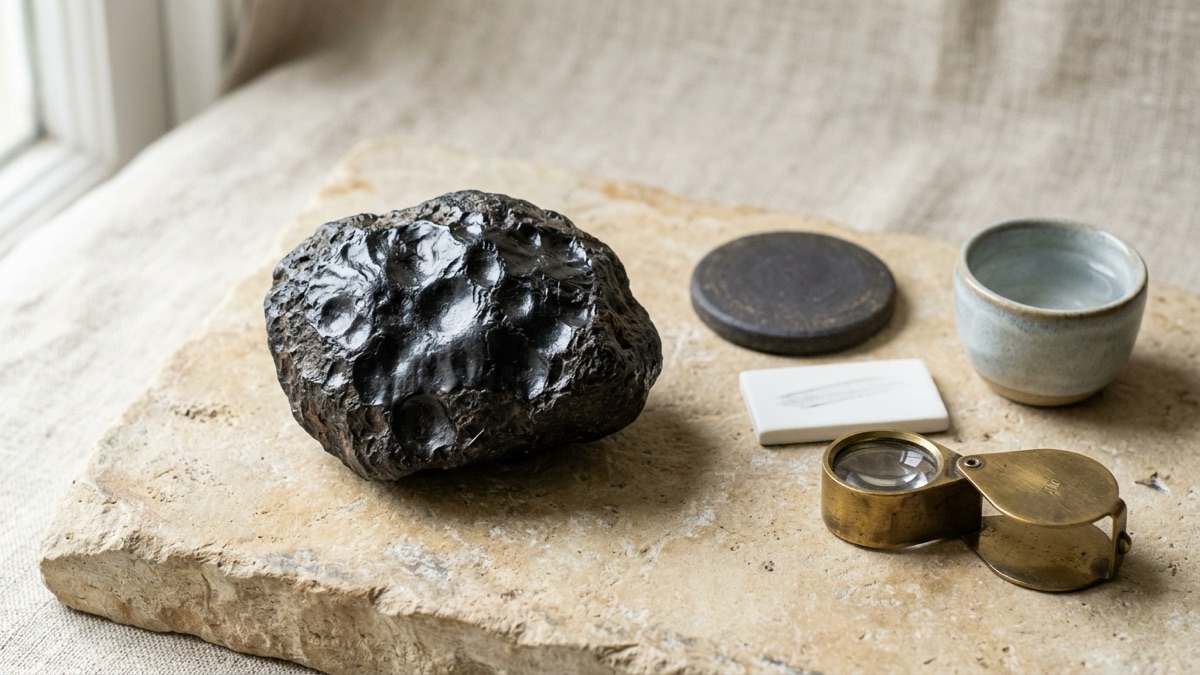
Somebody hands you a chunk of bottle-green glass with a wrinkly, almost carved surface and says it came from space. Or you spot a black, glassy blob in a tray at a gem show, labeled "tektite." Both are real things with a wild backstory, but neither is quite what the label suggests.
Quick answer
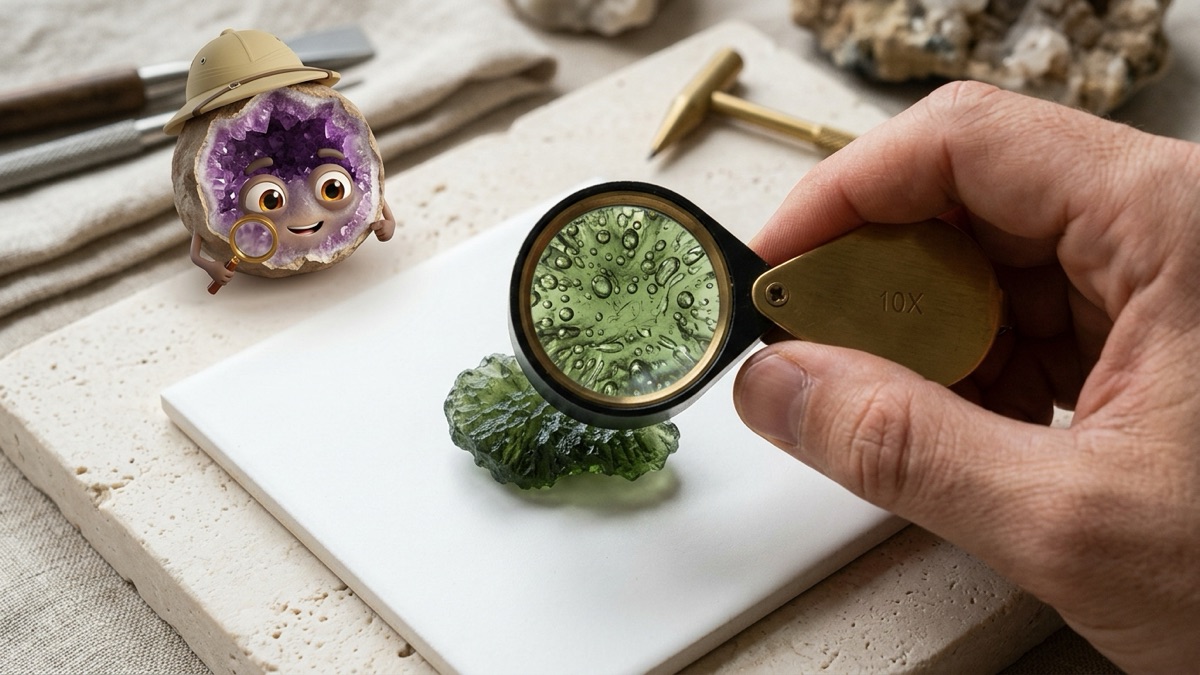
Meteorite impact glass is Earth rock that melted when a large asteroid hit, then cooled so fast it became natural glass. Tektites such as moldavite, plus Libyan Desert Glass, are the famous kinds. None of it is a meteorite. Real moldavite is full of bubbles and tiny silica wires; clean, nearly bubble-free green glass is a warning sign.
Key takeaways
- Impact glass is melted Earth rock, not a piece of an asteroid, so it is not a meteorite.
- Tektites are splash droplets thrown out by a big impact that cooled in flight, often into buttons, teardrops and dumbbells.
- Moldavite (green, Czech Republic), Australasian tektites (black, across a tenth of the globe) and Libyan Desert Glass (yellow, Egypt) are the best known.
- Moldavite imitations are old news and very common. Bubbles, lechatelierite wires, density and size are the classic clues.
- A price far below what established dealers ask is a red flag, but only a gem lab can settle a hard case.
What is meteorite impact glass?
When a big asteroid slams into Earth, the ground and the incoming object try to occupy the same space at the same instant. The American Museum of Natural History describes the result as an explosion: some of the surface rock is not just thrown into the air but heated into a melt that behaves like liquid glass.
Geologists call everything made this way impactites: melted rock, shocked minerals, shatter cones and more. The glassy members of that family are what collectors call impact glass. Some of it stays near the crater. Some of it flies a very long way.
Here is the key point for anyone hoping they found a space rock: impact glass is made of terrestrial rock, rock that was already on Earth. So impact glass is a souvenir of an impact, not a piece of the thing that hit.
How do tektites form?
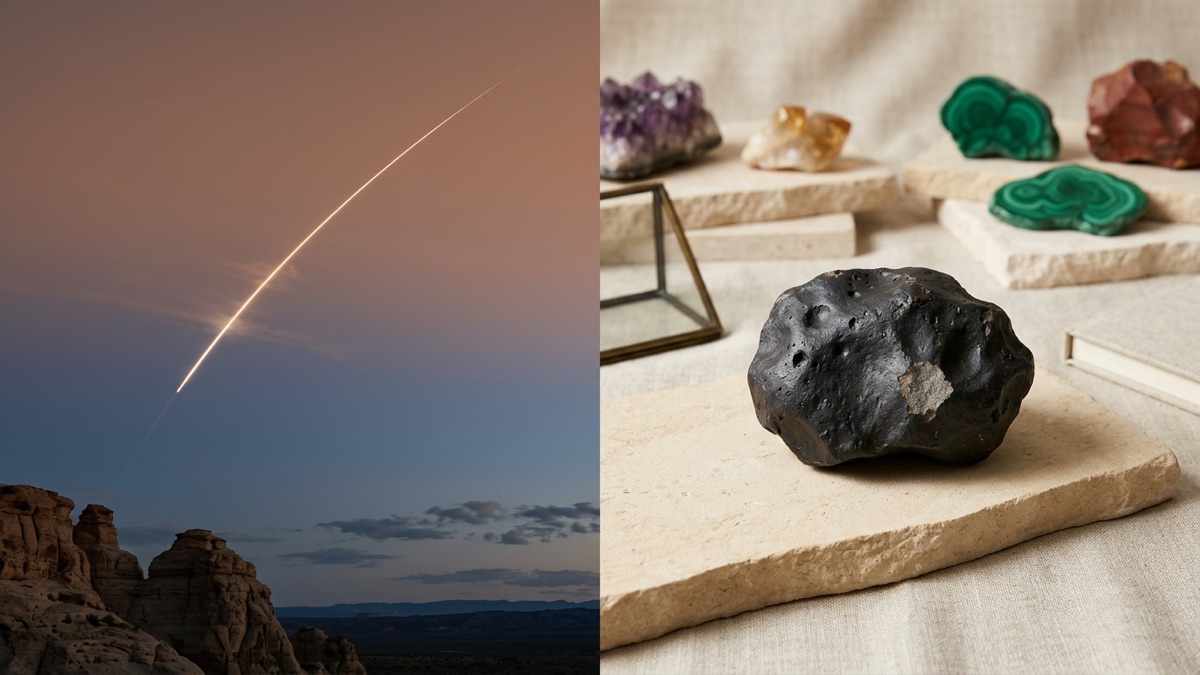
Tektites are the long-distance travelers. The AMNH calls them "splash droplets" from major impacts: blobs of melt that fly through the atmosphere and quench into solid glass, often keeping a droplet shape. The area where they come down is called a strewn field, and it can stretch for hundreds or even thousands of miles.
A University of Waterloo explainer lists the classic tektite shapes: buttons, dumbbells, teardrops, disks and rods, ranging from sand-grain size up to about 1 kilogram (2 pounds). Not every tektite is a neat splash form, though. Researchers describe Muong Nong-type tektites from Southeast Asia as the least streamlined and the largest of the ejected melt fragments: blocky, layered chunks rather than droplets.
Fun fact
Moldavite has been treasured for a very long time. GIA notes that moldavite tektites were first found at the Venus of Willendorf archaeological site in Austria, which dates back roughly 29,000 years.
Which kinds of impact glass are most famous?
Three names cover most of what you will see for sale. Ages and sources come from the museum, gem lab and journal pages listed at the end of this post.
| Impact glass | Where it is found | Formed | What it looks like |
|---|---|---|---|
| Moldavite | Czech Republic, from the Ries crater impact in southern Germany | about 15 million years ago | translucent bottle green to brownish green, with a sculpted, etched surface |
| Australasian tektites (including indochinites) | Indochina to East Antarctica, about a tenth of Earth's surface | about 790,000 years ago | black and opaque; splash forms and blocky Muong Nong-type pieces |
| Libyan Desert Glass | western Egypt, over several thousand square kilometers | about 29 million years ago | pale canary yellow, nearly pure silica |
A few details worth knowing about each:
- Moldavite is green because it contains very little iron. GIA notes that all other tektites are richer in iron and therefore black. The National Museum in Prague holds the largest public moldavite collection in the world, with specimens from about 140 find sites in Bohemia and Moravia.
- Australasian tektites come from what a 2020 study in the Proceedings of the National Academy of Sciences calls the largest known young meteorite impact on Earth. The authors propose that the source is a crater about 15 km (9 miles) wide, buried under younger lava flows in southern Laos.
- Libyan Desert Glass had a long-debated origin. In 2019, a Curtin University team reported tiny zircon grains in the glass carrying evidence of reidite, a high-pressure mineral that forms only in meteorite impacts. The same glass was carved into the scarab on one of Tutankhamun's pectorals.
Is impact glass a meteorite?
No, and that is not a technicality. A meteorite is a piece of an asteroid (or, rarely, of the Moon or Mars) that fell to Earth. Washington University in St. Louis (WUSTL) puts it plainly for moldavite: it is glassy impact ejecta made of terrestrial material that melted and cooled quickly in the atmosphere, so it is not a meteorite, although it is attractive. If the words meteor, meteoroid and meteorite blur together, our guide to meteor vs meteorite sorts them out.
That also means the usual meteorite clues point the other way. Very few meteorites have gas bubbles, while glass often does. WUSTL notes that glass fractures conchoidally (in smooth, shell-shaped curves) and that a rock with conchoidal fractures is not a meteorite. For the whole checklist, see our guide on how to identify a meteorite.
Black tektites can also be confused with volcanic glass and with slag, the glassy waste from smelting. Our guides to obsidian and rocks that look like glass cover those look-alikes, and meteorite or meteorwrong covers slag. Shape helps: a true splash form (button, teardrop, dumbbell) is a good sign of a tektite, but a lab is the only way to be sure.
Try it
If you found something glassy and wonder whether it fell from the sky, run it through the free meteorite checker. Its questions about crust, bubbles and metal steer glassy, bubbly stones away from "meteorite," which is the right call for tektites too.
Why is so much cheap moldavite fake?
Because demand is high and green glass is cheap. A 2015 report in GIA's journal, Gems & Gemology, noted that moldavite prices had risen and that imitations had become more widespread as a result. Imitations are not new, either. Faceted moldavite was popular in Czech jewelry in the second half of the 1800s, and imitations made from green bottle glass appeared by the early 1900s. When a GIA contributor examined five 19th-century "moldavite" jewelry sets in a Prague museum, only one set actually contained moldavite, so glass fakes are even older than people thought.
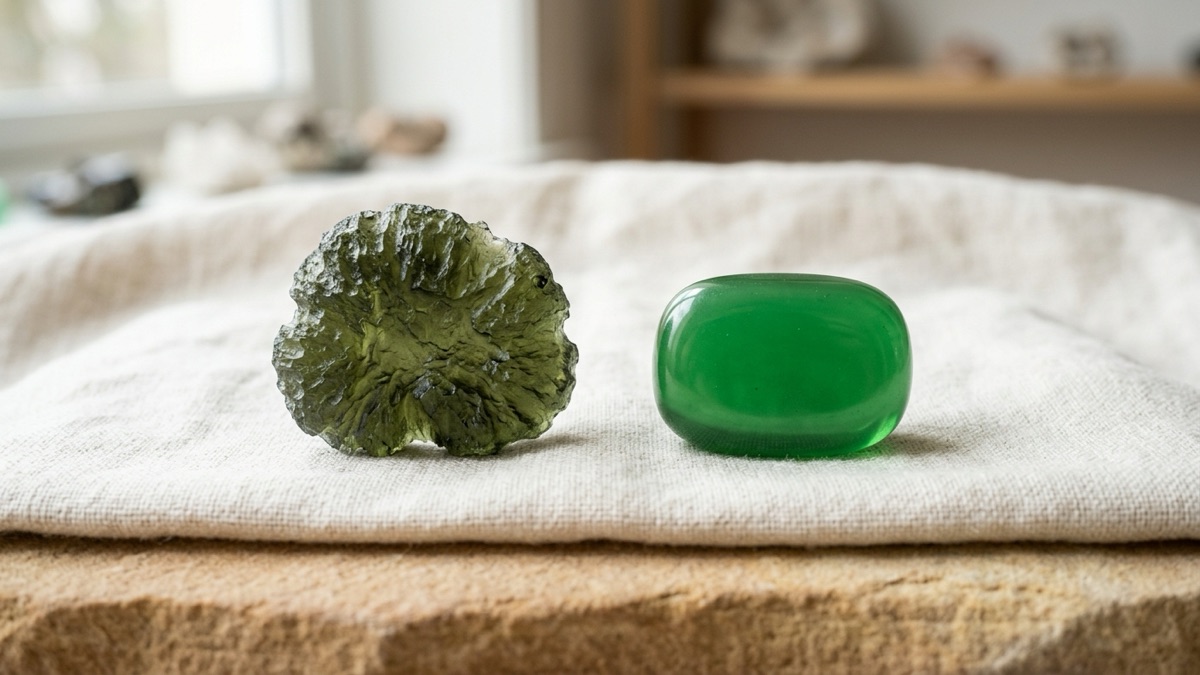
Modern fakes are better. The same GIA report describes small imitations from China, just a few grams each, whose wrinkled surface was likely created by etching glass in acid. WUSTL adds that many fake "tektites" sold online are plain glass, and that some offered as moldavite look "a bit too perfect and regular in shape."
Price is a useful sanity check. As of September 2026, Aerolite Meteorites listed rough moldavite at roughly $20 to $30 a gram (for example, a 1.4 g piece for $35), while black Indochinite tektites sold for well under $1 a gram (a 19.4 g piece for $6) and Libyan Desert Glass for about $2 to $3 a gram. These are one dealer's asking prices, not an appraisal. Still, a big, flawless "moldavite" at a small fraction of the going rate should make you suspicious.
How can you spot fake moldavite?
GIA published a side-by-side comparison of natural moldavite and imitations. Here are the clues that matter most:
| Clue | Natural moldavite | Common imitations |
|---|---|---|
| Gas bubbles | abundant, almost always far more than in artificial glass | few |
| Lechatelierite | thin, wormlike "wires" of silica glass, easy to see with a loupe | absent |
| Density (specific gravity) | about 2.35 (range 2.27 to 2.46) | 2.52 to 2.53 in the Chinese imitations tested; another fake measured 3.60 |
| Shortwave UV light | inert | some glow chalky; others are inert too |
| Size and shape | very few real pieces weigh more than 100 g; shapes are irregular | oversized or suspiciously perfect |
What you can check at home
- Use a 10x loupe. Look inside for plenty of round and stretched bubbles and for thin, curving wires. GIA notes that dunking rough material in water (or oil) makes the lechatelierite easier to see.
- Check the density. Weigh the stone dry, then weigh it hanging in water from a thread. Divide the dry weight by the weight it lost in water. Natural moldavite comes out around 2.27 to 2.46.
- Judge the size and shape. A fist-sized, perfectly symmetrical "moldavite" is a warning sign.
- Ask where it came from. Good sellers name a find area. GIA notes that Besednice, in South Bohemia, is widely considered the source of the finest material.
Tip
The density test needs a scale that reads to 0.01 g, and it works best on bigger pieces. Tiny stones give noisy numbers, so treat one reading as a hint, not a verdict.
Acid-etched fakes can copy the surface almost perfectly, and some imitations do not glow under UV either. If a lot of money is at stake, a gem lab can measure refractive index and absorption spectra, which GIA used to separate the real thing from the glass.
Can you collect impact glass yourself?
Only where the land manager allows it. The National Museum in Prague lists moldavite find sites that include working sand mines, and those belong to somebody. Wherever you are, the basic rules are the same:
- Private land: always get the owner's permission first.
- National parks (US): collecting any rocks or minerals is prohibited, and so is using a metal detector. Our guide to the meteorite metal detector covers where detecting is allowed.
- BLM land (US): reasonable amounts of rocks and mineral specimens for personal, noncommercial use, except in closed or posted areas. Ask the local BLM office.
Heads up
Many countries protect natural heritage objects and restrict their export. If you buy impact glass from abroad, ask the seller where it was found and how it left the country, and keep the paperwork.
The takeaway
Impact glass is a genuine piece of cosmic history, just not a piece of space. Tektites like moldavite are Earth rock melted by an impact and splashed across whole regions. If you are buying, look for bubbles and silica wires, check the density, be wary of perfect shapes and bargain prices, and remember that a gem lab has the final word. If you found something glassy and heavy and wonder what it is worth, our guide to meteorite value explains what actually drives prices. The RockhoundID app, coming soon, will suggest likely matches from a photo and tell you which test confirms them.
The pictures in this guide are AI-generated illustrations of what to look for; real specimens vary, so trust the tests over any picture. RockhoundID guides help you narrow down what you found. They suggest likely candidates, not certain identifications or appraisals. For anything valuable, rare or possibly from space, ask a museum, a university geology department or your state geological survey, and check the collecting rules for the land before you take anything home.
Questions rockhounds ask
Is moldavite a meteorite?
No. Moldavite is Earth rock that melted when a large meteorite struck what is now southern Germany about 15 million years ago. The melt splashed out, cooled into green glass and landed mostly in what is now the Czech Republic.
What is the difference between a tektite and a meteorite?
A meteorite is a piece of an asteroid, the Moon or Mars that fell to Earth. A tektite is terrestrial rock that was melted by a big impact, thrown through the air and cooled into glass. It is a product of an impact, not a piece of the object that hit.
How can you tell if moldavite is real?
Look with a 10x loupe for lots of gas bubbles and thin wormlike wires of lechatelierite, a silica glass that natural moldavite contains and imitations lack. Real moldavite is also lighter for its size than the imitations GIA tested. Acid-etched fakes can fool the eye, so a gem lab has the final word.
Why is Libyan Desert Glass yellow?
Libyan Desert Glass is nearly pure silica, which gives it its pale canary-yellow color. It formed about 29 million years ago in what is now western Egypt, and a scarab in one of Tutankhamun's pectorals is carved from it.
Can you find impact glass yourself?
Only where collecting is allowed. National parks ban collecting, private land needs the owner's permission, and many countries restrict the export of natural heritage objects. Check the land manager's rules before you go.
Where these facts come from
- American Museum of Natural History: Tektites and Impactites: www.amnh.org/research/physical-sciences/earth-and-planetary-sciences/geology-col
- GIA Gems & Gemology, Spring 2015: Moldavites, natural or fake? (archived copy): web.archive.org/web/2023/https://www.gia.edu/gems-gemology/spring-2015-gemnews-m
- GIA Gems & Gemology, Spring 2026: Quarterly Crystal, spires on moldavite: www.gia.edu/gems-gemology/spring-2026-microworld-quarterly-crystal-spires-on-mol
- Sieh et al. (2020), PNAS: Australasian impact crater buried under the Bolaven volcanic field, Southern Laos: pmc.ncbi.nlm.nih.gov/articles/PMC6983392
- Curtin University: Libyan Desert Glass formed by a meteorite impact (2019): www.curtin.edu.au/news/?p=19254
- University of Waterloo, Wat On Earth: Tektites and strewnfields: uwaterloo.ca/wat-on-earth/news/tekties-and-strewnfields
- National Museum (Prague): collection of tektites: www.nm.cz/en/collections/collection-of-tectites
- Washington University in St. Louis meteorite site: Caveat emptor: sites.wustl.edu/meteoritesite/items/caveat-emptor/
- Washington University in St. Louis meteorite site: Glass: sites.wustl.edu/meteoritesite/items/glass/
- Aerolite Meteorites: impactites and tektites for sale (prices checked September 30, 2026): aerolite.org/shop/our-impactites/