Blog color id
Black Rocks and Minerals: How to Tell 12 Look-Alikes Apart
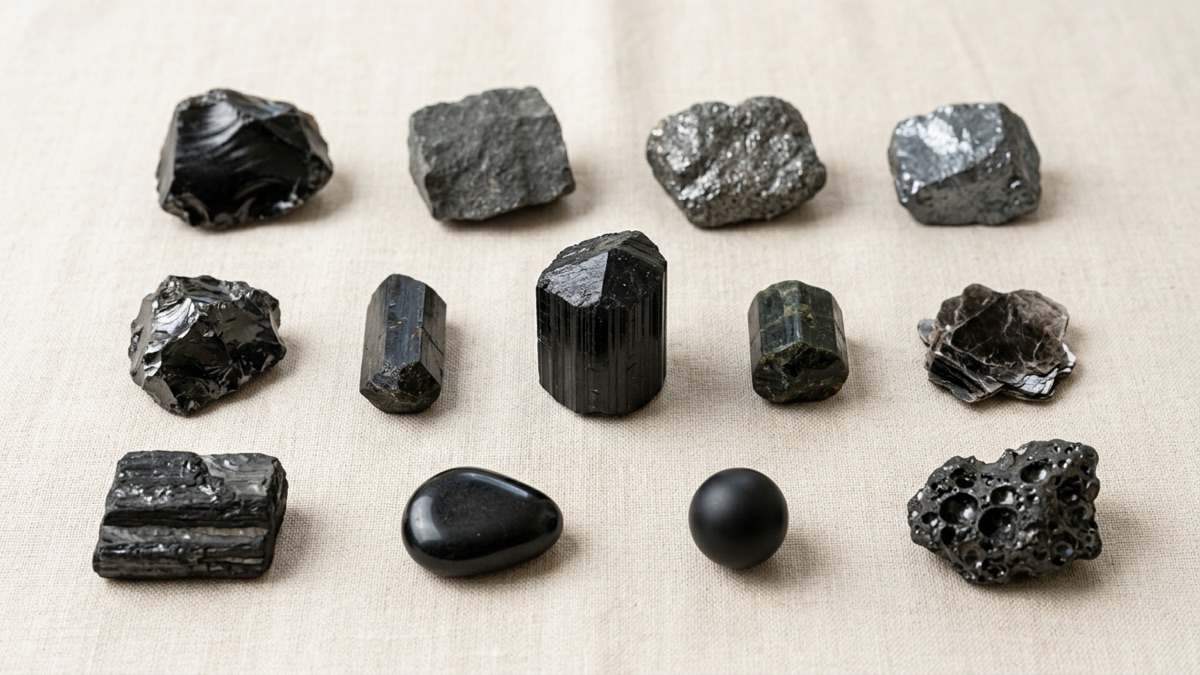
Black rocks turn up everywhere: on beaches, in creek beds, in driveway gravel and along railroad tracks. Some are ordinary volcanic rock, some are interesting minerals and a few are leftovers from a furnace. From a few steps away they all look the same, which is exactly why color is no help here.
Quick answer
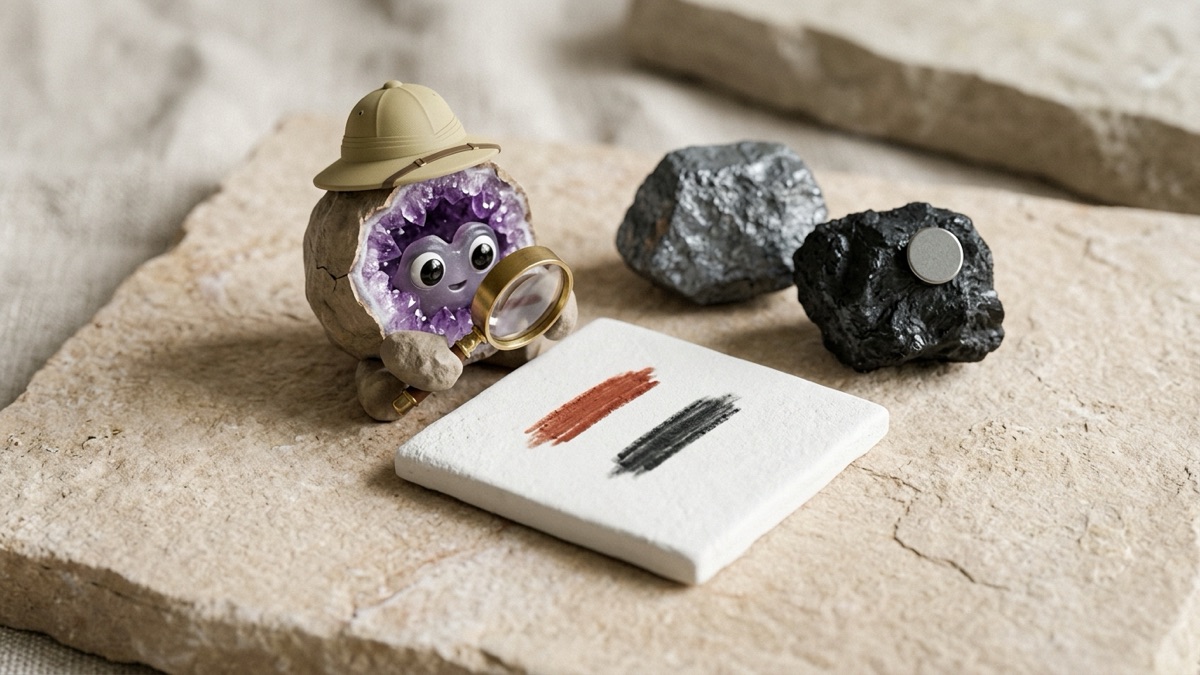
Most black rocks are basalt, obsidian, magnetite, hematite, black tourmaline, hornblende, augite, biotite, coal or slag. Two tests settle most of them: a streak on an unglazed tile (hematite streaks red, magnetite black, most others white or pale) and a fridge magnet (magnetite, most meteorites and much slag attract it).
Key takeaways
- With black rocks, color tells you almost nothing. Streak, a magnet, hardness and texture do the work.
- A red to reddish-brown streak from a black or silvery rock means hematite. A black streak plus a strong pull on a magnet means magnetite.
- Glassy with smooth, curved breaks is obsidian. Glassy and full of bubbles is usually slag, a furnace leftover.
- Long grooved crystals that scratch glass point to black tourmaline; soft flakes that peel apart are biotite mica.
- Very few black rocks are meteorites. A real one has a thin fusion crust, attracts a magnet, shows metal flecks inside and has no bubbles.
What two tests identify most black rocks?
Test 1: the streak
Rub a corner of the rock firmly across the unglazed back of a white bathroom tile and look at the powder. The Washington University in St. Louis meteorite site says hematite and magnetite streaks are easy to make, "almost like chalk on a sidewalk": hematite's is rust or blood red, magnetite's dark gray. Most other black minerals leave a white, pale brown or green streak. Anything harder than about 6.5 leaves no streak at all, because it is harder than the tile. Our streak test guide covers the method in detail.
Test 2: the magnet
Use a cheap fridge magnet, not a strong rare-earth one, which pulls on many ordinary rocks. A handy trick from the same site: stand the magnet on its edge on a table and bring the rock close. If the rock attracts it, you can make the magnet roll by pulling it along with the rock. Magnetite attracts it strongly. Pure hematite does not.
After those two, a steel nail or knife (about 5 to 5.5 on the Mohs scale), a piece of glass (about 5.5) and a hand lens break the remaining ties. Our guide to magnetic rocks goes further into what makes a rock pull a magnet.
Black rock look-alikes at a glance
"Skip" means the test is not useful for that rock, usually because it is a mixture of minerals or too varied to give one answer.
| Look-alike | Streak | Mohs hardness | Fridge magnet? | Best clue |
|---|---|---|---|---|
| Obsidian | Skip | 5 to 5.5 | No | Smooth glass, curved sharp breaks |
| Basalt | Skip | Varies (a rock) | Usually no | Fine grained, sometimes bubbly |
| Magnetite | Black to dark gray | 5.5 to 6.5 | Yes, strongly | Heavy, metallic, magnetic |
| Hematite | Red to reddish brown | 5 to 6 | No | Red streak from a dark rock |
| Black tourmaline | White or none | 7 to 7.5 | No | Grooved crystals, scratches glass |
| Hornblende | Dark green | 5 to 6 | No | Cleavage at 56 and 124 degrees |
| Augite | Greenish white | 5 to 6 | No | Stubby crystals, square-ish ends |
| Biotite | Very pale brown | 2.5 to 3 | No | Peels into thin sheets |
| Coal | Skip | Varies by type | No | Layered, light, sedimentary |
| Jet | Skip | 2.5 to 4 | No | Very light, takes a polish |
| Black onyx | White or none | About 7 | No | Evenly black, usually dyed |
| Slag | Skip | Varies | Often | Glassy with gas bubbles |
Try it
Pick "black" in the free rock identifier, add your streak color and whether a magnet sticks, and it lines up the likely candidates with the one test that would settle each.
What are the 12 black look-alikes?
1. Obsidian
Obsidian is natural volcanic glass, usually rhyolite in composition, that formed when lava cooled too fast for crystals to grow. Oregon State University's Volcano World gives it a typical hardness of 5 to 5.5 and says its jet-black color comes from microscopic crystals of minerals such as magnetite, hornblende and pyroxene. It breaks with smooth, curved (conchoidal) surfaces whose edges can be sharper than a razor. More in our obsidian guide.
Heads up
Handle broken obsidian by its sides, never along an edge, and wear safety glasses whenever you scratch, tap or break any rock.
2. Basalt
Basalt is the everyday black rock. The University of Auckland calls it the most widespread of all igneous rocks, more than 90 percent of all volcanic rocks, dark gray to black and fine grained. Look with a lens: you will see tiny grains, sometimes green olivine specks, sometimes round gas holes (vesicles). Dull and grainy rather than glassy is the tell.
3. Magnetite
Magnetite is black, metallic and heavy, about 5.2 times as heavy as water against about 2.7 for an average rock. It streaks black and is a natural magnet, which is how it got its name. It forms eight-sided crystals, grains in many igneous rocks and black sand on some beaches.
4. Hematite
Hematite can be steel gray, silvery or black, often in lumpy, kidney-shaped masses, and it is about 5 to 6 on the Mohs scale. Whatever the outside looks like, the streak is cherry red to reddish brown. That single test separates it from magnetite, and pure hematite does not attract a magnet.
5. Black tourmaline (schorl)
Schorl forms long prisms with fine grooves running along their length and a rounded, triangular outline when seen end on. It is 7 to 7.5 on the Mohs scale, so it scratches glass, and it is common in granites and pegmatites (very coarse-grained granite). Its streak is white, though at that hardness it barely marks a tile.
6. Hornblende
Hornblende gives many granites and diorites their dark specks. It is dark green to black, about 5 to 6 in hardness, and leaves a dark green streak. With a lens, its two cleavages (flat breaking directions) meet at about 56 and 124 degrees, like a squashed diamond.
7. Augite
Augite looks almost identical to hornblende and lives in basalt and gabbro. The difference is geometry: its two cleavages meet at close to right angles, and its stubby crystals have square-ish cross sections. Its streak is greenish white, paler than hornblende's.
8. Biotite
Biotite is black mica, brown to black and soft (2.5 to 3). Its one perfect cleavage lets it peel into thin, shiny sheets with a fingernail or a pin. You will see it as glittering black flakes in granite, schist and gneiss. Its streak is very pale brown.
9. Coal
The USGS describes coal as a black or brownish-black sedimentary rock made mostly of carbon, and readily combustible. Bituminous coal is blocky and shiny, with thin alternating shiny and dull layers; anthracite is hard, brittle and lustrous. Coal often feels light for its size and turns up in layers among other sedimentary rocks. Do not try to burn a sample to test it.
10. Jet
Jet is a compact, velvet-black coal that takes a good polish, which is why it has been carved into beads and jewelry. The USGS lists it at 2.5 to 4 on the Mohs scale with a specific gravity of 1.30 to 1.32, only about half as heavy as quartz. Very light and soft is what separates it from obsidian and onyx.
Tip
Hold a black bead or pebble in one hand and a same-size piece of quartz in the other. Jet, at about half the weight of quartz, feels noticeably lighter; onyx, which is quartz underneath, feels about the same.
11. Black onyx
Onyx is a banded form of chalcedony, the microcrystalline quartz family that includes agate and jasper. GIA notes that what many call "black onyx" is actually dyed black chalcedony, because natural black chalcedony is rare. It is about 7 on the Mohs scale, scratches glass and is smooth, waxy and evenly black. You are far more likely to meet it as beads than in a creek bed.
12. Slag
Slag is the glassy, bubbly waste from smelting and furnaces, and it is common in fill, gravel and near old industry. The Washington University in St. Louis meteorite site says a rock is probably slag if it attracts a magnet or has flow features on one surface, because slag often contains metallic iron. Glassy plus gas bubbles means slag. See meteorite or meteorwrong for the full lineup of fakes.
Could a black rock be a meteorite?
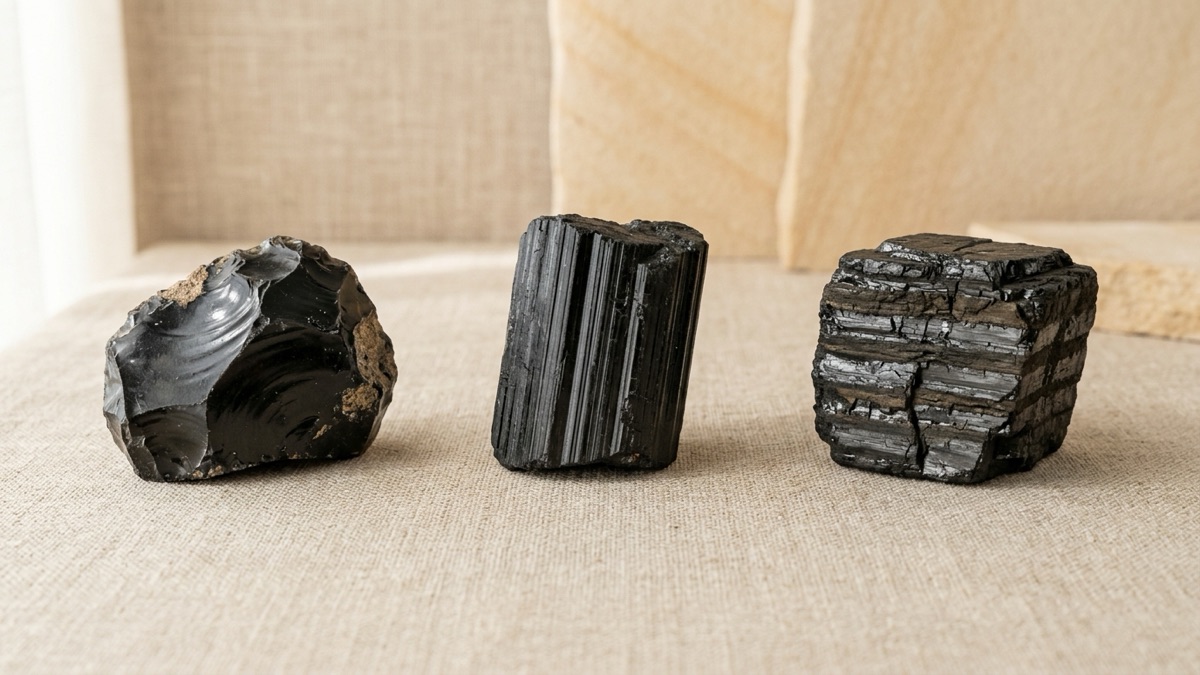
It is possible, but the odds are long, and the checks are strict. A meteorite should have a fusion crust, a thin skin rarely more than 1 to 2 mm thick that is almost always darker than the inside. About 95 percent of meteorites attract a cheap magnet, because they contain iron-nickel metal, and ordinary chondrites (most stony meteorites) show shiny metal specks on a sawn or broken face. Very few have gas bubbles.
A black rock that attracts a magnet but shows no metal inside is not a meteorite; magnetite or slag is far more likely. A find from a beach, a stream bed, a roadside or a railroad is almost certainly not one either. Do not clean or test a possible meteorite with a wire brush, abrasives, acid or a torch.
Try it
Run your find through the free meteorite checker. It runs nine checks and gives an honest verdict, including when the answer is "probably not".
Other black rocks worth a second look
A few more dark stones show up often enough to mention. Scoria is bubbly black or red lava rock, denser than pumice. Black chert and flint break into sharp, curved flakes and scratch glass. Smoky quartz can be so dark it looks black, but it is still glassy quartz that scratches glass and streaks white. If yours looks like glass but is none of the above, try our guide to rocks that look like glass, and for every other color, start from the rock identification by color hub.
The takeaway
Black rocks look alike, but they do not behave alike. A streak on a tile and a fridge magnet split the metallic minerals, a glass scratch and a hand lens sort the crystals, and the heft test picks out coal and jet. The RockhoundID app, coming soon, will suggest likely matches from a photo and tell you which of these tests confirms them. Until then, keep a white tile and a magnet in your pocket, and most black rocks will tell you their names.
RockhoundID guides help you narrow down what you found. They suggest likely candidates, not certain identifications or appraisals. For anything valuable, rare or possibly from space, ask a museum, a university geology department or your state geological survey, and check the collecting rules for the land before you take anything home.
Questions rockhounds ask
What is a shiny black rock?
Glassy and shiny with smooth, curved breaks usually means obsidian. Metallic and shiny points to magnetite or hematite, and long glassy crystals with grooves point to black tourmaline. A streak test and a fridge magnet sort out most of them in a minute.
What black mineral leaves a red streak?
Hematite. It can look black, steel gray or silver, but its powder is red to reddish brown on an unglazed tile. Magnetite, which looks similar, leaves a black to dark gray streak and grabs a magnet.
Is a black rock that sticks to a magnet a meteorite?
Probably not. Magnetite and a lot of furnace slag attract a magnet too. A meteorite also needs a thin fusion crust, shiny metal flecks on a cut or broken face and no gas bubbles, and it is almost never found on a beach, in a stream or next to a road.
How can I tell obsidian from slag?
Both are glassy, but slag is usually lumpy and full of gas bubbles and often attracts a magnet, and it turns up in fill, gravel and near old industry. Obsidian is natural volcanic glass with smooth, curved, very sharp breaks.
Is black onyx a natural stone?
Mostly it is dyed. GIA notes that what many call black onyx is actually dyed black chalcedony, because natural black chalcedony is rare. It is still quartz underneath, so it is about 7 on the Mohs scale.
Where these facts come from
- University of Auckland, minerals: Streak: rocksminerals.flexiblelearning.auckland.ac.nz/minerals/streak.html
- University of Auckland, minerals: Magnetite: rocksminerals.flexiblelearning.auckland.ac.nz/minerals/magnetite.html
- University of Auckland, minerals: Hematite: rocksminerals.flexiblelearning.auckland.ac.nz/minerals/hematite.html
- University of Auckland, minerals: Hornblende: rocksminerals.flexiblelearning.auckland.ac.nz/minerals/hornblende.html
- University of Auckland, minerals: Augite: rocksminerals.flexiblelearning.auckland.ac.nz/minerals/augite.html
- University of Auckland, minerals: Biotite: rocksminerals.flexiblelearning.auckland.ac.nz/minerals/biotite.html
- University of Auckland, rocks: Basalt: rocksminerals.flexiblelearning.auckland.ac.nz/rocks/basalt.html
- Handbook of Mineralogy: Schorl: www.handbookofmineralogy.org/pdfs/schorl.pdf
- Handbook of Mineralogy: Hematite: www.handbookofmineralogy.org/pdfs/hematite.pdf
- USGS, Gemstones (mineral gemstones): tourmaline: pubs.usgs.gov/gip/gemstones/mineral.html
- USGS, Gemstones (organic gemstones): jet: pubs.usgs.gov/gip/gemstones/organic.html
- USGS Volcano Hazards Program glossary: obsidian: www.usgs.gov/glossary/volcano-hazards-program-glossary
- Oregon State University, Volcano World: Obsidian: volcano.oregonstate.edu/volcanic-minerals/obsidian
- USGS: What is coal?: www.usgs.gov/faqs/what-coal
- USGS: What are the types of coal?: www.usgs.gov/faqs/what-are-types-coal
- GIA 4Cs: Wedding anniversary gemstones (onyx and dyed black chalcedony): 4cs.gia.edu/en-us/blog/wedding-anniversary-gemstone-years-one-through-ten/
- Washington University in St. Louis meteorite site: Streak: sites.wustl.edu/meteoritesite/items/streak/
- Washington University in St. Louis meteorite site: Magnetic attraction: sites.wustl.edu/meteoritesite/items/magnetic_attraction/
- Washington University in St. Louis meteorite site: Some meteorite realities: sites.wustl.edu/meteoritesite/items/some-meteorite-realities/
- Washington University in St. Louis meteorite site: Slag: sites.wustl.edu/meteoritesite/items/slag/