Thunder Eggs: What They Are and Where to Find Them
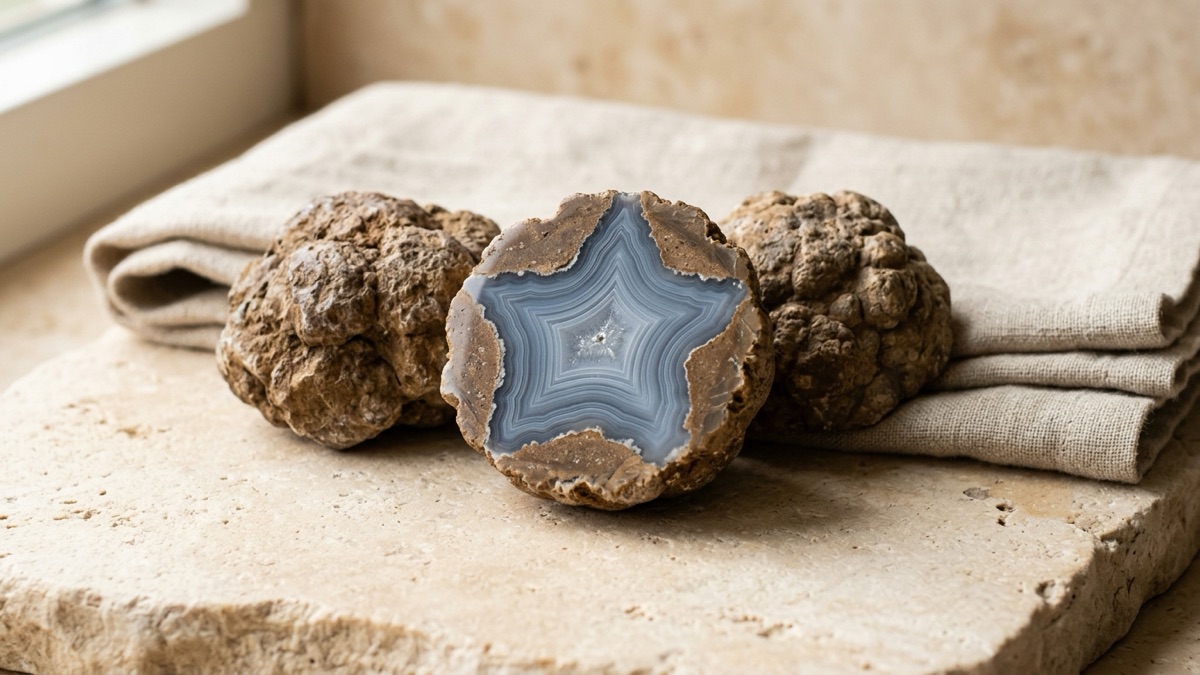
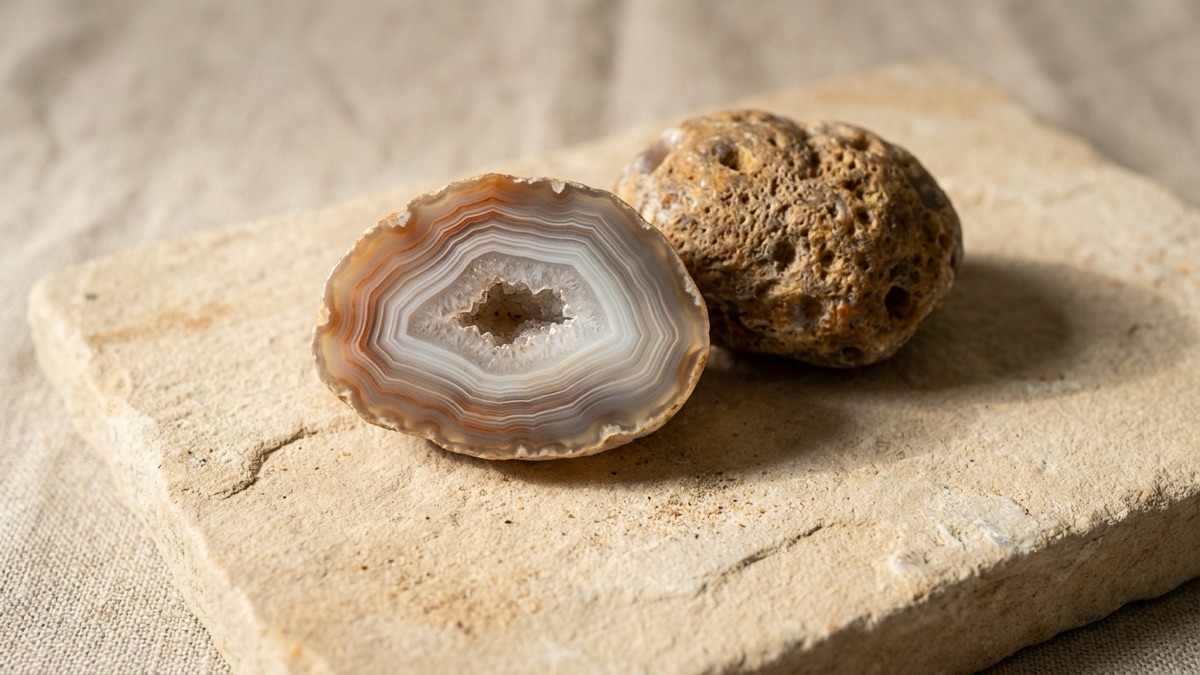
It looks like a lumpy brown potato that has been sitting in a field for a few million years. Then someone runs it through a saw, and the inside is a blue-gray star of banded agate with a fringe of quartz crystals. That is a thunder egg, and once you have seen one cut open, plain-looking round rocks never look plain again.
Quick answer
Thunder eggs are rounded nodules that formed in silica-rich volcanic rock. They have a drab, knobby rind and a core usually filled with agate, jasper or quartz crystals, often in a star shape. Oregon's state rock since 1965, they are collected at free Forest Service sites near Prineville, at Rockhound State Park in New Mexico, and at private fee digs.
Key takeaways
- A thunder egg is a rhyolite spherulite whose hollow center was later filled with agate, chalcedony or quartz. Most are a little bigger than a baseball.
- Unlike a hollow geode, a thunder egg is usually solid, so its beauty only shows when it is sawn and polished.
- Oregon made the thunderegg its state rock in 1965. Crook County calls itself the rockhound capital of the world.
- Verified public sites: Whistler Springs and White Fir Springs (Ochoco National Forest) and Rockhound State Park (New Mexico), each with its own rules.
- The famous Richardson's Rock Ranch no longer allows digging as of September 2026. Check every site before you drive.
What is a thunder egg?
Oregon's Department of Geology and Mineral Industries (DOGAMI) describes the thunderegg as a structure created in welded tuff or perlitic rocks, the glassy, silica-rich products of explosive volcanoes. They range from less than an inch to over four feet across. The Ochoco National Forest says most are a little larger than a baseball, with an uninteresting, drab rind that is often knobby.
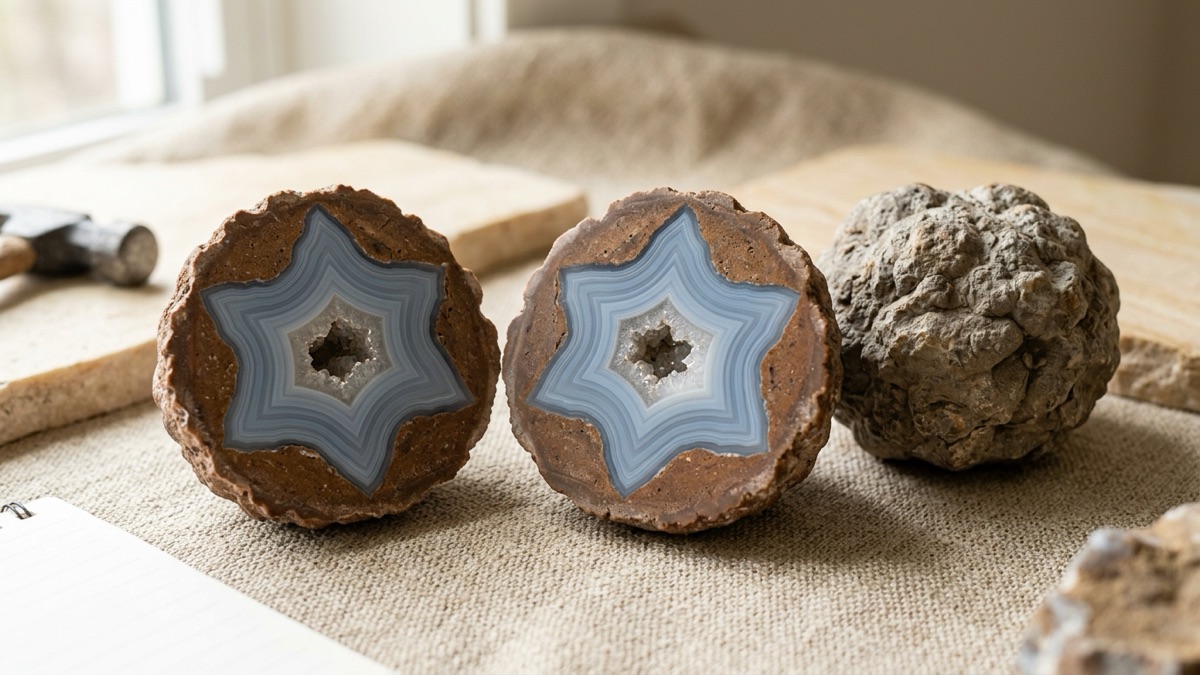
The inside is the surprise. The Forest Service says a sawn thunder egg may be filled with crystals, agate, jasper, a powdery calcite, or may hold just an empty cavity, and that the cut faces show designs ranging from five-pointed stars to miniature landscapes. DOGAMI puts it more simply: nondescript outside, exquisite designs in a wide range of colors when cut and polished. Geologists write "thunderegg" and most people type "thunder egg"; it is the same rock.
Fun fact
Oregon's 1965 Legislature named the thunderegg the state rock after rockhounds across the state voted it their first choice, according to DOGAMI. Not many state symbols were chosen by popular ballot of the people who dig them.
How do thunder eggs form?
The clearest account comes from a New Mexico Bureau of Geology and Mineral Resources study of the thunder eggs at Rockhound State Park. Geologists Nelia Dunbar and Virginia McLemore describe two stages.
- The shell grows in cooling lava. As rhyolite lava cools, spherulites form by rapid crystallization at high temperature, around 700 degrees Celsius. The shell is a mass of intergrown quartz, alkali feldspar, plagioclase feldspar and magnetite crystals. Some spherulites end up with a hollow center, which is where the fun happens.
- Hot water fills the hollow. Later, hydrothermal fluids, a mix of late-stage fluids escaping the magma and local groundwater, move into the hollow spherulites and deposit silica-rich minerals in several episodes. That is how the core becomes agate, chalcedony and quartz crystals.
The colors come from trace impurities in the silica: the study says iron gives red tones, manganese black and pink, and copper green and blue. At Rockhound State Park the spherulites range from under a millimeter to more than 30 centimeters across, and many show a white, blue or gray agate core. The banded material inside is chalcedony, the same microcrystalline quartz that makes up all agate, which is why our agate guide is the natural next read.
Thunder egg vs geode: what is the difference?
People use the words loosely, and DOGAMI itself writes "thunderegg (geode)." The distinction is about what the rock is and how it grew.
| Thunder egg | Geode | |
|---|---|---|
| Host rock | Rhyolite, welded tuff, perlite (volcanic) | Often sedimentary; also volcanic (Dugway, Utah) |
| Outside | Knobby, drab rhyolite rind | Lumpy, roughly spherical shell |
| Inside | Usually solid agate or jasper, often star-shaped, sometimes with a crystal pocket | Usually hollow and crystal-lined; quartz dominates, calcite common |
| Weight in the hand | Heavy for its size | Often light for its size |
| Best way to open | Saw and polish | Crack, saw or use a pipe cutter |
The Iowa Geological Survey describes that state's geodes as roughly spherical, lumpy and usually 2 to 6 inches across, with quartz-dominated interiors, in sedimentary rock. The Utah Geological Survey says Dugway geodes formed in gas cavities in rhyolite and are mostly hollow, though some are filled with banded quartz, which is where the two overlap. Heavy, solid, with a star-shaped agate core: thunder egg. Light and hollow: geode. Our geodes guide covers the hollow kind in depth.
Where can you find thunder eggs?
DOGAMI says thundereggs are found chiefly in Crook, Jefferson, Malheur, Wasco and Wheeler counties in Oregon, at both fee and free sites in central and southeastern Oregon. The Forest Service calls Crook County the rockhound capital of the world. New Mexico has the other famous public site. Here is what we could verify on official pages in September 2026. Always check the manager's current page before you go.
| Site | Who manages it | The rule (checked September 2026) |
|---|---|---|
| Whistler Springs and White Fir Springs, near Prineville, Oregon | Ochoco National Forest (Forest Service) | Free; personal use only; no commercial resale; use the Central Oregon Rockhounding Map |
| Southeastern Oregon sites (Malheur County) | BLM Vale office | DOGAMI points collectors to the BLM office in Vale for site information |
| Fee digs on private ranches, central Oregon | Private owners | DOGAMI refers collectors to the Madras and Prineville chambers of commerce; owner sets fees and limits |
| Rockhound State Park, near Deming, New Mexico | New Mexico State Parks (EMNRD) | Up to 15 pounds per person; souvenirs only; small hand tools with handles under 12 inches; no wheeled carts; designated areas only |
| National parks and monuments | National Park Service | No collecting (36 CFR 2.1) |
Oregon's free Forest Service sites
The Ochoco National Forest names Whistler Springs and White Fir Springs as its thunder egg collection sites, says the central Oregon rockhounding areas are managed by both the BLM and the forest, and states that collection sites are for personal use only with no commercial resale. The Forest Service's national rockhounding guide lists thundereggs among the lapidary materials generally collected under a free use permit, so ask the Prineville ranger district about current practice. The Central Oregon Rockhounding Map, downloadable from the forest's page, shows the designated areas and their rules. Our Oregon rockhounding guide covers the sunstone and obsidian sites too.
Oregon's fee digs
DOGAMI says thundereggs can be collected at fee sites in central and southeastern Oregon and points to the Madras and Prineville chambers of commerce for details. One caution: the best-known fee dig, Richardson's Rock Ranch near Madras, states on its own website that all digging is permanently closed, as of September 2026, although its rock shop remains open. Do not plan a trip around an old blog post. Call ahead, and on any private ranch, the owner's rules on tools, limits and fees are the rules. DOGAMI also mentions Thunderegg Days, held for five days around the first of June in Nyssa, in Malheur County.
Rockhound State Park, New Mexico
The New Mexico Bureau of Geology says Rockhound State Park, in the Little Florida Mountains southeast of Deming, was established in 1966 as the first park in the United States that allowed collecting of rocks and minerals for personal use, and that visitors may take up to 15 pounds of rocks and minerals from the 1,100 acre park. The hills are mid-Tertiary ash-flow tuffs and lavas, dated at 28.5 to 24.4 million years, and the list of finds includes gray perlite, thundereggs, geodes, jasper, agate, onyx, Apache tears and quartz crystals.
New Mexico's rule (19.5.2.25 NMAC) adds the fine print: rocks removed from the park are souvenirs only, not for resale, trade or commercial use; collecting is limited to small hand tools; and mechanical or motorized tools, tools with a handle longer than 12 inches, and wheeled devices such as wheelbarrows, carts or wagons are prohibited. Collecting is allowed only in designated, posted areas. The park has a campground and day-use fees, so check the state parks page for current prices.
Heads up
Every site above has a land manager and a rule, and the rules change. Never collect in a national park or monument, never dig on a private ranch or a mining claim without permission, and on BLM land keep to reasonable amounts for personal use with hand tools only (43 CFR 8365.1-5). Our guide to rock collecting rules explains each land type.
How do you spot a thunder egg in the field?
- Shape: rounded to lumpy nodules, often with a knobby or ribbed surface, weathering out of pale volcanic rock or lying loose in a wash.
- Weight: heavier than the pumice and perlite around it, because the core is solid silica.
- Surface: dull brown, gray or reddish rind, sometimes with a hint of the agate showing through a broken spot.
- Hardness: the agate inside is chalcedony, and chalcedony and agate sit at about 6.5 to 7, so a broken edge scratches glass.
A solid thunder egg feels dense and heavy in the hand, where a hollow geode feels light for its size. Do not smash it to check. Bag it, label the spot, and cut it at home.
Try it
Not sure whether that nodule is a thunder egg, a geode or a plain concretion? Run it through the free rock identifier, then check the hardness of a broken edge on the Mohs hardness scale. Both run in your browser and never upload a photo.
How do you cut and polish a thunder egg?
The pattern lives inside, so the saw matters more than anything you do in the field.
- Cut through the middle. The core sits at the center of the nodule, so a cut through the widest part shows the most pattern. An off-center cut clips the star.
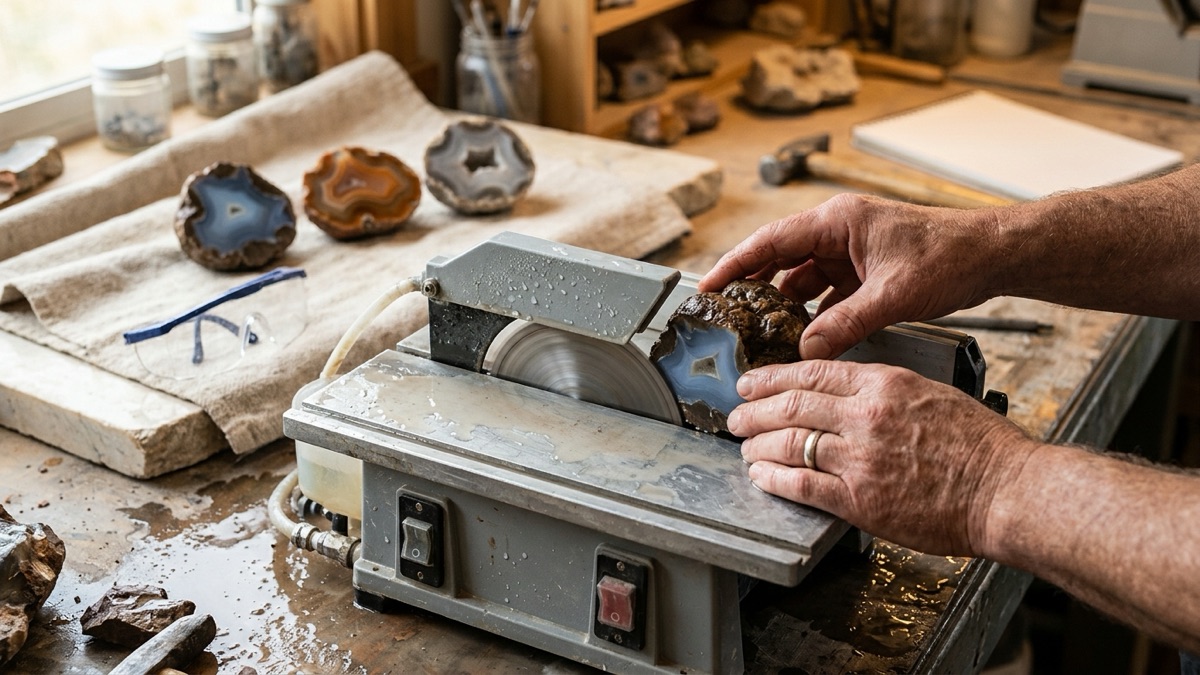
- Use a water-cooled diamond saw. A lapidary trim saw or slab saw with a diamond blade and water or oil coolant gives a clean face. Dry cutting overheats the blade and cracks the agate.
- Or let a rock shop do it. The Utah Geological Survey notes that rock shops can cut geodes, and the same shops cut thunder eggs for a small fee. This is the right choice for your first few eggs.
- Grind and polish the face. Work through progressively finer grits on a flat lap, finishing with a polish, the same coarse-to-fine sequence a rock tumbler uses.
- Skip the hammer. A hammer blow follows the rind, not the pattern, and turns a star into gravel.
Wear safety glasses at every step, keep fingers clear of the blade, and keep the cut wet so you are not breathing silica dust.
Are thunder eggs worth anything?
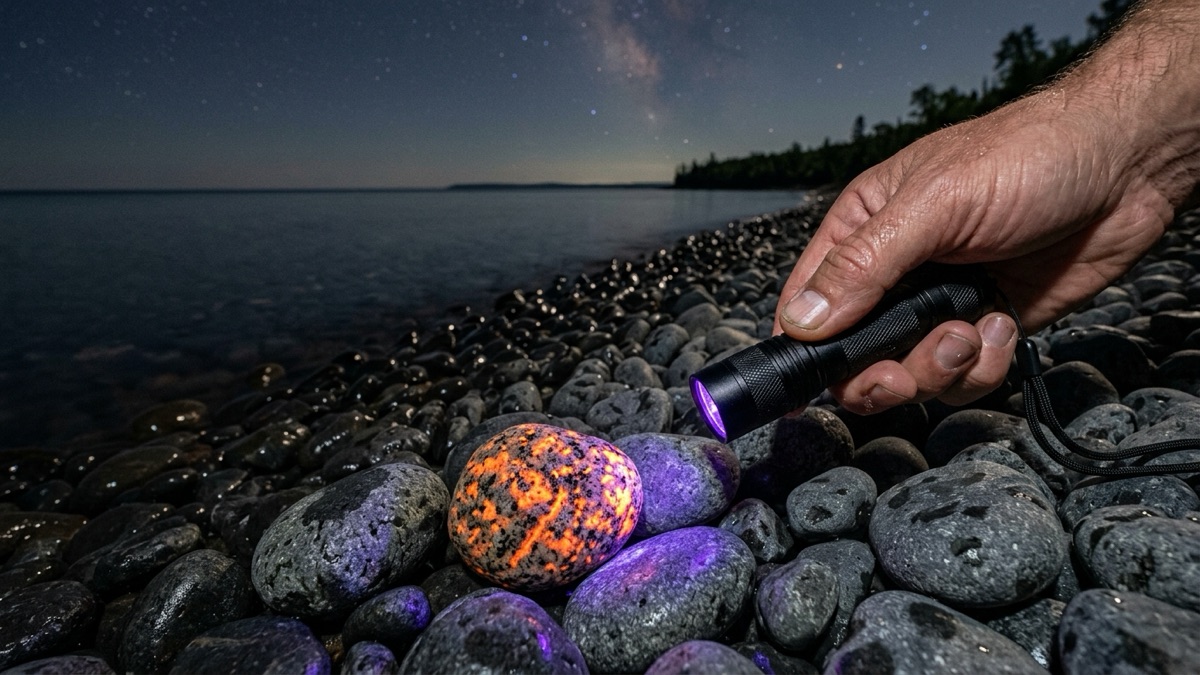
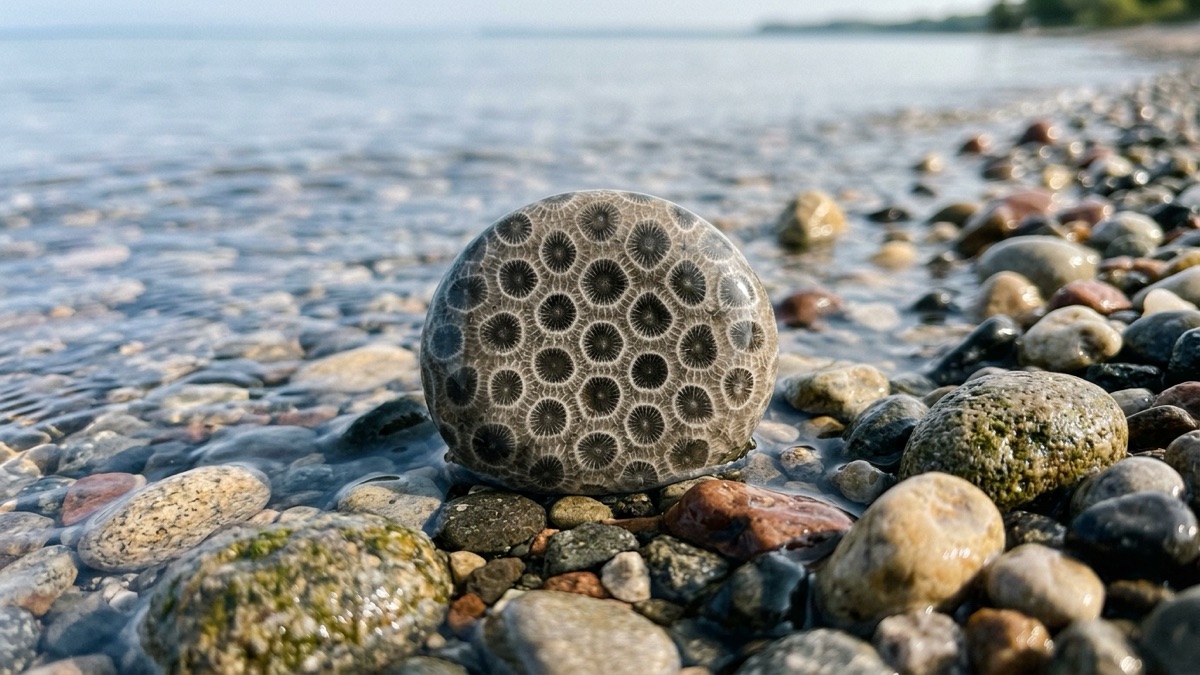
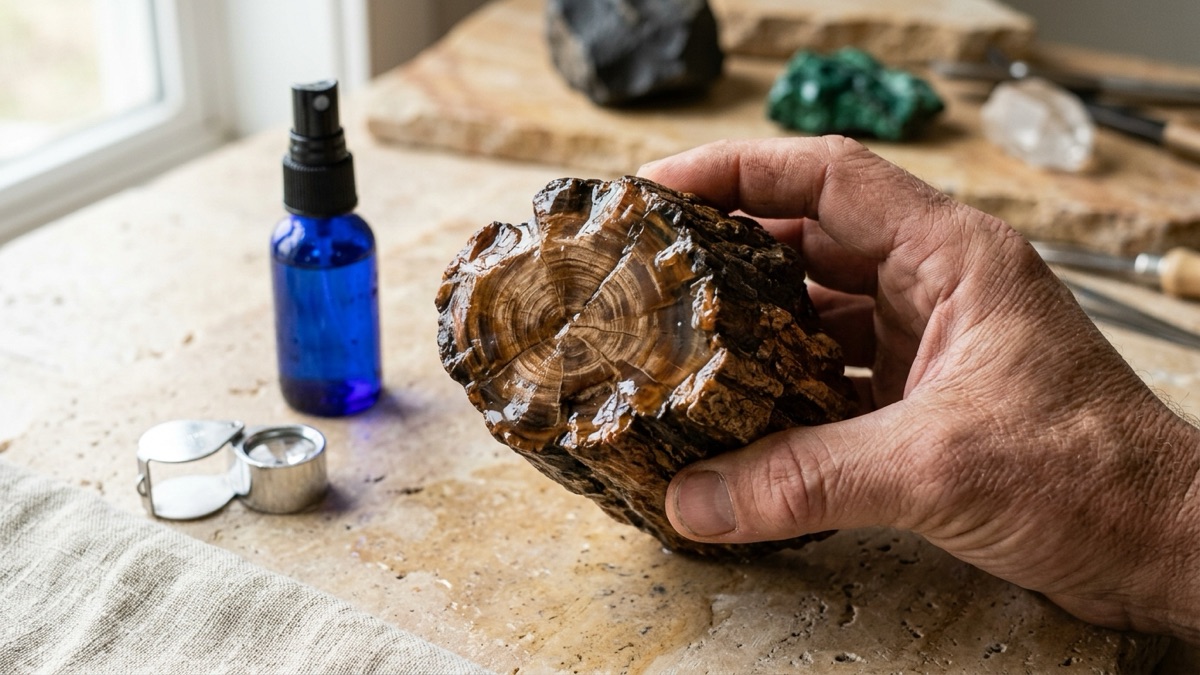
Most thunder eggs are worth more as a story than as a sale. Fine cut faces with strong color, a crisp star and a known locality sell to collectors, priced much like agate by color, pattern, size and origin, but ordinary eggs are inexpensive, and anything collected at a Forest Service or BLM site cannot be resold. Other rocks with a hidden side include Petoskey stones, which show their coral pattern when wet, and yooperlite, which glows under a UV light. For a look-alike in the wash, our guide to petrified wood identification helps sort silica lumps from silica logs. Broken chips of the agate core make good tumbling rough, because agate is hard and takes a bright polish; our rock tumbler guide explains the four stages.
The takeaway
A thunder egg is a rhyolite spherulite with an agate heart: drab outside, spectacular once sawn. Formed in cooling volcanic rock and filled by hot silica-rich water, it is Oregon's state rock and the prize at Rockhound State Park in New Mexico. Collect only where the manager allows it, cut it wet and slow, and label where it came from. The RockhoundID app, coming soon, will suggest likely matches from a photo and tell you which quick test confirms them.
The pictures in this guide are AI-generated illustrations of what to look for; real specimens vary, so trust the tests over any picture. RockhoundID guides help you narrow down what you found. They suggest likely candidates, not certain identifications or appraisals. For anything valuable, rare or possibly from space, ask a museum, a university geology department or your state geological survey, and check the collecting rules for the land before you take anything home.
Questions rockhounds ask
What is a thunder egg?
A rounded nodule that forms in silica-rich volcanic rock such as rhyolite and welded ash. It has a drab, knobby rind and a core that is often filled with agate, jasper or quartz crystals, sometimes in a star shape. Oregon named it the state rock in 1965.
What is the difference between a thunder egg and a geode?
A geode is a hollow, crystal-lined cavity, often in sedimentary rock. A thunder egg is a solid spherulite that grew in cooling rhyolite, with a central cavity later filled by agate or crystals. Some thunder eggs stay partly hollow, which is why Oregon's survey calls them thunderegg (geode).
Where can I find thunder eggs?
Verified public sites include Whistler Springs and White Fir Springs in the Ochoco National Forest near Prineville, Oregon (personal use only), and Rockhound State Park near Deming, New Mexico (up to 15 pounds per person, souvenirs only). Fee digs on private ranches exist in central and southeastern Oregon.
How do you open a thunder egg?
Saw it with a water-cooled diamond rock saw, or pay a rock shop to cut and polish it. A hammer usually shatters the pattern. Wear safety glasses either way.
Are thunder eggs valuable?
Most are worth more as a hobby prize than as a sale. Fine, colorful cut faces from known localities sell to collectors, but ordinary eggs are inexpensive, and material collected free on Forest Service or BLM sites cannot be sold.
Where these facts come from
- Oregon DOGAMI: Fossils, minerals and gems (thunderegg, state rock): www.oregon.gov/dogami/learnmore/Pages/fossilsmineralsgems.aspx
- USDA Forest Service, Ochoco National Forest: Rocks and minerals (updated March 27, 2025): www.fs.usda.gov/r06/ochoco/natural-resources/rocks-minerals
- USDA Forest Service: Rockhounding Guide, FS-1091 (June 2017): www.fs.usda.gov/media/229394
- New Mexico Bureau of Geology and Mineral Resources: Origin of rhyolitic spherulites (thundereggs) at Rockhound State Park (Dunbar and McLemore, 2000): geoinfo.nmt.edu/museum/nmms/abstracts/view.cfm?aid=232
- New Mexico Bureau of Geology and Mineral Resources: Rockhound State Park geology tour: geoinfo.nmt.edu/tour/state/rockhound/home.html
- New Mexico State Parks (EMNRD): Rockhound State Park: www.emnrd.nm.gov/spd/find-a-park/rockhound-state-park/
- New Mexico Administrative Code 19.5.2.25: Rock collecting at Rockhound State Park: www.srca.nm.gov/parts/title19/19.005.0002.html
- Richardson's Rock Ranch (digging status checked September 2026): www.richardsonrockranch.com/
- Utah Geological Survey: Dugway geodes (geodes in rhyolite, rock shops cut geodes): geology.utah.gov/popular/rocks-minerals/rock-mineral-collecting-sites/dugway-geo
- Iowa Geological Survey: Iowa geodes: iowageologicalsurvey.uiowa.edu/iowa-geology/popular-interest/iowa-geodes
- eCFR: 43 CFR 8365.1-5, collecting on BLM public lands: www.ecfr.gov/current/title-43/subtitle-B/chapter-II/subchapter-H/part-8360/subpa
- eCFR: 36 CFR 2.1, preservation of natural resources (National Park Service): www.ecfr.gov/current/title-36/chapter-I/part-2/section-2.1
- USGS: Gemstones, mineral hardness (quartz and chalcedony): pubs.usgs.gov/gip/gemstones/mineral.html