Where to Find Geodes: The Best Places in the US
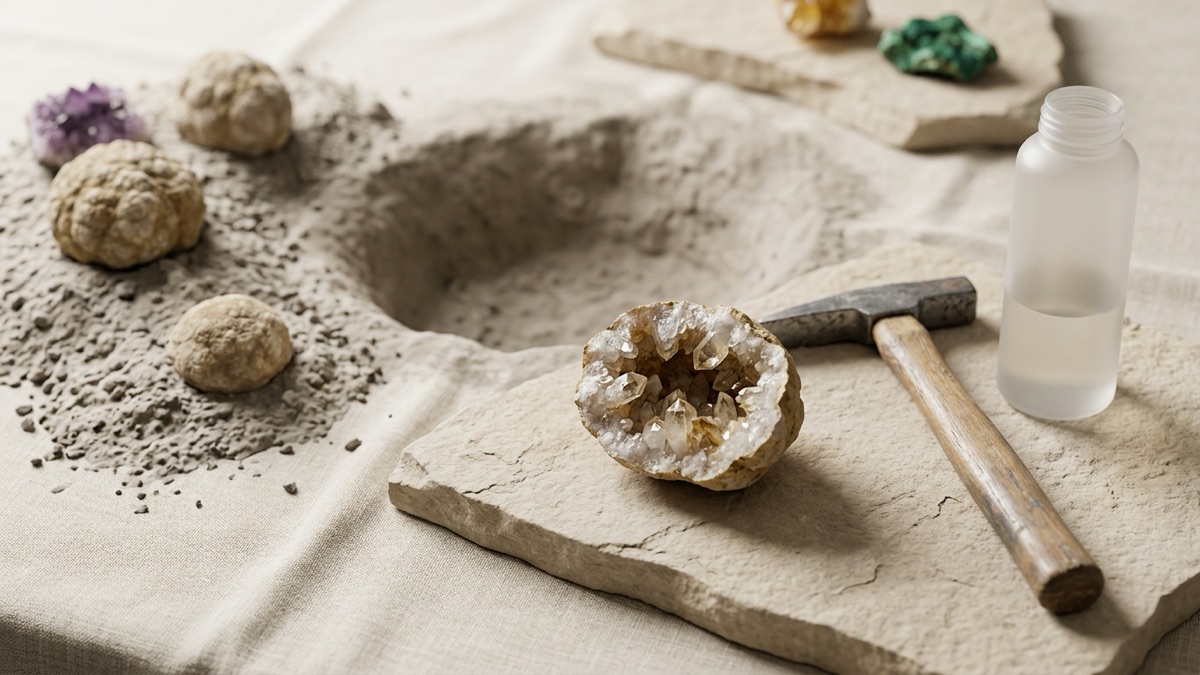
Every geode hunter remembers the first one: a lumpy gray ball that looked like a potato, a tap of the hammer, and a cave of crystals that no one had ever seen. The hard part is not opening them. It is knowing where they are, and whether you are allowed to take them home.
Quick answer
The most reliable public geode sites in the US are on BLM land: the Dugway Geode Beds in Utah and the Wiley Well District Geode Beds in California, both free for noncommercial collecting. Iowa's Keokuk country, Indiana, Kentucky, Texas and Florida hold geodes too, but most sites there are private or carry limits, so check who manages the ground first.
Key takeaways
- Geodes collect where the right rock layers weather out: old lake sediments in Utah, and limestone creek beds across Iowa, Indiana and Kentucky.
- Dugway (Utah) and Wiley Well (California) are BLM sites open to free, noncommercial collecting, as of September 2026.
- Around Keokuk, Iowa, most geode sites are private land: get the owner's permission, and stay out of state parks.
- National parks allow no collecting at all. Corps of Engineers lakes, state parks and national forests each have their own rules.
- Bring safety glasses, water, a hammer and a bag, and check the managing agency's page before every trip.
What makes a place good for geodes?
Geodes are round rocks with a hollow, crystal-lined center. They start as cavities in rock, and groundwater slowly lines the cavity with minerals, most often quartz. Utah's Dugway geodes formed in gas cavities in rhyolite, a volcanic rock; Iowa's geodes come from a sedimentary unit, the lower Warsaw Formation. Our geodes guide explains the process and how to open one safely.
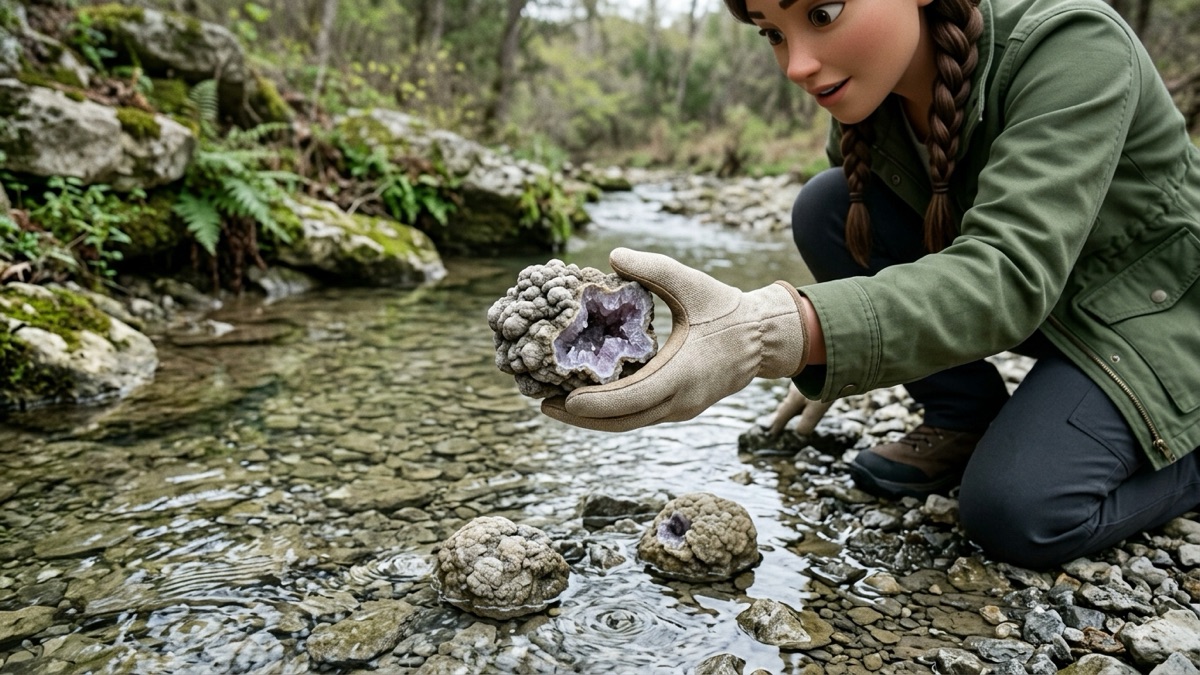
For finding them, that origin matters. Geodes are tougher than the rock around them, so when that rock erodes, the geodes pile up in the soft ground below and in the streams that drain it. The Iowa Geological Survey says geodes accumulate in stream channels where the Warsaw Formation is eroded; the Utah survey says ancient Lake Bonneville wore down the rhyolite and redeposited the geodes in lake sediments, which is where collectors dig today. The best places are not the cliffs. They are the creek beds, gravel bars and old lake beds beneath the geode-bearing layer.
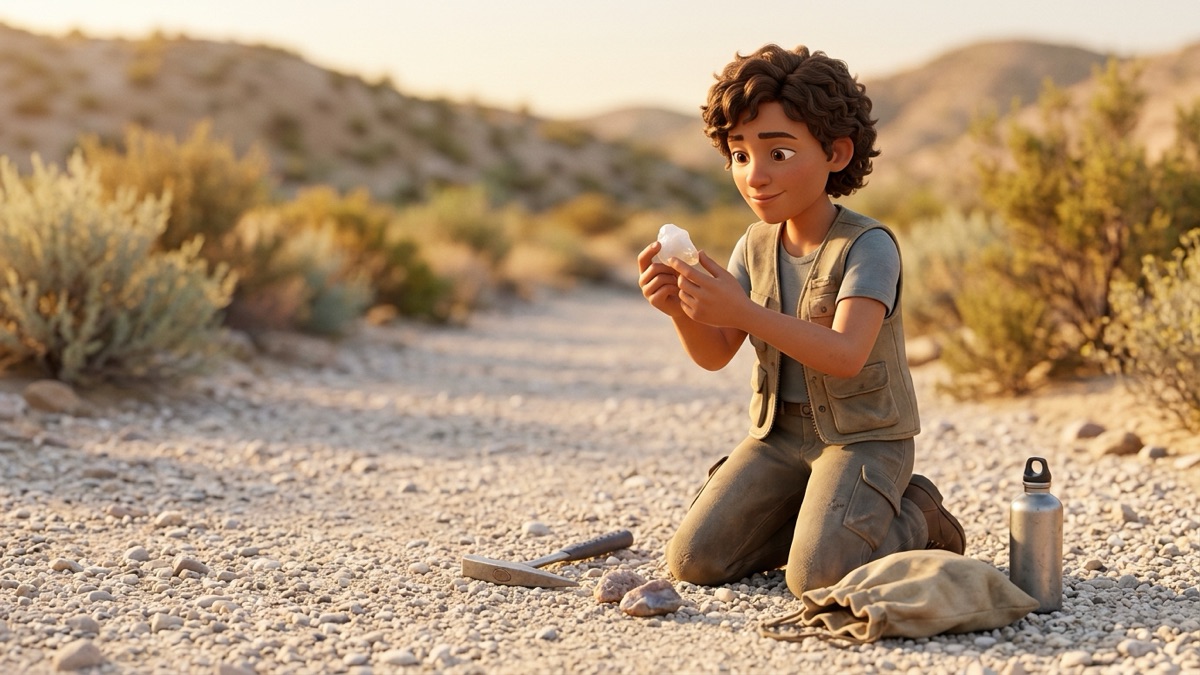
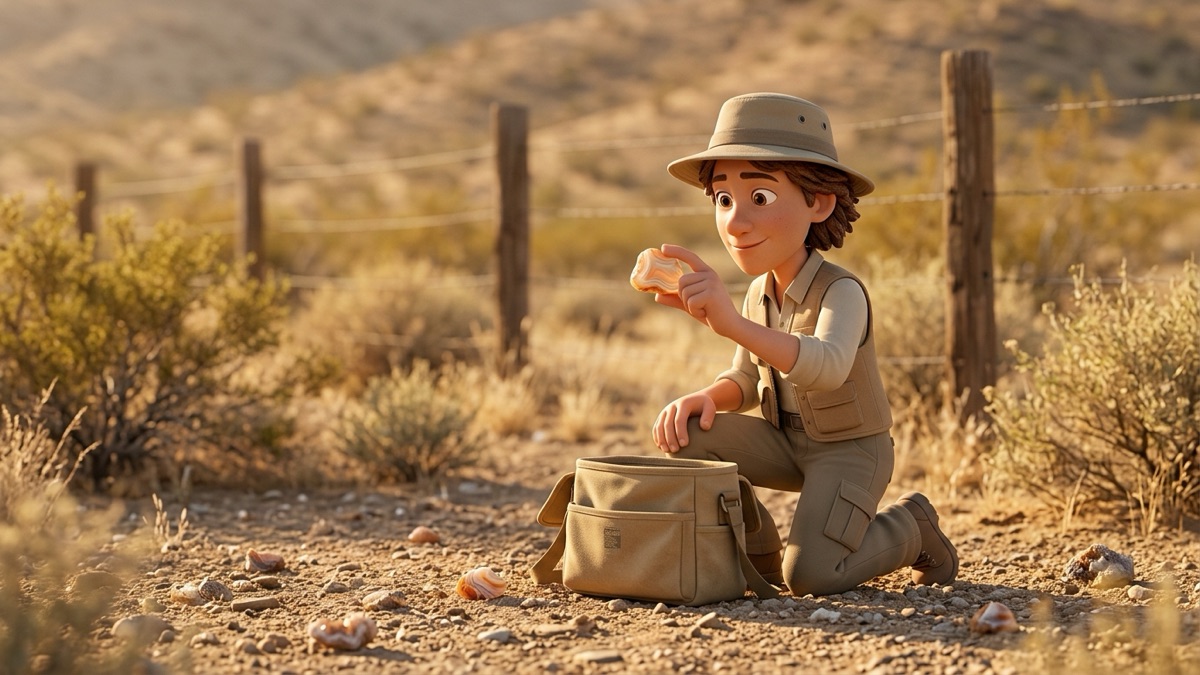
In the field, look for a rounded, bumpy stone that feels light for its size. The Iowa survey describes its geodes as roughly spherical, often lumpy or cauliflower-like, typically about 2 to 6 inches across, and the Utah survey says Dugway geodes are easy to recognize by their spherical shape and light weight.
Utah: Dugway Geode Beds (BLM)
The Dugway Geode Beds in Juab County are the classic beginner site. They sit on Bureau of Land Management (BLM) land under the Fillmore Field Office, and BLM lists them among its designated rockhounding areas. The Utah Geological Survey says the beds are free to the public, with no permits or permissions required and no current mining claims. Collecting must be noncommercial.
BLM says the geodes run about 2 to 4 inches across, lined mostly with quartz in clear, amethyst and rose colors. They lie in soft gray material below the surface, and BLM notes the best places to look are areas that have already been excavated. Both agencies warn that tunneling into the soft material is unsafe and not permitted, because it can collapse.
This is remote desert. The Utah survey recommends a high-clearance vehicle, plenty of water and a working spare tire; the nearest bathrooms and water are at Fish Springs National Wildlife Refuge and the nearest gas is in the town of Dugway. Our guide to rockhounding in Utah has the full trip plan.
California: Wiley Well District Geode Beds (BLM)
In the desert west of Blythe, the Wiley Well District Geode Beds are another BLM-listed rockhounding area, managed by the El Centro Field Office. BLM says Wiley's Well Road leaves Interstate 10 about 16 miles west of Blythe, and describes January and February as a beautiful time to visit. Summer heat there is dangerous, so plan for winter.
BLM notes that the district holds fossils and artifacts from many periods, and those stay where they are. Take rocks and minerals only, in reasonable personal amounts.
Heads up
Both BLM sites are hours from help. Carry more water than you think you need, tell someone your route and return time, wear safety glasses whenever anyone is swinging a hammer, and never crawl into an undercut bank or an old digging.
Iowa: the Keokuk geode country (mostly private land)
The Keokuk geodes of southeastern Iowa are famous enough that the geode is Iowa's state rock. The Iowa Geological Survey says one of the most productive regions lies within about a 35-mile radius of Keokuk, especially in Lee, Henry and Van Buren counties, where streams have cut through the lower Warsaw Formation and geodes have piled up in the channels. Quartz dominates the linings and calcite is common.
The catch is access. The Iowa survey states that most collecting localities are on private land, so permission must be secured before you enter or remove rocks, and that geode collecting is not permitted in state parks. It points to the Keokuk Area Convention and Tourism Bureau for a list of property owners who may allow collecting; some may charge a fee. Ask first, pay if asked, and fill your holes.
Indiana: Hoosier National Forest streams (US Forest Service)
Southern Indiana shares the same Mississippian-age limestones, and the Indiana Geological and Water Survey has published on the geodes that weather out of them. The clearest public-land option is the Hoosier National Forest. Its forest product permits page, updated September 29, 2026, says small quantities of rocks for personal use may be collected on the forest, and that geodes are generally found only in the northern part of the forest, in stream beds. Two conditions apply: the rocks may not be resold or bartered, and no earth may be disturbed. In plain words, pick geodes up from the stream gravel, do not dig for them, and ask the ranger district about access points first.
Kentucky: the Fort Payne belt (mixed ownership)
The Kentucky Geological Survey says geodes occur in the Fort Payne, Borden and Salem-Warsaw formations, and that they are common around Lake Cumberland in south-central Kentucky, both in the bedrock and as loose stones weathered out of it. They range from under an inch to two feet across, with a bumpy, cauliflower-like outside and quartz inside.
Who owns the ground is the question. Lake Cumberland is a US Army Corps of Engineers project, and Corps rules in 36 CFR 327.14 prohibit removing natural formations or mineral deposits from project land without written permission from the district commander, so the lake shore is not a free-for-all. The Kentucky Geological Survey's regulations page says collecting is prohibited in national and state parks, that road rights-of-way need permission, and that otherwise collecting follows property rights: private land needs the owner's yes. In the Daniel Boone National Forest the Forest Service's national rockhounding guide applies: hobby amounts for personal use, no selling, and ask the ranger district about permits and closed areas first.
Texas: mostly private land
Geodes are reported from parts of Texas, but most Texas land is private, and Texas state parks are closed to collecting. Under 31 Texas Administrative Code 59.134, it is an offense to take, remove or disturb any rock, gem, mineral, fossil or other geological deposit in a state park except by permit issued by the director. So in Texas the realistic options are a ranch with the owner's permission or a pay-to-dig operation, and neither should be assumed from a map. Our guide to rockhounding in Texas covers the state in detail.
Florida: agatized coral geodes
Florida's version of a geode is its state stone. The Florida Department of State says agatized coral was designated the official state stone in 1979, and describes it as a chalcedony pseudomorph after coral, appearing as limestone geodes lined with botryoidal agate or quartz crystals. It is found in three main areas: Tampa Bay, the Econfina River, and the Withlacoochee and Suwannee river beds.
The Florida Museum's fossil permit FAQ says there is no collecting of any kind inside Florida state parks, national wildlife refuges, national parks or national forests, and that invertebrate fossils, which include fossil coral, need no state permit elsewhere. Beyond that, the shoreline or river bank belongs to someone: check with the city, county or landowner before you wade in.
More geode country: Illinois, Oregon and New Mexico
Illinois. Keokuk sits where Iowa, Illinois and Missouri meet, and the geode beds do not stop at the river. The Illinois State Geological Survey's handbook of the state's rock layers says quartz geodes are common and locally abundant in the Warsaw Shale, a unit named for Warsaw in Hancock County, where the reference exposure is a ravine called Geode Glen. Most of that bluff and creek country is private farmland, so the Iowa rule holds: ask the owner first.
Oregon. Oregon's state rock is the thunderegg, which DOGAMI (the state's geology agency) writes as "thunderegg (geode)". Strictly speaking a thunder egg is usually solid, with an agate core instead of a hollow, but the hunt feels the same. Our guide to thunder eggs covers the free Ochoco National Forest sites and the private fee digs.
New Mexico. The New Mexico Bureau of Geology lists geodes and thundereggs among the finds at Rockhound State Park near Deming, which lets visitors take a limited amount for personal use from designated areas.
Geodes near me: a state-by-state summary
Every rule below was read on the managing agency's page in September or November 2026. Check again before you go.
| Place | Managed by | Rule |
|---|---|---|
| Dugway Geode Beds, Utah | BLM, Fillmore Field Office | Free, no permit, noncommercial; no tunneling |
| Wiley Well District Geode Beds, California | BLM, El Centro Field Office | Reasonable personal amounts, noncommercial; leave artifacts |
| Keokuk area, Iowa | Private landowners | Permission first; no collecting in state parks |
| Hoosier National Forest, Indiana | US Forest Service | Small personal amounts; no digging; no resale |
| Lake Cumberland area, Kentucky | Corps of Engineers, private owners | Corps land needs written permission; private land needs the owner's yes |
| Texas state parks | Texas Parks and Wildlife | No collecting without a permit from the director |
| Florida rivers and Tampa Bay | Varies; state parks and refuges closed | No collecting in state parks, refuges, national parks or forests |
| Warsaw and Hancock County, Illinois | Mostly private landowners | Permission first |
| Oregon thunderegg sites | Ochoco National Forest near Prineville; BLM Vale office in the southeast; private fee digs | Personal use only on Forest Service land; fee digs set their own fees and limits |
| Rockhound State Park, New Mexico | New Mexico State Parks | Up to 15 pounds per person, souvenirs only, designated areas |
| Any national park | National Park Service | No collecting at all |
Not on the list? Your state geological survey is the best local source on where geode-bearing rock is exposed, and the Association of American State Geologists keeps a directory of every state survey. Our guide to rockhounding near me shows how to check who manages a spot before you go.
What are the rules everywhere else?
The land decides. BLM regulations at 43 CFR 8365.1-5 let the public collect reasonable amounts of rocks and mineral specimens for noncommercial purposes, except on developed recreation sites or where prohibited and posted, with no explosives or motorized or mechanical equipment. The Forest Service's national Rockhounding Guide lists geodes and thundereggs among the materials that can generally be collected for personal use under a free use permit, with details set by each forest. National parks are closed to all collecting under 36 CFR 2.1. Private land always needs permission. Our guide to rock collecting rules covers each land type.
Heads up
Never collect where artifacts or bones are on the surface, never enter an old mine or tunnel into a bank, and never assume a creek bank is public because the water is.
What should you bring on a geode hunt?
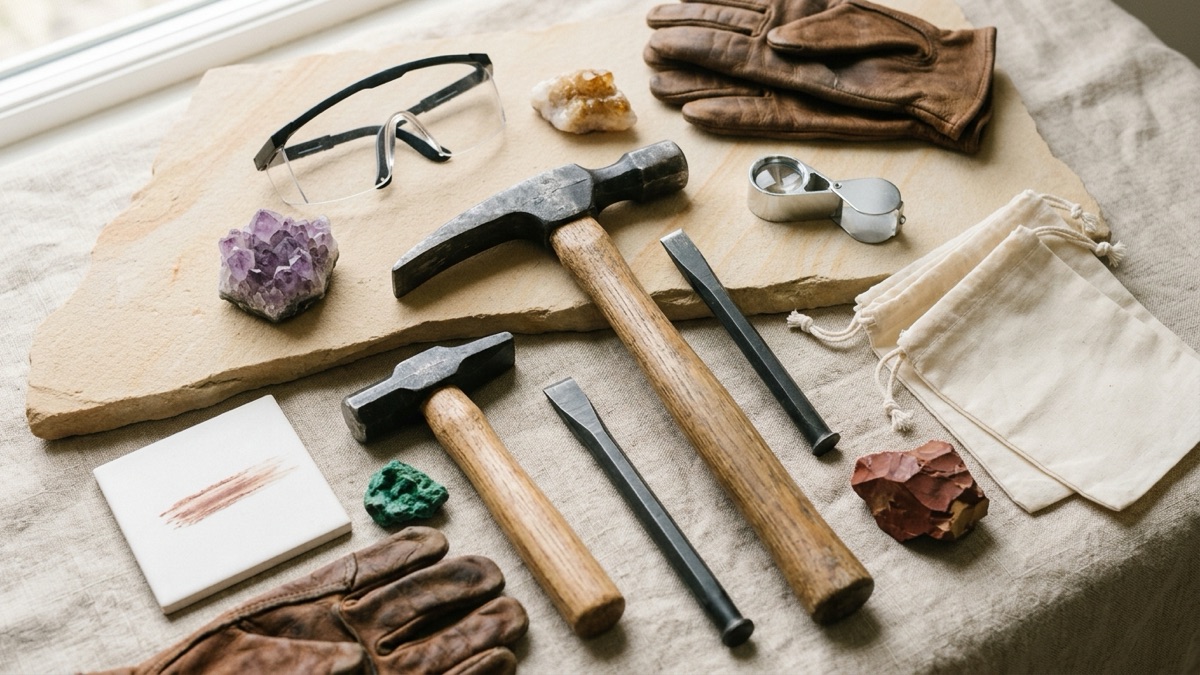
A geode trip needs little more than a day hike, plus a few tools: safety glasses (chips fly), a rock hammer and a small chisel, gloves, a bucket or sturdy bag, water, sun protection and a first-aid kit. BLM's Dugway page lists a pick, hammer, chisel, center punch, carbide-tipped saw and pipe cutter among the tools visitors use.
Leave the geodes whole until you are home, or take them to a rock shop to be sawn; a hammer blow in the field often shatters the best one of the day. Our rockhounding tools guide covers the kit, and our rockhounding for beginners hub covers how to plan a first trip.
Try it
Found a round rock and not sure whether it is a geode, a concretion or a plain cobble? Answer a few questions in the free rock identifier for likely candidates, and check any crystals inside with the Mohs hardness scale. Quartz scratches glass; calcite does not.

The RockhoundID app, coming soon, will suggest likely matches from a photo and tell you which test confirms them.
The takeaway
Geodes gather in the soft ground and creek beds below the layers that made them, and the best public places to find them are BLM's Dugway beds in Utah and Wiley Well in California. Iowa, Indiana, Kentucky, Texas and Florida have geode country too, but most of it is private, park or Corps land with its own rules. Read the managing agency's page, ask the landowner, pack glasses and water, and dig in the soft ground rather than under it. The crystals have waited millions of years; they can wait for you to do it right.
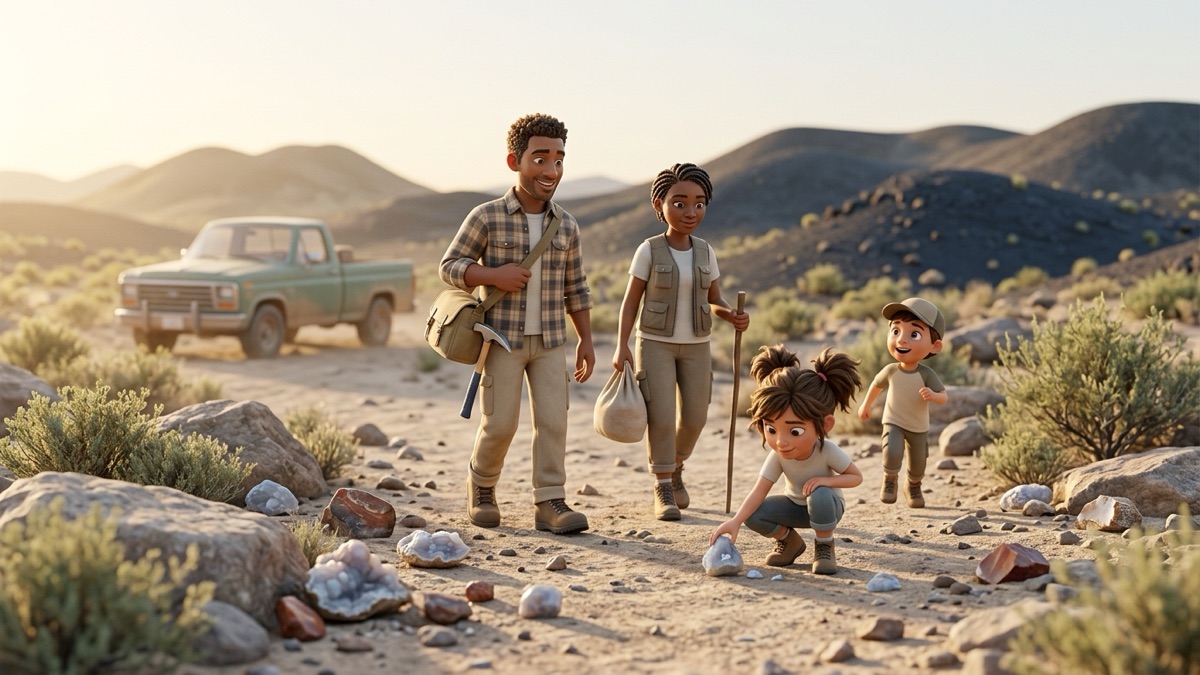
The pictures in this guide are AI-generated illustrations of what to look for; real specimens vary, so trust the tests over any picture. RockhoundID guides help you narrow down what you found. They suggest likely candidates, not certain identifications or appraisals. For anything valuable, rare or possibly from space, ask a museum, a university geology department or your state geological survey, and check the collecting rules for the land before you take anything home.
Questions rockhounds ask
Where is the best place to find geodes in the US?
For a beginner, the Dugway Geode Beds in Utah are hard to beat: BLM land, free, no permit, and geodes in the soft material of old lake sediment. The Keokuk area of Iowa is famous too, but most sites there are private and need the owner's permission.
Can you find geodes near me without going to a designated site?
Often, yes, if you live near the right rock. Geodes weather out of certain limestone and volcanic layers and collect in creek beds downstream. State geological survey pages tell you which formations in your state hold them; who owns the creek bank decides whether you can collect.
Can you collect geodes in a national park?
No. Under 36 CFR 2.1, possessing, removing or disturbing mineral resources in any national park unit is prohibited, and that includes geodes. Look, photograph, and leave them.
How do you know a rock is a geode before you open it?
Look for a rounded, lumpy or cauliflower-like stone that feels light for its size, because a hollow center weighs less than solid rock. Geodes cluster in particular layers and in the streams below them, so where you find one, look for more.
Do you need a permit to collect geodes on BLM land?
Usually not. BLM rules let the public collect reasonable amounts of rocks and mineral specimens for noncommercial use without a permit, except on developed recreation sites or where collecting is posted as prohibited. Check the local field office for closures.
Where these facts come from
- BLM: Dugway Geode Beds, Utah (checked September 30, 2026): www.blm.gov/visit/dugway-geode-beds
- Utah Geological Survey: The Rockhounder, Dugway Geode Beds: geology.utah.gov/popular/rocks-minerals/rock-mineral-collecting-sites/dugway-geo
- BLM: Wiley Well District Geode Beds, California (checked September 30, 2026): www.blm.gov/visit/wiley-well-district-geode-beds
- BLM: Rockhounding on public lands: www.blm.gov/programs/recreation/rockhounding
- eCFR: 43 CFR 8365.1-5, property and resources (BLM): www.ecfr.gov/current/title-43/subtitle-B/chapter-II/subchapter-H/part-8360/subpa
- Iowa Geological Survey (University of Iowa): Iowa geodes: iowageologicalsurvey.uiowa.edu/iowa-geology/popular-interest/iowa-geodes
- Illinois State Geological Survey, ILSTRAT: Warsaw Shale (quartz geodes common; type section at Geode Glen, Warsaw): ilstratwiki.web.illinois.edu/wiki/Warsaw_Shale
- Oregon DOGAMI: Fossils, minerals and gems (thunderegg, state rock): www.oregon.gov/dogami/learnmore/Pages/fossilsmineralsgems.aspx
- New Mexico Bureau of Geology and Mineral Resources: Rockhound State Park geology tour: geoinfo.nmt.edu/tour/state/rockhound/home.html
- Association of American State Geologists: State geological surveys directory: www.stategeologists.org/surveys
- USDA Forest Service, Hoosier National Forest: Forest product permits (updated September 29, 2026): fs.usda.gov/r09/hoosier/permits/forest-product-permits
- Indiana Geological and Water Survey: Geodes of Indiana (Shaffer, 2008, poster record): scholarworks.iu.edu/dspace/items/e030eae0-5553-49fc-a4c6-f8332afdffa2/full
- Kentucky Geological Survey: Geodes of the Fort Payne Formation: www.uky.edu/KGS/geoky/fieldtrip/fort_payne/geocode.htm
- Kentucky Geological Survey: Fossil collecting regulations: www.uky.edu/KGS/fossils/fossil-regulations.php
- Cornell LII: 36 CFR 327.14, public property (US Army Corps of Engineers projects): www.law.cornell.edu/cfr/text/36/327.14
- Cornell LII: 31 Texas Administrative Code 59.134, rules of conduct in parks: www.law.cornell.edu/regulations/texas/31-Tex-Admin-Code-SS-59-134
- Florida Department of State: State stone, agatized coral: dos.fl.gov/florida-facts/florida-state-symbols/state-stone/
- Florida Museum: Florida fossil permit FAQ: www.floridamuseum.ufl.edu/florida-fossil-permit/faq
- USDA Forest Service: Rockhounding Guide, FS-1091 (June 2017): www.fs.usda.gov/media/229394
- eCFR: 36 CFR 2.1, preservation of natural resources (National Park Service): www.ecfr.gov/current/title-36/chapter-I/part-2/section-2.1