Rotary vs Vibratory Rock Tumbler: Which One to Get
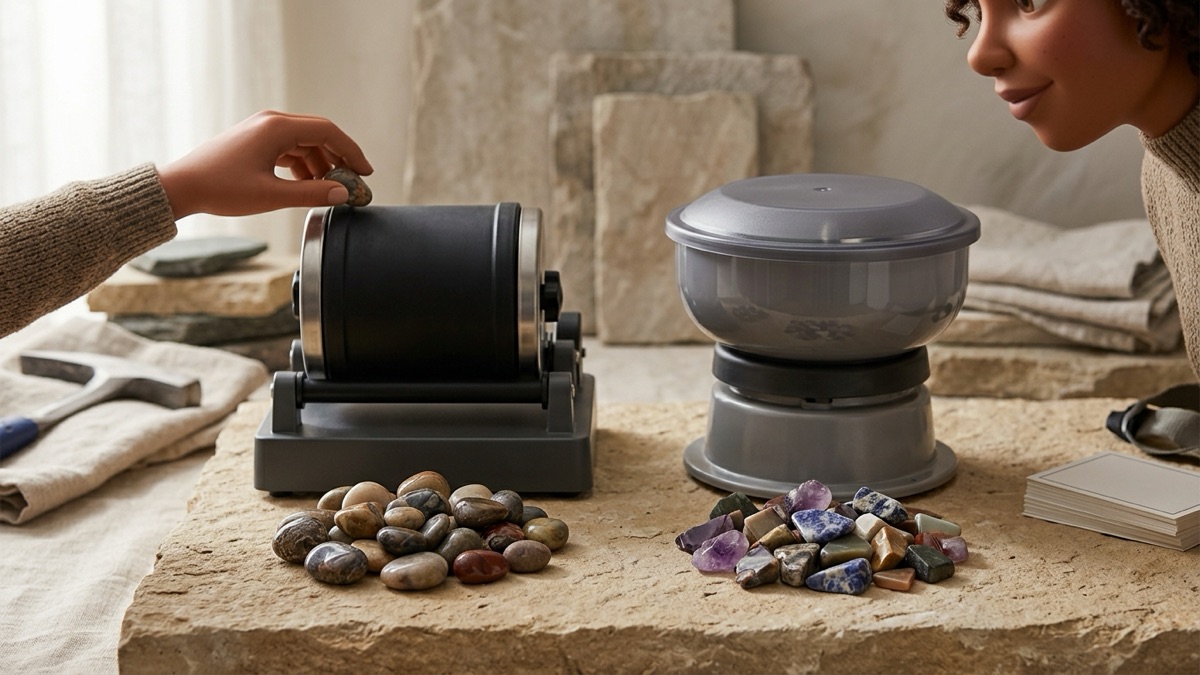
Both machines turn rough rock into shiny stones. They just go about it in opposite ways: one rolls the rocks for weeks, the other shakes them for days. Which one is right comes down to a simple question: do you want your finished stones round, or do you want them to keep their shape?
Quick answer
A rotary tumbler rolls rocks in a slowly turning barrel, so they come out rounded, and a batch takes about four to eight weeks. A vibratory tumbler shakes them thousands of times a minute, so they keep their shape and finish in one to two weeks with far less grit. Most beginners start with rotary.
Key takeaways
- A rotary barrel turns about 30 to 50 times a minute. The rocks roll and knock their edges off, so they come out rounded.
- A vibratory bowl shakes 3,000 or more times a minute. The rocks rub against each other, so they get smooth and shiny but keep their shape.
- Vibratory tumbling skips the coarse stage, finishes in about half the time and uses roughly a quarter of the grit and polish.
- Many people use both: a rotary for the coarse shaping, then a vibratory for medium, fine and polish.
- In one set of meter tests, the quietest machines were small rotary tumblers with soft rubber barrels.
How does a rotary tumbler move the rocks?
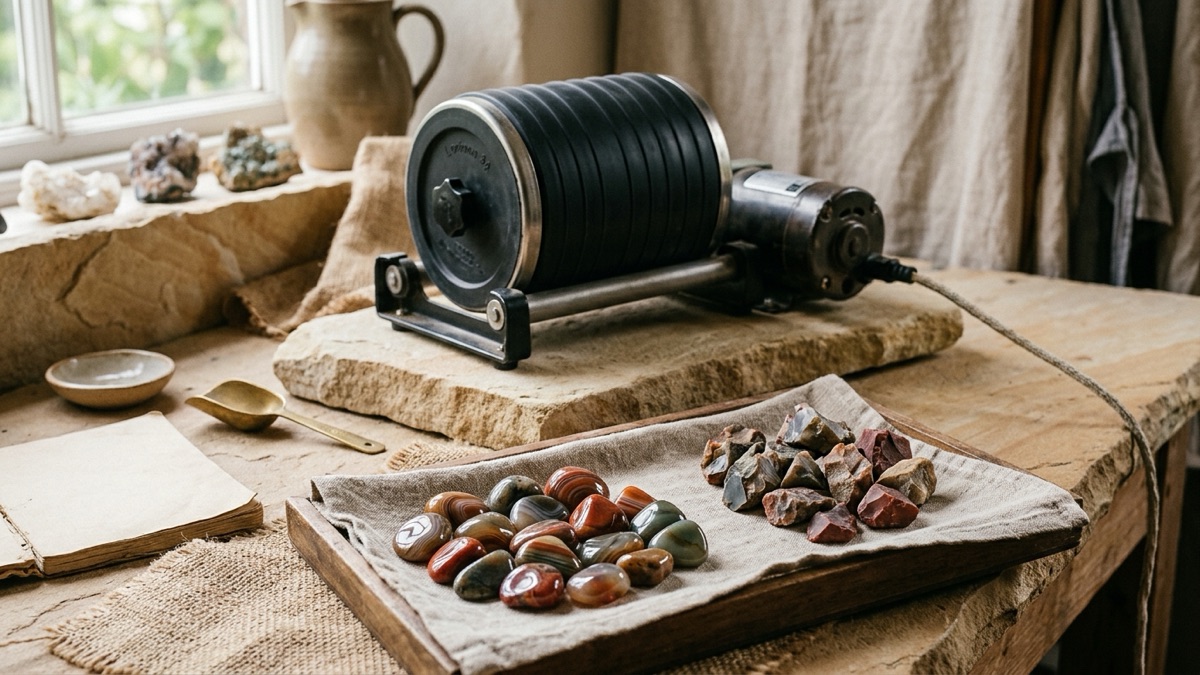
A rotary tumbler is a sealed barrel lying on two rollers. A motor drives a roller and the barrel rolls, slowly and steadily; RockTumbler.com puts a typical rotary barrel at about 30 to 50 turns a minute. Inside, the load of rocks, grit and water rides up the side of the barrel and tumbles back down, over and over.
That tumbling is the whole point. As the rocks roll, their points and edges get knocked off and ground down by the grit, so every stone drifts toward a rounded, pebble-like shape. The standard rotary recipe is four stages of about a week each, coarse, medium, fine and polish, and our step-by-step rock tumbler guide walks through each one.
How does a vibratory tumbler move the rocks?
A vibratory tumbler holds the rocks in a bowl that shakes very fast. RockTumbler.com says the bowls vibrate at least 3,000 times a minute, and Thumler's product page for its UV-10 model lists 3,000 vibrations per minute (checked September 2026). Instead of rolling, the rocks slide back and forth against each other with grit caught between them, which grinds their surfaces smooth.
Because the rocks hardly roll, they barely change shape. An angular chunk goes in and comes out as a smooth, shiny angular chunk. The grit also behaves differently: in a vibratory tumbler you add only enough water to make the grit stick to the wet rocks, so each rock works like a small sheet of sandpaper, instead of a sloshing slurry.
Rotary vs vibratory at a glance
| Feature | Rotary tumbler | Vibratory tumbler |
|---|---|---|
| How the rocks move | Roll and tumble in a turning barrel | Rub against each other in a shaking bowl |
| Finished shape | Rounded | Close to the original shape |
| Typical stages | Coarse, medium, fine, polish | Medium, fine, polish (no coarse) |
| Typical total time | About 4 to 8 weeks | About 1 to 2 weeks |
| Grit per pound of rock | About 2 level tablespoons | About 1/2 tablespoon |
| Water | Just below the top of the rocks | Just enough to make grit stick |
| Usual first machine? | Yes, for most beginners | Often a second machine |
Sources: RockTumbler.com's guides to rotary and vibratory tumbling, checked September 2026.
Which one gives the shape you want?
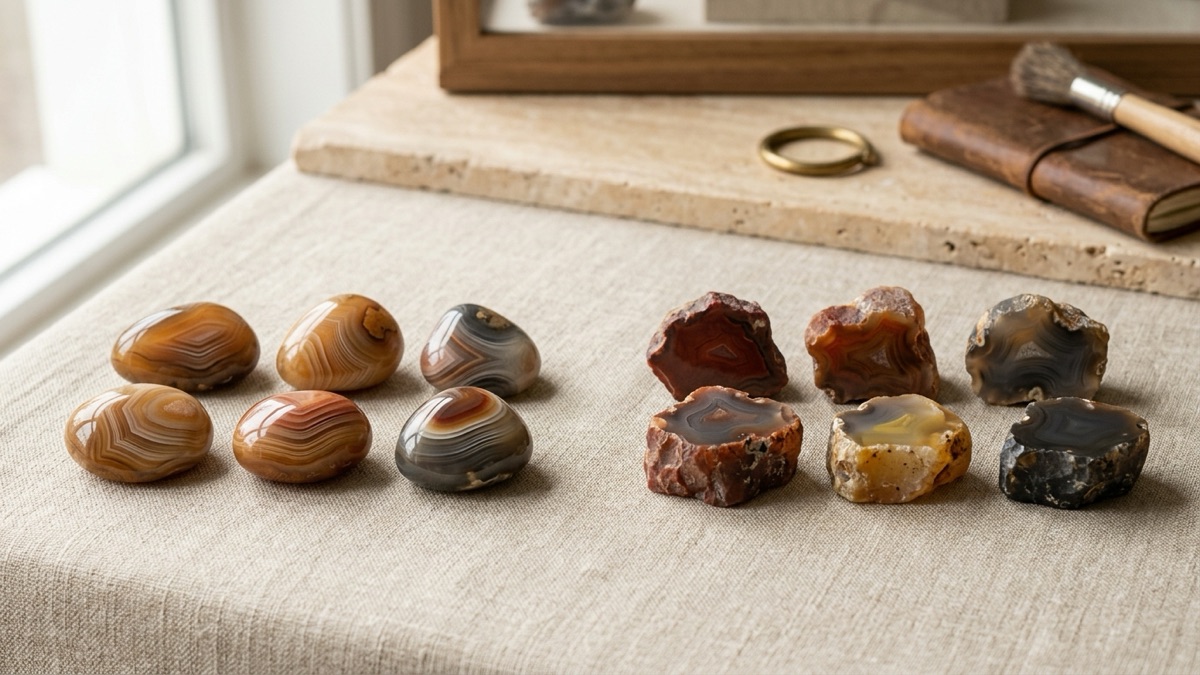
This is the biggest difference, and it is a matter of taste. RockTumbler.com photographed a set of stones from each machine side by side: the rotary stones came out round, and the vibratory stones came out smooth and angular.
- Choose rotary if you picture classic tumbled stones: smooth, rounded pebbles you can roll between your fingers.
- Choose vibratory if you want to keep a shape you like: a broken agate nodule with its bands showing, a flat slab, or rough you have already rounded.
A vibratory tumbler can also be gentler on brittle materials. RockTumbler.com says mookaite, a brittle jasper-like rock, often chips or bruises badly in a rotary tumbler, so they shape it in a rotary and then do the medium, fine and polish stages in a vibratory. They do the same with feldspars, which tend to split along flat planes when tossed around.
Which is faster, and which uses less grit?
Vibratory, by a wide margin. RockTumbler.com's timing for each:
- Rotary: about one week per stage, so about four weeks in all, and four to eight weeks if you repeat the coarse stage for better shapes.
- Vibratory: medium grit in runs of 12 to 24 hours, rinsing and adding fresh grit each time, for about three to seven days in total (less if the rocks were already shaped in a rotary); then two or three days each for fine grit and polish. About one to two weeks overall.
Grit use drops just as sharply. A rotary tumbler uses about two level tablespoons of grit per pound of rock per stage, while a vibratory tumbler uses about half a tablespoon or less. In a rotary barrel most of the grit is sloshing around in the slurry, but in a vibratory bowl it stays stuck to the rocks where the cutting happens. RockTumbler.com puts the saving at 75 percent or more. Our rock tumbler grit guide explains the grit sizes for both.
Tip
Vibratory polish should coat the rocks like a thin paint. RockTumbler.com checks the slurry after 15 to 30 minutes and aims for about the thickness of latex house paint, adding water a few drops at a time if it gets pasty.
Which one is quieter?
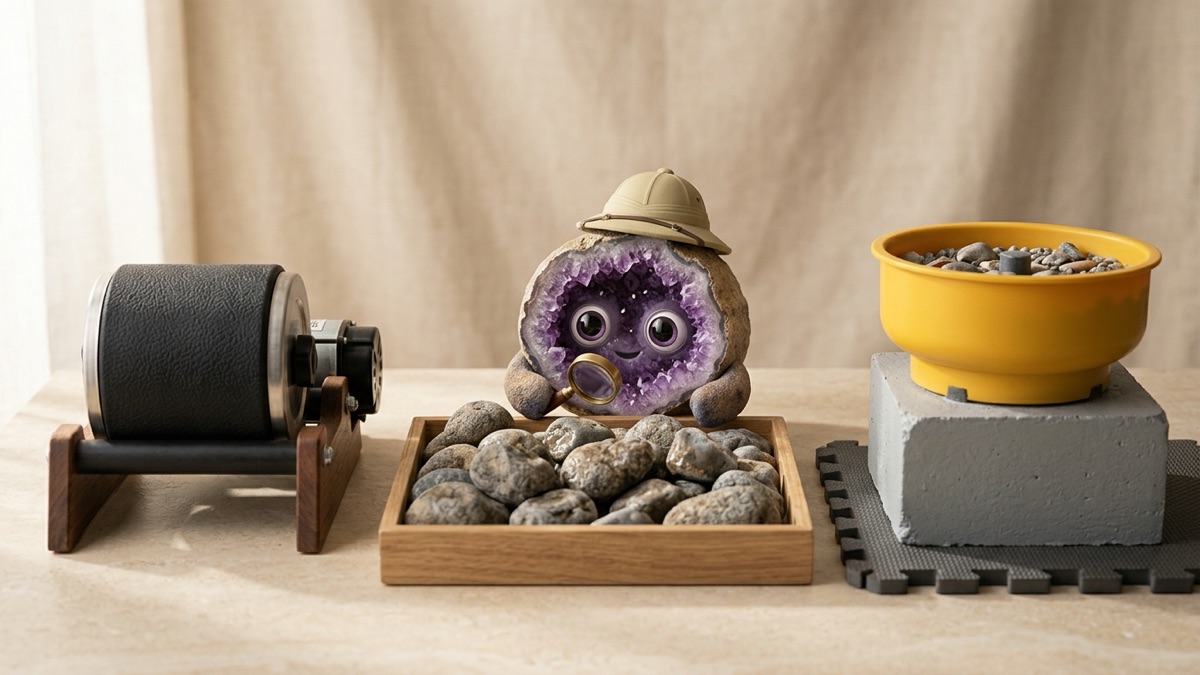
It depends more on the machine than on the type. In RockTumbler.com's sound-meter tests, taken three feet away, small rotary tumblers with soft rubber barrels measured roughly 55 to 64 decibels. A small single-barrel vibratory machine, glued to a concrete block that sat on foam board, measured 61 to 64, which they compare to normal conversation. A larger vibratory bowl measured 72 to 74, near the top of their chart.
A few practical differences:
- Rubber barrels are quiet; hard plastic barrels rattle. RockTumbler.com found a small toy tumbler with a plastic barrel far noisier than a big rubber-barrel machine.
- Some vibratory machines need a heavy base. RockTumbler.com anchors theirs to a concrete block and warns against bolting it to a workbench, which makes the whole bench vibrate and walk.
- Vibratory hum carries. RockTumbler.com's author runs his vibratory machine only during the day, because the hum reaches the bedroom above the garage.
What are the downsides of each?
Rotary tumblers are slow, use more grit and electricity per batch, and can bruise fragile rough. If the barrel is under half full, rocks such as quartz and obsidian get thrown around and chip, so you need filler or cushioning. They round everything, whether you want that or not.
Vibratory tumblers cost more: when we checked in September 2026, RockTumbler.com, a tumbler retailer, said a vibratory machine typically costs about half again as much as a rotary one. They do not round rocks, some models need a heavy anchor, and the medium stage needs a rinse and fresh grit every 12 to 24 hours.
Heads up
Some materials, including obsidian and glass, give off a little gas as they grind. A rubber rotary barrel can usually handle it if you vent it now and then (Lortone's manual says to open the barrel occasionally), but some vibratory barrels have a push-on cap that can pop off. If that happens and the water evaporates, the rocks can end up cemented together in dried mud. RockTumbler.com pokes a tiny hole in the cap to let gas escape.
Can you use both?
Yes, and many experienced tumblers do. The combination looks like this:
- Shape in the rotary. Run the coarse stage for one to three weeks until the rocks are rounded.
- Finish in the vibratory. Clean everything, then run medium, fine and polish in the vibratory at a few days per stage.
RockTumbler.com says this gets rounded stones about two weeks faster than using a rotary alone, with less grit and polish for the last three stages. For example, they tumbled beach-rounded basalt pebbles for three weeks of coarse in a rotary, then three days each of medium, fine and polish in a vibratory. Our before and after guide shows what the rocks should look like at each of those checkpoints.
Which one should you get?
- Your first tumbler: a rotary tumbler with a soft rubber barrel. RockTumbler.com recommends rotary machines to first-time buyers because they are easy to run.
- You want round pebbles: rotary.
- You want to keep angular shapes, slabs or nodule faces: vibratory.
- You tumble a lot and hate waiting: both, rotary for shaping and vibratory for finishing.
- You tumble brittle or fragile rough: consider a vibratory for the finishing stages, with plenty of ceramic media as cushioning.
Whichever you choose, the rough matters more than the machine. Start with hard, uncracked stones from our list of the best rocks for tumbling.
Try it
Check how hard your rough is before you tumble it. Scratch it against glass and a steel knife, then compare it with the free Mohs hardness scale tool. Tumble together only rocks of similar hardness, whichever machine you use.
The takeaway
A rotary tumbler rolls rocks round over weeks; a vibratory tumbler rubs them smooth in days and leaves their shape alone. Beginners usually start rotary, and many hobbyists eventually add a vibratory for faster finishing. Decide on the shape you want, and the machine chooses itself. The RockhoundID app for Android suggests likely matches from a photo and tells you which test confirms them.
The pictures in this guide are AI-generated illustrations of what to look for; real specimens vary, so trust the tests over any picture. RockhoundID guides help you narrow down what you found. They suggest likely candidates, not certain identifications or appraisals. For anything valuable, rare or possibly from space, ask a museum, a university geology department or your state geological survey, and check the collecting rules for the land before you take anything home.
Questions rockhounds ask
Is a rotary or vibratory rock tumbler better for beginners?
Most beginners start with a rotary tumbler. It is simple to run, the instructions for it are everywhere, and it rounds rough rock into classic pebble shapes. A vibratory tumbler is faster but costs more and needs a little more attention.
Does a vibratory tumbler round rocks?
Not much. A vibratory tumbler rubs the rocks against each other, so they come out smooth and shiny but close to the shape they went in. If you want rounded stones, shape them in a rotary tumbler first.
Can you use coarse grit in a vibratory tumbler?
Usually not. Vibratory recipes start with medium grit, because coarse grains are too large to cling to the wet rocks in a vibrating bowl. That is one reason many people do the coarse stage in a rotary tumbler.
Is a vibratory tumbler louder than a rotary tumbler?
It depends on the machine and how it is mounted. In RockTumbler.com's meter tests, small rubber-barrel rotary tumblers were among the quietest, while vibratory machines ranged from similar levels to among the loudest they measured.
Where these facts come from
- RockTumbler.com: rotary and vibratory rock tumblers explained: rocktumbler.com/tips/rotary-and-vibratory-rock-tumblers-explained/
- RockTumbler.com: save time and money with a vibratory tumbler: rocktumbler.com/blog/save-time-and-money-with-a-vibratory-tumbler/
- RockTumbler.com: how long does rock tumbling take?: rocktumbler.com/tips/how-long-does-rock-tumbling-take/
- RockTumbler.com: how we use the Lot-O-Tumbler (vibratory method): rocktumbler.com/tips/how-we-use-the-lot-o-tumbler/
- RockTumbler.com: how much noise does a tumbler make?: rocktumbler.com/tips/how-much-noise-does-a-tumbler-make/
- RockTumbler.com: rotary rock tumblers explained: rocktumbler.com/tips/rotary-rock-tumblers/
- RockTumbler.com: what is rock tumbler grit?: rocktumbler.com/blog/what-is-silicon-carbide-grit/
- RockTumbler.com: rock tumbling before and after: rocktumbler.com/rough/before-and-after/
- Thumler's Tumbler: UV-10 vibratory tumbler product page: www.thumlerstumbler.com/products/thumlers-tumbler-uv-10-industrial-vibratory-tum
- Lortone: Model 3A rotary tumbler instructions and parts list (PDF): lortone.com/cdn/shop/t/4/assets/3A_Tumbler_Instructions.pdf
Read next
identification
How to Tell If Amber Is Real: Salt Water, UV and More