Dendritic and Tree Agate: What the Branches Really Are
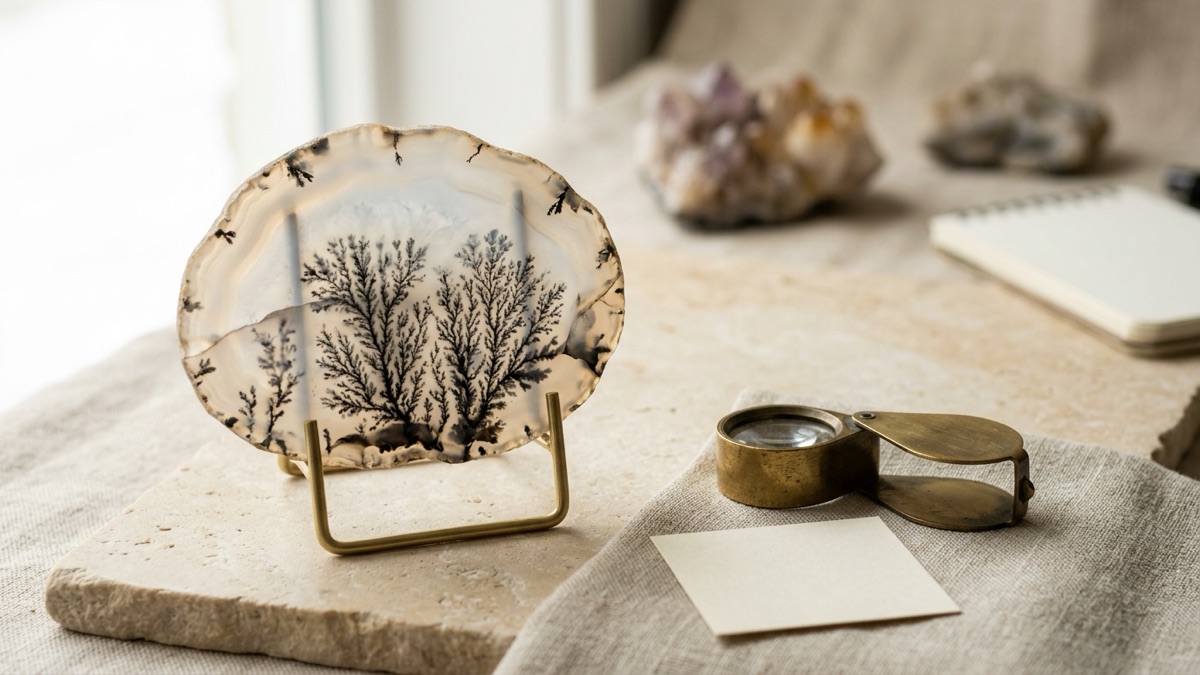
Hold a slice of dendritic agate to the window and you see a tiny winter forest: black trees, fern fronds, maybe a whole hillside of shrubs frozen in clear stone. It looks exactly like a fossil. It is not, and the real story is almost as good.
Quick answer
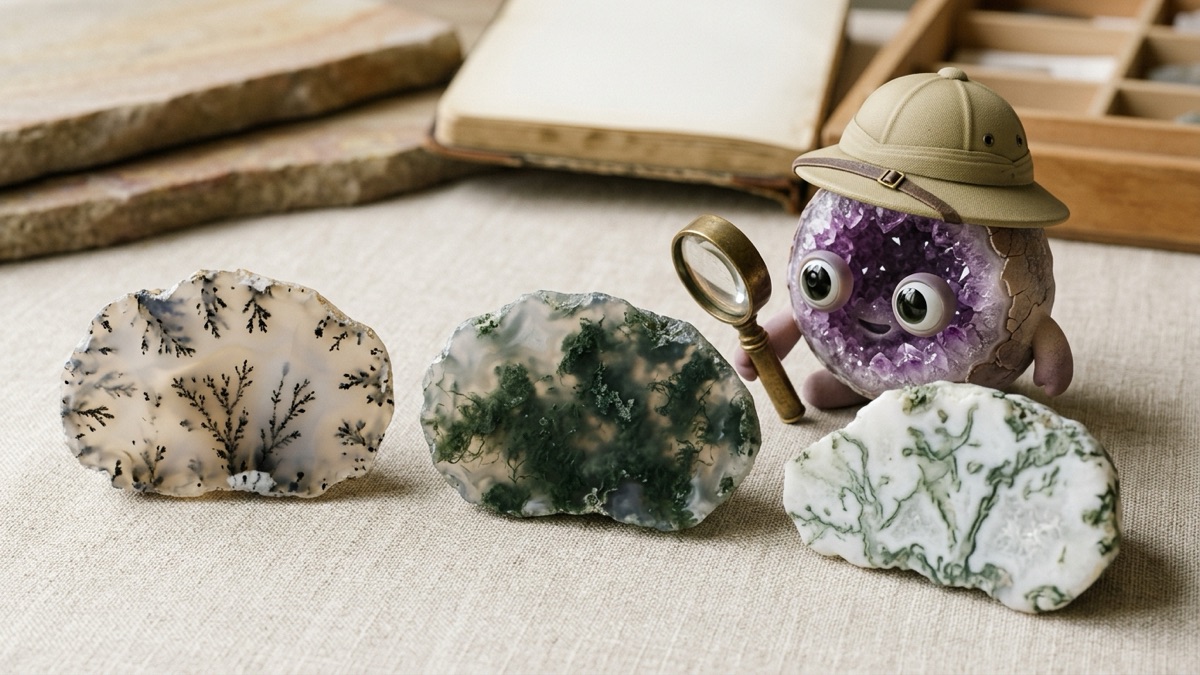
Dendritic agate is translucent chalcedony with dark, branching mineral growths inside called dendrites. They are usually manganese or iron oxides that crystallized along hairline cracks, not fossil plants. Tree agate is a trade name for white chalcedony with green branching patterns, and moss agate has denser, tangled growths that look like moss.
Key takeaways
- The "trees" in dendritic agate are crystals of dark minerals, usually manganese or iron oxides, not plants.
- Dendrites grow along cracks, so they often lie on thin, flat planes inside the stone.
- Dendritic, moss and tree agate are pattern names, not different minerals. All are chalcedony (microscopic quartz).
- Real dendritic agate scratches glass and glows at a thin edge under a flashlight.
- Bright, even colors or patterns sitting on the surface are red flags for dye or imitation.
What are the branches in dendritic agate?
They are dendrites, from the Greek word for tree. The Geological Survey of Western Australia describes dendrites as branching crystal growths, typically made of manganese oxide minerals, that look darker than the surrounding rock and grow along cracks. Iron oxides can form them too.
The idea is simple. Water carrying dissolved manganese or iron seeps into a hairline crack. As it spreads, the oxide minerals come out of solution and build outward in finer and finer branches, a bit like frost spreading across a window. Once the crack is sealed inside hard chalcedony, the pattern is locked in.
Museum specimens show it clearly. The Oxford University Museum of Natural History describes a moss agate from Sardinia in its Corsi Collection of decorative stones as white chalcedony with subtle agate banding and extensive dendritic iron and manganese oxides. Another agate in the same collection shows scattered black dendrites and small dark oxide and sulfide grains.
Are the trees fossil plants?
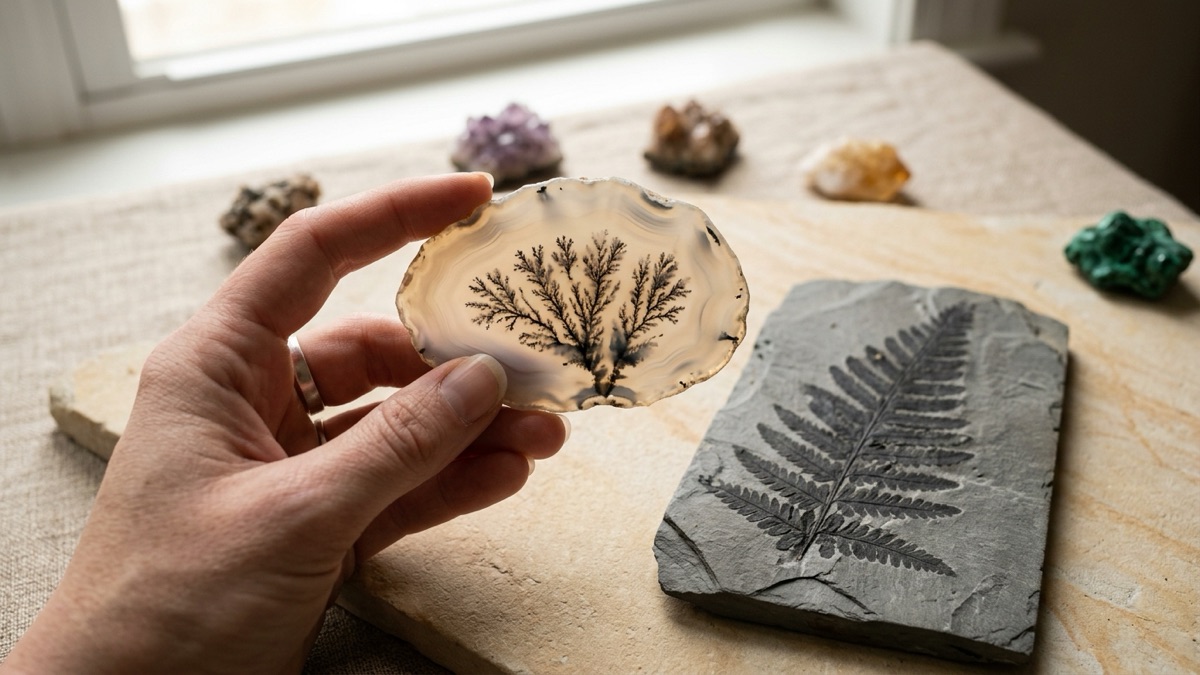
No, and this is the most common mix-up. Dendrites belong to a group geologists call pseudofossils: features that look like fossils but formed through inorganic processes, with no living thing involved.
The Western Australia survey gives two clues for telling them apart:
| Clue | Dendrite | Plant fossil |
|---|---|---|
| Shape | Irregular, branching again and again, no two branches alike | A real leaf, frond or stem outline, with a regular leaf shape |
| Where it sits | Grows along cracks and can extend in three dimensions, crossing layers | Lies flat on a bedding plane (the surface between rock layers) |
| Color | Black to brown, darker than the rock around it | Varies with how the plant was preserved |
| How it formed | Minerals crystallizing from water, no life involved | From a plant that once lived |
If you want to know what a real plant fossil looks like, our fossil identification guide walks through the common ones.
Fun fact
Dendrites are not picky. The Western Australia survey notes they grow along cracks in rock, so the same black "ferns" also show up on the split faces of ordinary rocks. Only the ones sealed inside chalcedony are dendritic agate.
What is the difference between dendritic, tree and moss agate?
All three are chalcedony with something growing inside. The names describe how the growth looks, and sellers do not always use them the same way.
| Name | What you see | Background stone | What makes the pattern |
|---|---|---|---|
| Dendritic agate | Fine, crisp black or brown branches, often in one thin plane | Clear to milky, translucent | Manganese or iron oxide dendrites |
| Moss agate | Denser, tangled clouds that look like moss or seaweed, spread through the stone | Clear to milky, translucent | Mineral inclusions, often oxides |
| Tree agate | Green, branching or mossy veins | Mostly white and fairly opaque | Green mineral inclusions |
Two real-world examples show how loose the naming is. The Minnesota DNR lists moss agates, containing mineral deposits, among Lake Superior agates. Geology.com's Montana page describes Montana moss agate as transparent to translucent chalcedony from the Yellowstone River basin, named for black dendritic to mossy to geometric inclusions thought to be a manganese oxide. In other words, one of the most famous "moss" agates is full of dendrites.
Tree agate is a trade name, not a scientific one. Because its white background is often fairly opaque, some pieces fail the flashlight test that most agates pass, and would be called jasper by a strict definition. Our agate vs jasper guide explains that dividing line.
If you searched for "dendritic agate meaning", here is the plain answer: dendritic means branching like a tree, so the name just means agate with tree-shaped patterns. This guide sticks to what the stone is made of.
How do you identify dendritic agate?
Five quick checks separate the real thing from look-alikes and fakes.
1. Confirm it is agate
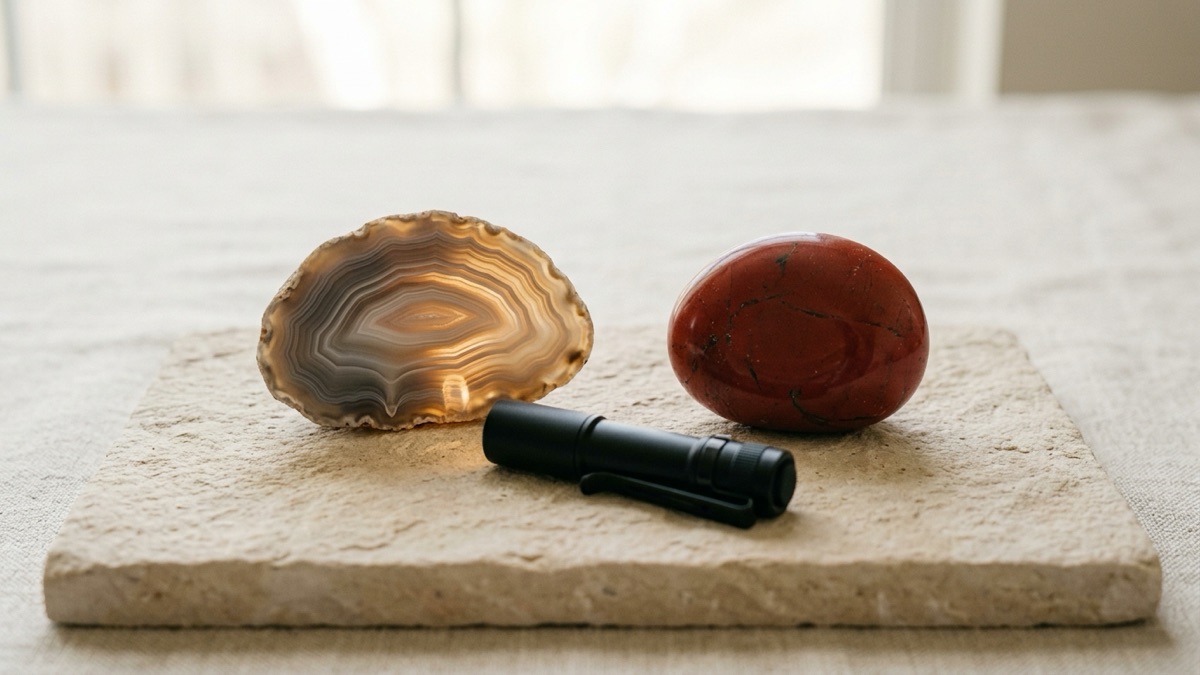
Dendritic agate should pass the agate tests. It scratches glass (agate is about 6.5 to 7 on the Mohs scale), has a waxy to glassy shine, and a thin edge glows when you hold a flashlight behind it. If a steel knife scratches it or it fizzes in vinegar, you have dendrites on a softer rock such as limestone, not agate.
2. Look at the branches with a hand lens
Natural dendrites branch and re-branch into finer and finer tips, with no two branches alike. They are crisp, dark and sit inside the stone, under a smooth polished surface.
3. Tilt the stone
In many dendritic agates the branches lie along one thin plane, following an old crack, so they look like a drawing when you view them face on and almost vanish when you view them edge on. Moss agate growths, by contrast, fill the stone in depth.
4. Check the surface
Run a fingernail over the pattern. If you can feel it, or if it sits on top of the polish like ink, be suspicious. Real dendrites are sealed within the stone.
5. Question neon colors
Geology.com notes that agate is porous and readily accepts dye. Natural dendrites are black, brown or rusty. Green tree agate and moss agate get their green from mineral inclusions; unnaturally bright or perfectly even color, especially when it collects in cracks, suggests dye.
Try it
Not sure whether your stone is agate, jasper or something softer? The free rock identifier asks about light, luster, hardness and banding, then suggests likely matches and the test that confirms each one.
Where does dendritic and moss agate come from?
Dendrites can form wherever chalcedony has hairline cracks and manganese or iron in the groundwater, so dendritic and moss agates turn up in many places. Two well-documented examples above are Sardinia, in the Oxford museum's collection, and Montana's Yellowstone River basin, where Geology.com says the moss agate nodules formed in cavities in igneous bedrock and volcanic ash deposits.
If you hunt for them yourself, the usual rules apply. On most BLM land you may collect reasonable amounts for personal, noncommercial use with hand tools, except where posted as closed. National parks allow no collecting at all. River gravel bars can be public or private depending on the stretch, so check who manages the land before you pick anything up, and ask permission on private land. Wear safety glasses if you chip a stone to peek inside.
Is dendritic agate valuable?
It depends on the piece. Collectors are drawn to crisp, well-formed dendrites that make a picture (a clear tree, a line of shrubs, a whole landscape) in a clean, translucent background. The Minnesota DNR notes that collectors value Lake Superior agates for size and unusual markings, and scenic dendrites are exactly that kind of marking.
No photo can price a stone, and we do not try. For what drives prices up or down, see our guide to agate value. For the bigger family picture, start with our agate stone guide or browse the types of agate.
The RockhoundID app for Android suggests likely matches from a photo and tells you which quick test confirms them.
The takeaway
Dendritic agate is one of geology's best tricks: a forest drawn by manganese in a crack, then sealed in quartz. The branches are crystals, not plants, and tree and moss agate are variations on the same idea. Check that the stone scratches glass and glows at the edge, look for crisp branches inside rather than on the surface, and enjoy the view.
The pictures in this guide are AI-generated illustrations of what to look for; real specimens vary, so trust the tests over any picture. RockhoundID guides help you narrow down what you found. They suggest likely candidates, not certain identifications or appraisals. For anything valuable, rare or possibly from space, ask a museum, a university geology department or your state geological survey, and check the collecting rules for the land before you take anything home.
Questions rockhounds ask
Is dendritic agate a fossil?
No. The tree and fern shapes are mineral growths, usually manganese or iron oxides that crystallized along hairline cracks. Geologists call features like this pseudofossils: they look like fossils but formed without any living thing.
What is the difference between dendritic agate and moss agate?
Dendritic agate has clear, fine branches, often lying along one thin plane like a drawing inside the stone. Moss agate has denser, tangled growths that fill the stone in depth like moss. The names overlap, and sellers use both loosely.
What is tree agate?
Tree agate is a trade name rather than a mineral species. Sellers use it for a mostly white, fairly opaque chalcedony with green, branching or mossy patterns running through it.
What does dendritic mean?
Dendritic means branching like a tree. The word comes from the Greek for tree, so dendritic agate simply means agate with tree-shaped patterns inside.
How can you tell if dendritic agate is real?
Real dendritic agate is hard enough to scratch glass, lets light through a thin edge, and has fine, crisp branches inside the stone rather than printed or painted on the surface. Very bright, even colors can mean dye.
Where these facts come from
- Geological Survey of Western Australia: Pseudofossils: www.wa.gov.au/organisation/department-of-mines-petroleum-and-exploration/geologi
- Oxford University Museum of Natural History, Corsi Collection: moss agate from Sardinia (stone 725): www.oum.ox.ac.uk/corsi/stones/view/725
- Oxford University Museum of Natural History, Corsi Collection: agate with black dendrites (stone 728): www.oum.ox.ac.uk/corsi/stones/view/728
- Geology.com (Hobart M. King): Montana gemstones, Montana moss agate: geology.com/gemstones/states/montana.shtml
- Geology.com (Hobart M. King): Agate: geology.com/gemstones/agate/
- Minnesota DNR: Lake Superior agate: www.dnr.state.mn.us/snapshots/rocks_minerals/lakesuperioragate.html
- USGS: Gemstones (mineral gemstones): pubs.usgs.gov/gip/gemstones/mineral.html
- University of Auckland, minerals: Quartz: rocksminerals.flexiblelearning.auckland.ac.nz/minerals/quartz.html
- eCFR: 43 CFR 8365.1-5, rockhounding on BLM public lands: www.ecfr.gov/current/title-43/subtitle-B/chapter-II/subchapter-H/part-8360/subpa