Types of Agate: 15 Kinds and How to Recognize Them
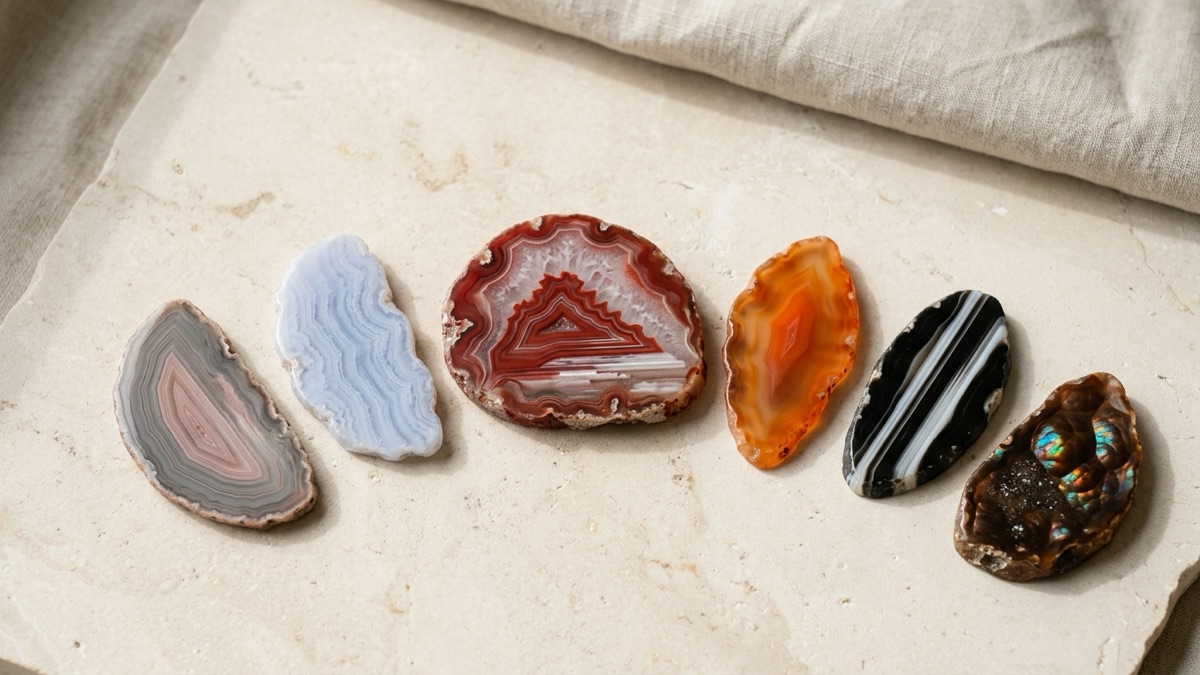
Agate types are named three ways: by the pattern inside the stone, by the place it comes from, and by old color names. Fortification, iris and plume are patterns, Botswana and crazy lace are sources, and carnelian and onyx are colors. Here is how to sort the 15 you will meet most, and what each one actually looks like.
Quick answer
Agate is banded chalcedony, and its types are named three ways. Pattern names describe what is inside (fortification, eye, iris, moss, dendritic, plume, fire). Source names tie a stone to one region (Lake Superior, Botswana, Laguna, crazy lace, blue lace). Classic color names cover carnelian, onyx and sardonyx. Confirm it is agate first: translucent edges, and it scratches glass.
Key takeaways
- Every agate is chalcedony, a quartz with crystals too small to see. It is translucent at thin edges and about 6.5 to 7 on the Mohs scale.
- Pattern names (fortification, eye, moss, plume, iris, fire) tell you what to look for. Place names (Botswana, Laguna) tell you where a stone is said to come from.
- A place name on a label is the seller's claim. Many agates look alike across continents.
- Very bright blue, pink or green agate is often dyed. Natural agate is more often red, orange, brown, gray, white or soft blue.
- The flashlight test separates agate from jasper, which is the most common mix-up.
What makes a stone an agate?
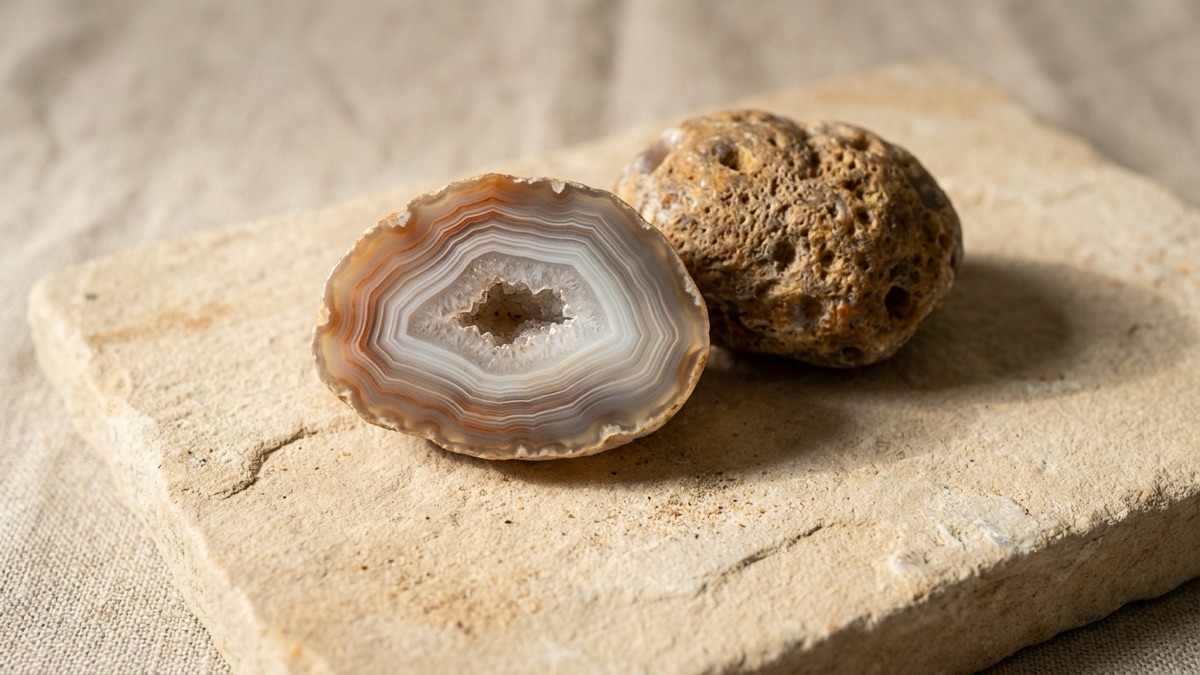
Agate is banded chalcedony: quartz built from crystals too fine to see, laid down in layers. Most agates grew inside cavities, especially gas bubbles in volcanic rocks such as basalt, as silica-rich water seeped in and deposited band after band. A University of Botswana study notes that agates also form in sedimentary and metamorphic rocks and as vein agate in cracks. Our agate stone guide covers the basics.
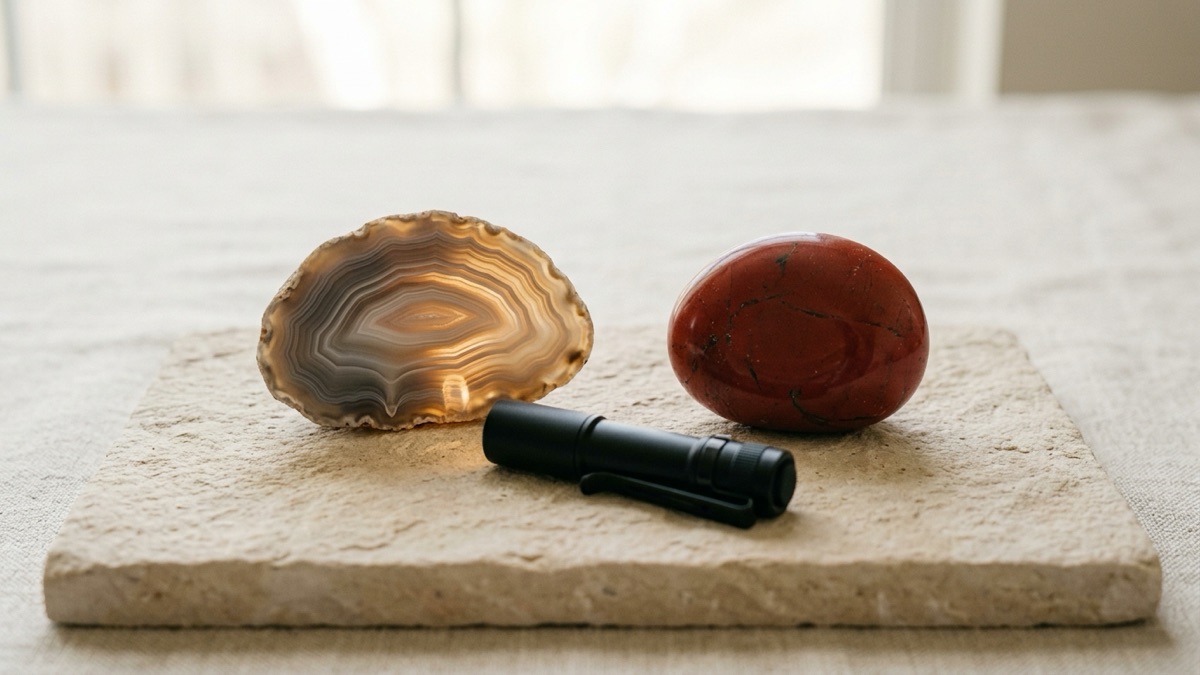
Two quick checks confirm you have agate before you worry about the type. It should let light through at a thin edge, and it should scratch window glass (about 5.5), because agate rates about 6.5 to 7. If light will not pass through at all, you probably have jasper; our agate vs jasper guide shows the flashlight test.
The 15 types of agate at a glance
| Type | What it looks like | Named for |
|---|---|---|
| Fortification | Bands that close around the stone like fort walls | Pattern |
| Eye | Round, bull's-eye rings on the surface | Pattern |
| Iris | Very fine bands that flash rainbow colors in a thin slice | Pattern |
| Moss | Moss-like mineral growths inside, often green | Pattern |
| Dendritic | Flat, dark, tree- or fern-like branches | Pattern |
| Plume | Feathery or smoky plumes suspended inside | Pattern |
| Fire | Rainbow iridescence under a brown, bubbly skin | Pattern |
| Lake Superior | Rusty red, orange and yellow iron bands | Place: Minnesota, Wisconsin, Michigan |
| Botswana | Pink, gray and brown concentric bands | Place: Botswana |
| Laguna | Bright, ornate bands of red, orchid, orange and yellow | Place: Chihuahua, Mexico |
| Crazy lace | Twisting, zig-zag and scalloped bands, mostly white and gray | Pattern (source: Chihuahua, Mexico) |
| Blue lace | Pale blue and white wavy, lacy bands | Pattern and color (source: southern Namibia) |
| Carnelian | Translucent orange to red chalcedony, banded or plain | Color |
| Onyx | Straight, parallel black and white bands | Color and pattern |
| Sardonyx | Straight bands of brownish red sard and white | Color and pattern |
Agate types named for their pattern
1. Fortification (banded) agate
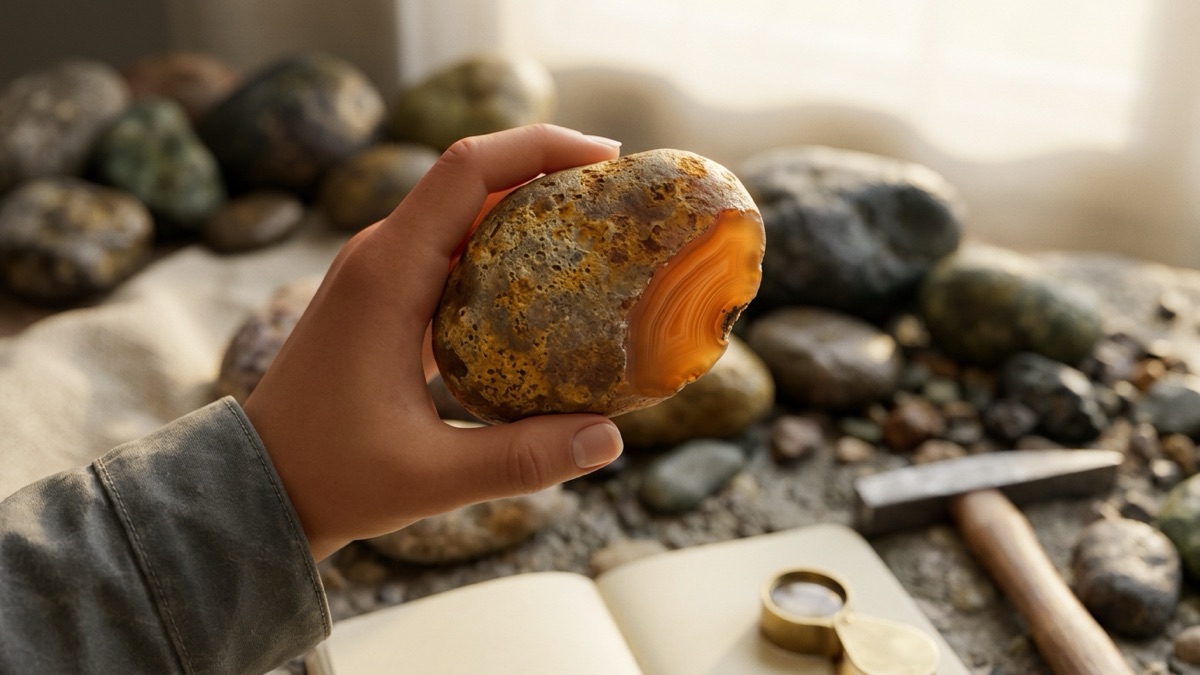
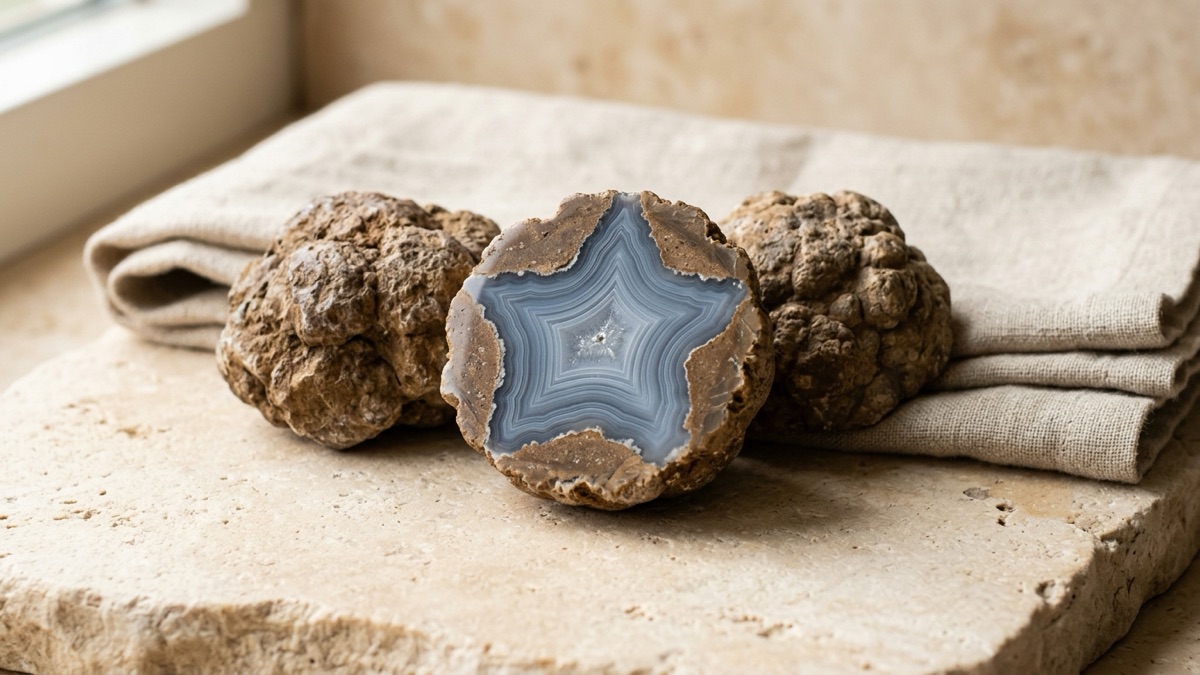
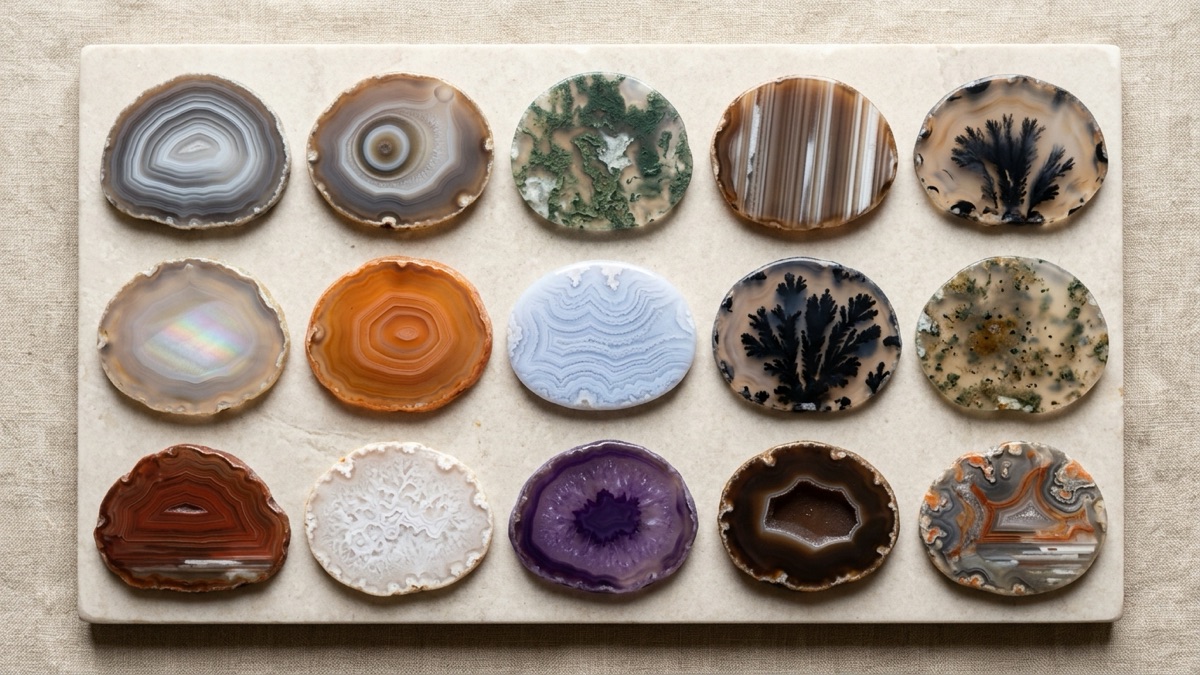
The classic agate. Its bands follow the shape of the cavity it grew in and close around on themselves. The Minnesota DNR explains the name: trace a band around the stone and it connects with itself like the walls of a fort. It is the most common Lake Superior type, and "banded agate" in a shop usually means this.
2. Eye agate
Eye agates carry perfectly round, bull's-eye bands on the outside of the stone. USGS lists "bull's eye agate" among chalcedony varieties, and the Minnesota DNR calls eye agates one of the most popular and rarest Lake Superior types.
3. Iris agate
Iris agate looks ordinary until you hold a thin, polished slice up to a light: its extremely fine bands split the light into rainbow colors. GIA's guide to phenomenal gems groups iris agate with precious opal under play-of-color.
4. Moss agate
Moss agate is clear to milky chalcedony with mineral growths inside that look like moss, pond weed or tangled roots, often green. The growths sit at different depths, so the stone looks like a tiny aquarium. It often has no bands at all.
5. Dendritic agate
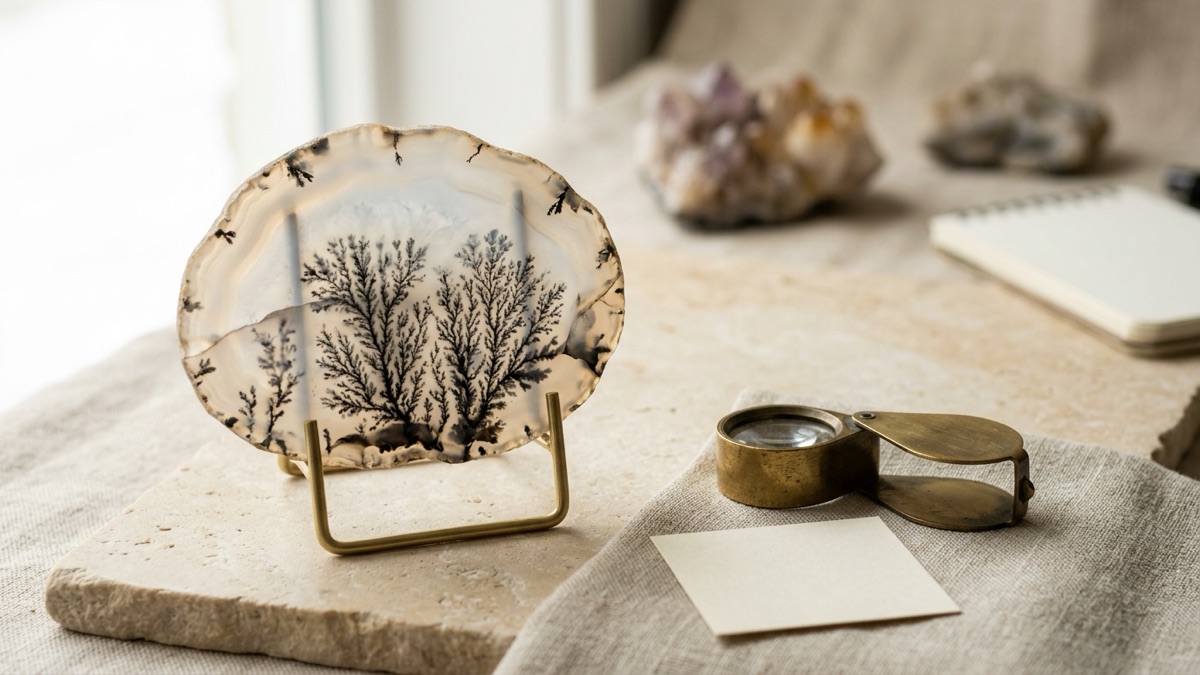
Dendritic agate has flat, dark, branching patterns that look like trees or ferns drawn inside clear chalcedony. They look like fossil plants but are mineral growths: an Oxford University Museum of Natural History catalog entry describes the dendrites in a Sardinian moss agate as iron and manganese oxides. Our guide to dendritic and tree agate explains what the branches really are.
6. Plume agate
Plume agate holds feathery, billowing plumes of color, like smoke or seaweed frozen in the stone. A 2019 New Mexico Mineral Symposium paper lists plume agates among the agates found along a trend from Nuevo Casas Grandes in Chihuahua north to the New Mexico border near Deming.
7. Fire agate
Fire agate is chalcedony with thin layers of iron oxide that create rainbow iridescence, usually under a brown, bubbly (botryoidal) skin. GIA describes its botryoidal form as resembling a cluster of grapes. The BLM says it is known only from the desert regions of Arizona, southern California and central Mexico. Our fire agate guide covers how to spot it in the rough.
Agate types tied to one source
8. Lake Superior agate
Minnesota's state gemstone is colored red, orange and yellow by iron and formed in lava flows more than a billion years old. Glaciers spread it across Minnesota, northwestern Wisconsin and Michigan's Upper Peninsula. See our guide to spotting a Lake Superior agate on the beach.
9. Botswana agate
According to a study in Botswana Notes and Records, Botswana's agates come mainly from the Bobonong area, along the Motloutse River and around Serowe, in basalt about 180 million years old. Most are small nodules with a green clay coating when fresh. The study's samples include pink, gray and brown banded agate and carnelian, with bands that nearly follow the shape of the cavity.
10. Laguna agate
Laguna agate comes from nodules mined east of Estación Ojo Laguna in Chihuahua, Mexico, according to the New Mexico Mineral Symposium paper. It is known for bright, ornate bands in raspberry red, orchid, soft yellow, orange and gray, often brightest in the center. The paper notes that all these Mexican agate deposits are on private land, mostly large cattle ranches.
11. Crazy lace agate
Crazy lace agate is a vein agate from the Sierra Santa Lucia in Chihuahua. The same paper describes irregular, twisted bands in zig-zags, scallops, bouquets, sunbursts and eyes. Most of it is actually gray or white, with red, yellow or brown staining supplying the color, and unlike other Mexican agates it is mined from limestone rather than volcanic rock.
12. Blue lace agate
Blue lace agate is pale sky blue with white, wavy, lacy bands. The classic source is Ysterputs in southern Namibia, which the Cape Town Mineralogical Society documents in its archive while noting the site can no longer be visited. Its blue is soft and pastel; an intense electric blue points to dye (more on that below).
Agate types named for their color
13. Carnelian
Carnelian is translucent orange to red chalcedony. The University of Auckland calls it a yellow to orange agate, and the Botswana study notes that carnelian may or may not be banded, so the line between carnelian and a red banded agate is fuzzy. Hold it to the light and it glows like a coal.
14. Onyx
In the gem trade, onyx is chalcedony with straight, parallel bands, classically black and white (University of Auckland). The Minnesota DNR even calls Lake Superior's straight-banded stones "onyx-fortification" or water-level agates. Solid black "onyx" in jewelry can be dyed chalcedony: GIA lists chalcedony among the gems most often dyed, and its imitation guide shows dyed black chalcedony used as a backing layer.
15. Sardonyx
Sardonyx is onyx's warmer cousin. Sard is a yellow to brown chalcedony, and sardonyx is banded sard (University of Auckland), classically brown or reddish brown layers against white. Look for straight, even bands in warm browns and reds rather than the black of onyx.
Can you trust a type name on a label?
Treat it as a lead, not a certificate. Place names are the easiest to stretch: agates from different continents can look alike, and a popular name sells. GIA notes that huge agate deposits were found in Rio Grande do Sul, Brazil, in the 1800s and shipped to Idar-Oberstein in Germany for cutting, and Brazilian agate is still a favorite of carvers, so an agate's cutting center and its source can be continents apart.
Color is the other trap. GIA lists chalcedony among the gems most often dyed, and agate's porous bands soak dye unevenly. Very bright blue, pink or green bands, color that pools in cracks, or a whole bin of identical slices all point to dye. Natural agate is more often red, orange, brown, gray, white or soft blue.
Try it
Not sure your banded stone is agate at all? The free rock identifier walks you through translucence, hardness and luster to suggest likely matches.
How do you figure out which type you have?
- Confirm agate. Light through a thin edge, a waxy to glassy shine, and it scratches glass.
- Read the pattern. Rings that close (fortification), round eyes, straight parallel bands (onyx or water-level), moss, flat branches, plumes or rainbow fire.
- Read the color. Rusty iron colors suggest Lake Superior types; soft pink and gray suggest Botswana-style banding; orange with little banding suggests carnelian.
- Check for dye. Look for unnatural brightness and color pooled in bands or cracks.
- Ask where it came from. A collector's own find with a known location is the strongest evidence of all.
Can you collect these agates yourself?
Some, yes. Lake Superior agates turn up on public beaches and in gravel, but Minnesota state parks and National Park Service areas ban collecting. Fire agate is the main attraction at the BLM's Black Hills Rockhound Area in Arizona, managed by the Safford Field Office. The Chihuahua agates come from private ranches, and Botswana and blue lace material is imported. Wherever you hunt, check the land manager's rules first; our guide to rock collecting rules explains BLM land, forests, parks and private property.
Heads up
Wear safety glasses when you crack, chip or scratch-test agate. Chalcedony breaks into sharp, curved flakes that can cut fingers and eyes.
The RockhoundID app for Android suggests likely matches from a photo and tells you which test confirms them.
The takeaway
Most agate names answer one of three questions: what pattern is inside, where it was found, or what color it is. Confirm you have agate with a flashlight and a glass scratch, then read the pattern and color. Enjoy the names, but trust your own tests more than the label.
The pictures in this guide are AI-generated illustrations of what to look for; real specimens vary, so trust the tests over any picture. RockhoundID guides help you narrow down what you found. They suggest likely candidates, not certain identifications or appraisals. For anything valuable, rare or possibly from space, ask a museum, a university geology department or your state geological survey, and check the collecting rules for the land before you take anything home.
Questions rockhounds ask
What are the main types of agate?
Agates are named three ways: by pattern (fortification, eye, iris, moss, dendritic, plume and fire agate), by source region (Lake Superior, Botswana, Laguna, crazy lace and blue lace) and by classic color names (carnelian, onyx and sardonyx).
What is the rarest type of agate?
It depends on the family, but some types are rare by nature. The Minnesota DNR calls eye agates rare among Lake Superior agates, and fire agate is known only from the desert Southwest and Mexico. Large, perfectly banded specimens of any type are uncommon.
Is onyx a type of agate?
Yes, in the gem trade onyx is chalcedony with straight, parallel black and white bands, the flat-banded cousin of fortification agate. Solid black onyx in jewelry can be dyed chalcedony, since GIA lists chalcedony among the gems most often dyed.
How can you tell what type of agate you have?
First confirm it is agate: it should be translucent at a thin edge and scratch glass. Then look at the pattern (rings, eyes, straight bands, moss, plumes or iridescence) and the colors, and compare with a table of types. A place name on a label is a claim, not proof.
Is blue lace agate natural?
Natural blue lace agate exists and has pale, soft blue and white lacy bands. Very bright or dark blue agate is usually dyed, because agate is porous and takes dye well. GIA lists chalcedony among the gems most often dyed.
Where these facts come from
- Minnesota DNR: Minnesota's state gem, the Lake Superior agate (fortification, water-level, eye agates): www.dnr.state.mn.us/education/geology/digging/agate.html
- Minnesota DNR: Lake Superior agate (Nature Snapshot): www.dnr.state.mn.us/snapshots/rocks_minerals/lakesuperioragate.html
- University of Auckland, minerals: Quartz (chalcedony varieties: onyx, sard, sardonyx, carnelian): rocksminerals.flexiblelearning.auckland.ac.nz/minerals/quartz.html
- USGS: Gemstones (chalcedony varieties): pubs.usgs.gov/gip/gemstones/mineral.html
- Botswana Notes and Records, vol. 45: Optical features, microstructure and microanalysis of Botswana agates (Jain, Coetzee, Diskin): journals.ub.bw/index.php/bnr/article/view/403/162
- New Mexico Bureau of Geology and Mineral Resources, 40th New Mexico Mineral Symposium (2019): The agates and geodes of northern Chihuahua and southern New Mexico (Brad L. Cross): geoinfo.nmt.edu/museum/nmms/abstracts/2019/2019-NMMS_p22.pdf
- Cape Town Mineralogical Society: Blue lace agate, Ysterputs: ctminsoc.org.za/?p=4536
- GIA: Fall for autumn gems (fire agate, Brazilian agate), 2018: www.gia.edu/gia-news-research/fall-autumn-gems
- GIA, Gems & Gemology: G&G in a Flash, guide to phenomenal gems (iris agate, fire agate): www.gia.edu/gems-gemology-summary-guide-to-phenomenal-gems
- GIA: An introduction to gem treatments: www.gia.edu/gem-treatment
- GIA: An introduction to imitation diamonds and other gems (dyed black chalcedony): www.gia.edu/articles/gem-imitation
- Oxford University Museum of Natural History, Corsi Collection: stone 725, moss agate with dendritic iron and manganese oxides: www.oum.ox.ac.uk/corsi/stones/view/725
- BLM: Black Hills Rockhound Area, Arizona: www.blm.gov/visit/black-hills-rockhound-area