How to Identify Raw Agate: 5 Field Checks That Work
You picked up a lumpy pebble because something about it looked different, and now you want to know how to identify raw agate before you carry a bucket of plain rocks home. Good news: an uncut, unpolished agate gives itself away in five small ways, and you can check all of them with a flashlight and a piece of glass.
Quick answer
To identify raw agate, look for a waxy shine, a pitted or peeled-looking skin and a thin edge that glows when you hold it up to the sun or a flashlight. Then check chips and worn spots for curved bands, and try to scratch glass with a sharp corner. Agate is about 6.5 to 7 on the Mohs scale and breaks with smooth, shell-shaped surfaces.
Key takeaways
- Raw agate rarely looks like the polished slices in shops. Expect a small, lumpy stone with a dull, pitted or rust-stained skin.
- The five field checks, in order: waxy look, light through a thin edge, bands or eyes, hardness, and shell-shaped (conchoidal) chips.
- Light is the fastest test. Agate is translucent, so a thin edge glows; jasper, chert and most beach pebbles stay dark.
- Wet stones show their color and shine. Hunt after rain, or carry a spray bottle.
- Know who manages the land before you pocket anything. National parks allow no collecting at all.
What does raw agate look like on the outside?
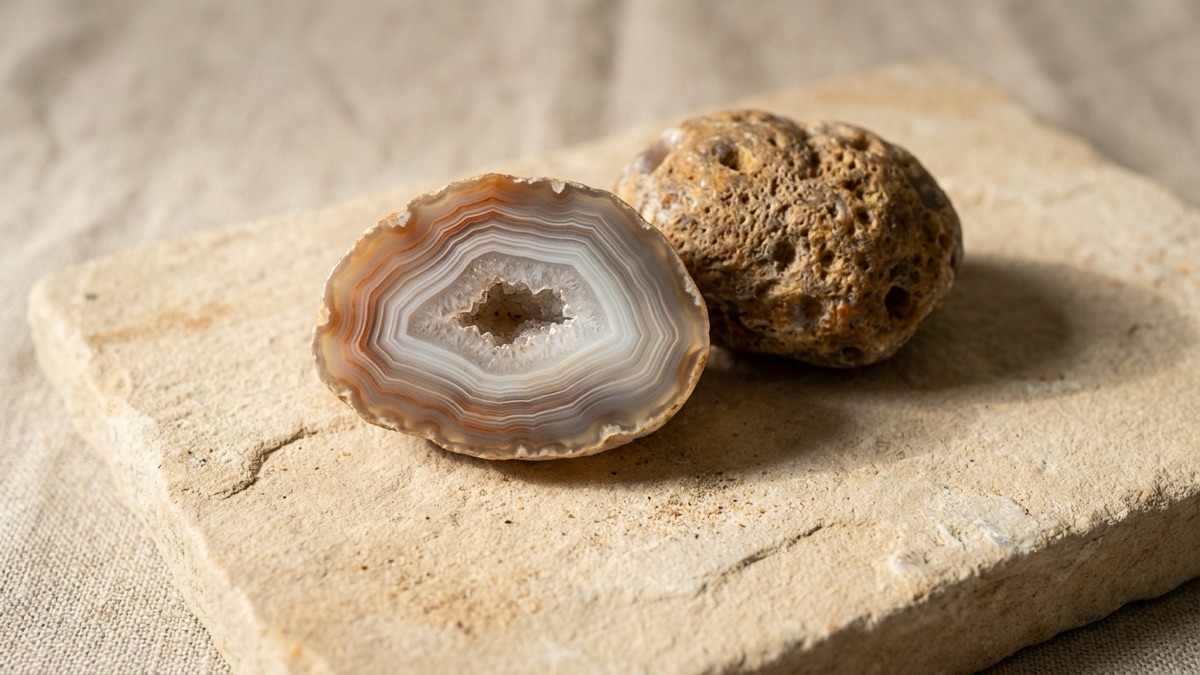
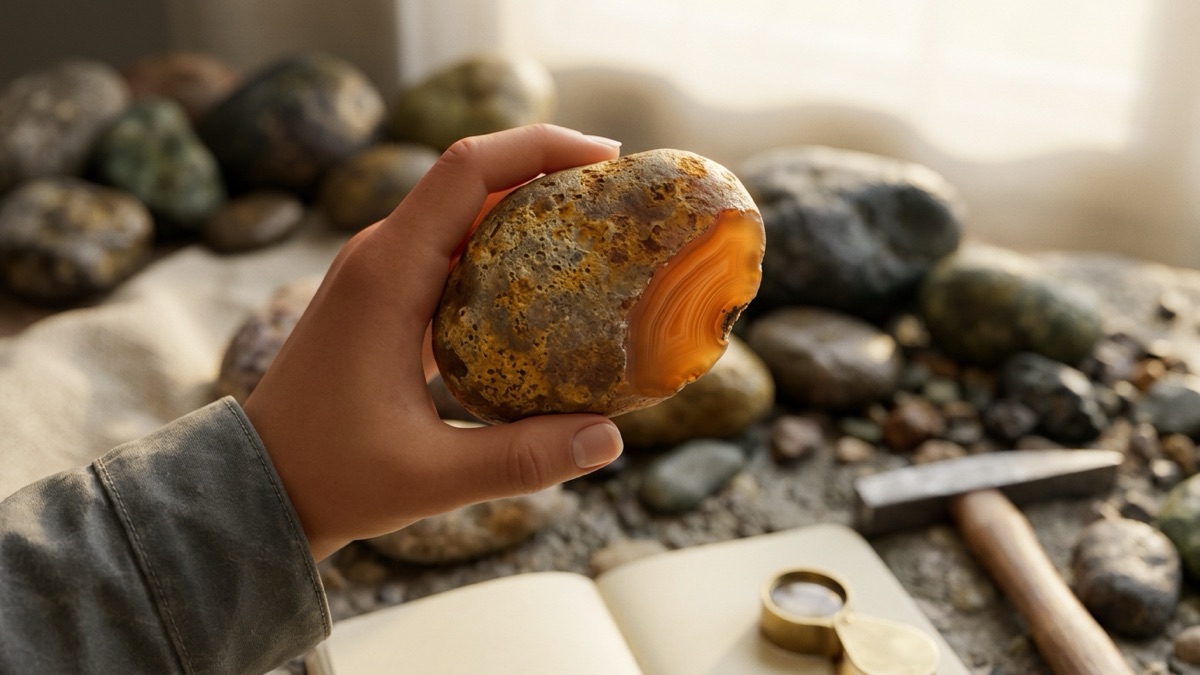
A raw agate is one that nobody has cut, tumbled or polished. On the outside it is usually a small, rounded, lumpy stone, a bit like a tiny potato, with a skin that hides most of what is inside. Minnesota Conservation Volunteer magazine, published by the Minnesota DNR, puts it well: some agates are rough and dark on the outside and give only a hint of the treasure locked inside.
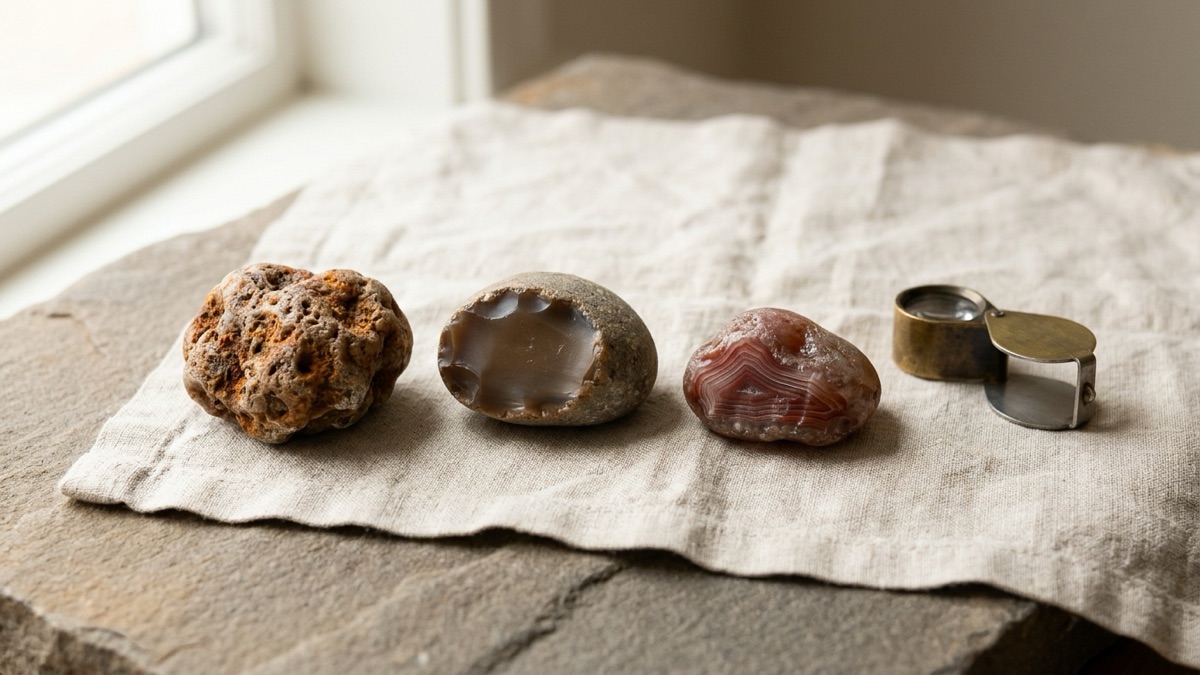
Here are the outside clues, with the reasons behind them where the Minnesota DNR explains them:
| Outside clue | What you see | Why it happens |
|---|---|---|
| Waxy shine | A soft glow like a candle, strongest on chips and broken faces | Agate is chalcedony, a very fine-grained quartz with a waxy luster |
| Pitted skin | Tiny holes or pockmarks over the surface | Knobs of a softer first mineral layer left dents in the agate that grew over it |
| Peeled texture | Flat or curved patches that look like layers were peeled off | The stone has broken along its own bands |
| Rusty staining | Red, orange, yellow or brown color over much of the stone | Iron oxide staining, found on nearly all Lake Superior agates |
| Glowing edge | A thin edge or corner that lets light through | Translucence is a built-in feature of chalcedony |
| Shell-shaped chips | Small, smooth, curved dents with sharp edges | Quartz has no flat cleavage, so it breaks in curves |
Two more things help. First, size: the magazine notes that most agates weigh just a few ounces, so think pebble, not boulder. Second, heft: the Kansas Geological Survey gives agate a specific gravity of 2.58 to 2.64, which is about average for a rock. A raw agate should feel like a normal stone of its size, never heavy like an ore and never light like pumice.
Luster is the word for how a surface reflects light. It is the hardest clue to learn from a photo and the easiest once you have held one real agate.
How do you identify raw agate? The 5 field checks, in order
Work through these from fastest to slowest. No single check proves anything, but three or four passes together make agate the likely answer.
1. The waxy look
Scan the gravel for anything that looks like it was already polished. The Minnesota DNR describes a glossy, waxy appearance, especially on a chipped or broken surface, as a classic clue. Next to grainy granite and dull basalt, an agate looks smooth and a little greasy, like a stone someone rubbed with a candle.
If the whole surface is dull, find the freshest chip and look there. A sandy, sparkly or sugary surface points to something else.
2. The light test
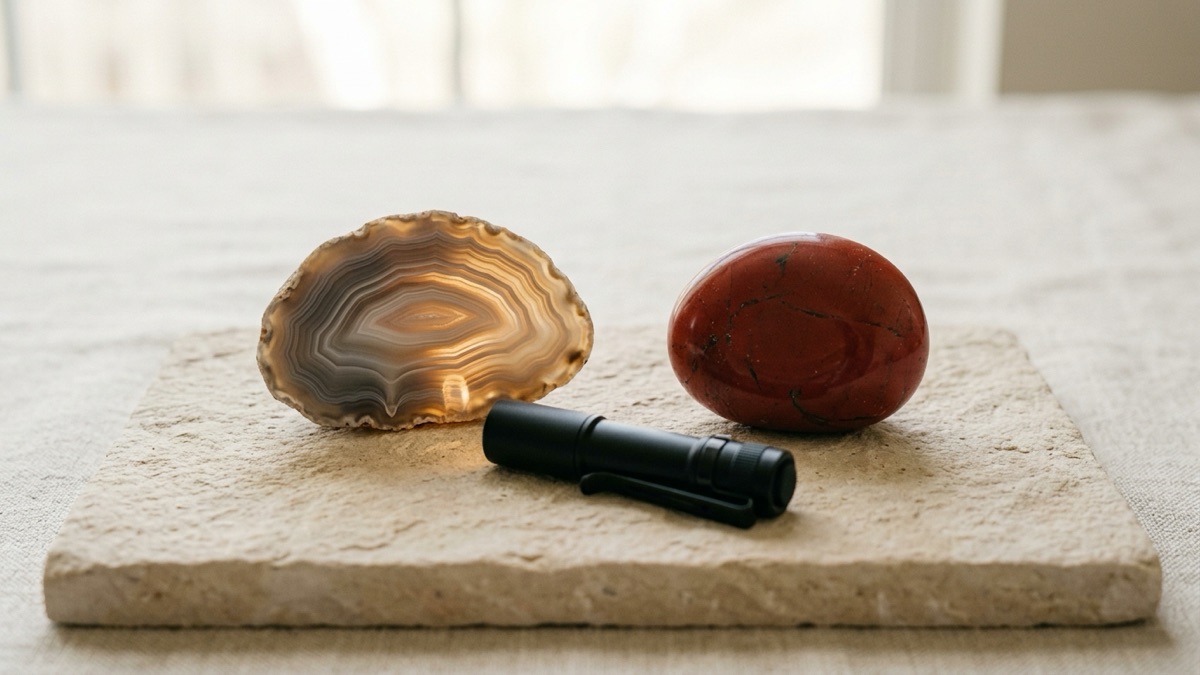
Hold the stone up so the sun is behind its thinnest edge, or press a small flashlight against the back. Agate is translucent, so the edge glows, often honey, orange or smoky gray. The Minnesota DNR notes that sunny days are best for observing translucence, which is why agate hunters walk toward a low sun.
Thick stones can stay dark in the middle even when they are agate. Judge the thin edge, not the center. If nothing glows anywhere, even at a paper-thin corner, the stone is opaque and agate is unlikely.
3. Bands or eyes
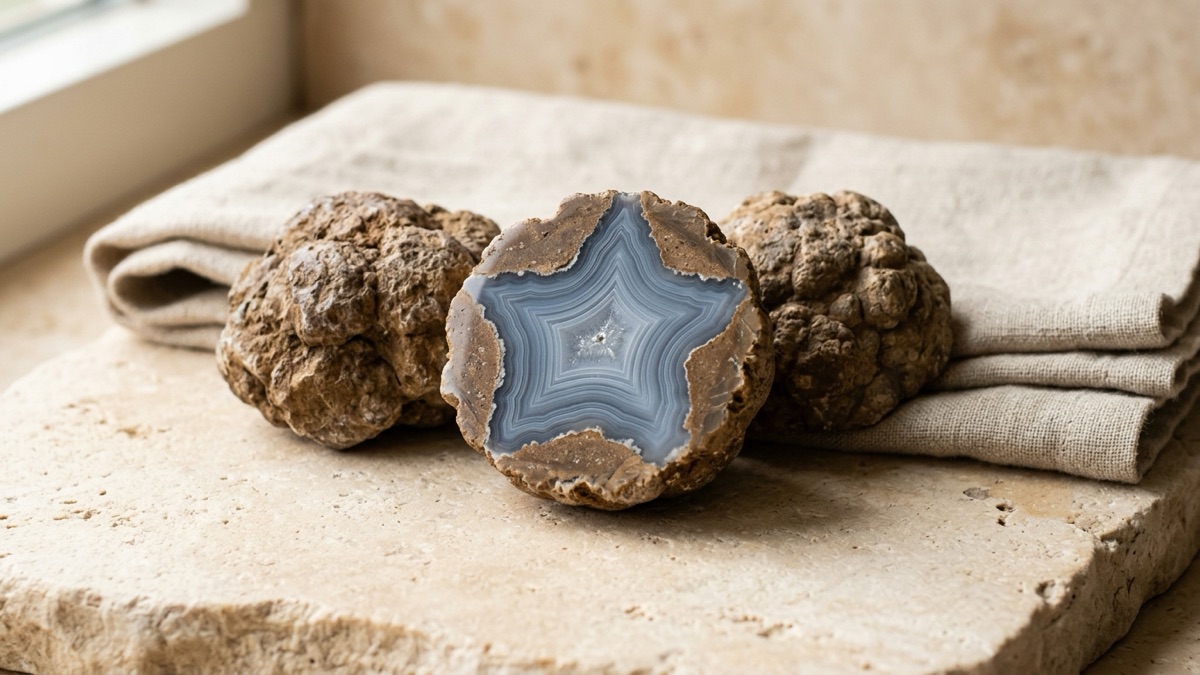
Now look for pattern. Check every chip, crack and worn spot for thin, curved lines that follow the shape of the stone. Minnesota Conservation Volunteer says the layers inside look like a sliced onion. Round bull's-eye marks on the surface, called eyes, count too.
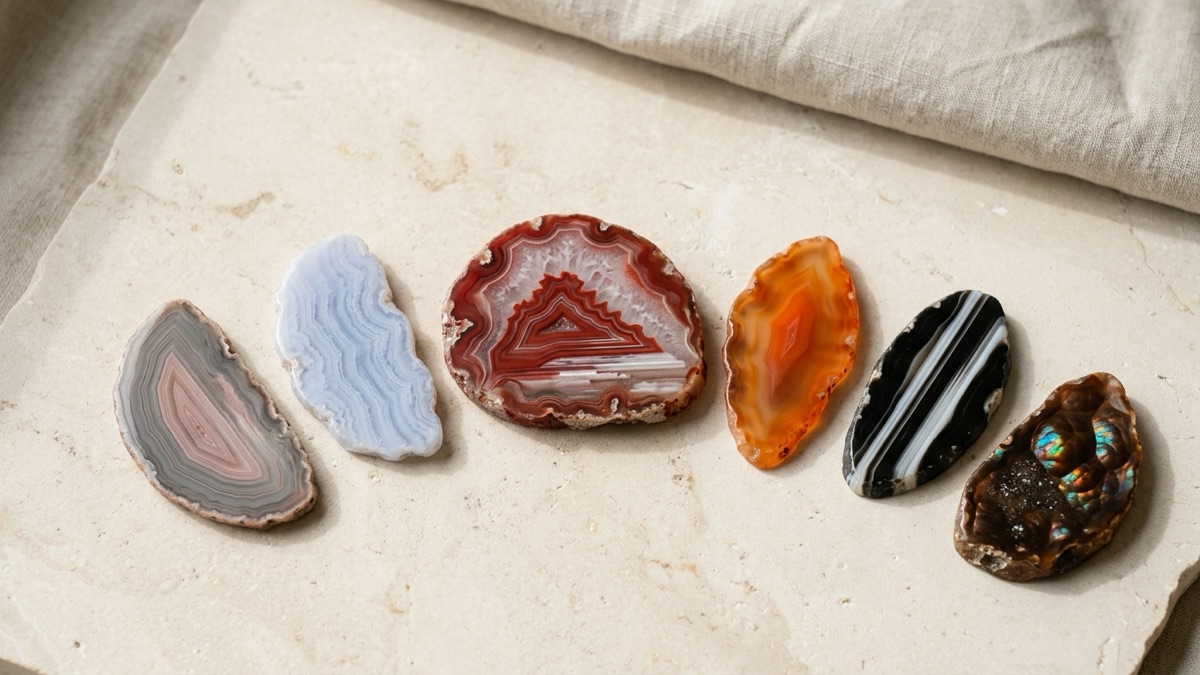
Many raw agates show bands only where the skin has worn through, so turn the stone slowly and wet it. A stone that passes every other check but has no pattern at all is plain chalcedony: the same mineral, just without the bands. Our guide to the types of agate shows the patterns you might uncover.
4. The hardness test
Agate is about 6.5 to 7 on the Mohs scale. Window glass is about 5.5 and a steel knife about 5 to 5.5, so two quick tests follow:
- Agate scratches glass. Press a sharp corner firmly across an old glass jar. Rub the mark with your finger. A groove that stays is a real scratch.
- A steel knife will not scratch agate. Drag the blade across a flat spot. A gray line that wipes off is steel left on the stone, not a scratch.
The Mineralogical Society of America suggests testing both ways like this, because some minerals leave a powder trail that looks like a scratch. Wear safety glasses, and compare numbers on our Mohs hardness scale. The Mohs hardness test guide shows the technique.
5. Conchoidal fracture
Last, look at how the stone has broken. Conchoidal fracture means a smooth, curved break, like the inside of a shell or the edge of a chip in thick glass. The University of Auckland lists conchoidal fracture and no cleavage for quartz, and agate follows that rule. Flat, shiny, stair-stepped breaks point to a different mineral, such as calcite or feldspar.
Tip
Carry three small things: a pocket flashlight, a spray bottle and a scrap of glass with taped edges. Together they cover checks 1 to 4 right where you are standing.
What looks like raw agate but is not?
Seven look-alikes cause most of the mix-ups. Each one fails a different check.
| Look-alike | Why it fools you | The one test that separates it |
|---|---|---|
| Jasper | Same hardness, same waxy shine | Light test: jasper is opaque, so a thin edge stays dark |
| Chert and flint | Hard, smooth, shell-shaped chips | Light test: usually opaque and duller, with no curved bands |
| Quartz (milky quartz, quartz pebbles) | Hard, pale, lets some light through | Luster: glassy or sparkly rather than waxy, and no bands |
| Chalcedony without bands | The same mineral, passes every test | Pattern: no bands or eyes means plain chalcedony |
| Beach glass | Frosted, translucent, glows in the sun | Hardness: it cannot put a clean scratch in glass, and one even color runs all the way through |
| Slag | Glassy and colorful, sometimes banded | Look for gas bubbles and flow swirls; it often attracts a magnet |
| Calcite | Banded and translucent | Hardness: a knife scratches it easily (Mohs 3), and it fizzes in vinegar |
A few notes on the table. Geologist Hobart King defines agate as translucent to semitransparent chalcedony and jasper as the opaque kind, so the flashlight really is the dividing line; our agate vs jasper guide goes deeper. Slag is a glassy leftover from smelting. Randy Korotev of Washington University in St. Louis notes that slags are glassy, commonly hold gas bubbles, and are sometimes used in road construction and as landscaping gravel, which is how they end up in creek beds. Our guide to rocks that look like glass covers slag and beach glass in more detail.
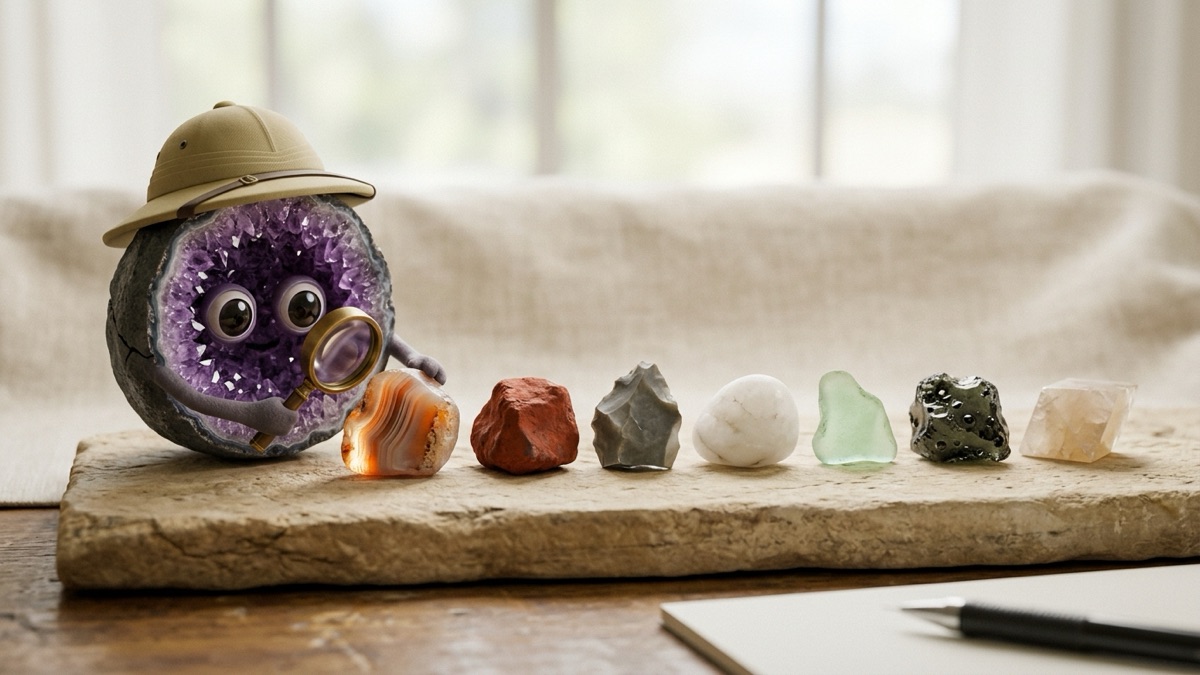
Try it
Stuck between agate, jasper and chert? Answer a few questions about luster, light, banding and hardness in the free rock identifier. It suggests likely matches and the one test that separates them, and it never uploads a photo.
Does raw agate look different wet and dry?
Very different, and it is the reason so many finds disappoint at home. A dry raw agate often looks frosted and pale, because tiny scratches and pits on the skin scatter the light. Water fills them in, so the color deepens, the waxy shine comes back and the bands sharpen.
Minnesota Conservation Volunteer lists "rich color when wet" among its agate clues and gives the simplest field advice there is: look after a rain, or squirt the rocks. That is why the best hunting is at the waterline, on a gravel bar after a shower, or on a beach just after waves have turned the stones.
Before you decide a stone is boring, wet it. Before you decide it is an agate, let it dry and run the five checks, because almost every pebble looks better wet.
Where do raw agates turn up?
Agate forms in cavities in rock, most often old lava, and it is harder than the rock around it. When that rock weathers away, the agates are left behind and get moved by rivers, waves and ice. So you look where tough pebbles collect:
- Gravel bars and river banks. The Minnesota DNR says many fine agates have been found in gravel banks along rivers and streams, and that virtually any place with exposed gravel offers a chance.
- Gravel beaches. Waves sort and wet the stones for you. Lake Superior's shore and the Oregon coast are both known for beach agates.
- Desert pavement. The National Park Service describes desert pavement as a closely packed surface layer of coarse pebbles and gravel. Waxy white and orange chalcedony stands out against darker stones there.
- Volcanic country. Agate-filled nodules weather out of old lava and ash beds. Oregon's thunder eggs are the famous example.
These are places where an official page confirms that collecting is allowed, with who manages them and the rule we found when we checked in November 2026:
| Place | Who manages it | The rule |
|---|---|---|
| Great Lakes beaches in Michigan, below the ordinary high water mark | State of Michigan | 25 pounds of rocks per person per year, personal use only |
| Oregon ocean shore | Oregon Parks and Recreation Department | Agates and other loose stones: one gallon per person per day, three gallons per year, each person with their own container |
| Black Hills Rockhound Area, Arizona (fire agate) | BLM Safford Field Office | Open for digging without fees or permits; very hot in summer |
| Savahia Peak Rock Collecting Area, California (white chalcedony) | BLM Needles Field Office | Noncommercial collecting; ask the field office about limits |
In Minnesota, the DNR calls the public beaches along Lake Superior a popular place to hunt agates, but rock collecting is not allowed in state parks, state recreation areas or state scientific and natural areas, and you need the landowner's permission to search a gravel pit. Our Lake Superior agate guide covers that shoreline.
Heads up
Rules follow the land manager, and they change. National parks, lakeshores and monuments allow no collecting at all (36 CFR 2.1). Most BLM land allows reasonable amounts for personal, noncommercial use with hand tools, except in developed recreation sites and posted areas (43 CFR 8365.1-5). National forests, state parks, tribal land and beaches each set their own rules, and private land, including gravel pits, needs the owner's permission. Leave arrowheads and other artifacts where they lie. Our rock collecting rules guide explains each land type. Check the managing agency's own page before every trip.
A few safety basics: wear safety glasses when you chip or scratch anything, stay out of active gravel pits and away from steep cut banks, carry more water than you think you need in the desert, and watch the waves on any beach.
Should you cut or tumble a raw agate?
It depends on size and on what the stone is already showing you.
- Small pebbles: tumble them. Agate is classic beginner tumbling rough. RockTumbler.com lists it with jasper and petrified wood as a good first choice, because it is hard, dense and takes a bright polish. Our rock tumbler guide walks through the four stages.
- Larger nodules: cut them. A lumpy stone the size of a plum or bigger may hide its best pattern in the middle. Saw it through the widest part with a water-cooled diamond saw, or ask a rock shop or a local rock club to cut it for you.
- Stones with a great natural face: leave them. A raw agate with a clean, banded, water-worn face is already a display piece. You can always cut later. You cannot uncut.
Whatever you choose, skip the hammer. A blow follows cracks, not bands, and turns a pattern into chips. Keep any cutting wet so you are not breathing rock dust, and wear safety glasses. Write down where each stone came from before it goes in the bag, because the place it was found is part of what collectors care about. Our guide to agate value explains what else matters.
The takeaway
Raw agate hides behind a dull, pitted, rust-stained skin, but it cannot hide all five clues at once. Look for the waxy shine, put light behind a thin edge, hunt for bands in every chip, scratch a piece of glass and check for shell-shaped breaks. Wet the stone to see it at its best, then test it dry. For the mineral behind the pebble, how it forms and its many varieties, start with our agate stone guide. And when you are standing on a gravel bar with a maybe in your hand, the RockhoundID app for Android ranks likely matches from a photo and names the one quick test that separates the look-alikes.
The pictures in this guide are AI-generated illustrations of what to look for; real specimens vary, so trust the tests over any picture. RockhoundID guides help you narrow down what you found. They suggest likely candidates, not certain identifications or appraisals. For anything valuable, rare or possibly from space, ask a museum, a university geology department or your state geological survey, and check the collecting rules for the land before you take anything home.
Questions rockhounds ask
How do you identify raw agate?
Run five checks in order. Look for a waxy shine, hold a thin edge up to the sun or a flashlight to see if light passes through, search chips and worn spots for curved bands or eyes, try to scratch glass with a sharp corner, and look for smooth, shell-shaped breaks. Three or four passes together make agate the likely answer.
What does agate look like on the outside?
On the outside a raw agate is usually a small, lumpy, rounded stone with a dull or frosted skin, tiny pits and rusty or brown staining. The giveaways are a waxy shine on any chipped spot, a thin edge that glows when light is behind it, and a few curved bands showing where the skin has worn through.
What do unpolished agates look like?
Unpolished agates look much plainer than the slices in shops. Dry, they can be dull gray, brown or rust colored, with a pitted or peeled-looking surface. Wet, the color deepens and the waxy shine comes back. Bands often show only on a broken face, so turn the stone over and check every chip.
How can you tell if a rock is an agate?
Use light and hardness, not color. Agate is translucent, so a thin edge glows with a flashlight behind it. It is about 6.5 to 7 on the Mohs scale, so it scratches glass and a steel knife cannot scratch it. Add a waxy shine, curved bands and shell-shaped chips and you have a strong case.
How do you identify agate rock outside?
Search wet gravel with the sun low and in front of you, so light shines through the stones. Agates stand out as small pebbles with a waxy, almost polished look and a glowing rim. Pick up candidates, check chips for bands, and carry a small flashlight and a spray bottle for dry or cloudy days.
How do you find agates?
Go where gravel collects in regions with old volcanic rock: river gravel bars, river mouths, gravel beaches and desert flats covered in pebbles. Hunt after rain or waves have turned the stones, look at wet rocks, and walk toward the sun. Check who manages the land first, because many parks ban collecting.
Does raw agate scratch glass?
Yes. Agate is a form of quartz, about 6.5 to 7 on the Mohs scale, and window glass is about 5.5, so a sharp corner of agate leaves a real groove in glass. Rub the mark with your finger: a scratch stays, while powder from a softer stone wipes away. Wear safety glasses when you test.
Should you cut open a raw agate?
Only if the stone is big enough to be worth it. Small pebbles usually look best tumbled whole. A larger nodule can be sawn through the middle with a water-cooled diamond saw, or cut for you at a rock shop or rock club. Do not use a hammer, which shatters the pattern.
Where these facts come from
- Minnesota DNR: Minnesota's state gem, the Lake Superior agate (Scott F. Wolter): www.dnr.state.mn.us/education/geology/digging/agate.html
- Minnesota Conservation Volunteer, Young Naturalists: Agate Hounds (July to August 2011): files.dnr.state.mn.us/mcvmagazine/young_naturalists/young-naturalists-article/ag
- Minnesota DNR: Lake Superior agate (Nature Snapshot): www.dnr.state.mn.us/snapshots/rocks_minerals/lakesuperioragate.html
- Minnesota DNR: Recreational geology (collecting rules, gravel pits): www.dnr.state.mn.us/geologyrec/index.html
- Kansas Geological Survey, GeoKansas: Agate: geokansas.ku.edu/agate
- RockTumbler.com (Hobart M. King): What is agate, jasper and chalcedony?: rocktumbler.com/blog/what-is-agate-jasper-chalcedony/
- RockTumbler.com: Rocks for tumbling: rocktumbler.com/tips/rocks-for-tumbling/
- University of Auckland, minerals: Quartz: rocksminerals.flexiblelearning.auckland.ac.nz/minerals/quartz.html
- University of Auckland, rocks: Chert: rocksminerals.flexiblelearning.auckland.ac.nz/rocks/chert.html
- Mineralogical Society of America: Mineral Identification Key, hardness: www.minsocam.org/MSA/collectors_corner/id/mineral_id_keyi4.htm
- Handbook of Mineralogy: Calcite: www.handbookofmineralogy.org/pdfs/calcite.pdf
- Washington University in St. Louis meteorite site: Slag: sites.wustl.edu/meteoritesite/items/slag/
- National Park Service: Arid and semi-arid region landforms (desert pavement): www.nps.gov/subjects/geology/arid-landforms.htm
- Michigan Geological Survey (Western Michigan University): MGS Rockhounds: mgs.wmich.edu/education-and-outreach/corekids/mgs-rockhounds/
- Oregon Administrative Rule 736-021-0090: ocean shore, agates and other natural items: oregon.public.law/rules/oar_736-021-0090
- BLM: Black Hills Rockhound Area, Arizona: www.blm.gov/visit/black-hills-rockhound-area
- BLM: Savahia Peak Rock Collecting Area, California: www.blm.gov/visit/savahia-peak-rock-collecting-area
- BLM: Rockhounding: www.blm.gov/programs/recreation/rockhounding
- eCFR: 43 CFR 8365.1-5, rockhounding on BLM public lands: www.ecfr.gov/current/title-43/subtitle-B/chapter-II/subchapter-H/part-8360/subpa
- eCFR: 36 CFR 2.1, preservation of natural resources in national parks: www.ecfr.gov/current/title-36/chapter-I/part-2/section-2.1