Black Obsidian Rock: How to Identify Volcanic Glass
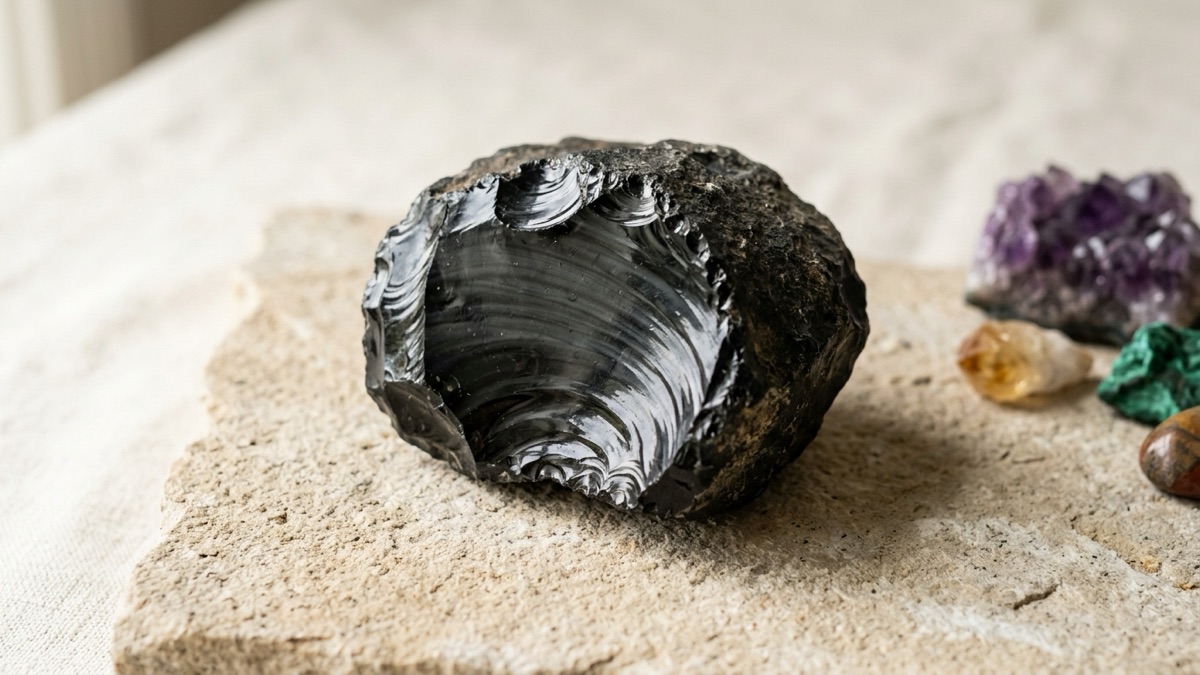
It looks like a chunk of broken black bottle, but you found it on a sagebrush hillside far from any road. The edges are sharp enough to worry about, and the surface shines like a mirror. Chances are you are holding obsidian: glass that a volcano made, no factory required.
Quick answer
Black obsidian is natural volcanic glass, an extrusive igneous rock that formed when silica-rich lava cooled too fast for crystals to grow. Identify it by its glassy shine, smooth shell-shaped (conchoidal) breaks, razor-sharp edges and lack of grains. It is about 5 to 5.5 on the Mohs scale, so it will not scratch glass the way quartz does.
Key takeaways
- Obsidian is a rock made of volcanic glass, not a mineral, because glass has no crystal structure.
- The clues are a glassy luster, curved conchoidal breaks, very sharp edges, no visible grains, and often flow bands or streaks.
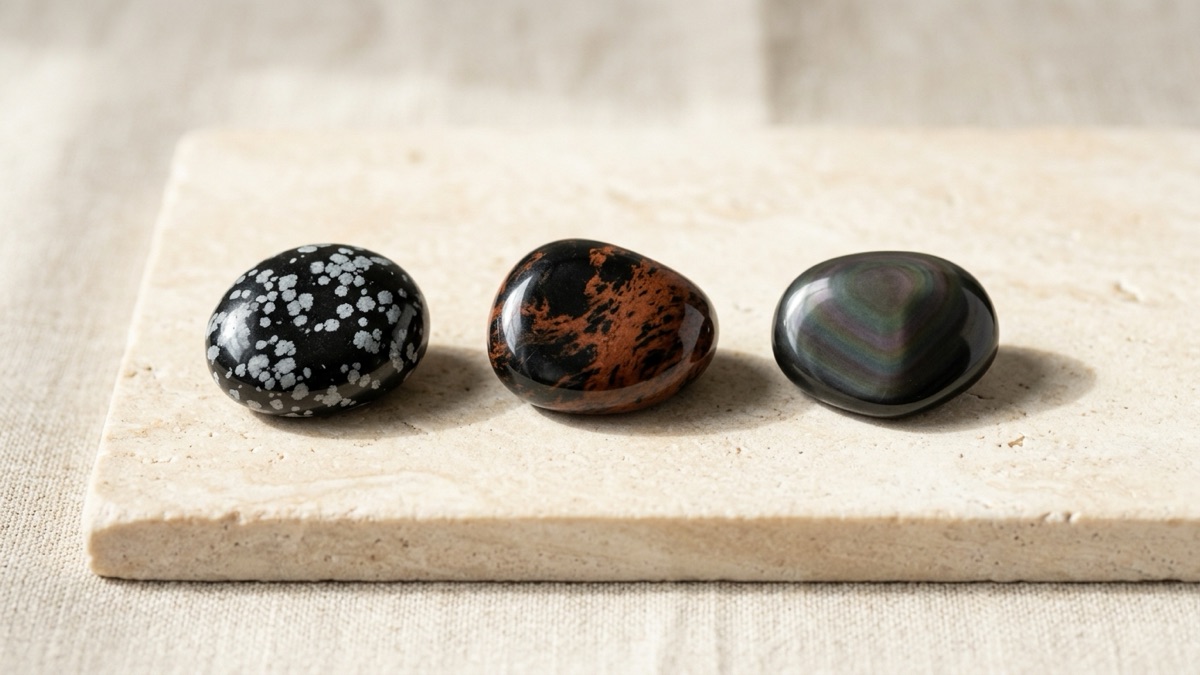
- Snowflake obsidian has white spots of cristobalite, mahogany obsidian swirls black with red-brown, and rainbow and sheen obsidian shimmer because of tiny crystals or flattened bubbles lined up in the glass.
- Man-made glass and slag look similar and have about the same hardness. Bubbles, a magnet and the place you found it are better clues.
- Collect only where it is allowed, such as Glass Butte on BLM land in Oregon, and leave any flaked pieces: they may be artifacts.
What type of rock is obsidian?
Obsidian is an igneous rock, the family that forms from molten rock, and more precisely an extrusive one, meaning it cooled at the surface as lava. The USGS defines it as dense volcanic glass, usually rhyolite in composition and typically black, that forms when lava cools so fast that crystals do not have time to grow.
Rhyolite is the silica-rich volcanic cousin of granite. The University of Auckland explains that rhyolite lava is so viscous it flows "like tooth paste squeezed out of a tube", and in some flows it can collapse into obsidian. The Minerals Education Coalition puts obsidian at about 70 to 75 percent silica.
Why so dark, then? The USGS says tiny crystals of iron oxide give the glass its dark color, and different oxidation states of iron can tint it red, brown or green.
Is it a mineral? No. The University of Auckland defines a mineral as a crystalline solid with a fixed structure, and it files volcanic glass such as obsidian under mineraloids instead. Glass, volcanic or man-made, cools without forming crystals, the USGS explains, and without that structure it breaks in smooth, curved shapes in every direction.
Fun fact
Obsidian does not last forever as glass. The USGS notes that most obsidian is younger than 20 million years, because older obsidian has devitrified, slowly changing from glass into crystalline rock.
How do you identify obsidian?
Check these clues in order.
- Glassy luster. Fresh surfaces shine like window glass. Weathered pieces can look dull or frosted, so check a fresh break.
- Conchoidal fracture. Breaks are smooth, curved and rippled, like the inside of a clam shell. The USGS says those breaks leave edges sharper than the finest steel blades.
- No grains. Look at a broken edge with a 10x lens. You should see smooth glass, with no sparkly crystals or sandy grains.
- Color and banding. Mostly black, sometimes brown, red-brown or gray. The USGS says obsidian is commonly banded or streaked, because the thick, sticky melt did not mix impurities evenly.
- Hardness. About 5 to 5.5, close to window glass. It will not scratch glass cleanly the way quartz does, and a quartz crystal scratches it.
| Property | Obsidian | What it tells you |
|---|---|---|
| Luster | Glassy (vitreous) | Shiny like glass on a fresh break |
| Fracture | Conchoidal | Smooth, curved, shell-like breaks |
| Hardness | About 5 to 5.5 | Similar to glass; softer than quartz |
| Streak | White | Not much help; many minerals streak white |
| Texture | Glass, no grains | Separates it from basalt and other dark rocks |
Oregon State University's Volcano World gives obsidian a typical hardness of 5 to 5.5, against 7 for quartz. Because man-made glass sits in the same range, a scratch test cannot separate the two. Our Mohs hardness test guide shows how to scratch test without fooling yourself.
What are snowflake, mahogany and rainbow obsidian?
A few named varieties turn up often. All of them are still volcanic glass.
- Snowflake obsidian. Black glass with whitish-gray spots. The Utah Geological Survey explains that each spot is a spherulite: a radiating cluster of needle-shaped crystals of cristobalite, a high-temperature form of silica that grew inside the glass.
- Mahogany obsidian. Black and reddish-brown swirled together. Volcano World says red or brown obsidian generally owes its color to tiny crystals of the iron oxides hematite or limonite.
- Rainbow and sheen obsidian. Under direct light, bands of color or a gold or silver shimmer appear. Volcano World explains rainbow colors as microscopic feldspar or mica crystals lined up along flow layers, and gold and silver sheen as tiny gas bubbles stretched nearly flat along those layers.
- Apache tears. Small rounded nodules of obsidian, about an inch or less, found in volcanic areas of the southwestern United States, according to Geology.com.
How do you tell obsidian from slag and black glass?
This is where most mix-ups happen, and hardness will not help: obsidian and man-made glass both sit around 5 to 5.5. Look at texture, shape, magnetism and, above all, where you found it.
| Clue | Obsidian | Slag | Man-made glass |
|---|---|---|---|
| Where found | Volcanic country, near old lava flows | Roadsides, rail beds, landscaping gravel, near old smelters | Beaches, old dumps, farmsteads, landscaping |
| Texture | Smooth glass, often with streaks or flow bands | Many gas bubbles and a rough exterior | Round bubbles and swirly flow lines |
| Shape | Irregular, with fresh shell-shaped breaks | Lumpy, sometimes with flat faces from cooling in a container | Molded curves, even thickness, very even color |
| Magnet | Not a useful clue | Often attracts a magnet | Not a useful clue |
The slag clues come from Washington University in St. Louis, which describes slag as a glassy by-product of smelting with gas bubbles, very rough exteriors, flow features and sometimes flat surfaces from having solidified in a contained space. It is common in road building and landscaping gravel, and many slags attract a fridge magnet because they contain metal. Glassy plus bubbly plus magnetic points to slag.
For man-made glass, the GIA lab found gas bubbles and flow lines in a molded glass imitation, and it notes that colored glass can imitate almost any colored gem. So treat vivid, see-through blue or purple "obsidian" with suspicion. Our guide to rocks that look like glass compares quartz, obsidian and slag side by side.
An honest note: a photo cannot settle obsidian versus a lump of dark furnace glass. Where it was found and how it breaks usually can.
What else looks like black obsidian?
A glass scratch test sorts most dark, shiny impostors.
| Look-alike | How it fools you | The test |
|---|---|---|
| Black tourmaline | Shiny black | Grows as long grooved crystals; at 7 to 7.5 it scratches glass easily |
| Black onyx or chalcedony | Smooth, black, glassy polish | At about 6.5 to 7 it scratches glass; waxy rather than glassy luster |
| Jet or coal | Black and shiny | Much softer (jet is 2.5 to 4) and noticeably light in the hand |
| Hematite | Dark and shiny | Metallic luster and a red-brown streak on a white tile |
| Basalt | Black volcanic rock | Dull, not glassy, with fine grains under a lens |
Try it
Not sure whether your black stone is obsidian, tourmaline or slag? The free rock identifier asks about luster, hardness, texture and magnetism, then suggests likely matches and the test that separates them.
Where can you find obsidian legally?
Obsidian is common in the volcanic West, but who manages the land decides whether you may pick it up. These two sites are on BLM land, where federal rules allow reasonable amounts for personal, noncommercial collecting with hand tools, except where an area is closed or posted. As of September 2026, when we checked the managing agencies' and state surveys' pages:
- Glass Butte, central Oregon. The Oregon Department of Geology and Mineral Industries describes it as a rockhounding site on BLM land along Highway 20 between Bend and Burns.
- Black Spring, Black Rock Desert, Utah. The Utah Geological Survey says obsidian from eruptions about 2.5 million years ago lies on the ground here, mostly black pieces from half an inch to 6 inches, with some reddish-brown and snowflake obsidian. The site is on BLM land, but state trust land and private land are nearby, and marked mining claims are off limits.
Places to look, not collect: the USGS names Obsidian Cliff in Yellowstone National Park, the Big Obsidian Flow at Newberry Crater, Oregon, and Glass Mountain, California, as places to see obsidian flows. National parks ban collecting outright under 36 CFR 2.1, and the Oregon agency says no collecting is permitted in Newberry's national monument. Our rockhounding in Oregon guide covers more of the state's legal spots.
Heads up
People have made tools from obsidian for thousands of years, and the USGS notes it was traded hundreds of miles from its source. Flakes with ripple scars, worked edges or point shapes may be artifacts. The BLM says arrowheads and other stone tools may not be removed from public land, so photograph them and leave them where they lie.
How do you handle obsidian safely?
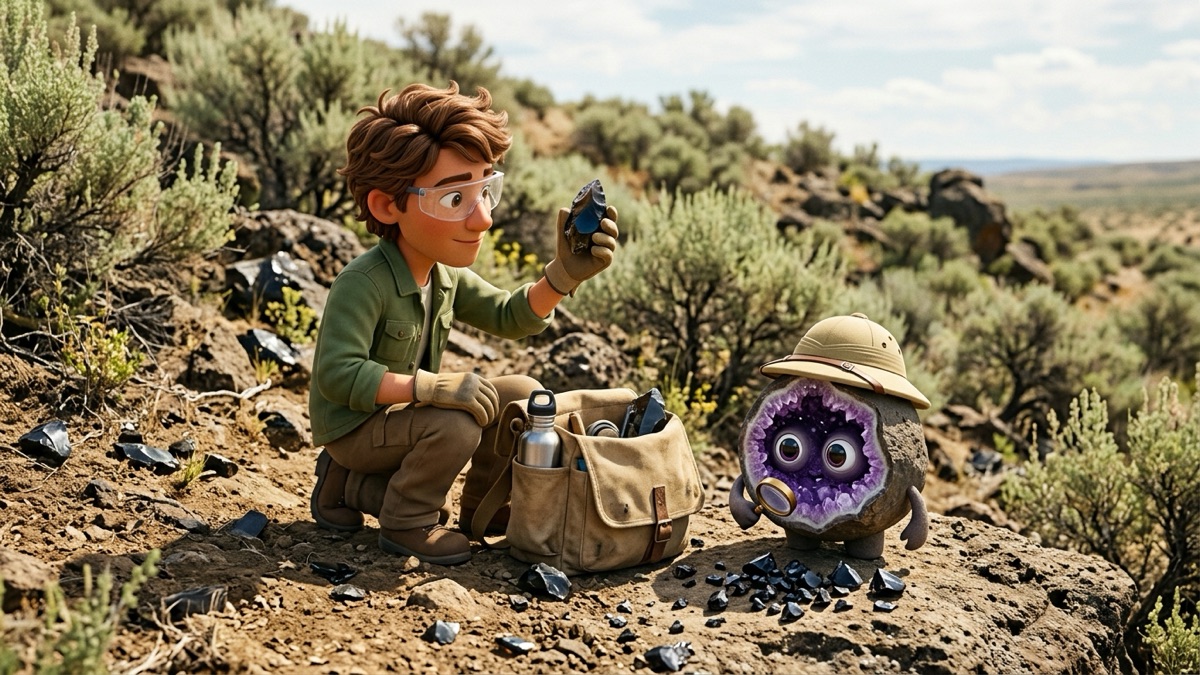
Treat every broken piece like a knife. The Oregon agency notes that obsidian can be flaked to an edge much sharper than any knife or razor.
- Wear gloves when picking through piles, and carry pieces wrapped in cloth or newspaper.
- Wear safety glasses if you break or chip anything: flakes fly.
- In the desert, carry more water than you think you need and watch for rattlesnakes, as the Utah survey reminds collectors.
Wondering if your piece is worth anything? Our guide to obsidian value covers what collectors and carvers look for. For more on the quartz family of stones, from agate to jasper, see the agate stone hub.
The RockhoundID app for Android suggests likely matches from a photo and tells you which test confirms them.
The takeaway
Black obsidian is lava that froze before it could crystallize: a rock made of glass. Look for a glassy shine, curved shell-shaped breaks, knife-sharp edges and no grains, and expect it to be about as hard as window glass. Snowflakes, mahogany swirls and rainbow sheen are all still obsidian. When a glassy lump turns up by a road or rail line full of bubbles and tugging at a magnet, think slag. And when you go looking, stay on land where collecting is allowed and leave the artifacts for the next person to wonder about.
The pictures in this guide are AI-generated illustrations of what to look for; real specimens vary, so trust the tests over any picture. RockhoundID guides help you narrow down what you found. They suggest likely candidates, not certain identifications or appraisals. For anything valuable, rare or possibly from space, ask a museum, a university geology department or your state geological survey, and check the collecting rules for the land before you take anything home.
Questions rockhounds ask
What type of rock is obsidian?
Obsidian is an extrusive igneous rock: natural volcanic glass that formed when lava cooled too fast for crystals to grow. It is usually rhyolite in composition, rich in silica, even though it looks black.
Is obsidian a mineral?
No. Minerals are crystalline, and obsidian is glass, which has no crystal structure. Geologists call volcanic glass a mineraloid, and obsidian as a whole is classed as a volcanic (extrusive igneous) rock.
What is snowflake obsidian?
Black obsidian with whitish-gray spots. The Utah Geological Survey explains that each spot is a spherulite, a radiating cluster of needle-shaped cristobalite crystals, a high-temperature form of silica that grew inside the glass.
How can you tell obsidian from man-made glass?
Hardness will not help, since both are about 5 to 5.5. Look instead for natural flow bands, snowflakes or sheen, and for where it was found. Many gas bubbles, a rough surface and a pull on a magnet point to slag; molded shapes, even color and round bubbles point to man-made glass.
Where can you collect obsidian legally?
Glass Butte in central Oregon and the Black Spring area of Utah's Black Rock Desert are on BLM land, where reasonable amounts may be collected for personal use. National parks and monuments such as Yellowstone and Newberry allow no collecting.
Where these facts come from
- USGS Volcano Hazards Program glossary: obsidian: www.usgs.gov/glossary/volcano-hazards-program-glossary
- USGS Volcano Watch: Obsidian, a scarce commodity in Hawaii: www.usgs.gov/news/volcano-watch-obsidian-a-scarce-commodity-hawaii
- Minerals Education Coalition: Obsidian: mineralseducationcoalition.org/minerals-database/obsidian/
- Oregon State University, Volcano World: Obsidian (Jim Miller): volcano.oregonstate.edu/volcanic-minerals/obsidian
- Geology.com (Hobart M. King): Obsidian: geology.com/rocks/obsidian.shtml
- Utah Geological Survey: The Rockhounder, Obsidian in the Black Rock Desert, Millard County: geology.utah.gov/popular/rocks-minerals/rock-mineral-collecting-sites/obsidian-b
- Oregon Department of Geology and Mineral Industries: Fossils, minerals and gems: www.oregon.gov/dogami/learnmore/Pages/fossilsmineralsgems.aspx
- University of Auckland, minerals: definition of a mineral (mineraloids): rocksminerals.flexiblelearning.auckland.ac.nz/minerals/index.html
- University of Auckland, rocks: Rhyolite: rocksminerals.flexiblelearning.auckland.ac.nz/rocks/rhyolite.html
- Washington University in St. Louis meteorite site: Slag: sites.wustl.edu/meteoritesite/items/slag/
- GIA Gems & Gemology, Fall 2021 Lab Notes: Glass imitation of star sapphire: www.gia.edu/gems-gemology/fall-2021-glass-imitation-star-sapphire
- BLM: Can I keep this?: www.blm.gov/learn/can-i-keep-this
- eCFR: 43 CFR 8365.1-5, rockhounding on BLM public lands: www.ecfr.gov/current/title-43/subtitle-B/chapter-II/subchapter-H/part-8360/subpa
- eCFR: 36 CFR 2.1, preservation of natural resources in national parks: www.ecfr.gov/current/title-36/chapter-I/part-2/section-2.1