
Real vs Fake Turquoise: 7 Tests You Can Do at Home
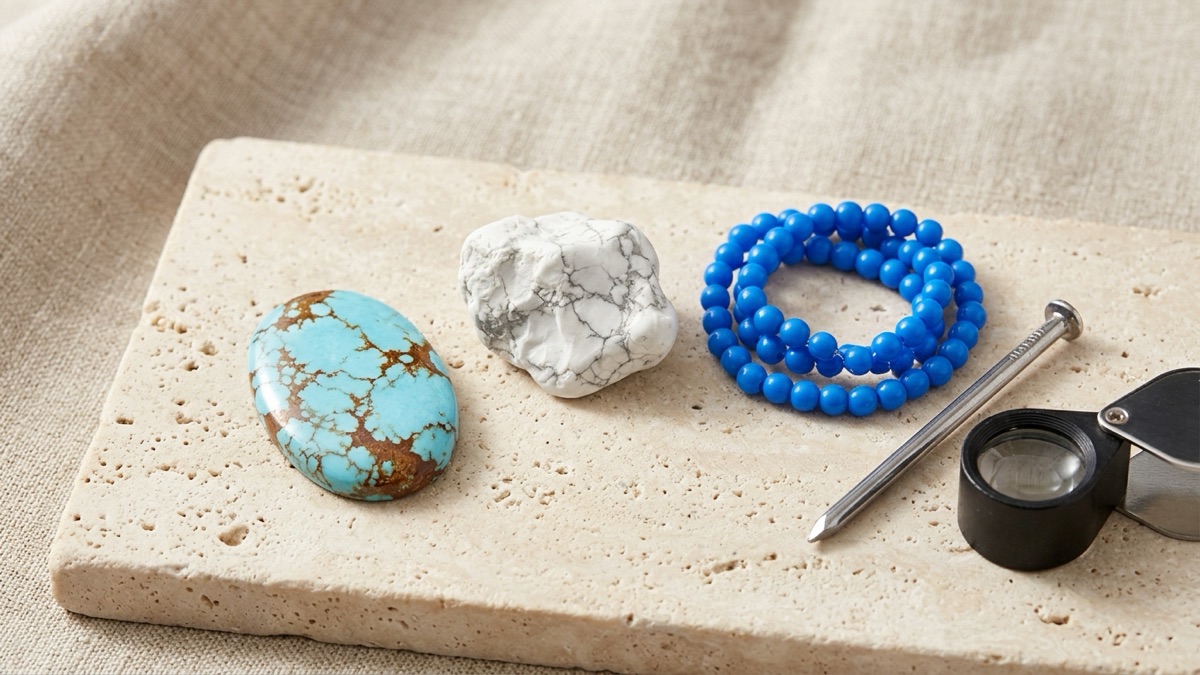
A market stall, an estate ring, a strand of chunky blue beads that cost almost nothing. Turquoise is one of the most imitated gems on earth, and one of the most treated. The good news: most fakes give themselves away to a loupe, a steel point and a little common sense.
Quick answer
Real turquoise is blue to green all the way through, has a waxy to dull luster, rates 5 to 6 on the Mohs scale and feels solid for its size. Dyed howlite scratches easily and shows white underneath, plastic is light and warm, glass has bubbles. Stabilized stone is still turquoise; only a gem lab can confirm treatment.
Key takeaways
- "Real" has layers: natural, stabilized and reconstituted turquoise are all sold as turquoise, and GIA says all treatments should be disclosed.
- The three big fakes are dyed howlite or magnesite, plastic and glass. Each fails a different simple test.
- Test only a hidden spot or the unpolished back, and never scratch, swab or heat a stone you value.
- Turquoise rates 5 to 6 (GIA), howlite 3.5 and magnesite 3.5 to 4.5 (Handbook of Mineralogy), so a steel point sorts them fast.
- No home test proves a stone is natural and untreated. That takes a gemologist's instruments.
What does "real turquoise" even mean?
Turquoise is a hydrated copper and aluminum phosphate that forms where acidic, copper-rich groundwater seeps through dry rock, which is why the classic sources are deserts (GIA). It is porous, built from microscopic crystals packed into a solid mass. Fine-grained material takes a waxy polish; coarse material stays dull. The brown or black veins are matrix, leftover host rock: limonite makes dark brown marks, sandstone makes tan ones.
Because most turquoise is soft and porous, most of it is treated. GIA lists turquoise among the gems most often impregnated with polymer, wax or plastic, and its buying guide says plainly that turquoise is commonly treated to improve stability and color. A 2009 Arizona Daily Star story quoted the operator of the Kingman mine saying only about 3 percent of the turquoise from that mine is hard enough to skip processing.
So the market has tiers, and the honest ones are labeled:
| Term | What it is | Still turquoise? |
|---|---|---|
| Natural | Cut and polished, nothing added | Yes |
| Stabilized | Natural stone impregnated with resin or polymer (USGS describes pressure impregnation with hot acrylic resin) | Yes, treated |
| Reconstituted or block | Turquoise powder and fragments bonded with resin into blocks | Mostly binder; disclose it |
| Dyed or color-enhanced | Stabilized stone with added dye | Yes, treated |
| Imitation | Dyed howlite or magnesite, plastic, glass, ceramic | No |
| Synthetic | Lab-made material; GIA notes Gilson introduced an imitation turquoise in the early 1970s | No, not natural |
The tests below sort real from fake. Sorting natural from stabilized is a lab job, and we cover that at the end. Our gemstone identification guide explains the same rough-versus-cut logic for other stones.
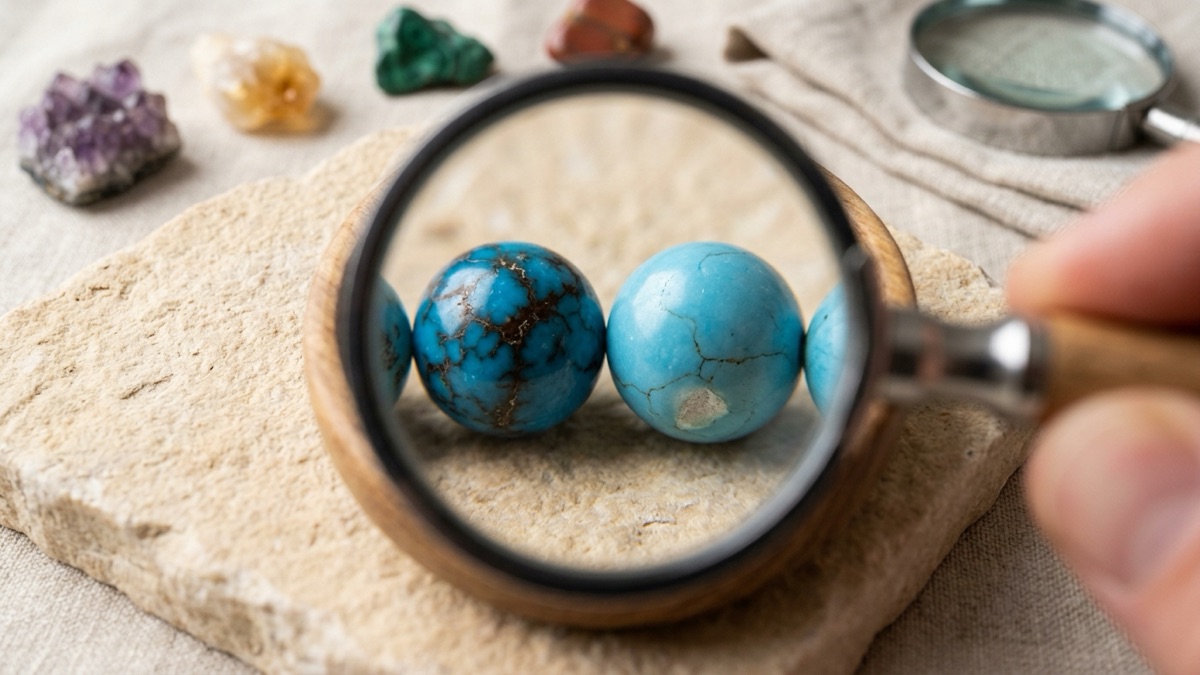
Test 1: What does a 10x loupe show?
Start with the cheapest tool and the least risk. Look at the face, the back and any drill holes.
- Round bubbles and swirls mean glass or plastic. GIA lab notes on glass imitations describe trapped gas bubbles and flow lines; plastics show bubbles and swirl marks.
- A mold seam running around a bead or cabochon means it was cast, not cut.
- Color pooled in cracks with paler flat areas is the signature of dye. GIA notes that dye enters porous or fractured material, and a quench-crackled, dyed look is easy to see under magnification.
- Matrix that looks painted on (flat, sitting on top of the surface, identical from bead to bead) is a decoration, not host rock.
- Real matrix dips into the stone, has depth and varies from piece to piece. On natural stone the matrix on the back often stays rough and unpolished; a Heritage Auctions condition note on a 2025 turquoise ring describes exactly that.
Test 2: Does a steel point scratch it?
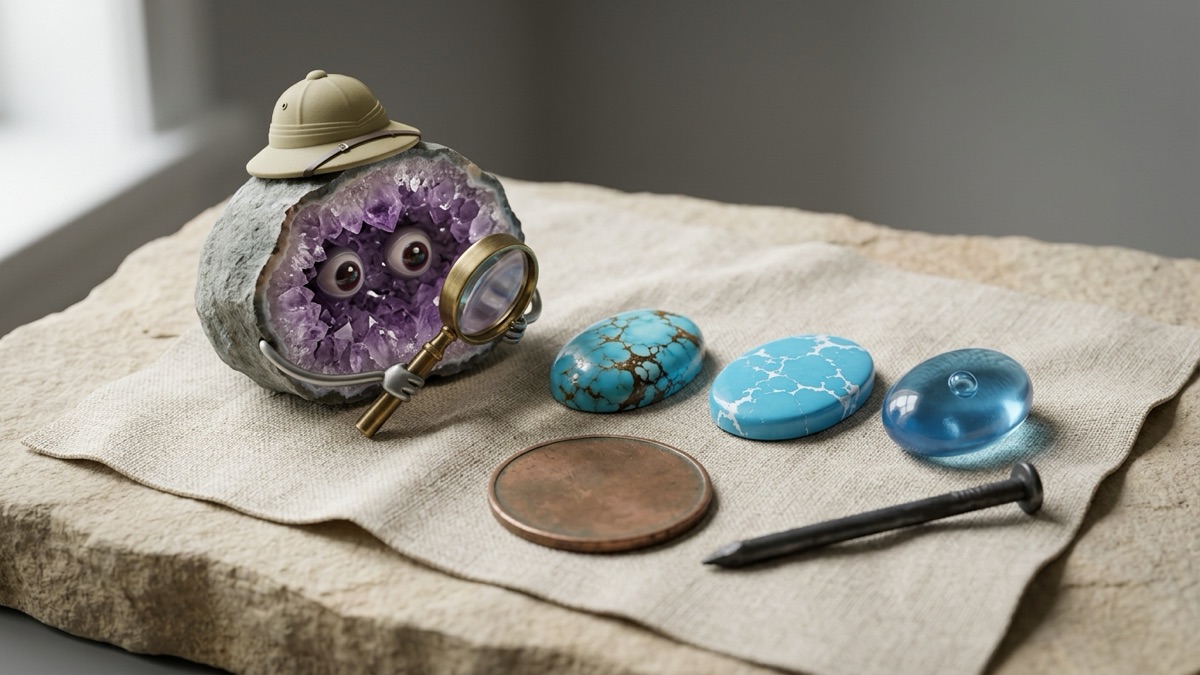
Turquoise rates 5 to 6 on the Mohs scale (GIA), which puts it right at window glass and a steel knife blade (both about 5.5). So a steel point may leave a faint mark on softer turquoise, or none at all on hard stone, and either result is fine. What matters is what happens to the fakes:
| Material | Mohs hardness | What a scratch shows |
|---|---|---|
| Turquoise | 5 to 6 | Little or no mark; blue or green under any scratch |
| Howlite | 3.5 | Scratches easily; white powder |
| Magnesite | 3.5 to 4.5 | Scratches easily; white |
| Plastic | Soft | Gouges; can smell of plastic |
| Glass | about 5.5 | Similar to turquoise, so rely on bubbles and cold feel instead |
Only test rough stone or the unpolished back of a loose cabochon, on a spot smaller than a pinhead, and never a set stone, a bead you love or anything you might sell. A proper scratch test uses a fresh point and a light touch.
Try it
The free Mohs hardness scale lists turquoise, howlite and the everyday testers, and its scratch simulator shows what a knife, a coin and glass will and will not mark.
Test 3: What color is it underneath?
Howlite and magnesite are white minerals (Handbook of Mineralogy). Dye colors only the outer skin and the cracks. So look wherever the surface is broken: a chip, a drill hole, the flat back of a bead. A white core under a blue skin ends the conversation.
Turquoise is blue or green through and through. Its streak (the powder it leaves on unglazed tile) is white to pale greenish blue, so a streak test does not settle the question by itself, but the color under a scratch does.
Test 4: Does acetone lift the color?
GIA notes that some dyes come off with acetone or alcohol. Dip a cotton swab in nail polish remover, touch it to a hidden spot for a few seconds and look at the swab. Blue on the cotton means dye.
Heads up
GIA also warns that solvents can damage the treated surfaces of stabilized turquoise, so acetone can leave a dull spot on a real, treated stone. Use it only on the back, on a tiny area, in a ventilated room, and never on a piece you value. A negative result does not prove natural: many stabilized stones carry no dye at all.
Test 5: How heavy is it for its size?
Turquoise has a specific gravity of about 2.76 (GIA), so a stone weighs close to 2.8 times as much as the same volume of water. Plastic imitations that GIA has tested in its lab came in at about 1.2 to 1.4. That is roughly half the weight for the same size, and your hand can feel it. Plastic also warms quickly in your palm; stone and glass stay cool longer.
Howlite (2.53 to 2.59) sits close enough to turquoise that heft cannot separate them, which is why Tests 2 and 3 exist. Magnesite is a little heavier at 3.00. Weight in the hand is one of the seven checks in our rock identification method, and it works on gems too.
Test 6: The hot needle, if you must
A hot needle touched to plastic burns it and releases a strong, acrid smell; GIA describes exactly that reaction in a lab note on a plastic imitation. Turquoise does not burn. But GIA also says high heat can discolor turquoise and damage treated surfaces, and burning plastic fumes are unpleasant to breathe.
Treat this as a last resort for a cheap bead when Tests 1 and 5 have not settled it. Hidden spot, open window, one brief touch, and never on jewelry you care about.
Test 7: Ask, and read the price
GIA's buying guide says to buy from a jeweler you trust and that all treatments should be disclosed. So ask the three questions: Is it natural, stabilized or reconstituted? Is it dyed? Where is it from? A seller who cannot answer the first question is telling you something.
Price is a clue too. Turquoise is still mined, so cheap turquoise exists, but a strand of big, flawless, matrix-free "natural" beads for the price of lunch is almost certainly dyed howlite, magnesite or block. Our guide to what turquoise is worth has dated sales to compare against.
Which look-alikes fool people most?
GIA's buying guide lists the usual imitations: plastic, glass, dyed howlite, variscite, amazonite and pectolite, plus synthetic turquoise. USGS adds variscite and faustite as natural minerals sometimes mistaken for turquoise. A few notes from the field:
- Dyed howlite and magnesite are the big ones, sold as "turquoise howlite" or under invented names. White inside, soft, dye in the cracks.
- Plastic is light, warm and often too perfect, with a seam. GIA notes it is not a durable imitation.
- Glass can be any color; look for bubbles and a glassy luster where turquoise would be waxy.
- Variscite is a real green mineral that overlaps turquoise in color. It is a legitimate gem, just a different one, and separating the two is lab work.
- Chrysocolla and other blue-green copper minerals turn up in the same copper country. Our blue rocks guide sorts them.
Fun fact
Turquoise takes its name from the French word for Turkey, because Iranian stone reached Europe through Turkish traders (Handbook of Mineralogy). GIA notes that Egyptian turquoise artifacts date to about 4000 BC.
What can only a gem lab tell?
Home tests catch imitations. They do not prove a stone is natural. A gemologist measures refractive index (turquoise reads 1.610 to 1.650, GIA) and specific gravity, examines the stone under a microscope and uses infrared spectroscopy to detect the resins and polymers used in stabilization and reconstitution. GIA says a qualified gemologist can in most cases readily identify impregnation, and a GIA colored stone report states whether the stone is natural or synthetic and lists any detectable treatments.
Even big auction houses defer here: Heritage Auctions noted on a 2025 turquoise ring that the stone was "not tested for origin of color or treatment." If you are paying natural-turquoise money, ask for a lab report rather than a promise.
The RockhoundID app for Android suggests likely matches from a photo and tells you which test confirms them, but no photo can see a resin.
The takeaway
Look with a loupe, scratch a hidden spot, check for white underneath, feel the weight, and ask the seller what was done to the stone. Those steps catch dyed howlite, plastic and glass at home. Whether a real turquoise is natural or stabilized is a question for a gemologist, and for anything you plan to pay real money for, that report is worth having.
The pictures in this guide are AI-generated illustrations of what to look for; real specimens vary, so trust the tests over any picture. RockhoundID guides help you narrow down what you found. They suggest likely candidates, not certain identifications or appraisals. For anything valuable, rare or possibly from space, ask a museum, a university geology department or your state geological survey, and check the collecting rules for the land before you take anything home.
Questions rockhounds ask
Is stabilized turquoise real turquoise?
Yes. Stabilized turquoise is natural turquoise that has been soaked with a resin or polymer so it is harder and keeps its color. It is real turquoise with a treatment, which should be disclosed and is worth less than untreated stone of the same look. Reconstituted turquoise is powder and resin pressed into blocks, which is a different thing.
How can you tell dyed howlite from turquoise?
Howlite is white with gray veins and has a hardness of only 3.5, so a steel point scratches it easily and the scratch shows white. Dye sits near the surface, so chips and drill holes look white inside, and a swab of acetone on a hidden spot often lifts blue color off. Turquoise is blue or green all the way through and rates 5 to 6.
Does real turquoise scratch easily?
Not very. Turquoise rates 5 to 6 on the Mohs scale, about the same as window glass and a steel knife, so a knife point may or may not mark it. Anything a copper coin or fingernail scratches is not turquoise. Test only rough or the unpolished back of a stone, never the face of a finished piece.
Is the hot needle test safe for turquoise?
Only as a last resort, on a hidden spot, and never on a stone you value. Heat can discolor turquoise and damage stabilized surfaces, and burning plastic gives off fumes. Weight, hardness and a loupe usually answer the plastic question without any heat.
What can a gem lab tell about turquoise that I cannot?
A lab can measure refractive index and specific gravity, spot resin and polymer with infrared spectroscopy, and separate natural stone from synthetic and imitation material. A GIA colored stone report states whether a stone is natural or synthetic and lists any detectable treatments.
Where these facts come from
- GIA: Turquoise (properties): www.gia.edu/turquoise
- GIA: Turquoise description: www.gia.edu/turquoise-description
- GIA: Turquoise care and cleaning: www.gia.edu/turquoise-care-cleaning
- GIA: Turquoise buying guide (PDF): 4cs.gia.edu/wp-content/uploads/2014/12/Tourquoise-Buying-Guide.pdf
- GIA: An introduction to gem treatments: www.gia.edu/gem-treatment
- GIA: An introduction to simulants or imitation gem materials: www.gia.edu/gem-imitation
- GIA Gems & Gemology, Spring 2018 Lab Notes: New plastic imitation opal from Kyocera (hot point and specific gravity of a plastic imitation): gia.edu/gems-gemology/spring-2018-labnotes-new-plastic-imitation-opal-from-kyoce
- GIA Gems & Gemology, Winter 2022: Identification of natural, reconstructed and imitation root amber (specific gravity of plastic imitations): gia.edu/gems-gemology/winter-2022-gemnews-identification-of-natural-reconstructe
- GIA Gems & Gemology, Fall 2021 Lab Notes: Glass imitation of star sapphire (gas bubbles and flow lines in glass): www.gia.edu/gems-gemology/fall-2021-glass-imitation-star-sapphire
- GIA Gems & Gemology, Spring 2017: Plastic amber imitation rosary (bubbles and swirl marks in plastic): www.gia.edu/gems-gemology/spring-2017-gemnews-plastic-amber-imitation-rosary
- GIA: Colored stone reports and services: www.gia.edu/gem-lab-service/colored-stone-analysis-report-service
- USGS Minerals Information archive: Turquoise (SP 14-95): apps.usgs.gov/minerals-information-archives/gemstones/sp14-95/turquoise.html
- Handbook of Mineralogy: Turquoise: www.handbookofmineralogy.org/pdfs/turquoise.pdf
- Handbook of Mineralogy: Howlite: www.handbookofmineralogy.org/pdfs/howlite.pdf
- Handbook of Mineralogy: Magnesite: www.handbookofmineralogy.org/pdfs/magnesite.pdf
- Arizona Daily Star (tucson.com): Only 2 Ariz. operations mine for gem year-round (October 2009): tucson.com/business/article_71b58b5e-5733-5164-9cf7-cfee5935675e.html
- Heritage Auctions: Turquoise, diamond, platinum ring, lot 11048 (November 2025), condition note: jewelry.ha.com/itm/estate-jewelry/rings/turquoise-diamond-platinum-ring/a/23219-
Read next
identification
How to Identify Rocks: 7 Simple Tests and a Free Tool
identification
Rock Identification Chart: Match Your Find in 5 Steps
identification
Crystal Identification: Chart and 4 Quick Tests at Home
identification
Streak Test for Minerals: Definition and Color Chart
identification
How to Tell If Amber Is Real: Salt Water, UV and More
