How Much Is Turquoise Worth? Grades, Mines and Treatments
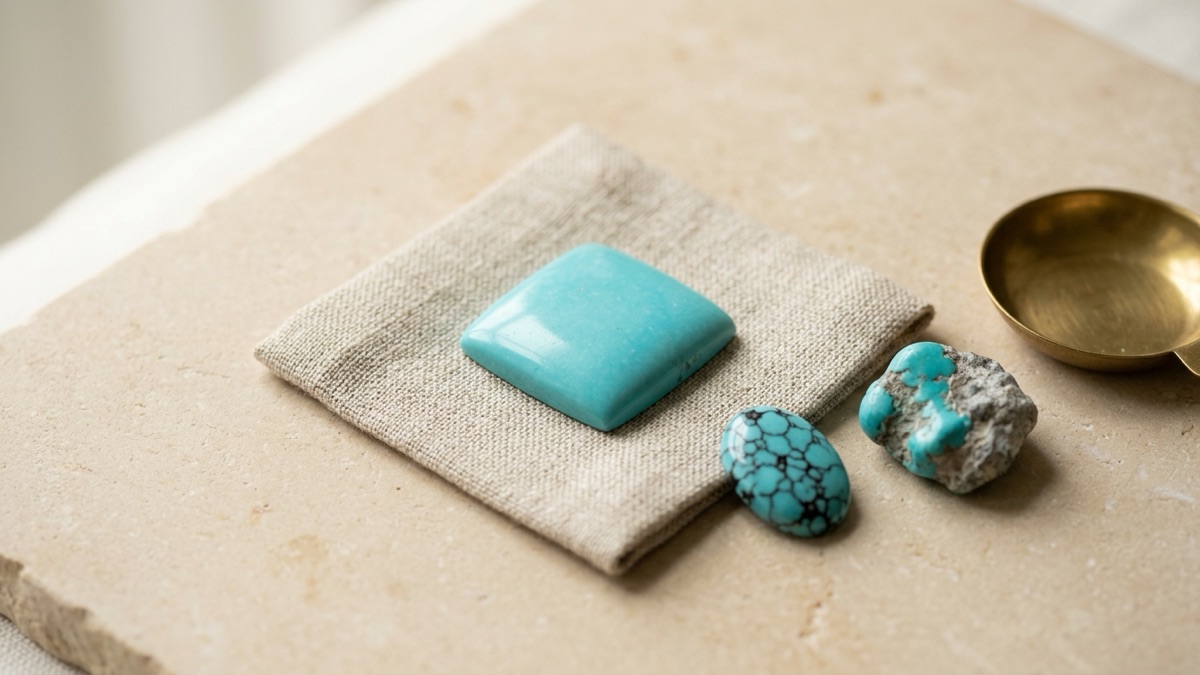
You have a turquoise ring from a grandparent, a bag of nuggets from a rock shop, or a cabochon you cut yourself. The internet will tell you it is worth anywhere from pocket change to a used car. Here is what real sales say, and what actually moves the number.
Quick answer
Turquoise sells across a wide range, from a few dollars a carat for common stabilized stone to far more for fine natural material. As of September 2026, verified sales ran from $100 for a 19 carat Kingman cabochon (Mineral Auctions, July 2025) to $2,000 for a 40 carat Sleeping Beauty cabochon (Bonhams, December 2016). Even color, little matrix and no treatment set the price.
Key takeaways
- GIA ranks turquoise on color, texture and matrix. The most valuable stone is an even, intense medium blue with no matrix and a good polish.
- Treatment matters as much as color. Most turquoise is stabilized, and treated stone sells for less than natural stone of the same look.
- Real sales, dated: $100 for a 19 carat Kingman cabochon (July 2025) and $167 for a 15.55 carat matched pair (May 2025) at Mineral Auctions; $2,000 for a 40 carat Sleeping Beauty cabochon at Bonhams (December 2016).
- Mine names such as Sleeping Beauty, Kingman and Nevada's small "hat mines" add interest, but GIA says pricing is primarily about quality, not origin.
- Nobody can value a stone from a photo. For real money, get a gem lab report and an independent appraiser.
What decides what turquoise is worth?
GIA judges turquoise on three things: color, texture and the presence or absence of matrix. Treatment sits on top of all three.
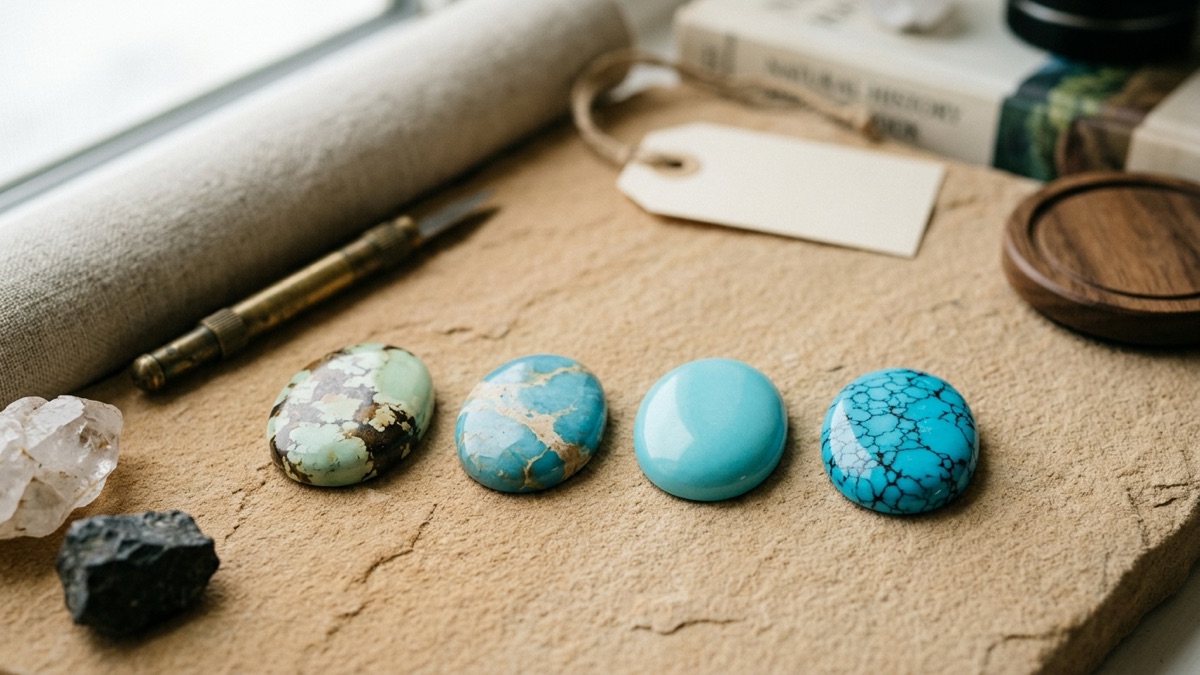
Color. The prize is an even, intense, medium blue, called robin's egg blue or Persian blue in the trade. Green turquoise is generally less valued, though GIA notes some designers actively seek unusual green hues for inlay, so taste plays a part. Evenness counts: GIA says that for any size, the quality and evenness of the color is the overriding value factor.
Matrix. Matrix is leftover host rock: limonite makes dark brown veins, sandstone makes tan ones (GIA). Stone with no matrix is most valuable and large matrix-free pieces are rare. Spiderweb turquoise, with fine, even, web-like seams of dark matrix, is the exception that collectors pay up for.
Texture. Fine-grained turquoise takes a waxy polish; coarse, porous stone stays dull and usually gets treated to make it more marketable (GIA).
Treatment. Turquoise is commonly treated for stability and color. GIA lists it among the gems most often impregnated with polymer, wax or plastic, and says price differences for similar-looking stones come down to color, matrix and whether the material is treated. Our guide to real vs fake turquoise explains natural, stabilized and reconstituted stone and how to tell them apart.
Size. Turquoise is weighed in carats, and five carats make one gram (GIA). Big, clean pieces are rare, so price per carat rises with size, but a large coarse stabilized nugget is still a cheap nugget.
What has turquoise actually sold for?
Prices below are real results from auction houses, with dates, as of September 2026. They are examples, not a price list.
| What sold | Where and when | Price |
|---|---|---|
| Kingman, Arizona freeform cabochon, 19.14 carats, strong blue with veins, treatment not stated | Mineral Auctions, closed July 2025 | $100 |
| Matched pair of pear cabochons labeled "Arizona," 15.55 carats total, saturated even blue | Mineral Auctions, closed May 2025 | $167 |
| Sleeping Beauty Mine pear cabochon, about 40.22 carats, even robin's egg blue | Bonhams, Los Angeles, December 2016 | $2,000 including premium |
A few things to read out of that table:
- Per carat, those results run from about $5 to about $50, and the difference is almost all color, evenness and the mine's reputation.
- The Bonhams stone is nearly ten years old as a data point, and Bonhams itself wrote that turquoise had "become increasingly expensive and rare." Prices for a closed mine can move; treat it as a ceiling for a fine single cabochon, not a rule.
- Heritage Auctions sold a large platinum and diamond ring with a 19 by 14.5 mm robin's egg blue turquoise cabochon in November 2025, but the realized price is only shown to logged-in members, so we do not quote it. The lot note is still useful: the turquoise was "not tested for origin of color or treatment," which is normal at auction and a reminder that a lab report is your job, not the seller's.
- Beads, chips and small stabilized cabochons trade for far less than any of these. Sold in strands and lots, they are decorative material, not investment pieces.
For context on how turquoise compares with other stones people bring us, see our hub on rocks worth money and our guides to jade value and the most valuable minerals.
Which mines matter, and why?
Mine names sell turquoise. GIA's buying guide is blunt about what they are worth: fine turquoise from historical sources such as Iran, New Mexico and Arizona can command a small premium from collectors, but pricing is primarily based on quality, not origin. With that said, these are the names you will hear.
Nishapur, Iran. The traditional source of "Persian" turquoise (GIA). USGS notes that "Persian" now describes a quality grade more than a place of origin.
Sleeping Beauty, Globe, Arizona. GIA singles out this mine for turquoise with smooth, even color. Bonhams noted in 2016 that the mine had closed in 2012 when its owners chose to concentrate on copper. Finite supply is part of why the name carries a premium.
Kingman, Arizona. The Colbaugh family has mined turquoise at Mineral Park northwest of Kingman since 1962, according to the Arizona Daily Star, which in 2009 named it one of only two year-round turquoise operations in the state. The same story quoted the operator saying only about 3 percent of its turquoise is hard enough to skip processing, which tells you how common stabilization is.
Nevada. USGS's turquoise review describes Nevada as a major producer since the 1930s, with an estimated 75 to 100 mines, and the largest US producer until the early 1980s. Heritage Auctions' description of a Blue Diamond Mine specimen (Lander County) calls it a "hat mine," a small deposit that could be covered by a hat, discovered in the 1930s with peak production in the 1960s and 1970s. Even that specimen, offered in August 2024, was stabilized, which Heritage called "a common practice for the variety."
New Mexico. USGS says New Mexico was the largest US producer until the 1920s, from districts such as Cerrillos Hills and the Burro Mountains, and that production has essentially ceased.
Heads up
A mine name on a tag is a claim. Origin cannot be read from the stone by eye, and GIA says its lab gives origin opinions only for certain gems. Buy the stone in front of you, not the story.
How much do treatments cut the price?
GIA does not publish discounts, and neither will we invent one. What the sources do say:
- Natural, untreated turquoise is the scarcest tier, and GIA's buying guide says if you want it, make sure your jeweler has the gemological expertise to identify treatments.
- Stabilized turquoise (impregnated with resin) is real turquoise and is the bulk of what is sold; USGS describes stabilization as pressure impregnation with hot acrylic resin.
- Reconstituted or "block" material is powder and fragments bonded into blocks (USGS). It sells as a craft material.
- Dyed stone and outright imitations (dyed howlite, plastic, glass, and synthetic turquoise) are worth their weight as beads.
So the same-looking cabochon can sit in four price tiers. The only way to know which tier you hold is a gem lab test.
How do you get a real appraisal?
Three steps, in order.
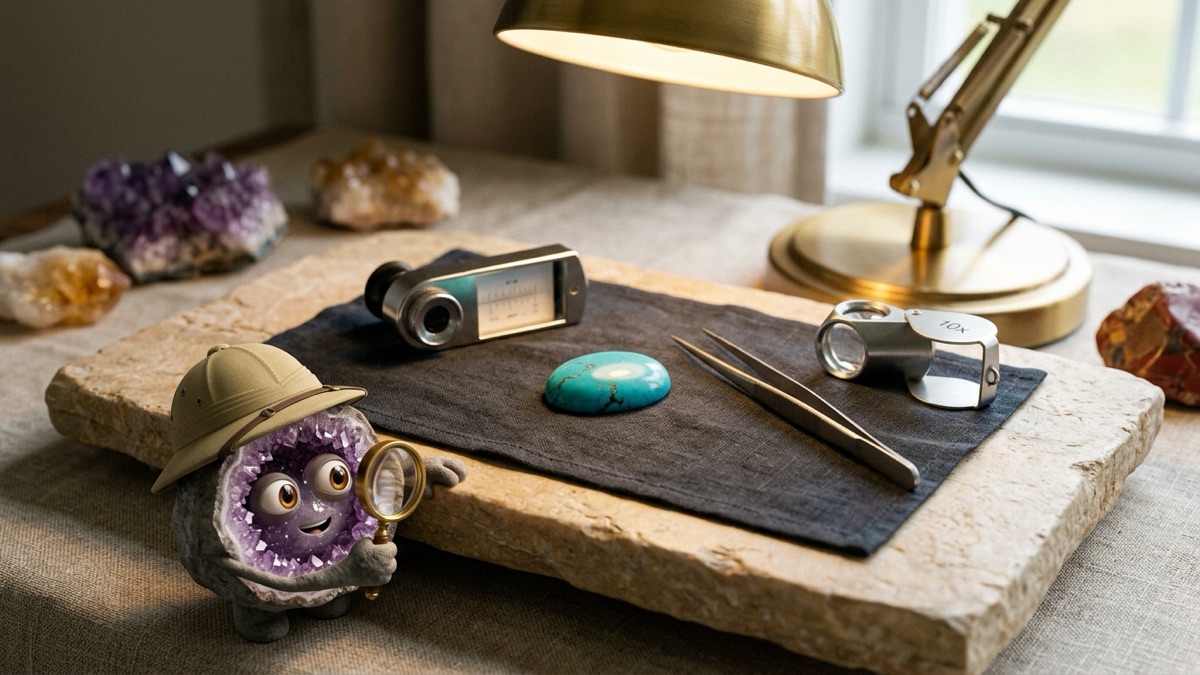
- Identify it. A gemologist measures refractive index (turquoise reads 1.610 to 1.650, GIA) and specific gravity (about 2.76), checks it under the microscope and looks for resin with infrared spectroscopy. A GIA colored stone report states whether the stone is natural or synthetic and lists any detectable treatments.
- Appraise it. Use an independent appraiser who is trained as a gemologist and is not offering to buy the piece. The American Society of Appraisers keeps a searchable directory. Say what the appraisal is for (insurance replacement and fair market value are different numbers).
- Sell it right. For a fine natural stone, an auction house or a specialist dealer will reach collectors. For beads and small stabilized cabochons, a local show or rock shop is realistic.
Try it
Not sure the blue stone is turquoise at all? The free rock identifier walks through luster, hardness and streak and suggests likely candidates, with turquoise and its common look-alikes in its list.
Where does turquoise come from, and can you collect it?
Turquoise forms in the alteration zones of copper deposits in dry country (Handbook of Mineralogy), which is why Arizona, Nevada and New Mexico dominate US production and why so much of it is a byproduct of copper mining (USGS). Working copper mines and turquoise claims are private, and no amount of enthusiasm gets you past the gate.
On unclaimed BLM land, the rule (43 CFR 8365.1-5) allows collecting reasonable amounts of rocks, mineral specimens and semiprecious gemstones for noncommercial use, except where posted or in developed recreation sites, and never on someone's active claim. Check with the local BLM field office before you go, and read our guide to rock collecting rules for state parks, national forests and private land. National parks allow no collecting at all.
The RockhoundID app for Android suggests likely matches from a photo and tells you which test confirms them, but it will never put a price on a stone.
The takeaway
Turquoise value is a spread, not a number. Even blue, little or no matrix, a fine texture and no treatment push a stone toward the top of the range; green tones, heavy matrix, coarse texture and stabilization pull it down. The dated sales above give you real anchors, a gem lab tells you which tier your stone is in, and an independent appraiser turns that into a figure you can act on.
The pictures in this guide are AI-generated illustrations of what to look for; real specimens vary, so trust the tests over any picture. RockhoundID guides help you narrow down what you found. They suggest likely candidates, not certain identifications or appraisals. For anything valuable, rare or possibly from space, ask a museum, a university geology department or your state geological survey, and check the collecting rules for the land before you take anything home.
Questions rockhounds ask
How much is turquoise worth per carat?
There is no single per-carat price. As of September 2026, the most recent sales we could verify ran from about $5 a carat for a 19 carat Kingman cabochon sold at Mineral Auctions in July 2025 to about $50 a carat for a 40 carat Sleeping Beauty cabochon sold at Bonhams in December 2016. Color, matrix, treatment and size move the price far more than weight alone.
Is natural turquoise worth more than stabilized turquoise?
Yes, for the same look. GIA says price differences depend on the quality of the color, the presence of matrix and whether the material is treated, and that all treatments should be disclosed. Stabilized turquoise is still real turquoise, but it sells for less than untreated stone.
Is Sleeping Beauty turquoise valuable?
It is sought after for its smooth, even blue, which GIA singles out, and Bonhams noted that the Globe, Arizona mine stopped producing turquoise in 2012. A 40 carat Sleeping Beauty cabochon sold for $2,000 at Bonhams in December 2016. Small pieces and beads sell for far less.
Does the mine a turquoise came from change its value?
A little. GIA's buying guide says fine turquoise from historical sources such as Iran, New Mexico and Arizona can command a small premium from collectors, but pricing is primarily based on quality, not origin. A named mine on a stone without paperwork is a claim, not a fact.
How do I get turquoise appraised?
Use an independent appraiser who is a trained gemologist, for example through the American Society of Appraisers directory, and ask for a gem lab identification report if you want treatment confirmed. A dealer who wants to buy the stone is not an appraiser.
Where these facts come from
- GIA: Turquoise quality factors: www.gia.edu/turquoise-quality-factor
- GIA: Turquoise buying guide (PDF): 4cs.gia.edu/wp-content/uploads/2014/12/Tourquoise-Buying-Guide.pdf
- GIA: Turquoise (properties and history): www.gia.edu/turquoise
- GIA: Turquoise description: www.gia.edu/turquoise-description
- GIA: An introduction to gem treatments: www.gia.edu/gem-treatment
- GIA: Colored stone reports and services: www.gia.edu/gem-lab-service/colored-stone-analysis-report-service
- Bonhams: Turquoise, Sleeping Beauty Mine, lot 287 (December 2016): www.bonhams.com/auction/23475/lot/287/turquoise
- Mineral Auctions: Turquoise matched pair, Arizona (closed May 2025): www.mineralauctions.com/items/turquoise-matched-pair-113862
- Mineral Auctions: Turquoise, Kingman, Arizona (closed July 2025): www.mineralauctions.com/items/turquoise-classic-material-114764
- Heritage Auctions: Polished turquoise free-form, Blue Diamond Mine, Nevada, lot 72041 (August 2024): fineart.ha.com/itm/minerals/cabinet-specimens/polished-turquoise-free-form-blue-
- Heritage Auctions: Turquoise, diamond, platinum ring, lot 11048 (November 2025): jewelry.ha.com/itm/estate-jewelry/rings/turquoise-diamond-platinum-ring/a/23219-
- USGS Minerals Information archive: Turquoise (SP 14-95): apps.usgs.gov/minerals-information-archives/gemstones/sp14-95/turquoise.html
- Arizona Daily Star (tucson.com): Only 2 Ariz. operations mine for gem year-round (October 2009): tucson.com/business/article_71b58b5e-5733-5164-9cf7-cfee5935675e.html
- Handbook of Mineralogy: Turquoise: www.handbookofmineralogy.org/pdfs/turquoise.pdf
- 43 CFR 8365.1-5: Property and resources (BLM): www.ecfr.gov/current/title-43/subtitle-B/chapter-II/subchapter-H/part-8360/subpa
- American Society of Appraisers: Find an appraiser: myaccount.appraisers.org/Directories/Find-An-Appraiser