Quartz Crystal Value: Clarity, Size and Damage
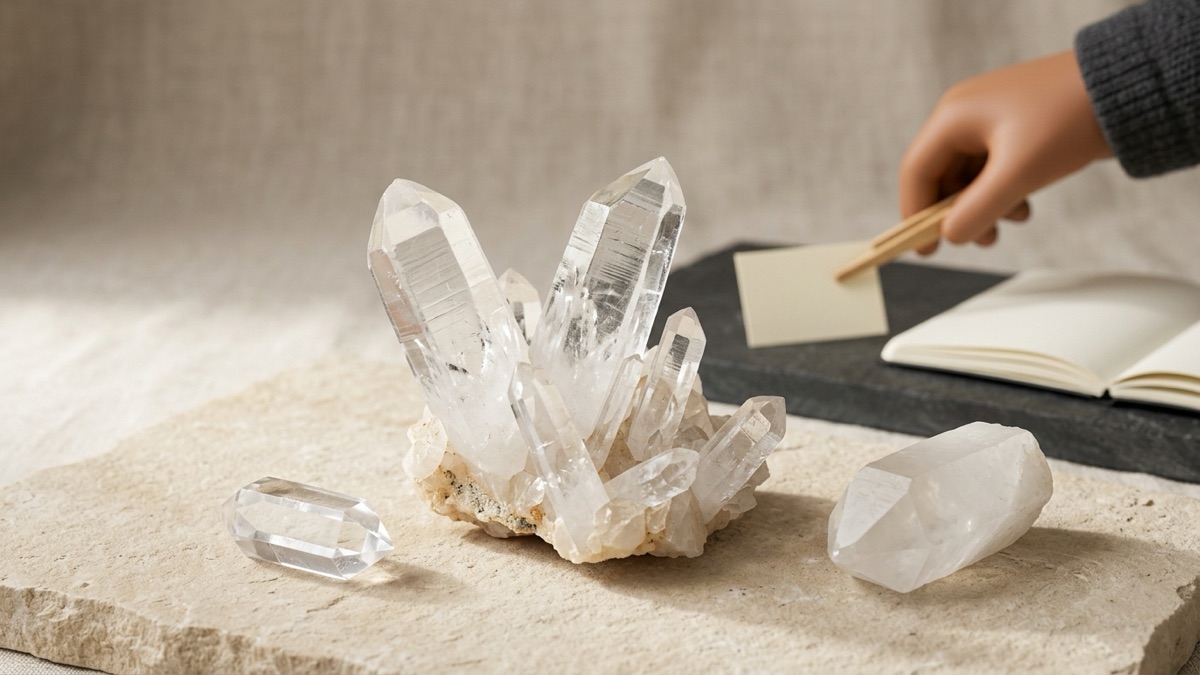
A six-sided point glints in a creek bed, or you come home from a dig with a bucket of sparkly crystals. Quartz looks like treasure, and some of it is. Most of it, though, is worth more as a souvenir than as a sale, and the difference comes down to a few things you can check yourself.
Quick answer
Most quartz crystals sell for a few dollars to a few hundred. Small Arkansas and Herkimer pieces have sold at Bonhams for $38.25 and $128, and as of September 2026 FossilEra listed clear Colombian clusters from $245 to $965. Clarity, undamaged points, size, cluster shape, rare features and locality decide where yours falls.
Key takeaways
- Quartz is common, so ordinary crystals are inexpensive. The Arkansas Geological Survey says exquisitely developed large single crystals and clusters may be worth thousands of dollars.
- Clarity and intact points (terminations) are the first things to check. Chips and cloudiness pull the price down.
- As of September 2026, dated sales and listings run from $38.25 for a small Arkansas piece to $7,320 for a huge cluster, and $10,625 for a faceted gem.
- Arkansas and Herkimer, New York, are the classic US localities. You can dig at fee mines or at the Forest Service's free Crystal Vista site.
- Label every crystal with where it came from. The Mineralogical Society of America says a missing locality can destroy a specimen's commercial value.
Is a quartz crystal worth anything?
Quartz is hard (Mohs 7), glassy and common, which is great for rockhounds and hard on sellers. A milky vein chunk or a rounded pebble is worth very little. Sharp, clear crystals are a different story. The Arkansas Geological Survey says Arkansas specimens are sold mostly to tourists, museums, schools and private collectors, and that exquisitely developed large single crystals and clusters may be worth thousands of dollars.
Arkansas takes its quartz seriously. The state's General Assembly named quartz crystal the official state mineral in 1967, and the Survey says crystals up to 5 feet long and over 500 pounds have come from its mines. For identification basics, see our guide to quartz.
How much is a quartz crystal worth? Real prices
Dealer prices are what a seller was asking when we checked in September 2026. Auction prices are what a buyer paid, including the buyer's premium, on the date shown. None of them is an appraisal of your crystal.
| What sold or was offered | Size | Price | Source and date |
|---|---|---|---|
| Two joined Arkansas crystals with small ones at the base | 3 x 3 x 1.5 in | $38.25 | Bonhams, November 2019 |
| Herkimer "diamond" quartz, double-terminated | 8 x 6 x 5.5 cm | $128 | Bonhams, March 2024 |
| Clear quartz crystal clusters, Colombia | 5.8 to 12.5 in | $245 to $965 | FossilEra, September 2026 |
| Double-terminated Arkansas quartz, four joined crystals | 7.5 x 6 x 2.5 in | $1,020 | Bonhams, May 2022 |
| Arkansas cluster with large, well-formed points | 8 x 10 x 7 in | $1,952 | Bonhams, May 2010 |
| Herkimer quartz on matrix, more than 30 crystals up to 4 in | 14 x 10.5 x 7 in | $6,710 | Bonhams, December 2009 |
| Arkansas cluster on a wooden stand | 25 x 20 x 18 in | $7,320 | Bonhams, May 2011 |
| Faceted, optically clear Arkansas rock crystal, about 1,155 carats | 73 x 46 mm | $10,625 | Bonhams, May 2017 |
Size is not the whole story. In FossilEra's listings, a 7.2 inch Colombian cluster was priced at $245 while a 5.8 inch one was $335. Something other than size, such as clarity, sharp points or shape, made the difference. That pattern runs through the whole table.
What makes one quartz crystal worth more?
Clarity
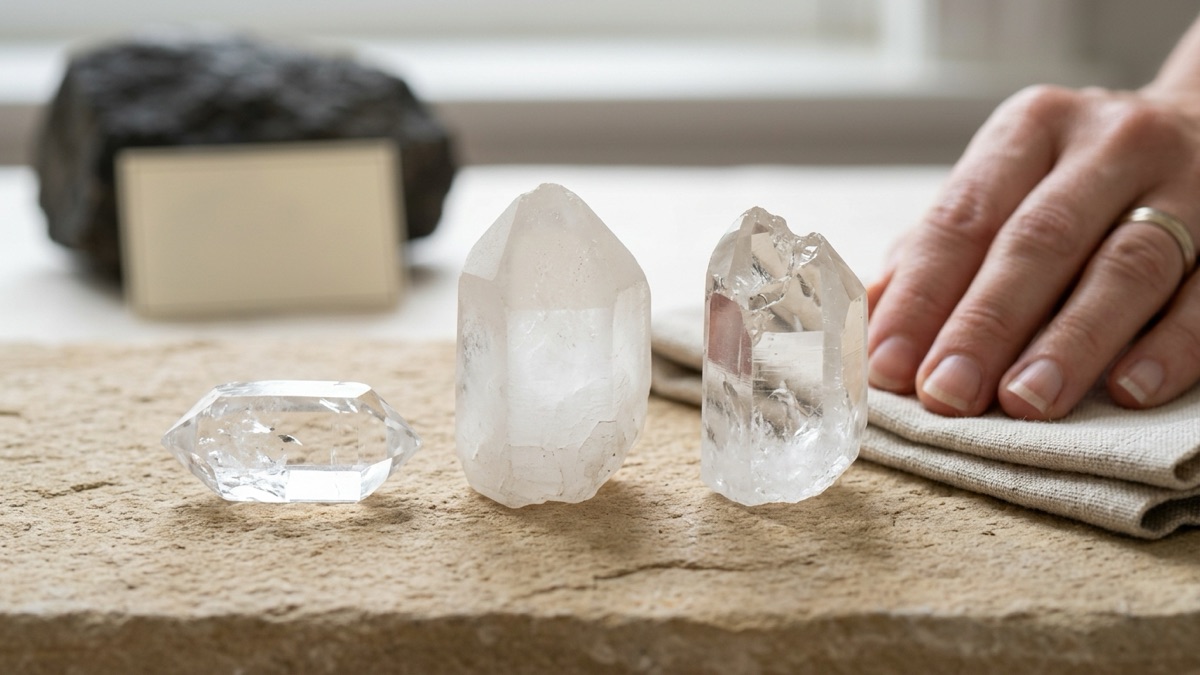
Water-clear crystals beat milky or cloudy ones. Clarity often fights with size: Herkimer Diamond Mines says its most brilliant, clear crystals are usually less than 1 inch long, and that as crystals get bigger they tend to lose clarity and become cloudier. At the top end, Bonhams described the 1,155 carat Arkansas gem as optically clear rock crystal, faceted into a round brilliant.
Intact points
The points (terminations) are easy to chip, and a chip is hard to miss. The Mineralogical Society of America advises packing specimens in newspaper or tissue so they are not ruined on the way home, and egg cartons for small ones. Double terminations, with a point at each end, add appeal: Bonhams called that feature highly coveted in a 2017 Arkansas cluster.
Size and cluster shape
Big crystals and big clusters are rarer, so size multiplies value when clarity and points hold up. For a cluster, look at the overall shape: many sharp points rising from a base, with no crushed or broken sides. The Arkansas cluster that sold for $7,320 in May 2011 was about 25 inches across, with points running from a translucent base to transparent tips, according to Bonhams.
Rare features and colors
Special features catch collectors' eyes. Herkimer Diamond Mines lists crystals with black anthraxolite inclusions, enhydros with a water bubble inside, twins, clusters, smoky, skeletal and phantom crystals among its valuable finds. FossilEra describes phantoms (ghostly growth zones inside a crystal) and rutile or tourmaline needles trapped in quartz. Color varieties such as amethyst and smoky quartz are their own markets; see amethyst hardness for how purple quartz behaves.
Locality
Where a crystal came from matters to buyers, and a label proves it. The Arkansas Geological Survey says large quantities of the state's crystals have been mined from open pits in Garland and Montgomery counties, in the Ouachita Mountains. Herkimer Diamond Mines says its double-pointed crystals grew in cavities in dolostone that began forming about half a billion years ago. The Mineralogical Society of America warns that a specimen without locality information can lose its scientific value and its commercial value.
Natural or polished
A natural crystal and a polished point are different products: one is a mineral specimen, the other is closer to decor, and different buyers price them. Faceting is the exception at the top: that optically clear Arkansas gem sold for $10,625. Our guide to crystal identification explains how to recognize natural crystal faces.
Fun fact
The Arkansas Geological Survey reports quartz clusters up to 15 feet long by 10 feet wide, weighing over 10 tons, from the state's mines. Good luck fitting that on a shelf.
Where can you dig your own quartz crystals?
Here are the rules we checked in September 2026. Always read the manager's current page before you go.
| Place | Who manages it | The rule |
|---|---|---|
| Crystal Vista, near Mount Ida, Arkansas | Ouachita National Forest (Forest Service) | Free, personal use only, no selling, no digging to expose crystal veins |
| Commercial crystal mines in the Mount Ida area, Arkansas | Private owners | Fee required; follow each mine's rules |
| Herkimer Diamond Mines, Herkimer, New York | Private fee dig | Admission fee, keep what you find, no powered equipment or tools over 12 pounds |
| National parks | National Park Service | No collecting |
On the Ouachita National Forest, the Forest Service says visitors may remove small amounts of material by hand from surface exposures, for personal use only, and that Crystal Vista on the Womble Ranger District is its one designated quartz collecting site, with no fee. For its 2026 season (April 12 to October 31), Herkimer Diamond Mines listed admission at $19 for ages 13 and up and $16 for ages 5 to 12, with $3 and $2 extra on Fridays, Saturdays and Sundays and free entry for ages 4 and under, as of September 2026. Check the next season's rates before you drive. Our guide to rock collecting rules covers BLM land, forests and private land.
Heads up
Breaking rock throws sharp chips. Wear safety glasses and closed-toe shoes, as the Herkimer mine requires shoes and recommends eye protection. Never climb into old mine workings, stay off unstable walls, and bring water on hot Arkansas afternoons.
How do you find out what your quartz crystal is worth?
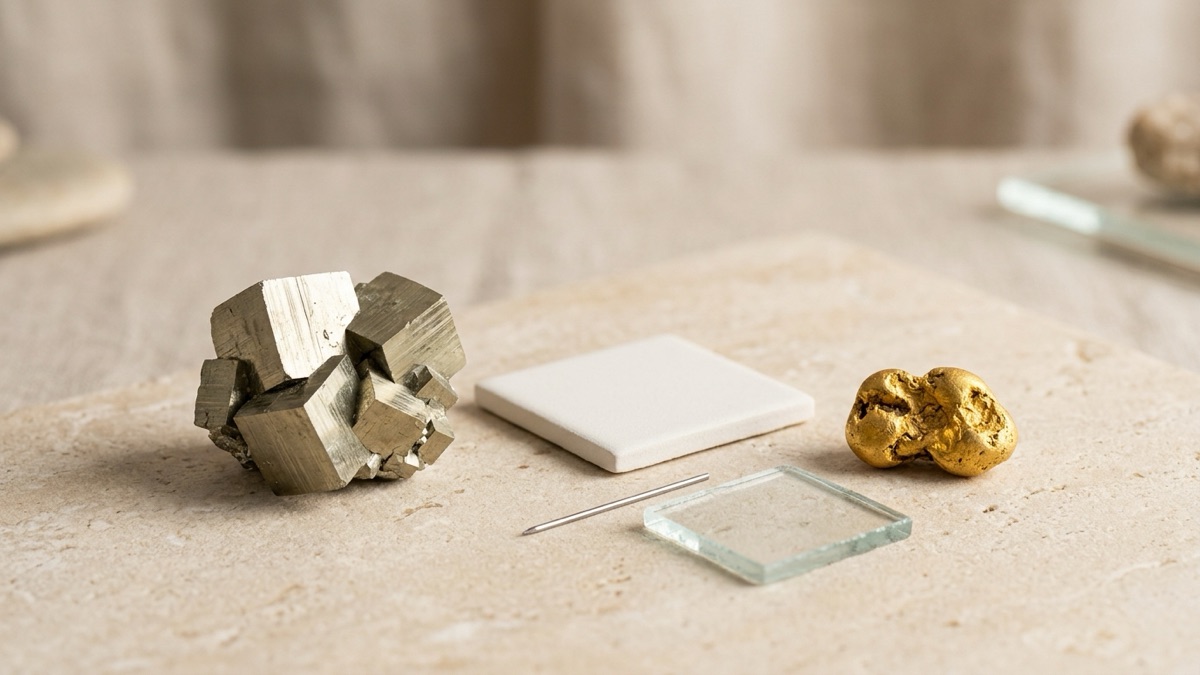
- Confirm it is quartz. Quartz scratches glass and forms six-sided points. Calcite and glass look similar but do not scratch glass.
- Clean it gently. Water and a soft brush are the safe start. Do not coat it; the Mineralogical Society of America says coating usually lowers a specimen's value.
- Inspect every point with a hand lens. Note chips, cracks and cloudiness honestly.
- Write down the locality. Where it was found, or where you bought it, belongs on a label.
- Compare with dated sales of similar size, clarity and locality, then get a market opinion from a specialist dealer or club. For insurance or an estate, the American Society of Appraisers lists members under Gems and Jewelry and Personal Property.
Try it
Check a crystal's hardness against glass and steel with the free Mohs hardness scale, which includes a scratch simulator. It runs in your browser and never uploads a photo.
For how quartz compares with other finds, see our hub on rocks worth money.
The takeaway
Quartz is common, so most crystals are worth modest sums, but clear, undamaged, well-shaped crystals from a known locality can sell for hundreds or even thousands. Check clarity and every point, protect crystals on the trip home, label where they came from, and collect only where the rules allow it. The RockhoundID app for Android suggests likely matches from a photo and tells you which test confirms them.
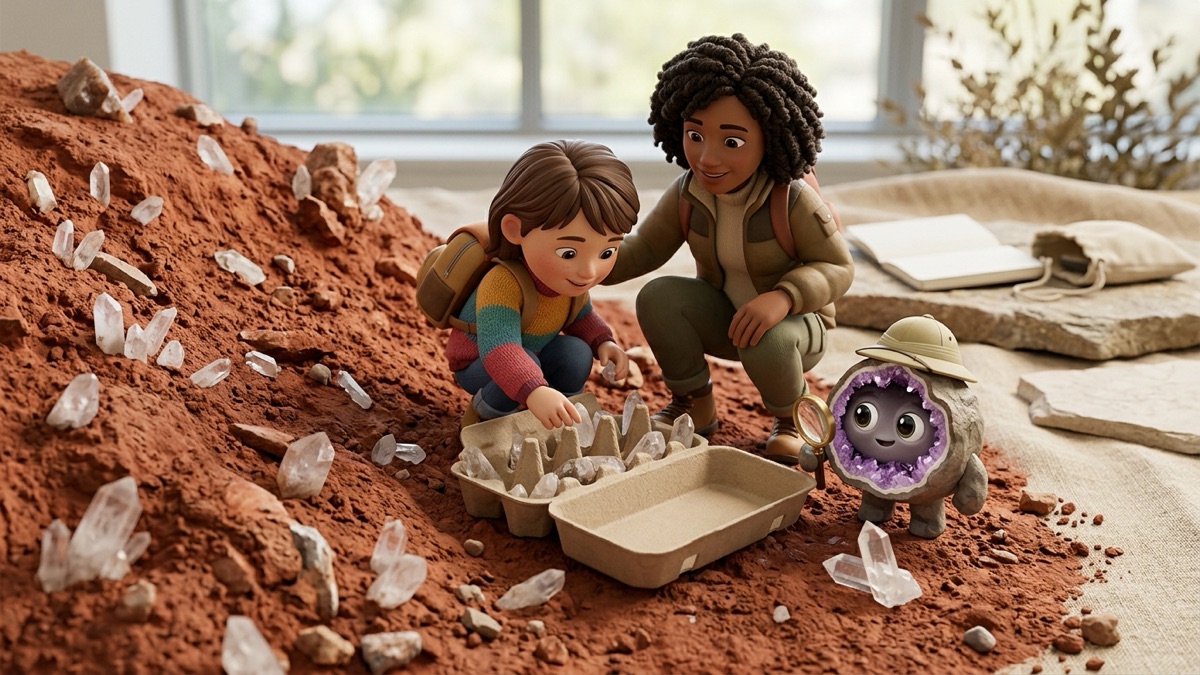
The pictures in this guide are AI-generated illustrations of what to look for; real specimens vary, so trust the tests over any picture. RockhoundID guides help you narrow down what you found. They suggest likely candidates, not certain identifications or appraisals. For anything valuable, rare or possibly from space, ask a museum, a university geology department or your state geological survey, and check the collecting rules for the land before you take anything home.
Questions rockhounds ask
How much is a quartz crystal worth?
Most sell for a few dollars to a few hundred. Small Arkansas and Herkimer pieces have sold at Bonhams for $38.25 and $128, and as of September 2026 FossilEra listed clear Colombian clusters from $245 to $965. The Arkansas Geological Survey says exquisite large single crystals and clusters may be worth thousands of dollars.
What makes clear quartz valuable?
Clarity, sharp and undamaged points, good size, an attractive cluster shape, unusual features such as phantoms or water bubbles, and a known locality. A cloudy crystal with chipped tips sells for far less than a water-clear one with perfect points.
Are Herkimer diamonds real diamonds?
No. They are double-terminated quartz crystals from the Herkimer area of New York, with points at both ends. Herkimer Diamond Mines says its brightest, clearest crystals are usually less than an inch long, and that larger crystals tend to be cloudier.
Where can I dig quartz crystals for free?
The Ouachita National Forest has one designated quartz collecting site, Crystal Vista, on the Womble Ranger District near Mount Ida, Arkansas, with no fee. Collecting is for personal use only, the material may not be sold, and digging to expose crystal veins is not allowed.
Where these facts come from
- Arkansas Geological Survey: Quartz (industrial), including quartz crystal: geology.arkansas.gov/minerals/industrial/Quartz-(Industrial).html
- USDA Forest Service, Ouachita National Forest: Rockhounding and Crystal Vista (read September 2026): www.fs.usda.gov/r08/ouachita/recreation/opportunities/other
- Herkimer Diamond Mines: Mine hours, admission and FAQ (2026 season): herkimerdiamond.com/mine/
- FossilEra: Quartz crystals for sale (asking prices checked September 2026): www.fossilera.com/minerals-for-sale/quartz-crystals
- Bonhams: Arkansas quartz (November 2019): www.bonhams.com/auction/25964/lot/3267/arkansas-quartz/
- Bonhams: Quartz Herkimer diamond (March 2024): www.bonhams.com/auction/29870/lot/181/quartz-herkimer-diamond/
- Bonhams: Double-terminated Arkansas quartz (May 2022): www.bonhams.com/auction/27482/lot/3298/double-terminated-arkansas-quartz/
- Bonhams: Arkansas quartz cluster (May 2010): www.bonhams.com/auction/18252/lot/1278/arkansas-quartz-cluster/
- Bonhams: Quartz crystal cluster with double-terminated crystal (December 2017): www.bonhams.com/auction/24889/lot/1032/quartz-crystal-cluster-with-double-termin
- Bonhams: Rare and large specimen of Herkimer quartz crystals on matrix (December 2009): www.bonhams.com/auction/17535/lot/2201/rare-and-large-specimen-of-herkimer-quart
- Bonhams: Impressive Arkansas quartz cluster on wooden stand (May 2011): www.bonhams.com/auction/19371/lot/3324/impressive-arkansas-quartz-cluster-on-woo
- Bonhams: Very large, optically clear rock crystal quartz, An Arkansas Gem (May 2017): www.bonhams.com/auction/24039/lot/2262/very-large-optically-clear-rock-crystal-q
- Mineralogical Society of America: Mineral collecting: www.minsocam.org/MSA/collectors_corner/MineralCollecting.htm
- 36 CFR 2.1: Preservation of natural resources (National Park Service): www.ecfr.gov/current/title-36/chapter-I/part-2/section-2.1
- 43 CFR 8365.1-5: Property and resources (BLM): www.ecfr.gov/current/title-43/subtitle-B/chapter-II/subchapter-H/part-8360/subpa
- American Society of Appraisers: Find an appraiser: myaccount.appraisers.org/Directories/Find-An-Appraiser