
Real vs Fake Opal: How to Spot Synthetics and Doublets
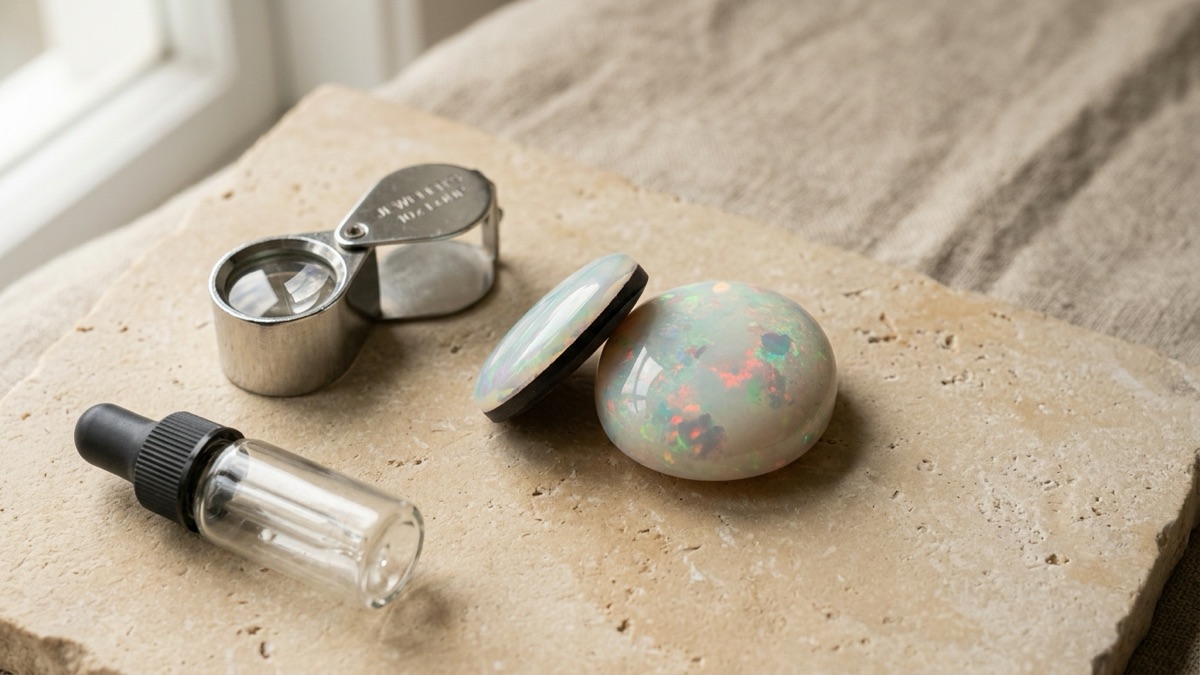
Nothing else looks like opal: a stone that flashes red, green and blue as you tilt it. That is exactly why it is imitated in glass, plastic and lab-grown material, and why thin slivers of real opal get glued onto backings and sold at solid-opal prices. Here is how to tell what you are holding without hurting it.
Quick answer
Look at the stone from the side for glue lines and a glassy cap (doublets and triplets). Under a 10x loupe, natural play-of-color comes in irregular patches; classic synthetic opal shows a regular chicken-wire pattern and columns; plastic is featherlight. Never scratch or heat an opal. Only a gem lab can confirm natural, untreated solid opal.
Key takeaways
- "Fake opal" covers four different things: assembled stones (doublets, triplets), lab-grown material, plastic and glass imitations, and treated opal that hides its true color.
- The side view catches assembled stones, and a loupe catches most lab-grown and plastic material.
- Opal is fragile (Mohs 5 to 6.5, toughness very poor to fair, GIA), so skip scratch tests, hot needles and soaking.
- Natural opal has a specific gravity of about 2; GIA measured a plastic imitation at 1.35, light enough to feel.
- A gem lab confirms what you cannot: refractive index, water content, resin, smoke and dye.
What is opal, and what counts as fake?
Opal is hardened silica gel with water trapped in it, usually 6 to 10 percent by the Australian Museum's account and up to 20 percent according to GIA. Precious opal is made of sub-microscopic silica spheres stacked in a grid; light diffracts between them into spectral colors, the play-of-color (GIA). Spheres about 0.2 micron across give red, and about 0.1 micron give violet. Common opal has spheres of mixed sizes and no play-of-color.
Four things get sold as opal that are not solid natural opal:
| Sold as | What it really is | Fair? |
|---|---|---|
| Doublet | Thin slice of real opal glued to a dark backing (Australian Museum) | Yes, if labeled |
| Triplet | Doublet plus a clear domed cap of rock crystal, plastic, glass or synthetic corundum (GIA) | Yes, if labeled |
| Synthetic or "created" opal | Lab-made material with a regular structure; some contain no water and are simulants (GIA) | Only if labeled |
| Imitation | Plastic, or glass such as "slocum stone" (GIA) | Only if labeled |
A fifth category is real opal that has been treated: impregnated with oil, wax or plastic, or given sugar or smoke treatment to darken the background (GIA). Treated opal is real opal wearing makeup, and it too should be disclosed. Our gemstone identification guide covers the general logic of imitations, synthetics and treatments.
Test 1: What does the side view show?
Turn the stone sideways and look at the edge, ideally out of its setting. A solid opal is opal all the way down, with a rounded or irregular back.
- A perfectly flat, straight line partway down, with dark material below, is the glue line of a doublet.
- A clear, glassy dome on top with a flat line beneath it is the cap of a triplet. Under a loupe the cap can show tiny bubbles in the glue.
- A dead-flat black back on a stone with vivid color is worth a second look; natural black opal is dark all the way through (GIA describes Ethiopian black opal that way).
Doublets and triplets are legitimate products. GIA notes they sell for only a fraction of the price of boulder opal, which is why they get passed off as solid stone.
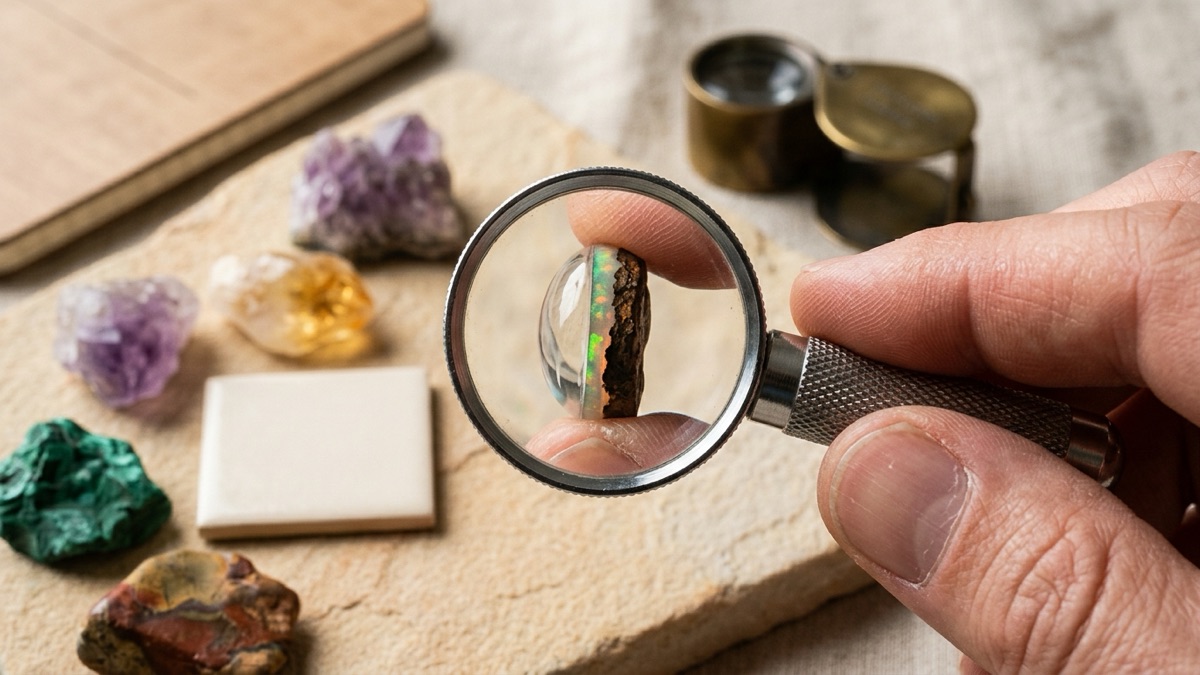
Test 2: What pattern does the loupe reveal?
Natural play-of-color is irregular: patches of different sizes and shapes, with "dead spots" of no color that GIA's quality guide says lower the value. Lab-made opal is too tidy.
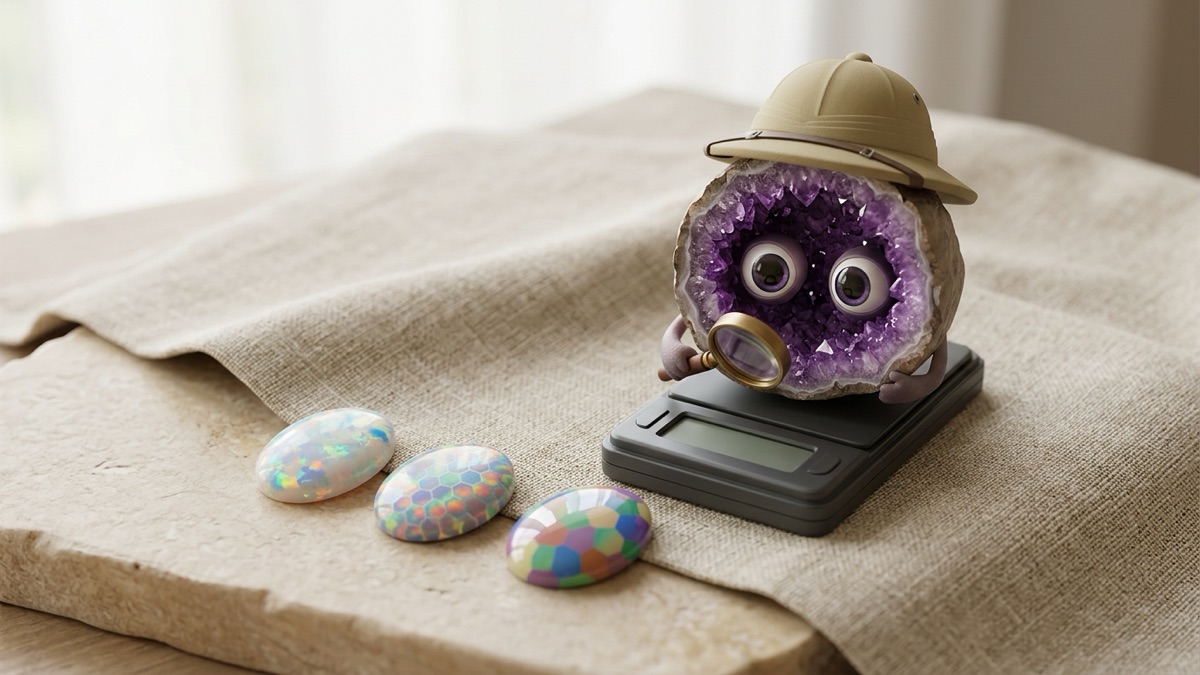
- Classic synthetic opal (the older Gilson-type and Kyocera-type material) shows what GIA calls a "snakeskin" or "chicken wire" pattern face-up, and a columnar structure when viewed from the side. GIA's 2018 lab note treats those as the expected diagnostic features of traditional polymer-impregnated synthetic opal.
- Newer plastic imitation opal described in that 2018 note has no snakeskin and no columns. Instead it shows colored polygonal patches about 2 mm across, evenly spread through the stone, which is its own giveaway.
- Glass shows round gas bubbles and swirled flow lines, the same tell GIA reports for glass imitations of other gems.
- Ethiopian hydrophane opal, which is natural, often shows a cellular "digit" pattern of play-of-color interfingering with common opal (GIA). It is real, just distinctive.
If a pattern repeats like wallpaper, be suspicious. If it wanders, that is what nature does.
Test 3: How heavy is it for its size?
Natural opal has a specific gravity of roughly 2, about twice the weight of the same volume of water; the Australian Museum gives 1.98 to 2.20, and GIA's 2018 lab note uses 2.00 as the natural reference. GIA measured the Kyocera plastic imitation at 1.35. A plastic "opal" feels wrong in the hand, and it warms to the touch far faster than stone.
Weight in the hand is one of the checks in our 7-test identification method, and for opal it is one of the few tests with zero risk.
Test 4: Does a drop of water sink in?
Much of the opal from Wollo, Ethiopia is hydrophane: porous enough to soak up water like a sponge, and it can turn transparent when wet (GIA). Hydrophane opal is natural, but it behaves differently, takes dye easily and needs care.
GIA's lab test is gentle: put a single drop of water on the surface and watch under magnification. If it soaks in, the spot changes appearance, and the stone is hydrophane. Do not immerse it. GIA reports that saturating hydrophane opal can make internal cracks enlarge and run through the whole stone.
Heads up
Opal hates heat and sudden temperature change. GIA says heat from intense light can cause fracture lines called crazing, and that opal loses moisture and can crack. That rules out the hot needle test entirely. Clean opal only with warm, soapy water, and keep it away from ultrasonic and steam cleaners.
Test 5: Is the dark color only skin deep?
A dark background makes play-of-color pop, which is why black opal commands the highest prices (GIA). It is also why light Ethiopian opal is smoke-treated or dyed to look black.
GIA's 2014 report on a natural Ethiopian black opal deposit describes the difference: treated opal shows black staining in surface pits, fissures and scratches, while the natural material is dark and even all the way through and shows no staining in scratches. So under the loupe, look at chips, pits and the drill hole of a bead. Color concentrated in cracks is added color, the same rule that catches dyed turquoise and dyed agate. Our real vs fake turquoise guide uses it too.
What should you not do to an opal?
Opal's hardness is 5 to 6.5 (USGS and GIA) and its toughness, its resistance to chipping, is very poor to fair (GIA). It is softer than the sand and dust in your pocket, which are mostly quartz at 7. Our gemstone hardness chart shows where it sits. So:
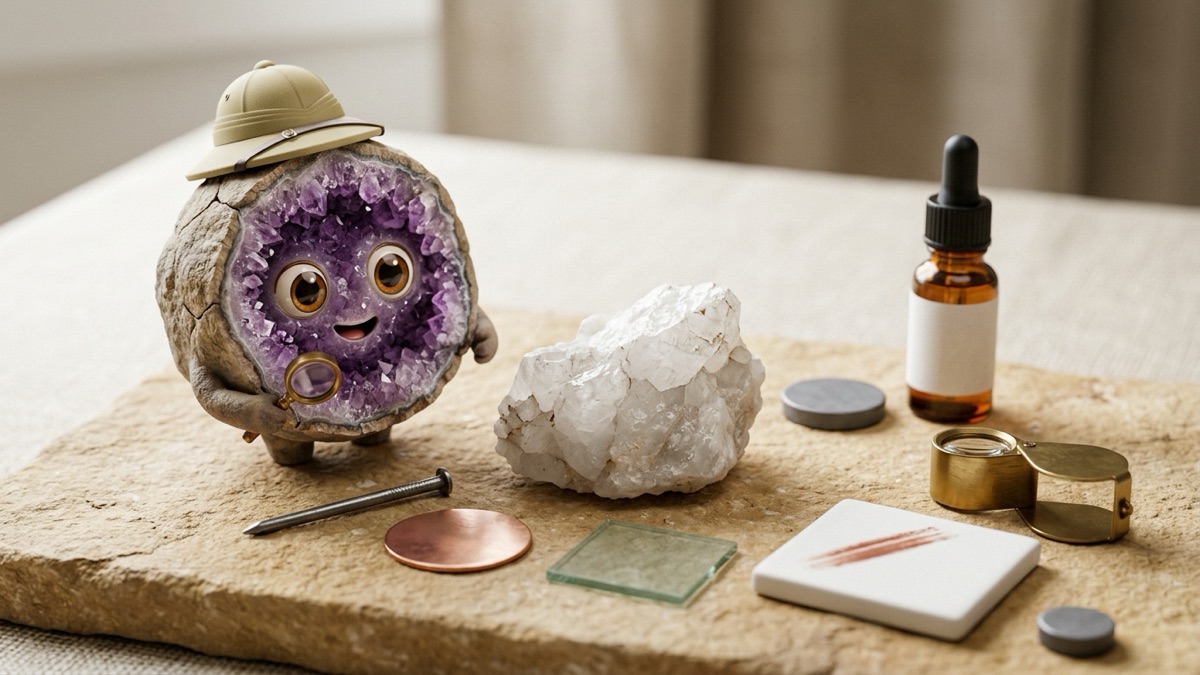
- No scratch tests, even on the back. A steel point can chip or craze it. If you have rough common opal from the field, test a hidden corner and accept the risk; on any cut stone, do not.
- No hot needle. Heat causes crazing.
- No soaking, no acetone. Hydrophane opal drinks liquids, and GIA notes opal is attacked by caustic alkaline solutions.
- No ultrasonic or steam. Warm soapy water only.
Try it
Found a glassy, milky or color-flashing stone in the field and want to know if it could be opal at all? The free rock identifier walks through luster, hardness and weight and suggests likely candidates, common opal included. Our guide to rocks that look like glass covers the obsidian, quartz and slag that get mistaken for it.
What can only a gem lab tell?
Home checks catch assembled stones, most classic synthetics and plastic. They cannot prove natural, untreated, solid opal. A gemologist can:
- Measure refractive index. Natural opal reads about 1.37 to 1.47; GIA measured the plastic imitation at 1.49, and says the high RI and low specific gravity make it easy to separate with standard tests.
- Weigh it in water for an exact specific gravity.
- Run infrared spectroscopy. Polymer-impregnated synthetics and plastics show a strong polymer signal; GIA reported the plastic imitation's polymer peak was nearly five times as strong as in traditional impregnated synthetic opal.
- Examine treatments under the microscope: smoke, sugar, dye, wax and resin.
- Check for water. GIA's 1987 study of Kyocera's play-of-color products found they contained no water and concluded they should be called opal simulants.
A GIA colored stone report states whether a stone is natural or synthetic and lists any detectable treatments. For a black opal or anything sold as solid Australian opal at a serious price, ask for one.
The RockhoundID app for Android suggests likely matches from a photo and tells you which test confirms them, but a photo cannot see a glue line from the side.
The takeaway
Turn it sideways, look through a loupe, feel its weight, and try one drop of water. Those four gentle steps catch doublets, triplets, classic synthetics and plastic. Never scratch, heat or soak an opal to test it. For solid natural opal with a price to match, a gem lab report is the only real proof, and honest sellers will not mind you asking for it.
The pictures in this guide are AI-generated illustrations of what to look for; real specimens vary, so trust the tests over any picture. RockhoundID guides help you narrow down what you found. They suggest likely candidates, not certain identifications or appraisals. For anything valuable, rare or possibly from space, ask a museum, a university geology department or your state geological survey, and check the collecting rules for the land before you take anything home.
Questions rockhounds ask
How can you tell if an opal is real?
Look at it from the side: a solid natural opal has no flat glue line and no glassy cap. Under a 10x loupe, natural play-of-color comes in irregular patches, while classic synthetic opal shows a regular chicken-wire or snakeskin pattern and columns from the side. Plastic opal is very light and has evenly sized polygonal patches. A lab confirms with refractive index, specific gravity and spectroscopy.
Is a doublet or triplet opal fake?
Not fake, but not solid opal either. A doublet is a thin slice of real opal glued to a dark backing; a triplet adds a clear domed cap. GIA notes they sell for only a fraction of the price of solid boulder opal, so they should be sold as doublets and triplets, never as solid opals.
Is synthetic opal real opal?
It depends on the material. GIA researchers found in 1987 that Kyocera's play-of-color products contained no water and said they should be called opal simulants, not synthetic opal. A 2018 GIA lab note describes a newer Kyocera product that is plastic. Either way, lab-made opal is not natural opal and should be labeled.
Can you scratch test an opal?
Do not. Opal rates only 5 to 6.5 on the Mohs scale and GIA rates its toughness as very poor to fair, so a scratch test can chip or craze it. Use the side view, a loupe and weight for size instead, and leave anything valuable to a gemologist.
Why does my opal change when it gets wet?
It is probably hydrophane opal, common from Wollo, Ethiopia. It is porous enough to soak up water like a sponge and can turn transparent when wet. GIA warns that soaking hydrophane opal can enlarge internal cracks, so test with a single drop, not a bath.
Where these facts come from
- GIA: Opal (properties and history): www.gia.edu/opal
- GIA: Opal description: www.gia.edu/opal-description
- GIA: Opal quality factors: www.gia.edu/opal-quality-factor
- GIA: Opal care and cleaning: www.gia.edu/opal-care-cleaning
- GIA: An introduction to simulants or imitation gem materials: www.gia.edu/gem-imitation
- GIA Gems & Gemology, Spring 2018 Lab Notes: New plastic imitation opal from Kyocera: gia.edu/gems-gemology/spring-2018-labnotes-new-plastic-imitation-opal-from-kyoce
- GIA Gems & Gemology, Fall 1987: Synthetic or imitation? Kyocera products that show play-of-color: www.gia.edu/articles/fall-1987-synthetic-opal-kyocera-schmetzer
- GIA Gems & Gemology, Fall 2013 Lab Notes: A technique for identifying hydrophane opal: www.gia.edu/gems-gemology/FA13-LN-technique-hydrophane-opal
- GIA Gems & Gemology, Summer 2010: Play-of-color opal from Wegel Tena, Ethiopia: www.gia.edu/gems-gemology/summer-2010-opal-ethiopia-rondeau
- GIA Gems & Gemology, Winter 2014: New deposit of black opal from Ethiopia: www.gia.edu/gems-gemology/winter-2014-gemnews-new-deposit-black-opal-from-ethiop
- GIA: Colored stone reports and services: www.gia.edu/gem-lab-service/colored-stone-analysis-report-service
- Australian Museum: Australian opal samples: australian.museum/australian-opal-samples
- USGS: Gemstones (mineral gemstones): pubs.usgs.gov/gip/gemstones/mineral.html
Read next
identification
How to Identify Rocks: 7 Simple Tests and a Free Tool
identification
Rock Identification Chart: Match Your Find in 5 Steps
identification
Crystal Identification: Chart and 4 Quick Tests at Home
identification
Streak Test for Minerals: Definition and Color Chart
identification
Real vs Fake Turquoise: 7 Tests You Can Do at Home
