How Much Is Pyrite Worth? Specimens vs Tumbled Pieces
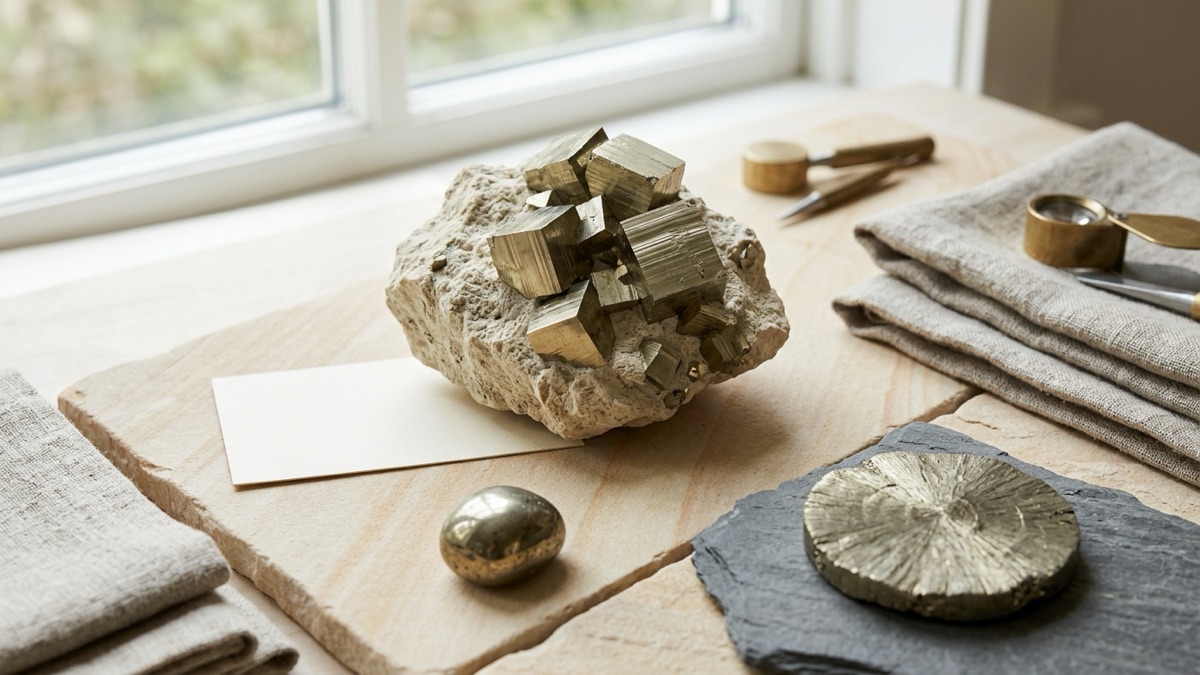
The rock in your hand is brassy, heavy and covered in tiny square faces, and someone has already told you it is fool's gold. Fair enough, but fool's gold has a price too. The answer is usually modest, and occasionally not.
Quick answer
Most pyrite is inexpensive. As of September 2026, FossilEra listed 65 pyrite specimens from $5 to $1,595, with tumbled pieces and small clusters under $100 and sharp Navajun cube groups and large Peruvian clusters above $700. Crystal form, luster, size, condition and locality set the price; the metal itself is worth nothing.
Key takeaways
- Pyrite is iron sulfide and one of the most common minerals on Earth, so ordinary lumps and tumbled stones sell for a few dollars.
- Collectors pay for form: sharp cubes, striated faces, pyritohedrons and clusters on matrix. As of September 2026, FossilEra's top pyrite listings ran from $795 to $1,595.
- Locality matters. Navajun (Spain), Huanzala (Peru) and the pyrite suns of Sparta, Illinois are the names buyers know.
- Pyrite decays in humid air, and a specimen that is crumbling or sweating white powder loses most of its value.
- A dealer, a club or a qualified appraiser can put a real number on a piece. No photo, quiz or app can.
What is pyrite, and why is it cheap?
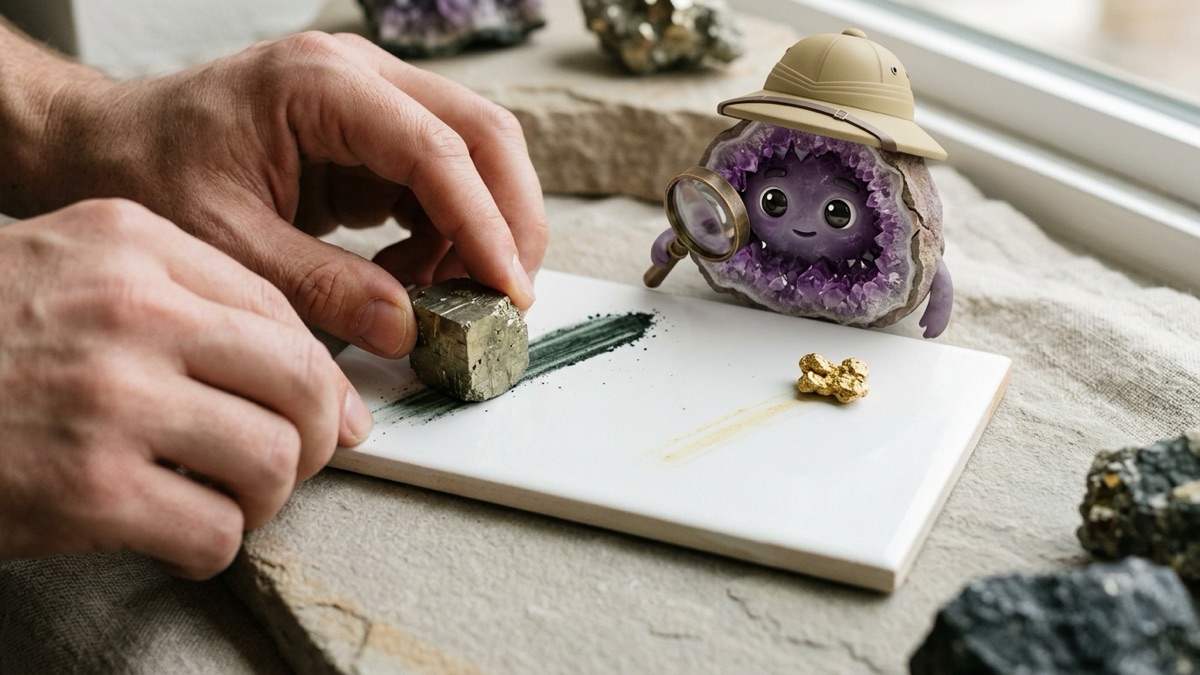
Pyrite is iron sulfide, Mohs 6 to 6.5, brassy yellow with a metallic luster and a greenish black streak. The University of Auckland calls it the most common sulfide mineral in rocks of all ages, found in virtually every geological environment. That abundance is the whole story: there is no shortage of pyrite, so a plain chunk has almost no market value.
Its name comes from the Greek word for fire, because it sparks when struck against steel (the Handbook of Mineralogy notes the origin). The cubes are real crystals, grown that way, and the fine parallel lines on their faces, called striations, are a signature feature.
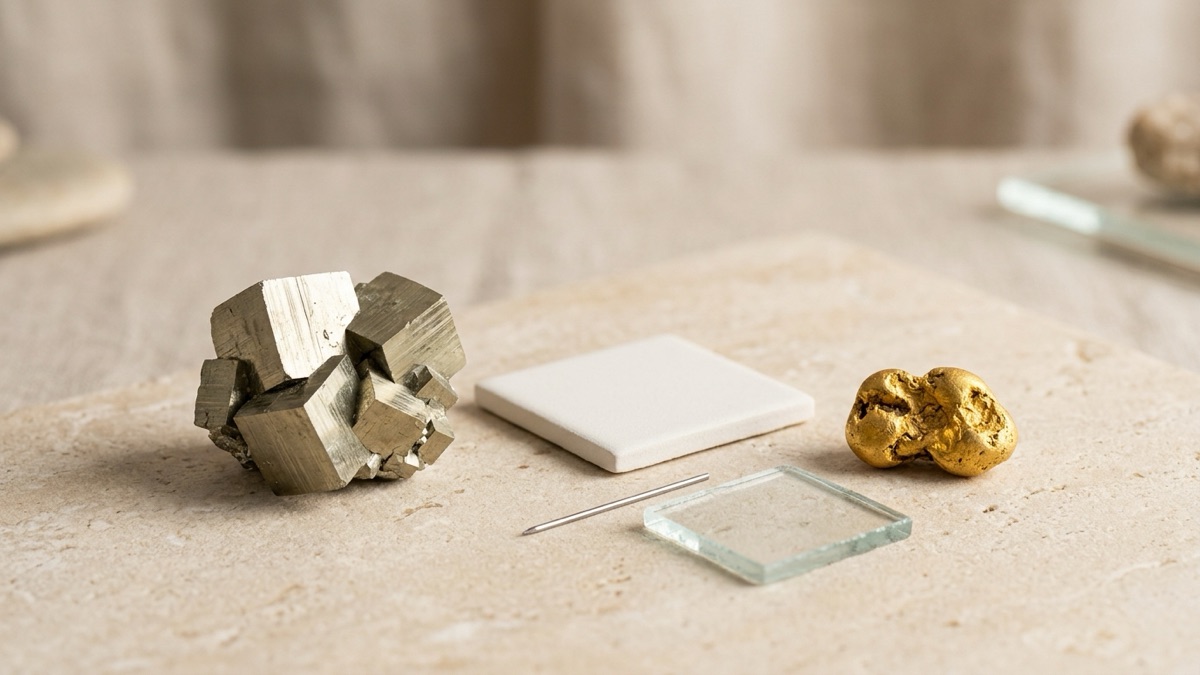
Gold is a different animal. The USGS says real gold dents like soft lead under a metal point and streaks golden yellow on unglazed porcelain, while pyrite flakes or crumbles and streaks dark green to black. Gold is also far denser: specific gravity 15.9 to 19.3 against pyrite's 4.9 to 5.2. If you are still unsure what you have, our guide to pyrite vs gold walks through every test.
Try it
Check the hardness first. Pyrite scratches glass, gold does not come close. The free Mohs hardness scale shows which everyday testers to use and what each result means.
What is pyrite worth right now?
Dealers price pyrite as a display specimen, and the ladder runs from pocket stones to museum pieces. These are FossilEra asking prices checked in September 2026, plus two auction estimates for context.
| Type of piece | Example | Price and date |
|---|---|---|
| Tumbled or small pieces | Smallest pyrite listings | From $5 (FossilEra, as of September 2026) |
| Polished sphere | 2.5 inch pyrite sphere, Peru | $59 (FossilEra, as of September 2026) |
| Pyrite on matrix | 3.7 inch golden pyrite on limonite clay, Pakistan | $69 (FossilEra, as of September 2026) |
| Pyrite sun | 2.8 inch pyrite sun on slate, Sparta, Illinois | $79 (FossilEra, as of September 2026) |
| Cube group | Three intertwined cubes in rock, Navajun, Spain | $795 (FossilEra, as of September 2026) |
| Large cluster | 12.5 inch cubic pyrite with quartz and sphalerite, Peru | $1,435 (FossilEra, as of September 2026) |
| Auction estimate | 6 inch Navajun pyrite on rhyolite with a 2 inch cube | Estimate $500 to $700 (Sotheby's, July 2022) |
| Auction estimate | 70 pound plate with ten pyrite suns up to 5.5 inches, Sparta | Estimate $2,000 to $3,000 (Bonhams, December 2006) |
Two things stand out. First, size alone does not make the price: a 3.7 inch matrix piece and a 2.5 inch sphere sit within a few dollars of each other. Second, the jump from under $100 to several hundred dollars happens when the crystals are sharp, complete and sitting in the rock they grew in. Sotheby's and Bonhams both show prices realized only to signed-in users, so the auction figures above are estimates, not results.
What makes one pyrite specimen worth more than another?
Crystal form
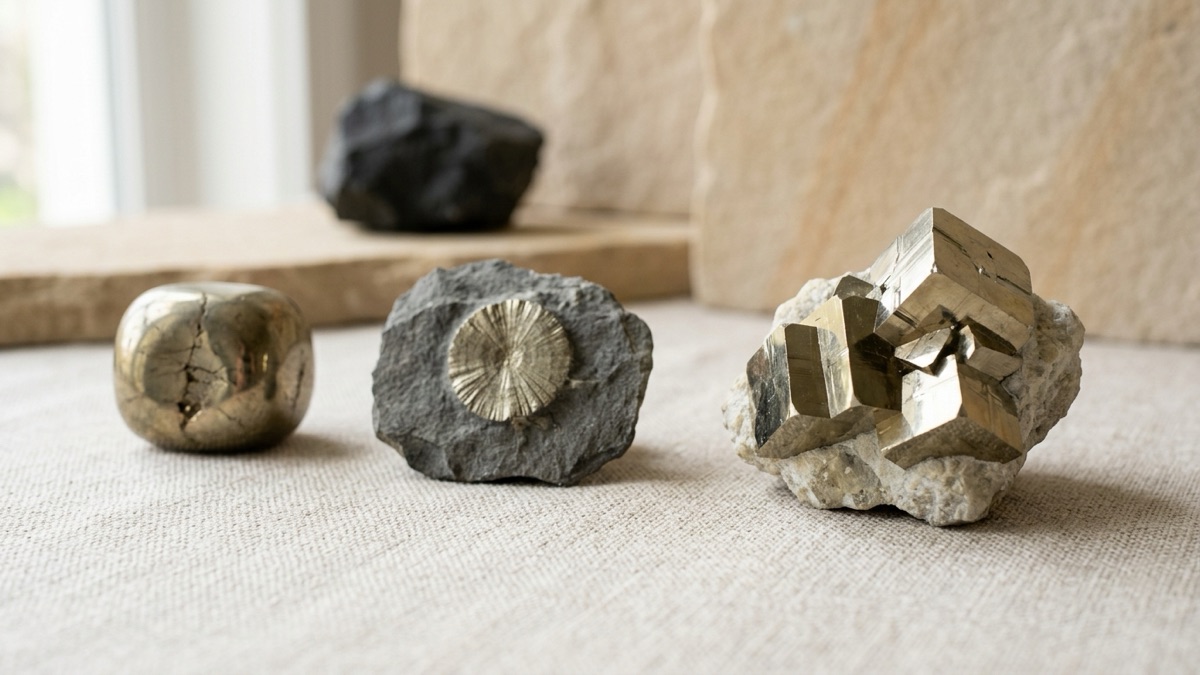
Pyrite grows as cubes, octahedrons and pyritohedrons (a twelve-sided form), often with striated faces. Sharp, undamaged crystals with crisp edges are what buyers want. A massive or granular lump, however heavy, is filler.
Luster and surface
Fresh pyrite has a bright brassy metallic shine. Dull, tarnished or rusty surfaces mean the specimen has started to oxidize, and buyers mark it down hard. Never polish a crystal specimen to "fix" it; that destroys the natural faces.
Matrix and presentation
Cubes still embedded in their host rock are prized because they show how the crystal grew. FossilEra's Navajun listings sell cubes "in rock" at a premium over loose ones. A clean, stable base that lets the piece stand on a shelf adds value; glue and reconstruction take it away, and honest sellers disclose repairs.
Size and completeness
Bigger is better only when the crystals are as good as the small ones. Large clusters from Peru command four figures because they combine size with sharp cubes and companion minerals such as quartz and sphalerite.
Locality
A label with a known mine is worth money. Three names come up again and again:
- Navajun, La Rioja, Spain. The source of the sharpest natural cubes in the world, often perfect and often grown right through each other. FossilEra says the largest cube found there exceeded 19 centimeters and weighed 9.5 kilograms.
- Huanzala, Peru. Lustrous cubes, octahedrons and pyritohedrons, often with quartz and sphalerite.
- Sparta, Illinois. Home of pyrite suns: flat, radiating disks that grew in the Anna Shale just above the Herrin coal seam, squeezed sideways between shale layers. Rock & Gem magazine says most are three to four inches across and the largest are nearly eight inches.
Fun fact
Pyrite suns are not fossils, though people often mistake them for petrified sand dollars or sunflowers. They are concretions that could only spread sideways because the shale above and below them would not give.
Does pyrite lose value over time?
Yes, if it is stored badly. Pyrite reacts with oxygen and water vapor to form hydrous iron sulfates and sulfuric acid. A paper by R. Chris Tacker in Palaeontologia Electronica (2020) says the two together do far more damage than either alone, and that the sulfate crusts themselves pull moisture from the air and keep the reaction going. The result is white or yellow powder, a sour smell, cracking, and eventually a pile of dust. Collectors call it pyrite decay or pyrite disease.
Practical steps for a home collection:
- Keep pyrite dry and away from bathrooms, basements and window sills.
- Store the best pieces in a closed box with silica gel, and for valuable specimens, a sealed bag with an oxygen absorber (the paper recommends anoxic storage).
- Watch for powder on the specimen or its label. Brush it off outside, wash your hands, and move the piece to drier storage.
- Never wash pyrite and put it away damp.
A specimen already crumbling is nearly worthless, so storage is a value question, not just a housekeeping one.
What about the gold price?
People often ask whether pyrite tracks gold. It does not. Gold is a commodity priced by weight: the USGS Mineral Commodity Summaries 2026 put the 2025 average at about $3,300 per troy ounce, a record annual high (as of September 2026, the latest figure published). Pyrite is priced per specimen and its iron and sulfur are worth almost nothing. Some ore deposits do carry gold alongside pyrite, but that gold is recovered by mines with chemistry, not by collectors with a hammer. If you found brassy flakes in a stream and hope they are the real thing, our guide to gold panning for beginners explains how prospectors test them.
Where can you collect pyrite?
Pyrite turns up almost everywhere: in shale and coal country, in quartz veins, in metamorphic rocks and in old mine dumps. Where you are standing decides whether you can pick it up.
- BLM land: you may collect reasonable amounts of rocks and mineral specimens for noncommercial use, with hand tools, outside developed sites and posted closures (43 CFR 8365.1-5). Selling what you collect needs a permit.
- National parks: no collecting at all (36 CFR 2.1).
- National forests, state parks, tribal land: each has its own rules. Check the managing agency's page first.
- Private land and old mine dumps: owner's permission first, always.
Heads up
Never climb into abandoned mines for pyrite or anything else. Wear safety glasses when hammering, and wash your hands after handling sulfide minerals; pyrite's oxidation products are acidic. Our guide to rock collecting rules covers each type of land.
How do you find out what your pyrite is worth?
- Confirm it is pyrite. Streak greenish black, scratches glass, brassy rather than golden. Chalcopyrite looks similar but is softer (a knife scratches it) and often shows blue and purple tarnish.
- Judge the crystals honestly. Sharp edges, bright luster, no chips, no powder.
- Note the locality if you know it, and keep any old label with the piece.
- Compare with dated sales of similar size and quality, not the highest number you can find online.
- Ask a specialist. A mineral dealer or a gem and mineral club at a show will give a market opinion. For insurance or an estate, hire a qualified appraiser; the American Society of Appraisers lists members under Gems and Jewelry and Personal Property.
For the bigger picture on which finds carry real value, see our hub on rocks worth money and our list of the most valuable minerals.
The takeaway
Pyrite is cheap as a mineral and occasionally valuable as a specimen. Tumbled chunks and small clusters sell for a few dollars, while sharp Navajun cubes in matrix, big Peruvian clusters and large pyrite suns reach the hundreds or low thousands. Keep it dry, keep its label, and get an in-person opinion before you name a price. The RockhoundID app for Android suggests likely matches from a photo and tells you which test confirms them.
The pictures in this guide are AI-generated illustrations of what to look for; real specimens vary, so trust the tests over any picture. RockhoundID guides help you narrow down what you found. They suggest likely candidates, not certain identifications or appraisals. For anything valuable, rare or possibly from space, ask a museum, a university geology department or your state geological survey, and check the collecting rules for the land before you take anything home.
Questions rockhounds ask
How much is a pyrite cube worth?
It depends on sharpness, luster, size and whether it sits in its natural matrix. As of September 2026, FossilEra listed three intergrown Navajun cubes in rock at $795 and a museum-quality Spanish cube cluster at $1,150, while small loose cubes and tumbled pieces sold for a few dollars.
Is there any gold in pyrite?
Pyrite is iron sulfide, not gold. Some ore deposits carry gold alongside pyrite, but a pyrite specimen is priced as a mineral specimen, not by metal content. The USGS says gold dents under a metal point and streaks golden yellow, while pyrite crumbles and streaks dark green to black.
Why is my pyrite turning to powder?
Pyrite reacts with oxygen and water vapor to form iron sulfates and sulfuric acid, a process collectors call pyrite decay. A paper published in Palaeontologia Electronica in 2020 says both oxygen and moisture are needed, so keep pyrite dry and, for valuable pieces, sealed with an oxygen absorber.
Can I sell pyrite I found on public land?
On BLM land you may collect reasonable amounts of mineral specimens for noncommercial use only; collecting to sell needs a permit. National parks allow no collecting at all. Check the managing agency's rules before you collect, and never collect on private land without permission.
Where these facts come from
- FossilEra: Pyrite for sale (asking prices checked September 2026): www.fossilera.com/minerals-for-sale/pyrite
- Sotheby's: Pyrite on rhyolite, Navajun, Spain (July 2022, estimate): www.sothebys.com/en/buy/auction/2022/natural-history/pyrite-on-rhyolite
- Bonhams: Large cluster of pyrite suns in matrix, Sparta, Illinois (December 2006, estimate): www.bonhams.com/auction/14046/lot/8138/large-cluster-of-pyrite-suns-in-matrix
- University of Auckland, minerals: Pyrite: rocksminerals.flexiblelearning.auckland.ac.nz/minerals/pyrite.html
- Handbook of Mineralogy: Pyrite (PDF): www.handbookofmineralogy.org/pdfs/pyrite.pdf
- USGS FAQ: What is fool's gold?: www.usgs.gov/faqs/what-fools-gold
- USGS Mineral Commodity Summaries 2026: Gold: pubs.usgs.gov/periodicals/mcs2026/mcs2026-gold.pdf
- Rock & Gem (Steve Voynick): Pyrite suns and coal mining (November 2022): www.rockngem.com/pyrite-suns-coal-mining/
- Palaeontologia Electronica (Tacker, 2020): A review of pyrite disease: palaeo-electronica.org/content/2020/3159-pyrite-disease
- 43 CFR 8365.1-5: Property and resources (BLM): www.ecfr.gov/current/title-43/subtitle-B/chapter-II/subchapter-H/part-8360/subpa
- 36 CFR 2.1: Preservation of natural resources (National Park Service): www.ecfr.gov/current/title-36/chapter-I/part-2/section-2.1
- American Society of Appraisers: Find an appraiser: myaccount.appraisers.org/Directories/Find-An-Appraiser